The global mobile gaming landscape in March 2026 showcased a complex interplay between seasonal volatility, the maturation of the "hybrid-casual" genre, and a significant shift in how top-tier publishers collect revenue. Data provided by Appmagic reveals that while established titans like Tencent continue to dominate the upper echelons of the charts, the middle-market is experiencing a radical transformation, highlighted by the record-breaking performance of merge games and a resurgence in legacy titles from Supercell. These figures, which track In-App Purchase (IAP) earnings, exclude advertising revenue, web shop expenditures, and the 30% platform fees collected by Apple and Google, as well as revenue from third-party Android stores in China.
High-Stakes Volatility in the Top Tier
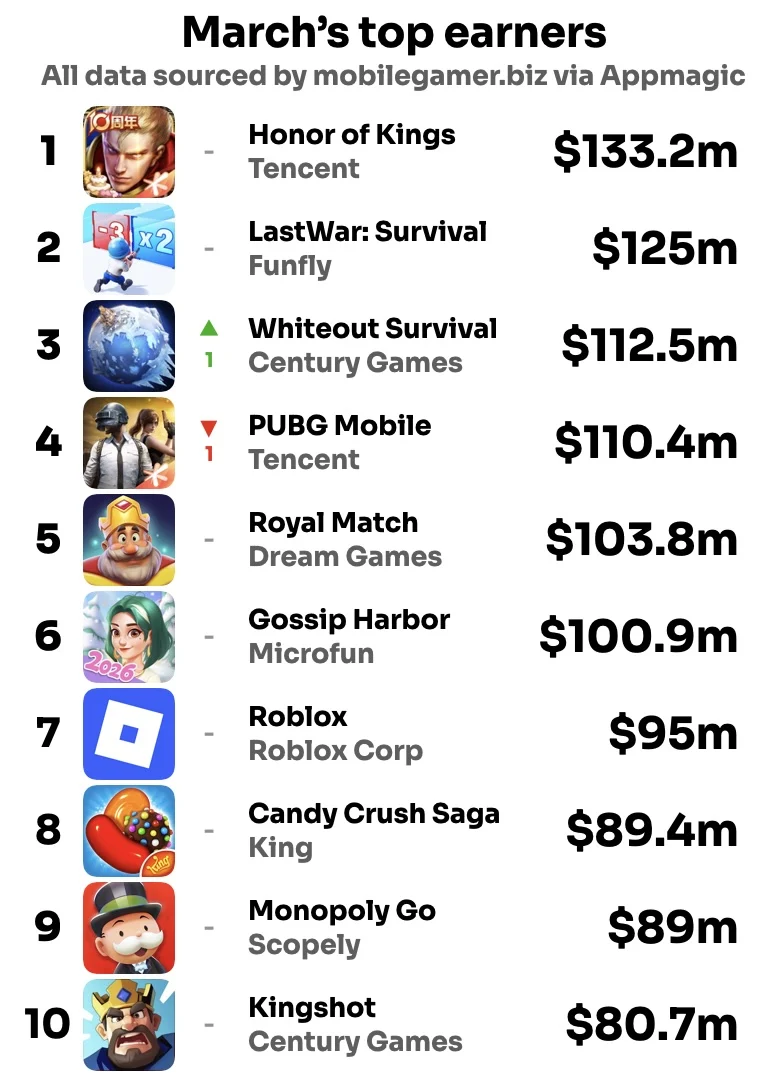
Tencent’s flagship MOBA, Honor of Kings, maintained its position as the world’s highest-grossing mobile game in March, despite a notable downward trend in month-over-month earnings. The title generated approximately $133 million in March, a sharp decline from the $150 million recorded in February and the staggering $188 million peak seen in January. Industry analysts attribute this "spiky" revenue behavior to the conclusion of major Lunar New Year events and seasonal content cycles in the Chinese market, which traditionally drive massive spending spikes at the start of the calendar year.
In contrast to the fluctuations of Honor of Kings, FirstFun’s LastWar: Survival has established a remarkably stable revenue floor. Earning approximately $125 million in March, the 4X strategy title has not dipped below the $120 million mark since its period of explosive growth in mid-2024. This consistency suggests that LastWar: Survival has successfully transitioned from a high-growth acquisition phase to a sustainable "live-ops" phase, where a dedicated core of high-spending players provides a predictable monthly baseline, occasionally bolstered to $150 million during major promotional windows.

Century Games also saw significant movement within the top five. Whiteout Survival reclaimed the third position, leapfrogging PUBG Mobile with earnings exceeding $112 million. This represents a return to form for the survival-themed strategy game, which maintained similar levels throughout the latter half of 2025 before experiencing a minor contraction in early 2026. Meanwhile, PUBG Mobile stabilized at approximately $110 million, a respectable performance following an outlier February where it surpassed $129 million.
The $100 Million Milestone: The Rise of Gossip Harbor
Perhaps the most significant narrative of March 2026 is the ascent of Microfun’s Gossip Harbor. The title officially joined the "hundred-million-dollar club," generating $100 million in monthly IAP revenue for the first time. This represents a substantial leap from February’s $82.5 million and confirms a long-term upward trajectory that has seen the game surpass legendary titles like King’s Candy Crush Saga.
The success of Gossip Harbor is indicative of a broader shift in the casual gaming market toward the "Merge" genre. By combining simple puzzle mechanics with deep, soap-opera-style narratives and high-frequency live events, Microfun has managed to capture a demographic that was previously the sole domain of Match-3 giants. If current trends persist, Gossip Harbor is positioned to challenge Dream Games’ Royal Match, which itself recovered in March to post earnings of over $100 million after a rare dip to $97 million in February.
The Monopoly Go Phenomenon and the Web Shop Pivot
One of the most discussed data points in the March report involves Scopely’s Monopoly Go. The title, which dominated global charts throughout 2024 and 2025, recorded approximately $89 million in IAP revenue for March. While this is an improvement over February’s $78 million, it remains significantly lower than the $128 million the game pulled in as recently as January.

Market analysts suggest this apparent decline may not reflect a loss of player interest, but rather a strategic pivot by Scopely toward direct-to-consumer (DTC) sales. By incentivizing players to purchase currency and bundles through official web shops rather than through the Apple App Store or Google Play Store, publishers can bypass the 30% platform commission. This "web shop migration" is becoming a standard tactic for high-revenue games, meaning that while "visible" IAP revenue may appear to be falling, the actual net profit for the publisher could be increasing.
Supercell’s Brawl Stars Resurgence
Further down the rankings, Supercell’s Brawl Stars continues its impressive comeback story. After facing a revenue stagnation period in late 2025, the game has undergone a series of meta-reworks and reward system overhauls that have successfully re-engaged its massive player base. In March, Brawl Stars earnings spiked to $34 million, a significant jump from the $23 million recorded in February.
This resurgence is credited to Supercell’s aggressive "Live Ops" calendar and the introduction of high-value seasonal passes. The ability of a title that is several years old to see a 47% month-on-month revenue increase highlights the efficacy of Supercell’s current "player-first" retention strategy, which focuses on frequent content drops and community-driven events.
Mid-Tier Performance and Emerging Competitors (Ranks 11-20)
The 11-20 bracket for March 2026 shows a mixture of steady performers and titles experiencing early-lifecycle cooling.

- Coin Master (Moon Active): $55.7 million
- Pokémon Go (Niantic): $46 million
- Township (Playrix): $44.1 million
- Royal Kingdom (Dream Games): $37 million
- MapleStory: Idle RPG (Nexon): $36.6 million
- Delta Force (Tencent): $36.5 million
- Last Z: Survival Shooter (Florere Game): $36.2 million
- Gardenscapes (Playrix): $36 million
- Brawl Stars (Supercell): $34 million
- Free Fire (Garena): $33 million
Playrix’s Township stood out in this group, showing stronger month-on-month growth than its immediate peers, Coin Master and Pokémon Go. However, Nexon’s MapleStory: Idle RPG showed signs of post-launch fatigue; after a strong debut in November 2025, its revenue has begun to slide, suggesting the "honeymoon phase" for the idle title may be concluding.
Tencent’s tactical shooter, Delta Force, also exhibited high volatility. After a massive February that saw nearly $60 million in earnings, the title dropped to $36.5 million in March. Such fluctuations are common in the shooter genre, where revenue is often tied to the release of limited-time "gacha" skins and battle pass resets.
Broader Market Implications and Future Outlook
The March 2026 data underscores several critical trends that will likely define the remainder of the fiscal year. First, the "Strategy-Survival" genre (led by LastWar and Whiteout Survival) has proven to be the most resilient category in mobile gaming, maintaining high LTV (Lifetime Value) for players even as other genres fluctuate.
Second, the success of Gossip Harbor and the recovery of Royal Match demonstrate that the casual puzzle market is far from saturated; instead, it is evolving. Players are increasingly gravitating toward titles that offer a blend of mechanical simplicity and narrative depth.

Finally, the industry is watching the "Monopoly Go effect" closely. If more top-tier publishers successfully migrate their "whale" (high-spending) players to external web shops, traditional tracking metrics like App Store IAP data will become an increasingly incomplete picture of a game’s financial health. This shift represents a fundamental challenge to the mobile platform duopoly and could lead to a more fragmented, yet potentially more profitable, ecosystem for developers.
As the industry moves into the second quarter of 2026, the focus will likely shift to how these publishers manage player retention during the traditionally slower spring months. With Supercell showing that old titles can be successfully revitalized and Microfun proving that new giants can still emerge, the mobile gaming sector remains a highly dynamic and lucrative segment of the global entertainment economy.
About the Author