Google Play’s General Manager for Games, Aurash Mahbod, has provided a comprehensive breakdown of the technology giant’s revamped service fee architecture and the introduction of its "Level Up" program, signaling a significant shift in how the platform interacts with its global developer community. This overhaul follows years of mounting regulatory pressure and high-profile legal challenges regarding app store monopolies, most notably the protracted litigation involving Epic Games. The new structure, which aims to decouple billing fees from platform service fees while incentivizing high-quality, cross-device development, represents one of the most substantial changes to the Android ecosystem’s monetization model since the inception of the Play Store.
The Architecture of the New Fee Structure
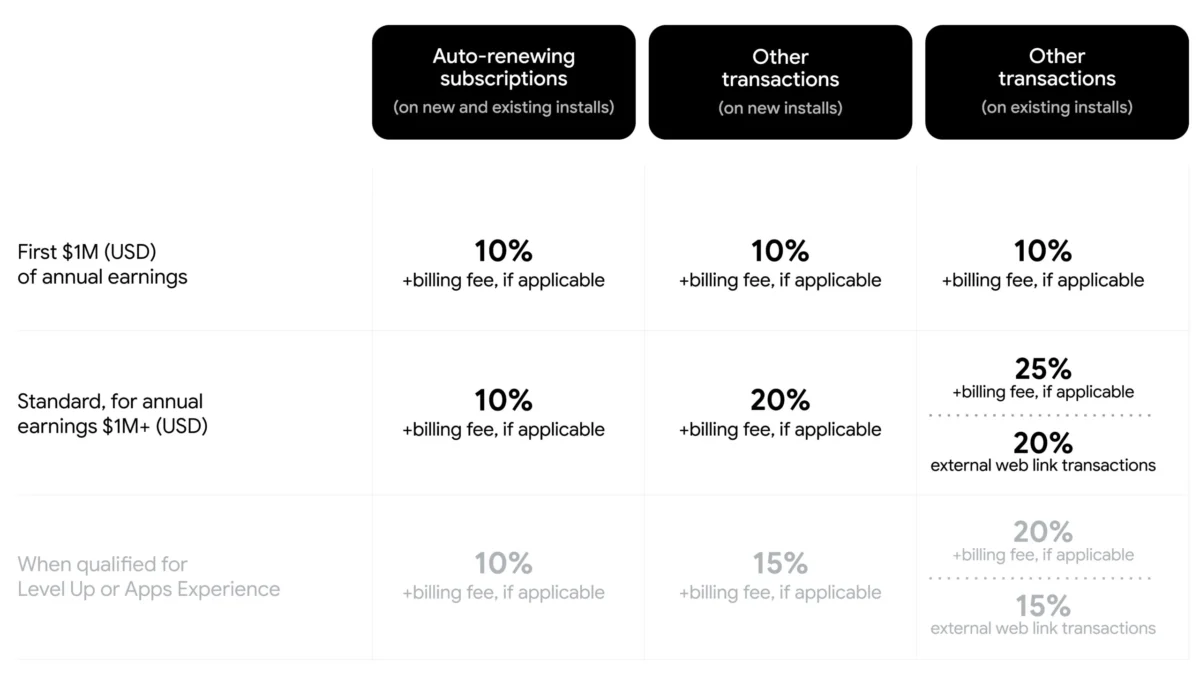
The cornerstone of Google’s new policy is a reduction in the baseline service fee for one-time purchases. Historically, Google maintained a standard 30% cut for most transactions within the Play Store. Under the new guidelines, this baseline is being reduced to 20% for new installs. However, the complexity of the new system lies in the "decoupling" of the billing fee. For developers operating in the United States, United Kingdom, and the European Union, Google has introduced a 5% billing fee for transactions processed through Google Play’s native billing system.
This effectively means that for existing players—those who installed the game before the policy shift—the total cost to the developer remains at 30% (a 25% service fee plus a 5% billing fee). For new installs, the total effective rate drops to 25% (a 20% service fee plus a 5% billing fee). If a developer chooses to use an alternative payment processor, they may be able to bypass the 5% Google billing fee, though they would then be subject to the processing fees of their chosen third-party provider. This nuance is critical for developers calculating their bottom line, as the "reduction" is not a flat drop across all revenue streams but a tiered system dependent on user acquisition timing and payment methods.
Global Implementation Timeline
Google is rolling out these changes in a phased approach across various jurisdictions to ensure compliance with local regulations and to allow developers time to adjust their technical infrastructures. The timeline for the implementation of the new fee structure is as follows:
- June 30, 2024: The changes officially took effect for developers and users within the United States, the United Kingdom, and the European Union.
- September 30, 2024: The new fee structure will be implemented in Australia.
- December 31, 2024: Japan and South Korea will transition to the new rates.
- September 30, 2027: The remainder of the global market is expected to be integrated into the new structure.
This staggered rollout reflects the varying degrees of regulatory scrutiny Google faces in different markets. In South Korea, for instance, the government has already passed legislation—the Telecommunications Business Act—specifically aimed at preventing app store operators from forcing developers to use their proprietary billing systems. The long lead time for the "rest of the world" suggests that Google is prioritizing regions with active legislative oversight or significant market share.
The Games Level Up Program: Incentivizing Premium Experiences
A major component of Mahbod’s explanation centered on the "Games Level Up" program. This initiative is designed to offer further discounts on service fees to developers who meet specific technical and quality benchmarks. While Mahbod noted that the program requires developers to "jump through a new set of compliance and technical hoops," he framed it as a reward for those who invest in the "premium, cross-device experience."
To qualify for the Level Up program’s lower rate card, developers must integrate specific Google Play services and ensure their titles are optimized for multiple form factors, including foldable phones, tablets, and the "Google Play Games on PC" ecosystem. This strategy serves a dual purpose: it improves the overall quality of the Android gaming library and deepens the integration of developer products into the broader Google ecosystem. By offering lower fees in exchange for deeper technical commitment, Google is effectively leveraging its fee structure to drive platform-wide innovation.
The Epic Games Shadow and Regulatory Pressure
During his briefing, Mahbod was asked whether the legal battle with Epic Games directly influenced the timing or nature of these policy changes. While he did not explicitly confirm a causal link, he emphasized that Google has been working on these transitions for "multiple years." The context, however, is difficult to ignore. In late 2023, a U.S. jury found that Google had maintained an illegal monopoly with its Play Store and billing practices. While that verdict is subject to appeal, the pressure to demonstrate a more open ecosystem has never been higher.

The introduction of alternative billing options and the reduction of the baseline fee are widely seen as attempts to preempt more drastic court-ordered remedies or legislative mandates like the Digital Markets Act (DMA) in the European Union. By voluntarily adjusting its rates and opening up billing, Google aims to maintain control over the narrative of platform fairness while preserving the core of its revenue-generating model.
Defending the Platform Service Fee
Despite the reductions, Google remains firm in its stance that a significant cut of in-app purchases (IAPs) is justified. Mahbod defended the up-to-30% cut by highlighting the massive infrastructure costs associated with maintaining a global marketplace. "The baseline platform service fees support our continued, immense investments across Android and Play," Mahbod stated. He pointed to the complexities of managing taxes, regulatory compliance, and subscriptions across more than 195 markets.
Furthermore, Google manages over 300 local payment methods, a feat that would be prohibitively expensive and technically daunting for individual developers to replicate. Mahbod argued that the value provided by Google Play extends beyond mere distribution; it includes security protocols that protect users from malware and fraud, as well as discovery algorithms that help developers find their audience in a crowded market.
Technical Integration and Developer Feedback
One of the more granular updates mentioned by Mahbod involves the integration of AI-powered tools and account management systems. Based on developer feedback, Google has added placement controls for "Sidekick," its AI-powered assistant designed to help developers optimize their store listings and user engagement strategies. Additionally, the company has introduced revamped account sign-up controls for Play Games Services.
These updates are intended to minimize the friction of onboarding new users while giving developers more agency over how their brands are presented within the store. Mahbod noted that "open dialogue" with developers is a priority for the company, as it seeks to balance the needs of its business partners with the expectations of its user base. The goal, according to Mahbod, is to ensure that the Level Up program provides "compelling rewards to power new-user acquisition mechanics" without destabilizing existing in-game economies.
Analysis of Market Implications
The shift from a flat 30% fee to a complex, multi-tiered system has several implications for the mobile gaming industry. For large-scale publishers with high volumes of new installs, the 5% reduction (from 30% to 25% including billing) could represent millions of dollars in reclaimed revenue. For smaller indie developers, who may already qualify for Google’s existing 15% rate on the first $1 million of annual revenue, the changes may be less impactful unless they can meet the technical requirements of the Level Up program.
Industry analysts suggest that this move is a strategic "middle ground." It offers enough of a concession to satisfy some regulators while ensuring that Google continues to capture a significant portion of the mobile commerce market. However, the requirement for developers to adopt specific Google technologies to access the lowest rates (via Level Up) may raise new questions about "vendor lock-in." If a developer must use Google’s proprietary account systems and cross-platform tools to get a fair rate, critics may argue that the platform is simply replacing one form of control with another.
Conclusion and Future Outlook
As the mobile gaming landscape continues to mature, the relationship between platform holders and content creators is undergoing a fundamental recalibration. Google’s new fee structure and the Level Up program are clear indicators that the era of the "one-size-fits-all" 30% commission is ending. In its place is a more nuanced, performance-based model that rewards technical alignment with the platform’s goals.
While Mahbod frames these changes as a pro-developer evolution designed to foster "exceptional user experiences," the reality is a sophisticated response to a global shift in antitrust sentiment. Developers will now need to weigh the financial benefits of the Level Up program against the technical overhead required to join it. As the rollout continues through 2027, the industry will be watching closely to see if these changes truly "level up" the ecosystem for all participants or if they merely add layers of complexity to an already contentious business relationship. For now, Google has signaled that it is willing to evolve, provided it remains the arbiter of the Android economy.
About the Author