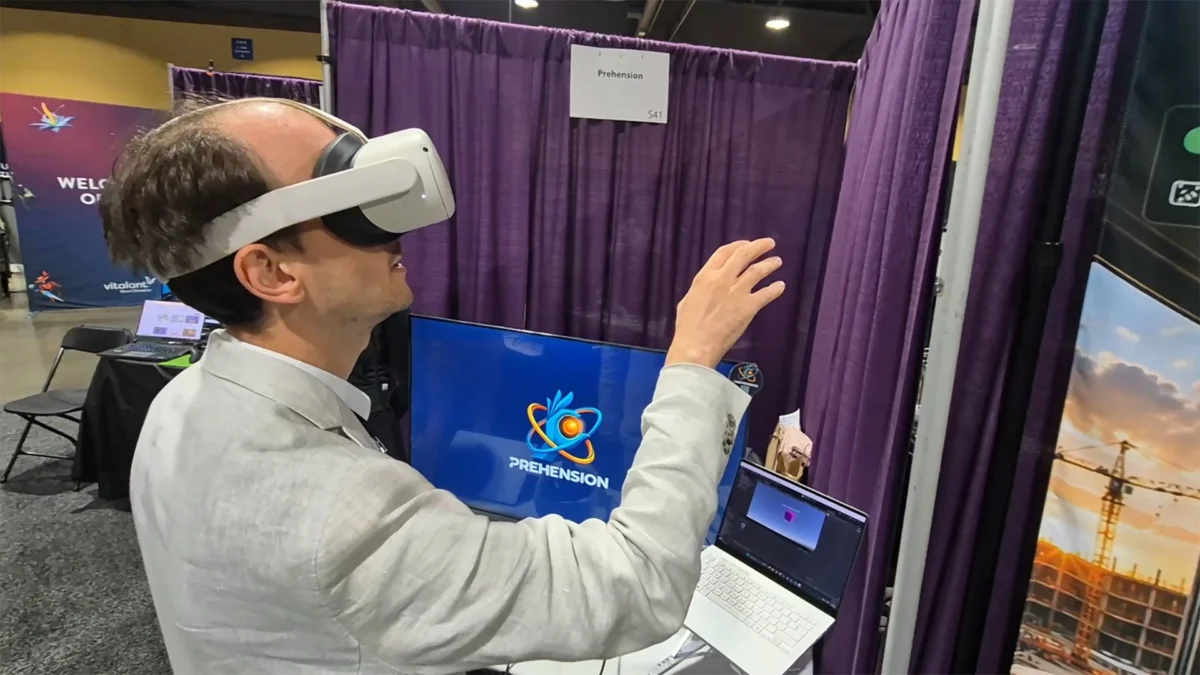
Prehension AI, a specialized technology startup focusing on human-computer interaction, has introduced its latest Unity-based Software Development Kit (SDK) designed to streamline the implementation of complex hand gestures in Mixed Reality (MR) and Virtual Reality (VR) environments. Debuted at the Augmented World Expo (AWE) USA 2026, the tool addresses a persistent challenge in the spatial computing industry: the difficulty of coding and detecting dynamic, time-based hand movements compared to static hand poses. While standard platforms often support basic poses like a "pinch" or "fist," Prehension AI focuses on "animated gestures"—movements that involve a hand changing position and shape over a specific duration, such as waving, circular motions, or culturally specific expressive gestures.
The Evolution of Gesture Recognition in Spatial Computing
The field of XR (Extended Reality) has long struggled with intuitive input methods. While hardware manufacturers like Meta, HTC, and Apple have made significant strides in optical hand tracking, the software layer responsible for interpreting those tracks into actionable commands remains fragmented. Developers typically face two primary hurdles when implementing custom gestures. First, the mathematical complexity of defining a movement over time—accounting for velocity, trajectory, and finger articulation—is immense. Second, the variance in how different individuals perform the same gesture creates a high margin of error for traditional, heuristic-based detection systems.
Prehension AI’s solution leverages machine learning (ML) to bypass manual coding. By shifting the burden from the developer’s logic to a trained model, the SDK allows for a more "natural" recognition process that can adapt to the physiological differences between users. At AWE USA 2026, the company demonstrated a workflow that significantly reduces the development cycle for gesture-based interactions, moving from weeks of manual tuning to minutes of automated training.
Technical Workflow: From Recording to Deployment
The Prehension AI SDK operates within the Unity ecosystem, providing a specialized environment for gesture capture and model generation. During the demonstration at AWE, the company outlined a three-stage process for integrating custom gestures into XR applications.
The first stage involves the "Recording Scene." Using a tethered headset—specifically the Meta Quest series via Link—developers record samples of the desired gesture in real-time. The system captures the hand data provided by the Quest’s native runtime. To ensure the robustness of the final model, the company recommends collecting multiple samples of the same gesture. Industry best practices, as echoed by Prehension AI, suggest involving multiple individuals in the recording phase to provide the ML model with a diverse dataset, accounting for variations in hand size, speed, and motion style.
The second stage is the "Cloud-Based Training" phase. Once the data samples are gathered, the developer initiates the training process via a dedicated button within the Unity Editor. The data is processed on Prehension’s cloud servers, where a classification model is generated. A notable technical achievement showcased at the event was the speed of this process; a model trained on three distinct gestures with approximately six samples each was completed in roughly sixty seconds. Once the training is finalized, the resulting model is downloaded back into the Unity project. Crucially, the inference—the actual detection of gestures during app usage—occurs locally on the device, ensuring the SDK can function in environments without an active internet connection.
The final stage is "Inference and Detection." The SDK provides a script that monitors hand data and compares it against the trained model. Unlike simpler systems that might "force" a movement to match the closest available gesture, the Prehension AI classifier includes a threshold for non-recognition. If a user’s movement does not sufficiently resemble the trained data, the system returns a null value, preventing accidental triggers and improving the overall reliability of the user interface.
Performance Analysis and User Experience
Preliminary testing of the SDK at AWE 2026 indicated a high level of generalization. In one demonstration, a user was able to trigger specific animations on a 3D object using gestures they had not personally recorded for the training set. This suggests that the underlying ML architecture is capable of identifying the "essence" of a gesture rather than merely performing a frame-by-frame comparison. This level of abstraction is vital for commercial applications where a diverse user base will interact with the software.
The SDK’s performance in the high-interference environment of a trade show floor—characterized by varied lighting and "noisy" sensor data—further validated its readiness for real-world deployment. While the current user interface for the recording scene remains in a "beta" state with minimal graphical polish, the core functionality of the gesture classification engine demonstrated high accuracy and low latency.
Market Positioning and Industry Implications
Prehension AI enters a market currently dominated by first-party solutions like Meta’s Presence Platform and Apple’s ARKit. However, these platforms often prioritize "system-level" gestures that are universal across the OS. Prehension AI targets the "niche and custom" segment, providing tools for developers who need specialized inputs for industrial training, sign language interpretation, or highly stylized gaming experiences.
The company has announced that the SDK is currently in a private beta phase, with plans to transition to a subscription-based model upon public release. This "Software as a Service" (SaaS) approach is common in the XR toolset industry, though it presents challenges for smaller independent developers. The sustainability of the business model will likely depend on adoption rates within the enterprise sector, where complex, hands-free interactions are in high demand for maintenance and surgical simulations.
Chronology of Development and Future Outlook
The journey of Prehension AI from a conceptual startup to a functional SDK provider has been marked by several key milestones:
- Q4 2025: Initial development of the ML-based classification engine and core Unity plugin.
- Q1 2026: Internal testing of cloud-based training protocols to optimize model turnaround time.
- May 2026: Preview of the technology at pre-AWE events, highlighting the focus on "animated" rather than "static" gestures.
- July 2026: Live hands-on demonstrations at AWE USA, showcasing the recording-to-inference pipeline.
- Q3-Q4 2026 (Projected): Expansion of the private beta and potential integration with other engines, such as Unreal Engine 5.
As the XR industry moves toward "spatial computing" as a standard, the demand for sophisticated input methods is expected to grow. The reliance on physical controllers is diminishing in favor of optical tracking, yet the software tools to make optical tracking "meaningful" have lagged behind the hardware. Prehension AI’s focus on democratizing machine learning for gesture recognition represents a significant step toward making complex XR interactions accessible to developers without deep backgrounds in data science.
The long-term impact of the Prehension AI SDK will be measured by its ability to maintain high precision across various hardware platforms. As headsets from various manufacturers continue to enter the market, a cross-platform, ML-driven gesture solution could become a vital component of the XR development stack. For now, the company remains focused on refining its Unity integration and building a library of pre-trained gestures to further lower the barrier to entry for immersive content creators.
About the Author