The global mobile gaming landscape in March demonstrated a blend of enduring classics and rising contenders, according to the latest market intelligence from Appmagic. While the industry continues to navigate a post-hypercasual era, the data reveals that accessible puzzle mechanics and established battle royale titles remain the primary drivers of massive scale. Leading the pack is Block Blast, which maintained a commanding lead over its nearest competitors, further solidifying its position as a dominant force in the puzzle genre.
The data provided by Appmagic offers a comprehensive view of the international market, though it is important to note that these estimates exclude downloads from China’s fragmented third-party Android marketplaces. However, the figures include the official Apple App Store and Google Play Store globally, providing a robust proxy for consumer interest and user acquisition trends across the Western and emerging markets.
Block Blast and the Continued Dominance of Puzzle Mechanics
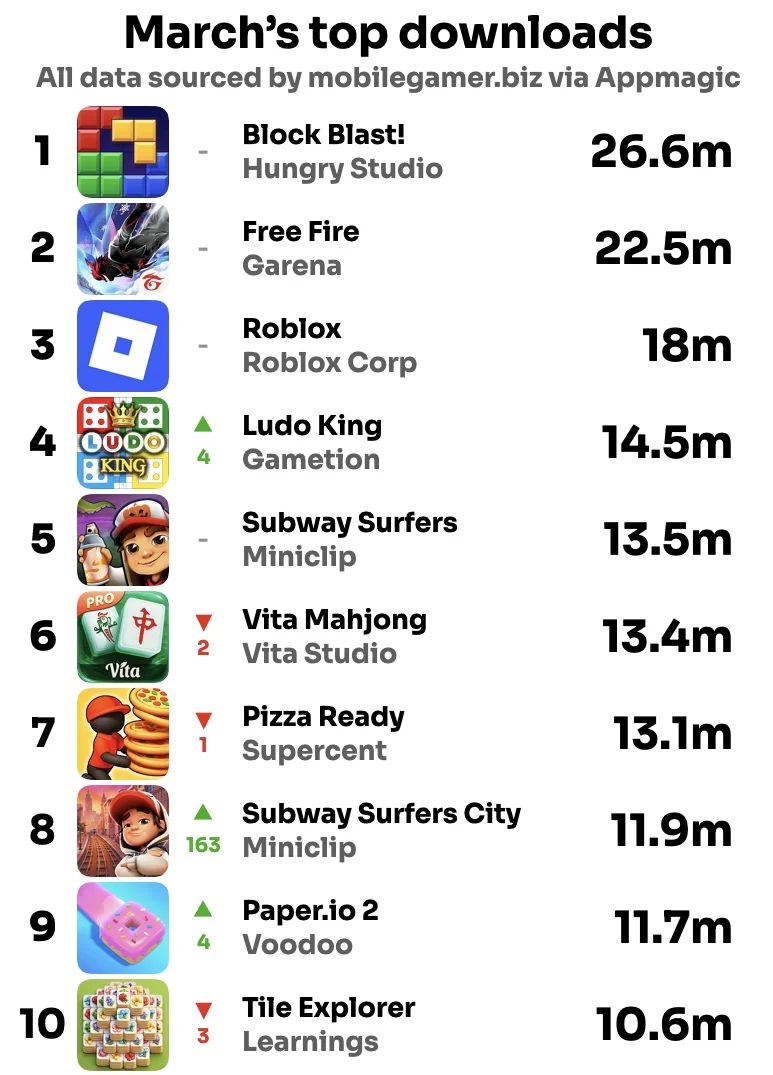
Hungry Studio’s Block Blast has emerged as a phenomenon that defies the typical volatility of the mobile charts. In March, the title achieved a significant milestone by securing the top spot with a lead of approximately 4 million installs over the second-place finisher, Garena Free Fire. This gap is particularly noteworthy given that March is often considered a transitional month in the mobile gaming calendar, falling between the high-spending winter holidays and the surge in engagement typically seen during the northern hemisphere’s summer break.

Block Blast’s success is attributed to its "easy to learn, hard to master" gameplay, which iterates on the foundational mechanics of block-matching puzzles. By focusing on high replayability and a low barrier to entry, Hungry Studio has managed to capture a broad demographic. The game’s ability to outpace multi-billion-dollar franchises like Free Fire and Roblox underscores a shift in the market where "snackable" content continues to thrive alongside more complex live-service platforms.
The Stability of Battle Royale and Social Ecosystems
Garena Free Fire remains a titan in the mobile space, consistently generating monthly downloads in the 20 million range for over a year. Despite minor fluctuations—referred to by analysts as "peaks and troughs"—the battle royale title remains the preferred competitive experience in regions such as Southeast Asia, Latin America, and India. Its optimization for lower-end hardware continues to be its greatest competitive advantage against more graphically demanding titles like PUBG Mobile.
Meanwhile, Roblox maintained a steady performance in March. While its download numbers did not reach the extraordinary heights witnessed during the summer of 2025, the platform remains a cornerstone of the mobile ecosystem. Market analysts anticipate a significant uptick in Roblox installs for April, coinciding with school holidays in many parts of the world, including the Easter break. As a "metaverse" platform rather than a singular game, Roblox’s retention rates often differ from traditional titles, as its value proposition lies in its endless variety of user-generated content.
The Subway Surfers Dual-Strategy: A Case Study in Brand Expansion
One of the most significant developments in March was the performance of the Subway Surfers franchise. SYBO and Miniclip have achieved what many publishers fear: launching a sequel or spin-off without cannibalizing the original game’s audience.

Subway Surfers, the original endless runner that has defined the genre for over a decade, secured the fifth spot with 13.5 million installs. Simultaneously, the newly released Subway Surfers City broke into the top ten, landing at eighth place with 11.9 million downloads in its first full month of global availability.
Industry observers note that Subway Surfers City offers a more modernized, graphically enriched experience, yet the original title has maintained its run rate of 13-15 million monthly downloads since late 2025. This suggests that the franchise is successfully expanding its total addressable market rather than simply shifting players from one app to another. The ability of the original Subway Surfers to maintain its momentum despite internal competition is a testament to its status as a digital "evergreen."
Resurgence of the Classics: Ludo King and Magic Tiles 3
March also saw a notable recovery for Ludo King. After a period of relative decline toward the end of 2025—where downloads dipped to the 10-12 million range—the game rebounded to 14.5 million installs in March. This resurgence suggests that Ludo King has successfully fended off a wave of newer competitors that emerged in the digital board game space late last year. Its dominance in the Indian subcontinent remains the primary engine of its growth.
Similarly, Amanotes’ Magic Tiles 3 is experiencing a secondary "golden age." Throughout 2024 and early 2025, the rhythm game typically attracted 5-6 million downloads per month. However, starting in mid-2025, the title began a steady climb. In March, it surpassed 10.5 million installs, marking its best performance since January 2022. This growth is particularly interesting as it coincides with the winding down of other major rhythm titles like Beatstar, suggesting that Magic Tiles 3 is consolidating the audience for the genre.

Regional Growth Drivers: The Power of Emerging Markets
A recurring theme in the March download charts is the influence of emerging markets, specifically Indonesia, India, and Brazil. Titles that may not be household names in Western markets are generating massive volume through these regions.
- School Party Craft: This Minecraft-Roblox hybrid continues to perform exceptionally well, securing 9.9 million installs in March. Its primary audience is located in Indonesia, India, and Brazil. The game’s focus on social simulation and creative building resonates strongly with younger demographics in these high-growth regions.
- Super Bear Adventure: Developed by Earthkwak Games, this 3D platformer has maintained healthy download figures since a major spike in early 2025. With 8 million installs in March, it remains a favorite in Indonesia, Turkey, Brazil, Russia, and Mexico.
- Football League 2026: Ranking 19th, this title has seen an uptick in monthly downloads. Beyond the traditional strongholds of India and Brazil, it has gained significant traction in Bangladesh and Algeria, highlighting the global appetite for accessible sports simulations.
The Top 20 Mobile Game Downloads: March Data Summary
The following list represents the top-performing titles by total downloads for the month of March:
- Block Blast (Hungry Studio): ~24m
- Free Fire (Garena): ~20m
- Roblox (Roblox Corporation): ~16m
- Ludo King (Gametion): 14.5m
- Subway Surfers (SYBO/Miniclip): 13.5m
- Vita Mahjong (Vita Studio): 13m
- Pizza Ready (Supercent): 12.5m
- Subway Surfers City (SYBO/Miniclip): 11.9m
- Paper.io 2 (Voodoo): 11m
- Tile Explorer (Plug in Digital): 10m
- Magic Tiles 3 (Amanotes): 10.5m
- Solitaire Associations Journey (Hitapps): 10m
- School Party Craft (Candy Room Games): 9.9m
- My Talking Tom 2 (Outfit7): 9.8m
- Mobile Legends: Bang Bang (Moonton): 9.75m
- PUBG Mobile (Tencent): 9.5m
- 8 Ball Pool (Miniclip): 9.2m
- Super Bear Adventure (Earthkwak Games): 8.1m
- Football League 2026 (Mobile Soccer): 8m
- FPS Strike Ops: Modern Arena (FPS Shooter & Action Game): 8m
Market Analysis: The Shift from Hypercasual to Hybrid-Casual
The March data highlights a broader structural shift in the mobile gaming industry. The era of "pure" hypercasual games—characterized by extremely simple mechanics and ultra-short lifespans—is evolving into the "hybrid-casual" era. Titles like Pizza Ready and Paper.io 2 exemplify this trend. While they retain the accessible core mechanics of hypercasual games, they incorporate deeper progression systems and more sophisticated monetization strategies.
Voodoo’s Paper.io 2, for instance, saw a resurgence in March, climbing back over the 11 million download mark. While this is lower than the 25 million monthly installs the game achieved during the hypercasual boom of 2018, its longevity is impressive. Publishers are increasingly prioritizing games that can maintain a steady "run rate" over several years rather than those that peak and disappear within a few weeks.

Furthermore, the performance of PUBG Mobile, which dropped seven places in the rankings despite maintaining a healthy 9.5 million installs, suggests that the market is becoming more competitive at the top. The decline in rank for certain titles is often not a result of their own failure, but rather the result of aggressive user acquisition campaigns from newer titles or the seasonal resurgence of established competitors.
Future Outlook and Implications
As the industry moves into the second quarter of the year, several factors will influence the download charts. The continued expansion of the Subway Surfers brand will be closely watched to see if Subway Surfers City can maintain its top-ten status once the initial launch momentum fades. Additionally, the impact of holiday schedules on titles like Roblox and Minecraft-inspired games will likely shift the rankings in favor of social and creative platforms.
For developers and investors, the March data reinforces the importance of regional diversification. With growth slowing in some saturated Western markets, the ability to capture audiences in Indonesia, Brazil, and India is no longer an option but a necessity for achieving global scale. The success of "mid-tier" developers like Earthkwak Games and Mobile Soccer proves that with the right localized appeal, independent studios can still compete with industry giants on the global stage.
In conclusion, March was a month defined by the resilience of established franchises and the successful tactical expansion of legacy brands. As Block Blast continues its reign at the top, the industry remains a dynamic environment where traditional gameplay values—accessibility, social connection, and consistent updates—remain the most reliable paths to success.
About the Author