The universe, a tapestry woven with billions of galaxies, each containing billions of stars, presents a profound enigma: if life is a natural outcome of cosmic evolution, why does Earth appear to be an isolated island of intelligence? This is the essence of the Fermi Paradox, a contradiction that challenges our understanding of life’s prevalence and our place within the vast cosmos. With a staggering 13.8 billion years of cosmic history providing an immense head start for potential alien civilizations, the absence of any discernible contact or evidence of extraterrestrial intelligence remains one of science’s most compelling unanswered questions.
Historical Context: Enrico Fermi and the Dawn of the Paradox
The paradox takes its name from Italian-American physicist Enrico Fermi, a Nobel laureate and key figure in the development of the first nuclear reactor. The famous question, "Where is everybody?", arose during an informal lunchtime conversation in 1950 with fellow scientists Emil Konopinski, Edward Teller, and Herbert York at Los Alamos National Laboratory. The discussion revolved around a New Yorker cartoon depicting aliens stealing public trash cans, prompting Fermi to muse on the high probability of extraterrestrial life given the sheer number of stars and the age of the universe. His quick calculation led him to conclude that, even with conservative estimates for the development of intelligent life and interstellar travel, Earth should have been visited by extraterrestrials long ago. The absence of such evidence struck him as a stark contradiction.
Fermi’s intuitive observation laid the groundwork for a more formalized approach to estimating the number of intelligent civilizations in our galaxy: the Drake Equation. Formulated by astronomer Frank Drake in 1961, this probabilistic argument factors in variables such as the rate of star formation, the fraction of stars with planets, the number of habitable planets per star, the fraction of planets where life arises, the fraction of life that evolves into intelligent life, the fraction of intelligent civilizations that develop detectable technology, and the length of time such civilizations release detectable signals into space. While the values for many of these variables are highly speculative, even optimistic estimations often yield a significant number of potential communicative civilizations within the Milky Way alone, intensifying the paradox. For instance, if even a tiny fraction of the estimated 100-400 billion stars in our galaxy host planets, and a fraction of those planets are habitable, the statistical likelihood of life emerging seems considerable.
The Great Silence: Why Haven’t We Heard From Them?
The lack of any convincing evidence for alien intelligence, either through direct visits or detectable signals, creates what is often referred to as "The Great Silence." Despite decades of dedicated efforts by projects like SETI (Search for Extraterrestrial Intelligence) to scan the cosmos for radio signals, our celestial neighborhood remains eerily quiet. This absence of evidence is a core tenet of the paradox, leading to a spectrum of theories attempting to reconcile the high probability of extraterrestrial life with its apparent non-existence.
The analogy to the time travel paradox is often drawn to illustrate this point. The absence of time travelers from the future, despite the seemingly inevitable development of such technology over vast timescales, mirrors the cosmic silence. As physicist Carl Sagan once suggested regarding time travelers, they could be here but disguising their existence or simply not recognized as such. This perspective introduces the possibility that our current methods of detection or our fundamental assumptions about what constitutes "evidence" might be insufficient or flawed. The observable universe, while unimaginably vast, is still a minuscule fraction of the entire cosmos, and our capacity to detect subtle or distant signals is severely limited by current technology and the speed of light.
The Great Filter Theory: Explaining the Cosmic Bottleneck
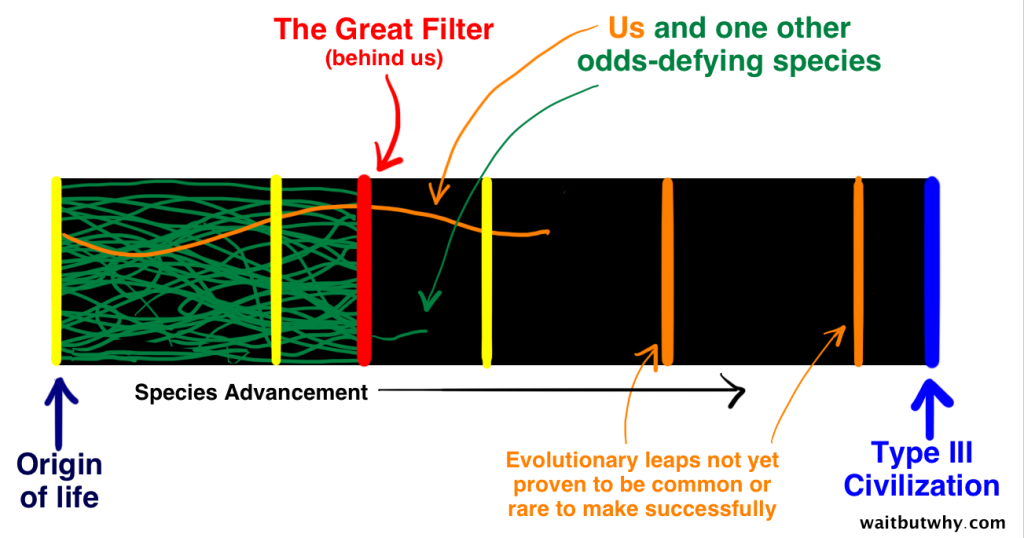
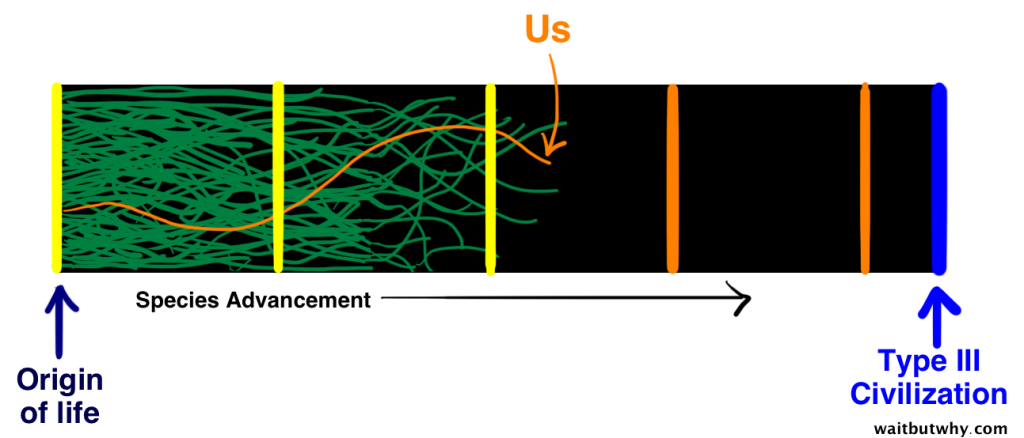
One of the most compelling explanations for the Fermi Paradox is the Great Filter theory, proposed by economist Robin Hanson. This theory posits that at some critical juncture between the genesis of life and the emergence of a Type III civilization (a civilization capable of harnessing the energy of an entire galaxy on the Kardashev scale), there exists an evolutionary "wall" or bottleneck that all, or nearly all, attempts at life encounter. This "filter" represents a stage in the long evolutionary process that is either extremely unlikely or impossible for life to overcome. The crucial question, then, is whether this filter lies in our past, our present, or our future.
The Great Filter can be broadly categorized into three main possibilities:
1. The Filter is Behind Us (The Rare Earth Hypothesis):
This perspective suggests that the critical filter has already occurred, implying that humanity has successfully navigated an extremely improbable series of events. If this is the case, life, especially complex, intelligent life, is extraordinarily rare in the universe. The "Rare Earth Hypothesis" elaborates on this, arguing that the specific confluence of astrophysical and geological conditions necessary for complex life to evolve and thrive, such as those found on Earth, are exceptionally rare. These conditions include:

- A stable galactic environment: Located in the habitable zone of a galaxy, away from destructive events like supernovae and active galactic nuclei.
- A stable star system: A sun-like star with a long lifespan, providing consistent energy.
- A planet with specific characteristics: Earth-sized, within the circumstellar habitable zone, with liquid water, a strong magnetic field, plate tectonics, and a large moon (stabilizing axial tilt).
- The improbable step of abiogenesis: The transition from non-living matter to self-replicating life.
- The evolution of complex cells: The leap from prokaryotes to eukaryotes.
- Multicellularity: The development of complex organisms from single cells.
- Sexual reproduction: Accelerating evolution and diversity.
- The Cambrian Explosion: A rapid diversification of life forms.
- The evolution of intelligence: The emergence of cognitive abilities leading to tool use, language, and civilization.
Each of these steps, individually, might be highly improbable. Their sequential occurrence on Earth, within a timescale allowing for the development of intelligence, could represent the Great Filter. If this is true, then we are exceptionally lucky, and the universe is largely devoid of advanced civilizations.
2. The Filter is Ahead of Us (Existential Risks and Self-Destruction):
This is a far more sobering possibility. If the Great Filter lies in our future, it means that most civilizations, once they reach a certain level of technological advancement, inevitably encounter a catastrophic hurdle that prevents their long-term survival or expansion. This filter could manifest as:
- Technological Self-Destruction: Nuclear warfare, uncontrolled artificial intelligence, bioweapons, or environmental collapse induced by industrial activity (e.g., climate change, resource depletion).
- Cosmic Catastrophes: Asteroid impacts, supervolcanic eruptions, or nearby gamma-ray bursts, which intelligent life might not be able to mitigate or escape.
- The Impossibility of Interstellar Travel: Fundamental physical limitations or immense energy requirements making widespread colonization infeasible.
- Societal Collapse: Inability to manage complex global systems, leading to internal strife, resource wars, or ideological conflicts that destroy civilization before it can expand beyond its home planet.
This scenario implies that we are not unique in reaching our current stage, but rather that our survival beyond it is far from guaranteed. The future development of increasingly powerful technologies, coupled with persistent human frailties, presents a formidable challenge.
3. The Filter is Ahead of Us (Transcendence or Divergence):
A less pessimistic, yet equally isolating, future filter involves advanced civilizations transcending their physical forms or diverging into forms unrecognizable or undetectable by us. This includes concepts such as:
- Technological Singularity: Civilizations reaching a point where artificial intelligence surpasses human intelligence, leading to an exponential acceleration of technological progress and a potential shift in the very nature of existence.
- Post-Biological Intelligence: The transition from biological forms to digital or synthetic forms of consciousness, no longer requiring physical planets or large-scale structures.
- Hyperspace or Higher Dimensions: Advanced life learning to manipulate space-time or inhabit dimensions beyond our current perception.
In this scenario, extraterrestrial intelligence might exist in abundance, but they have simply moved beyond our capacity to detect them, or their existence is fundamentally different from what we imagine.
Alternative Explanations and Modern Theories
Beyond the Great Filter, other theories offer explanations for the cosmic silence:
The "Small is Smart" Hypothesis:
This compelling idea, championed by thinkers like Jeff Atwood and astronomer Seth Shostak, posits that highly advanced civilizations may not manifest as the sprawling, planet-altering megastructures (like Dyson Spheres) often depicted in science fiction. Instead, they might follow an evolutionary path analogous to our own technological progress: things get smaller, faster, and more efficient.
"Why build planet-size anything when the real action is in the small things? Small spaces, small units of time, everything gets smaller," Atwood suggests. Shostak elaborates, "It could be that it’s the engineering of the small, rather than the large, that is inevitable." This follows from fundamental laws of physics: smaller machines require less energy, are faster due to reduced inertia, and have faster internal communication because of the speed of light. An advanced civilization might, for instance, prefer to build nanobots, self-replicating microscopic probes, or exist as distributed digital intelligences rather than constructing vast, visible space empires. If advanced life eventually sheds its physical constraints, opting for digital consciousness or existing within "infinite spaces between" atoms or computational networks, our current methods of searching for large-scale, energy-intensive signals would be entirely inadequate. They might inhabit virtual realities of their own making, or exist as vast, subtle information networks that are indistinguishable from cosmic background noise to us.
The "Dark Forest" Hypothesis:
Introduced by Chinese science fiction author Liu Cixin in his novel The Dark Forest, this theory offers a chilling explanation. It suggests that the universe is a "dark forest" where every civilization is a hunter, and every other civilization is a potential threat. Because the intentions of other intelligent life forms are unknowable, and their technological growth could be exponential, the safest strategy is to remain silent and destroy any other civilization that makes its presence known. This extreme caution leads to universal silence, as any signal would be an invitation for destruction.
The "Zoo Hypothesis":
This theory proposes that extraterrestrial civilizations are aware of our existence but choose not to interfere, treating Earth as a protected natural preserve or a "zoo." They might be observing us, allowing our civilization to develop naturally without external influence, until we reach a certain level of maturity or technological advancement that warrants contact. This would explain the lack of direct evidence while still allowing for the abundance of alien life.
The "Insufficient Search" Hypothesis:
A more pragmatic explanation is simply that we haven’t searched enough, or in the right ways. Our current search efforts, primarily focused on radio astronomy, have only scratched the surface of the vast cosmic haystack. We might be listening at the wrong frequencies, at the wrong times, or for signals that don’t conform to our assumptions about alien communication. Furthermore, the light-speed delay across interstellar distances means that any signals we receive might be millions of years old, and a two-way conversation could be practically impossible.
The Search Continues: SETI and Future Prospects
Despite the profound challenges posed by the Fermi Paradox, the scientific community remains committed to the search for extraterrestrial intelligence. Projects like SETI continue to refine their methodologies, utilizing increasingly powerful telescopes and sophisticated algorithms to analyze cosmic signals. The Allen Telescope Array (ATA) and the Breakthrough Listen initiative are examples of modern efforts, scanning vast swathes of the sky for technosignatures – any signs of technology that could indicate intelligent life.
The advent of advanced astronomical instruments, such as the James Webb Space Telescope (JWST), is also revolutionizing our understanding of exoplanets. By analyzing the atmospheres of exoplanets for biosignatures (gases like oxygen, methane, or ozone that could indicate biological activity), scientists are moving beyond simply identifying habitable zones to actively searching for direct evidence of life, even if it’s microbial. Future telescopes and observatories, both ground-based and space-based, promise even greater capabilities, pushing the boundaries of what we can detect.
However, the implications of a potential first contact, or the continued absence of it, are immense. Should we ever detect a signal, humanity would face unprecedented philosophical, ethical, and societal challenges. Conversely, if the silence persists, it compels us to re-evaluate our assumptions about the universe and reinforces the preciousness and potential uniqueness of life on Earth.
Philosophical and Societal Implications
The Fermi Paradox is not merely a scientific puzzle; it has profound philosophical and societal implications. It forces humanity to confront its own significance and potential isolation in the cosmos. If the Great Filter is behind us, it highlights the incredible improbability of our existence and places a unique responsibility on us to protect and cherish life on Earth. If the filter lies ahead, it serves as a stark warning about the fragility of civilization and the existential risks inherent in technological progress.
The persistent unanswered question fuels both scientific inquiry and public fascination. It drives our innate human curiosity to explore, to understand, and to define our place in the universe. The very act of searching for alien life, regardless of success, broadens our scientific horizons and pushes the boundaries of our technological capabilities. It compels us to consider the myriad possibilities of evolution and existence, from the simplest microbial life to highly advanced post-biological intelligences.
Conclusion: A Universe of Unanswered Questions
The Fermi Paradox remains one of the most enduring and perplexing mysteries in science. From Fermi’s initial lunchtime query to today’s sophisticated astronomical searches, the universe continues to withhold its secrets regarding the prevalence of intelligent life. Whether the silence is due to the extreme rarity of life, the inevitable self-destruction of advanced civilizations, their transcendence into undetectable forms, or simply the limitations of our current search capabilities, the question "Where is everybody?" continues to resonate.
As we look out into the vast, dark expanse, the silence is not merely an absence; it is a profound data point that shapes our understanding of life, intelligence, and the future of humanity. The quest to unravel this cosmic enigma continues, reminding us that even in the absence of answers, the pursuit of knowledge remains our most powerful tool for comprehending the universe and our unique, perhaps solitary, journey within it.
About the Author