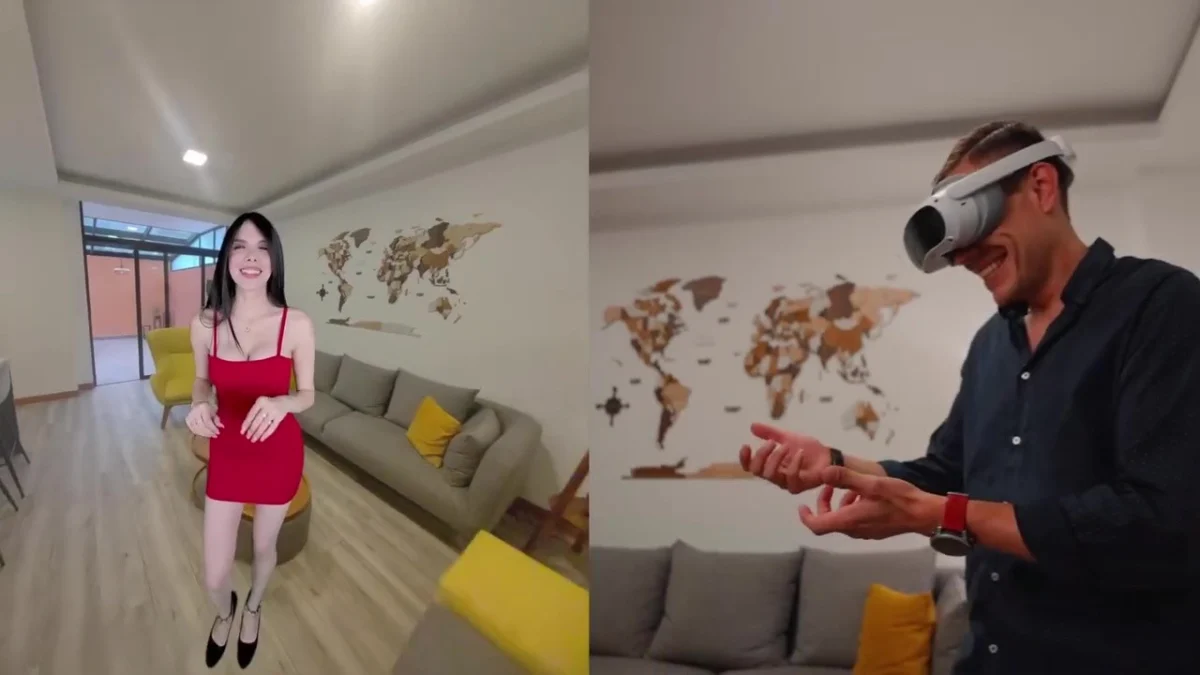
Braindance VR, an emerging technology startup, has introduced a specialized platform that utilizes volumetric video to redefine the parameters of adult entertainment within the extended reality (XR) landscape. Unlike traditional 180-degree stereoscopic VR videos that offer a fixed point of view, Braindance VR employs 4D Gaussian Splatting (4DGS) to create fully three-dimensional, photorealistic reconstructions of performers. This technological shift allows users to navigate around digital assets with six degrees of freedom (6DOF), effectively placing a high-fidelity volumetric representation of an actor within the user’s physical environment through augmented reality (AR) passthrough or a virtual space.

Technical Foundation and the Emergence of 4D Gaussian Splatting
The core innovation of the Braindance VR platform lies in its move away from mesh-based reconstruction and traditional video formats toward Gaussian Splats. While standard photogrammetry often struggles with complex textures such as hair, translucent materials, and reflective surfaces, Gaussian Splatting represents data as a collection of 3D distributions. This method excels in rendering fine details and light-dependent effects, providing a level of realism that closely mimics physical presence.
To achieve this, the production process utilizes an extensive camera array—reportedly consisting of up to 165 synchronized sensors—to capture every angle of a performance simultaneously. This data is then processed into "dynamic" or "4D" splats, which account for movement over time. The result is a volumetric file that maintains its visual integrity even when the viewer changes their physical position or orientation. This technology mirrors recent developments in spatial computing, such as Meta’s Horizon Hyperscape, which focuses on static environment reconstruction. Braindance VR, however, is among the few entities successfully applying these principles to dynamic human subjects for commercial consumption.

Chronology of Immersive Adult Media Development
The trajectory of adult entertainment in the XR space has historically served as a bellwether for broader technological adoption. The current state of volumetric video is the result of over a decade of incremental innovation:
- 2014–2016: The Stereoscopic Era. Early VR headsets like the Oculus Rift DK2 saw the first wave of 180-degree and 360-degree adult content. These were essentially flat videos curved around the viewer, lacking true depth when the user moved their head.
- 2015: Early Volumetric Experiments. Performers such as Ela Darling experimented with Microsoft Kinect sensors to produce low-resolution volumetric captures. While visionary, the hardware limitations of the time resulted in "noisy" digital models with significant graphical artifacts.
- 2020–2023: The Rise of Passthrough AR. As hardware like the Meta Quest 2 and Quest Pro improved, "green screen" 180-degree videos allowed users to superimpose performers onto their real-world environments. However, these remained two-dimensional "cutouts" without parallax.
- 2024–Present: The 4DGS Revolution. The maturation of Gaussian Splatting algorithms has enabled startups like Braindance VR to produce high-bitrate volumetric "memories" that support full movement and realistic lighting integration.
Hardware Requirements and Distribution Logistics
The implementation of 4D Gaussian Splats presents significant computational and logistical challenges. High-fidelity volumetric videos are data-intensive; a single "memory" or scene on the Braindance platform can exceed 20GB in file size. Consequently, the platform offers two primary modes of consumption: PC-tethered VR and standalone headset streaming.

For optimal performance, a PC-based setup requires a minimum of an NVIDIA GeForce RTX 2060 or equivalent GPU to handle the real-time rendering of complex splat distributions. Using a wired or high-speed wireless link (such as Meta Quest Link), users can achieve the highest level of detail and fluid frame rates. Conversely, for standalone devices like the Meta Quest 3, the company has developed a proprietary streaming technology. This system offloads much of the processing to remote servers, though it introduces certain trade-offs, including visible compression artifacts and a slight reduction in spatial resolution.
Analysis of Current Limitations and the "Uncanny Valley"
Despite the technological leap, 4DGS is not without its flaws. Technical analysis of the current Braindance VR library reveals several recurring issues inherent to early-stage volumetric video:

- Visual Artifacts: When two objects in a scene come into close proximity—such as a performer’s hand moving near their body—the splat algorithms can occasionally struggle to differentiate the boundaries, creating "webbing" or "meat-fusion" effects.
- The Gaze Problem: In traditional film, the director controls the camera. In a 6DOF environment, the performer may be looking at a "center point" that the user has moved away from, leading to a disconnect in eye contact that can break immersion.
- Lighting Incoherence: While the Quest version of the application allows for manual lighting presets (e.g., "daylight" or "indoor") to help the digital asset blend with the user’s room, the shadows and reflections on the performer do not yet update dynamically based on real-world light sources.
These factors contribute to the "uncanny valley" effect, where the brain recognizes the figure as nearly human but is occasionally distracted by non-human movements or graphical "brush strokes" visible upon close inspection.
Market Implications and Broader Applications
The business model for Braindance VR—a subscription-based service ranging from approximately €25 per month to €190 for a lifetime license—suggests a pivot toward high-value, niche technology enthusiasts. However, the implications of 4DGS extend far beyond adult entertainment. The ability to record and replay a human presence with photorealistic 3D accuracy has transformative potential for several sectors:

- Digital Preservation: Families could record volumetric "memories" of relatives, allowing future generations to experience a sense of presence that exceeds what is possible with 2D video or photography.
- Social Telepresence: The technology could evolve to support real-time 3D communication, making remote socialization feel significantly more intimate and physically grounded.
- Entertainment and Education: The music industry could utilize 4DGS for "private" performances where an artist appears to stand in the fan’s living room. Similarly, medical or technical training could benefit from viewing high-fidelity human movements from any angle.
Industry Outlook
Braindance VR represents a significant milestone in the commercialization of 4D Gaussian Splatting. By branding their content as "memories"—a nomenclature inspired by the "braindance" technology in the Cyberpunk 2077 franchise—the company is leaning into a futurist aesthetic that aligns with the current trajectory of spatial computing. As processing power on mobile chipsets increases and camera rigs become more accessible, the cost of producing and consuming volumetric media is expected to decrease.
While the adult industry is the current testing ground, the technical hurdles being solved by Braindance—such as streaming high-density splat data and improving 6DOF immersion—will likely inform the next generation of mainstream XR communication. The transition from watching a screen to sharing a space with a digital entity marks a fundamental shift in how human beings interact with recorded media.
About the Author