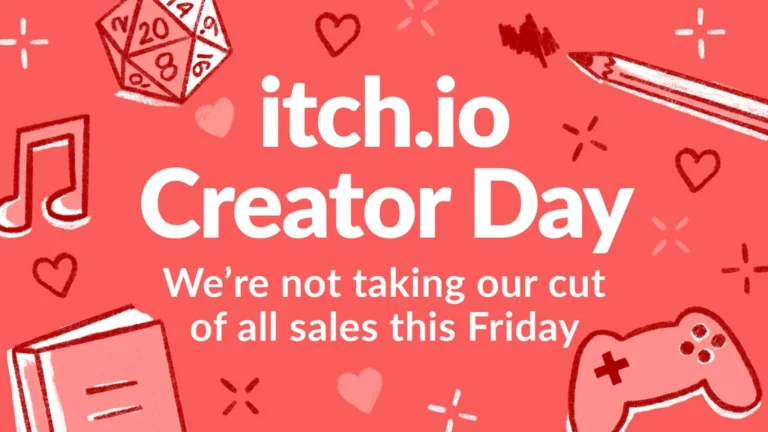
Creator Day is a pivotal, recurring 24-hour event hosted by the independent digital storefront itch.io, during which the platform completely waives its standard fee on all sales site-wide. This initiative ensures that creators receive 100% of the revenue from their sales, after standard taxes and payment processor fees, a significant departure from the typical revenue-sharing models prevalent across digital distribution platforms. Since its inception on May 14, 2021, Creator Day has become a cornerstone event, recurring multiple times throughout the year, reinforcing itch.io’s commitment to empowering its diverse community of independent game developers, artists, musicians, and asset creators. The event serves as a direct mechanism for the platform to give back to the innovators who form the backbone of its unique ecosystem, fostering a more equitable and supportive environment for independent digital content creation.
The Genesis of itch.io and its Creator-Centric Philosophy
To fully comprehend the significance of Creator Day, it is essential to understand the foundational principles upon which itch.io was built. Launched in 2013 by Leaf Corcoran, itch.io emerged as a direct response to the perceived limitations and commercial pressures faced by independent developers on larger, more established digital storefronts. From its very beginning, the platform differentiated itself by offering unparalleled flexibility and control to creators. Unlike platforms that impose rigid revenue splits (often 30% or more taken by the platform), itch.io introduced a flexible revenue share model, allowing creators to set their own percentage, with a default of 10% but often much lower, or even 0% in some cases, if the creator chose. This innovative approach signaled a deep understanding of the financial precarity often experienced by indie developers and a commitment to maximizing their earnings.
The independent game development landscape, particularly in the early to mid-2010s, was characterized by an explosion of creativity but also intense competition and challenges in discoverability. Many talented creators struggled to gain traction and generate sustainable income, often feeling squeezed by high platform fees and opaque algorithms. itch.io cultivated an environment that prioritized experimental games, niche genres, and diverse voices, becoming a haven for projects that might not find a home elsewhere. This ethos naturally led to the development of initiatives like Creator Day, which further solidified the platform’s reputation as a champion for the independent creator. The event is not merely a promotional gimmick; it is an organic extension of itch.io’s long-standing dedication to fostering a sustainable and thriving indie ecosystem.
A Chronology of Empowerment: The Evolution of Creator Day
The inaugural Creator Day took place on Friday, May 14, 2021. This first event was a strategic move by itch.io, born from a desire to provide tangible financial support directly to its creator base, especially in a period where many independent artists and developers were navigating uncertain economic landscapes. The success of this initial 24-hour window, which saw a significant surge in sales volume and community engagement, quickly demonstrated the profound positive impact such an initiative could have.
Following its highly positive reception, Creator Day transitioned from a singular event into a regular fixture on the itch.io calendar. While specific dates are announced periodically, the event typically occurs several times a year, often aligning with strategic moments in the retail cycle or significant cultural periods for the gaming community. For instance, Creator Day frequently coincides with major sales events like Black Friday, seasonal promotions (e.g., summer or winter sales), or specific indie game festivals. This strategic timing amplifies the event’s reach, drawing in both dedicated itch.io users and new buyers attracted by the broader promotional context. The consistent scheduling reinforces its status as a reliable income booster for creators, allowing them to plan product launches, sales, and marketing campaigns around these dates.
Each Creator Day runs for precisely 24 hours, meticulously scheduled from midnight to midnight Pacific Time (PT), which translates to 8 AM to 8 AM Coordinated Universal Time (UTC) the following day. This fixed window creates a sense of urgency and focuses buyer attention, maximizing the impact for creators within that specific timeframe. The predictability of its operational mechanics ensures that both creators and buyers can easily understand and participate in the event without needing to adjust account settings or navigate complex terms.
Operational Mechanics and Profound Economic Implications
The operational simplicity of Creator Day belies its profound economic implications for independent creators. During the designated 24-hour period, itch.io’s platform fee, which typically defaults to 10% but is often customized by creators to be lower, is temporarily set to 0%. This means that for every sale, the platform takes no cut. Creators directly receive the entirety of the sale price, minus only the mandatory taxes (such as VAT or sales tax, depending on jurisdiction) and the fees charged by third-party payment processors like PayPal or Stripe.
To illustrate the financial advantage: consider a game priced at $10. On a standard day, with itch.io’s default 10% revenue share, the creator would receive $9. If we factor in an approximate 2.9% + $0.30 payment processing fee (a common rate for Stripe/PayPal for smaller transactions), the creator might receive closer to $8.41. On Creator Day, however, with itch.io waiving its 10% fee, the creator would receive $10 minus only the payment processor fee and taxes, potentially increasing their take-home to around $9.41. While this might seem like a modest increase per sale, across hundreds or thousands of transactions during a 24-hour period, the aggregate difference can be substantial, often representing a significant boost to a creator’s monthly or quarterly income.
This direct injection of capital is critical for independent developers who often operate on razor-thin margins. The additional funds can be reinvested into development, used to cover living expenses, or allocated towards marketing and tool acquisition. For many, Creator Day provides crucial financial stability, enabling them to continue pursuing their passion projects without the constant pressure of making ends meet. It democratizes access to revenue, allowing smaller, less established creators to benefit just as much as more prominent ones, purely based on their sales volume during the event.
Strategies for Creators: Maximizing Visibility and Revenue
For creators, Creator Day presents a unique strategic opportunity that extends beyond mere financial gain. It becomes a focal point for marketing and community engagement efforts. Successful participation often involves proactive planning:
- Promotional Campaigns: Creators frequently launch targeted marketing campaigns leading up to and during Creator Day. This includes engaging on social media platforms (Twitter, Mastodon, Instagram, Reddit), sending newsletters to their mailing lists, and participating in itch.io’s own promotional channels.
- New Releases and Updates: Launching a new game, asset pack, or significant update on Creator Day can generate substantial buzz. The combined effect of a fresh release and the 100% revenue share incentivizes buyers and maximizes initial sales.
- Discounts and Bundles: While creators receive 100% of the actual sale price, running discounts or creating special bundles can dramatically increase sales volume. A 50% off sale on Creator Day still means 100% of that discounted price goes to the creator, making it an attractive proposition for both parties.
- Community Engagement: Actively interacting with potential buyers and existing fans during the event can drive sales. Responding to comments, showcasing development insights, and sharing behind-the-scenes content can foster a deeper connection and encourage purchases.
- Cross-Promotion: Collaborating with other creators to cross-promote projects during Creator Day can expand reach and introduce work to new audiences.
Importantly, itch.io has designed Creator Day to be seamless for creators; no changes to account settings or complex opt-ins are required. The system automatically adjusts the revenue share for the 24-hour window and reverts to the creator’s standard settings once the event concludes. This ease of participation ensures that all creators, regardless of their technical proficiency or available time, can benefit equally from the initiative.
The Indispensable Role of Buyers and Supporters
While Creator Day is designed to benefit creators, its success hinges equally on the enthusiastic participation of buyers and supporters. For consumers, the event offers a compelling incentive to purchase digital content. Knowing that 100% of their monetary contribution (after taxes and processor fees) directly supports the creator provides a powerful ethical and emotional motivation.
This aspect taps into a growing trend of conscious consumerism, where individuals increasingly seek to align their purchasing decisions with their values. For fans of independent games and digital art, Creator Day is the ultimate opportunity to put their money where their mouth is, ensuring that their support translates into the maximum possible benefit for the creators they admire.
Buyers often strategically plan their purchases around Creator Day, holding off on acquiring games, asset packs, or tools until the designated 24-hour window. This collective action significantly amplifies the event’s impact, creating concentrated periods of high sales volume. It fosters a symbiotic relationship: creators offer their work, and buyers, driven by a desire to directly support indie development, make their purchases, knowing their funds are going directly to the artists. This shared understanding strengthens the itch.io community as a whole, transforming a transactional process into a communal act of support and appreciation.
Broader Industry Implications and Analysis
Creator Day, and itch.io’s creator-first philosophy in general, carries significant implications for the broader digital distribution landscape. In an industry often dominated by platforms taking substantial cuts (e.g., 30% from Steam, Epic Games Store’s 12% being an outlier but still significant), itch.io’s 0% platform fee initiative challenges conventional business models. It serves as a potent reminder that alternative, more equitable distribution methods are not only feasible but also highly valued by both creators and consumers.
While it is unlikely that major platforms will immediately adopt a 0% fee model due to their different scales and operational costs, Creator Day puts pressure on them to re-evaluate their own revenue share structures and creator support initiatives. It highlights a clear demand from the creative community for platforms that prioritize artist welfare and financial sustainability. The success of Creator Day also underscores the power of a dedicated niche community. While itch.io may not command the user base of a Steam, its focused approach cultivates deep loyalty and engagement, demonstrating that quality community-driven initiatives can thrive outside of mainstream paradigms.
Furthermore, Creator Day contributes to the long-term sustainability and diversity of the independent digital content ecosystem. By injecting direct capital into creators’ hands, it enables more experimental projects, supports marginalized voices, and fosters innovation that might otherwise be stifled by financial constraints. It helps to level the playing field, allowing smaller studios and individual developers to compete more effectively and invest in their craft. This, in turn, enriches the entire digital content landscape, offering consumers a wider array of unique and creative experiences.
While specific aggregate sales data for Creator Day events are not publicly disclosed by itch.io, anecdotal evidence from participating creators and industry analysts consistently points to substantial increases in sales volume and direct revenue received during these 24-hour windows. These reports underscore the tangible economic benefits and the profound positive sentiment generated by the initiative. The continuous positive feedback loop between itch.io, its creators, and its buyers ensures that Creator Day remains a vital and celebrated event, embodying the platform’s unwavering dedication to fostering a truly creator-driven digital marketplace.
In conclusion, Creator Day stands as a powerful testament to itch.io’s foundational principles. It is more than just a promotional event; it is a recurring celebration of independent creativity, a significant financial lifeline for developers, and a powerful statement about equitable digital distribution. By empowering creators with 100% of their sales revenue, itch.io not only bolsters individual artists but also strengthens the entire independent digital content community, proving that a platform can thrive by genuinely putting its creators first.
About the Author