Canon Inc. utilized the Augmented World Expo (AWE) to demonstrate its latest advancements in mixed reality (MR) technology, presenting two distinct hardware solutions that target the enterprise and industrial sectors. The exhibition featured an ultra-compact, handheld MR prototype designed for brief, high-frequency interactions, alongside the MREAL X1, a high-fidelity enterprise headset retailing for approximately $20,000. These demonstrations highlight Canon’s ongoing commitment to the specialized MR market, prioritizing optical precision and industrial utility over the broader consumer-focused virtual reality (VR) trends. By focusing on niche applications such as museum exhibits and industrial design, Canon aims to leverage its legacy in optical engineering to solve specific spatial computing challenges.

The Evolution of the MREAL Ecosystem and Canon’s MR Strategy
Canon’s history in the mixed reality space is characterized by a deliberate focus on high-end enterprise solutions. The company’s MREAL (Mixed Reality for Engineering and Manufacturing) line was established to facilitate industrial design, medical simulations, and training by overlaying high-resolution digital assets onto the real world. Unlike consumer headsets from Meta or Apple, which emphasize standalone capabilities and entertainment, Canon’s ecosystem has historically relied on PC-tethered hardware to ensure the highest possible image fidelity and minimal latency.
The MREAL X1, showcased at AWE, serves as the more accessible successor to the MREAL S1, which was launched with a price tag exceeding $38,000. By reducing the entry price to approximately $20,000 for a complete kit—including the headset, a dedicated interface box, and a high-performance PC—Canon is attempting to broaden its footprint within the professional sector. This strategic pricing shift suggests an effort to compete with other high-end manufacturers like Varjo, though Canon remains focused on a "video passthrough" philosophy that emphasizes the clarity of the physical environment as much as the digital overlay.

Analysis of the Ultra-Compact Handheld MR Prototype
One of the most notable reveals at the Canon booth was a prototype that reimagines the form factor of MR hardware. Diverging from traditional head-mounted displays (HMDs), this device consists of a miniaturized optical module attached to a handle. It lacks a head strap, internal batteries, and onboard computational units, functioning instead as a tethered "viewfinder" for mixed reality content.
Technical Specifications and Design Logic
The prototype features a Full HD (1920×1080) resolution per eye with a field of view (FOV) estimated at approximately 50 degrees. While these specifications are modest compared to modern consumer VR headsets, the device’s design is dictated by its intended use case. Canon envisions this hardware being deployed in public environments, such as museums, galleries, or trade show floors. In these scenarios, the friction of "donning and doffing" a headset—adjusting straps, cleaning lenses, and calibrating IPD (interpupillary distance)—often creates a bottleneck.

By providing a handheld "lorgnette" style device, users can simply lift the module to their eyes, view the digital artifact, and set it back down for the next participant. This approach eliminates the hygiene concerns and technical barriers associated with wearable tech in public spaces. However, early assessments indicate that the 50-degree FOV may limit immersion, as the "window" into the digital world remains relatively small.
Tracking Mechanics
The current iteration of the prototype utilizes marker-based tracking. In demonstrations, users interacted with objects covered in QR-style markers to anchor 3D models. While this technology is considered dated in an era of SLAM (Simultaneous Localization and Mapping) and inside-out tracking, marker-based systems offer high stability and precision in controlled environments. Canon representatives indicated that the device is still in the prototype phase, with plans to potentially integrate more advanced tracking and larger FOV optics in future revisions.

The MREAL X1: High-End Performance and Industrial Requirements
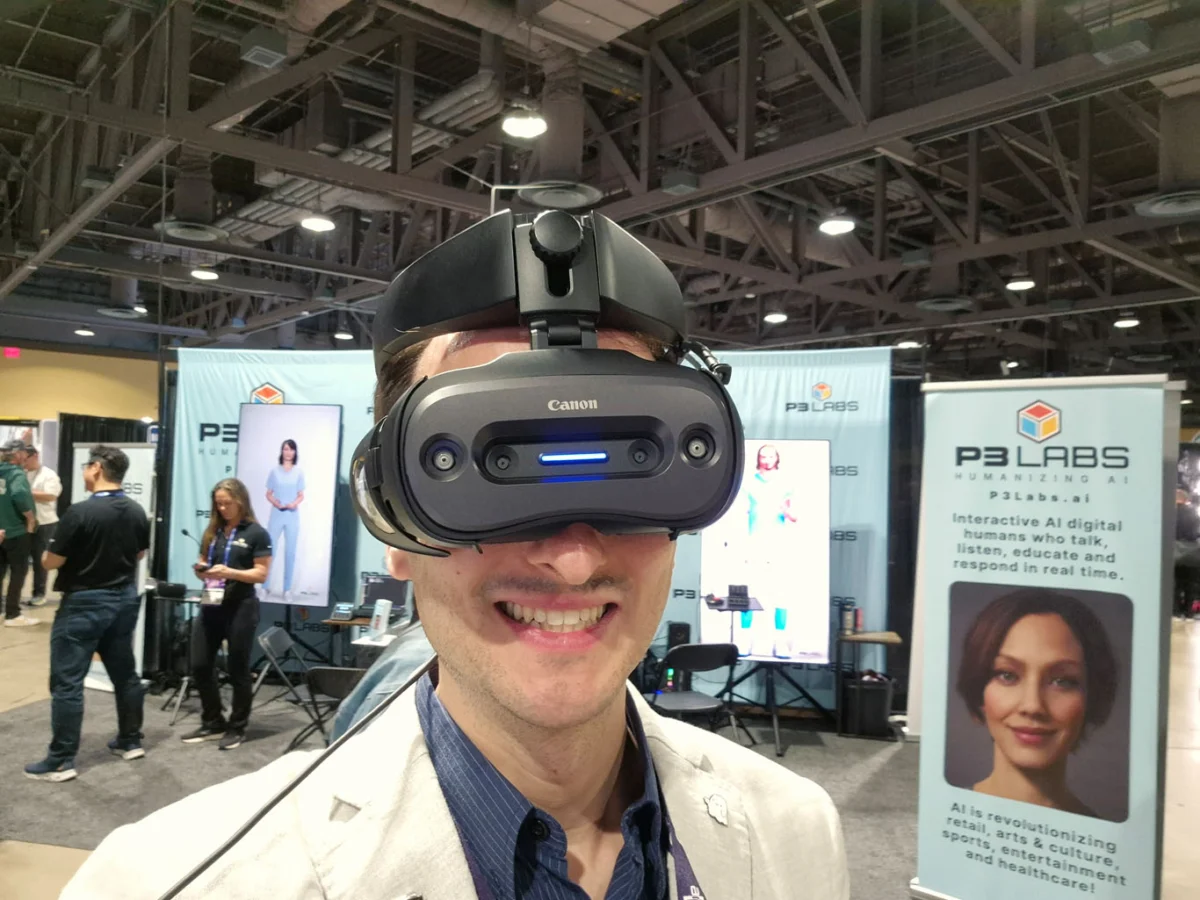
The MREAL X1 represents Canon’s current flagship for the enterprise market. Designed for long-duration professional use, the headset features a "halo" style strap and an open-periphery design. This allows the user to maintain natural peripheral vision of their actual surroundings, which is critical for safety in industrial settings where technicians must remain aware of their physical environment.
Hardware Architecture and Connectivity
A defining characteristic of the MREAL X1 is its reliance on an external interface box. The headset does not connect directly to a PC’s GPU; instead, it routes through a specialized hardware bridge that manages data throughput and ensures synchronization between the high-speed cameras and the display. This architecture, while reminiscent of earlier generations of VR hardware, is designed to prioritize the "passthrough" experience. By offloading processing and ensuring a high-bandwidth connection, Canon aims to provide a low-latency view of the real world with digital overlays that feel physically anchored.

Performance Data and Field of View
The MREAL X1 offers a resolution of 1920×2160 per eye. While the pixel density is high, the field of view is notably narrow compared to competitors, measuring 58 degrees horizontally and 60 degrees vertically. For context, the Meta Quest 3, a consumer-grade device, offers a significantly wider FOV at a fraction of the price. However, Canon argues that the MREAL X1’s value lies in its optical quality and its ability to integrate seamlessly with professional CAD (Computer-Aided Design) software.
During AWE demonstrations, the headset was used to visualize high-detail automotive models. While the pixel density provided sharp visuals, some observers noted that the tracking stability and motion blur during rapid head movements did not always align with the $20,000 price expectations. The reliance on floor markers for initial calibration further underscores Canon’s preference for controlled industrial environments over the "anywhere, anytime" flexibility of consumer AR.

Comparative Market Position and Competitive Challenges
Canon’s presence at AWE highlights a growing divide in the spatial computing industry. On one side, companies like Meta and Apple are pushing toward all-in-one, high-FOV, consumer-friendly devices. On the other, legacy optical firms like Canon are doubling down on specialized, high-cost hardware for specific professional workflows.
| Feature | Canon MREAL X1 | Varjo XR-4 (Focal Ed.) | Meta Quest 3 |
|---|---|---|---|
| Price (Approx.) | $20,000 (Kit) | $9,990+ | $499 |
| Resolution | 1920 x 2160 per eye | 3840 x 3744 per eye | 2064 x 2208 per eye |
| Horizontal FOV | 58° | 120° | 110° |
| Tracking | Marker-assisted | Inside-out / LiDAR | Inside-out |
| Target Market | Industrial/Enterprise | High-End Enterprise/Sim | Consumer/Prosumer |
The data suggests that Canon faces significant pressure from the "prosumer" market. As devices like the Quest 3 and Apple Vision Pro improve their passthrough capabilities, the justification for a $20,000 tethered system becomes increasingly tied to specific software integrations and "Made in Japan" optical reliability rather than raw hardware specifications.

Broader Implications and Future Outlook
The feedback from the AWE demonstrations suggests that while Canon’s handheld prototype is a brilliant solution for public exhibitions, its enterprise headsets like the MREAL X1 may need a significant technological refresh to remain competitive. The industry is moving toward wider fields of view and robust, markerless tracking as standard features.
However, Canon’s decision to keep its MR business strictly enterprise-focused allows it to ignore the price-sensitivity of the consumer market. For a global manufacturer, the cost of a $20,000 headset is negligible if it prevents a $200,000 mistake during the prototyping of a new vehicle or medical device. Canon’s strategy appears to be rooted in "optical integrity"—ensuring that the digital world does not distort the user’s perception of the physical world.

As Canon continues to iterate on its prototypes, the focus will likely shift toward expanding the FOV and integrating the same compact optical modules into more ergonomic, lightweight designs. For now, Canon remains a boutique player in a rapidly expanding field, offering specialized tools for an audience that values precision and reliability over mass-market appeal. The AWE showcase serves as a reminder that the future of mixed reality is not a one-size-fits-all trajectory, but a fragmented landscape of specialized hardware tailored to specific human needs.
About the Author