The landscape of Extended Reality (XR) hardware is undergoing a significant shift as startups move beyond traditional input methods toward more seamless, biological interfaces. At the VR/AR Expo China held in Shanghai this past May, Western startup Immersix unveiled a proprietary eye-tracking solution that departs from industry-standard pupil-tracking methodologies. By focusing on the internal structures of the eye rather than the exterior position of the pupil, the company aims to solve persistent issues regarding calibration drift, hardware bulk, and tracking accuracy in Mixed Reality (MR) and Virtual Reality (VR) environments.
A Paradigm Shift in Ocular Tracking
Current eye-tracking technologies, employed by industry leaders such as Tobii and integrated into premium headsets like the Apple Vision Pro and Meta Quest Pro, primarily utilize "pupil center corneal reflection" (PCCR). This method involves a ring of infrared (IR) LEDs creating glints on the cornea, which cameras then track to estimate gaze direction. While effective, PCCR systems are prone to "slippage"—a phenomenon where the tracking accuracy degrades if the headset shifts even slightly on the user’s face, often necessitating frequent recalibration.
Immersix proposes an alternative: retina tracking. Instead of monitoring the pupil’s surface movement, the Immersix system utilizes a single IR LED and a high-speed camera to look through the pupil and map the unique vascular patterns of the retina. Because the retina is a fixed biological structure that does not change over time, it provides an absolute "ground truth" for the eye’s orientation. This approach allows the system to maintain high precision even if the hardware is removed and put back on in a different position.

Technical Mechanics and Calibration Processes
The hardware footprint of the Immersix module is notably smaller than traditional arrays. By requiring only one LED per eye, the solution reduces both power consumption and the physical space required within the headset’s optical stack. This miniaturization is a critical factor for the development of lightweight Augmented Reality (AR) glasses, where internal volume is at a premium.
The implementation follows a two-stage process:
- Retinal Feature Mapping: During the initial setup, the user undergoes a calibration sequence. By following a digital pointer across a screen, the camera captures various segments of the retina. The software then stitches these segments together to create a comprehensive "feature map" or digital fingerprint of the user’s eye. This map is persistent and, according to the company, remains valid for years, barring significant medical changes to the eye.
- Active Tracking and Matching: Once the map is established, the system enters active tracking mode. The camera focuses on the specific region of the retina visible through the pupil at any given moment. A proprietary algorithm matches this visible "slice" against the stored full-retina map to determine the exact rotation of the eye with sub-degree accuracy.
Performance Data and Field Observations
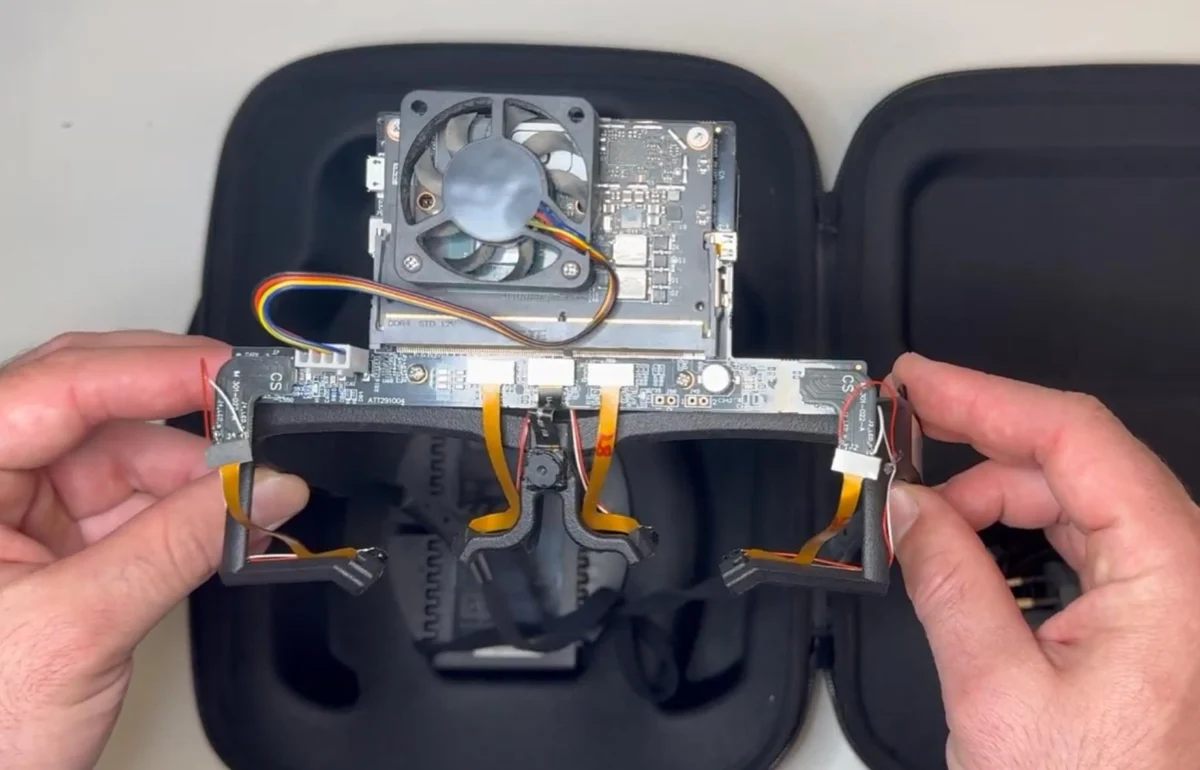
During technical demonstrations at the Shanghai expo, the technology was showcased using specialized evaluation frames. These prototypes, while not yet integrated into a consumer-ready AR headset, functioned as a developer kit (devkit) to prove the viability of the algorithm.
The calibration process observed during the event involved a "sweeping" task where the user moved a gaze-based pointer to erase a rectangular area on a laptop screen. This specific movement ensures the camera sees the lateral extremes of the retina. Following this three-to-five-minute calibration, the system demonstrated a high degree of responsiveness. In tracking tests involving a grid of interactive elements, the software consistently identified gaze targets with minimal latency.

Immersix claims the system can achieve a 120Hz refresh rate, matching the high-performance requirements of modern foveated rendering—a technique where only the area the user is looking at is rendered in high resolution to save computational power. Furthermore, the "re-wearing" tests confirmed that the system could re-acquire the gaze signal immediately after the frames were displaced, a significant improvement over current consumer-grade eye trackers that require manual re-adjustment.
Market Context and Industry Implications
The demand for robust eye tracking is surging as the XR industry moves toward gaze-centered user interfaces. According to market research, the global eye-tracking market is projected to grow at a CAGR of over 25% through 2030, driven largely by the integration of biometric sensors into wearable electronics.
For hardware manufacturers like Meta, Sony, and Pico, the Immersix solution offers three distinct advantages:
- Frictionless UX: Eliminating the need for daily calibration improves the user experience for casual consumers.
- Biometric Integration: Since the system already scans the retina, it can theoretically combine eye tracking with biometric authentication (similar to iris scanning) in a single hardware module.
- Form Factor Optimization: The reduction in LED count and the ability to work with smaller sensors could pave the way for "all-day" wearable AR glasses that look indistinguishable from standard eyewear.
Privacy and Data Security Considerations
As with any technology involving biometric data, the move toward retinal scanning raises significant privacy questions. Retinal patterns are highly sensitive biological identifiers, more unique than fingerprints. Under regulations such as the General Data Protection Regulation (GDPR) in Europe and the Biometric Information Privacy Act (BIPA) in the United States, the storage and processing of such data are strictly governed.

Industry analysts suggest that for retina-based tracking to gain mainstream acceptance, companies must ensure that all retinal mapping and matching occur locally on the device’s "Secure Enclave" or TEE (Trusted Execution Environment). By ensuring that the "retina fingerprint" never leaves the headset or reaches the cloud, manufacturers can mitigate the risks of identity theft or unauthorized biological surveillance.
Future Outlook
The introduction of retina-based tracking by Immersix marks a potential turning point in the evolution of human-computer interaction. While the technology is currently in the devkit and evaluation stage, its ability to provide stable, high-accuracy tracking without the need for repetitive calibration addresses one of the primary hurdles in XR adoption.
As Immersix begins shipping evaluation kits to global partners, the focus will shift to how well this technology integrates with existing optical engines, such as waveguides and birdbath optics. If successfully adopted by a major original equipment manufacturer (OEM), retina tracking could become the standard for the next generation of spatial computing devices, moving the industry closer to a future where digital interfaces respond as naturally as the human eye itself.
About the Author