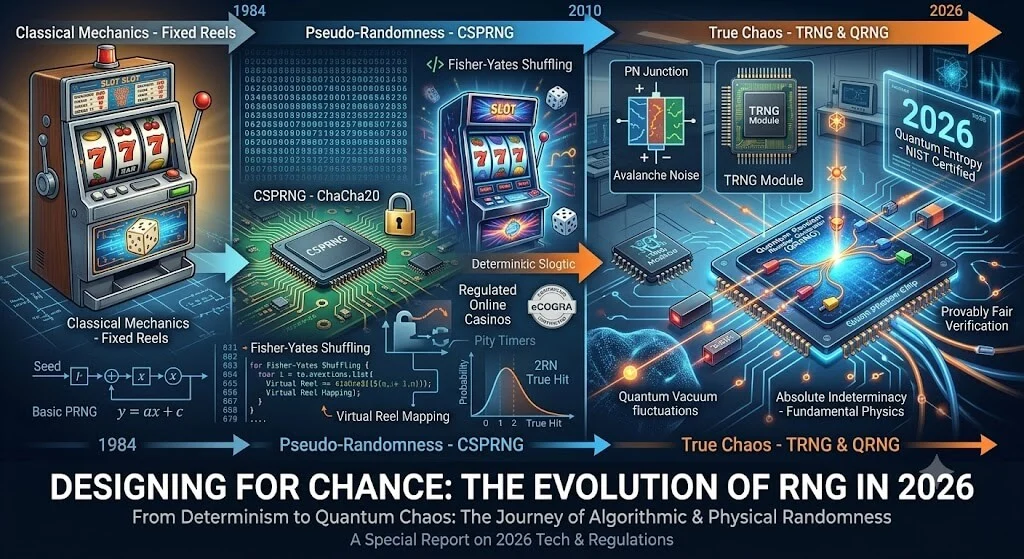
Computers, for all their formidable processing power and precision in executing complex algorithms, remain fundamentally deterministic machines when tasked with generating true unpredictability. The inherent inability of silicon to spontaneously conjure randomness presents a profound paradox at the heart of our global digital economy. From the cryptographic protocols safeguarding multi-trillion-dollar financial transactions to the intricate procedural generation that defines vast virtual worlds in modern video games, every facet of our interconnected lives relies on an artificial synthesis of chance. What the industry conventionally labels Random Number Generation (RNG) is, in practice, a sophisticated "calculated illusion," designed to mimic unpredictability rather than truly embody it. The philosophical and practical implications of this distinction are vast, influencing everything from national security to consumer psychology and the integrity of online gambling. The reality of 2026 underscores a brutal truth: the architecture of chance is inextricably linked to economic imperatives, with consumer entertainment prioritizing perceived fairness, while critical infrastructure demands mathematically unassailable and physically guaranteed entropy.
The Foundational Lie: Pseudo-Randomness Explained
At the core of most digital applications lies the Pseudo-Random Number Generator (PRNG). These are algorithms that, given an initial "seed" value, produce a sequence of numbers that appear random but are, in fact, entirely predictable. The beauty of PRNGs lies in their efficiency and speed, making them the workhorse for developers seeking "cheap, fast entropy." A seed value is fed into a mathematical formula, which then deterministically churns out a sequence of digits based on its internal state. The critical vulnerability, however, is that if an adversary gains knowledge of the initial seed, they can perfectly predict every subsequent output, effectively knowing the entire "future" of the software’s universe.
A stark illustration of this vulnerability emerged with the Mersenne Twister algorithm. Mathematically brilliant for scientific simulations and highly efficient, it was nonetheless cryptographically shattered. Researchers demonstrated that by observing just 624 consecutive 32-bit outputs, an attacker could reconstruct the algorithm’s entire internal state array, thus predicting all future outputs. This vulnerability made it unsuitable for security-sensitive applications. To patch this significant bleeding wound in digital security, the industry migrated to Cryptographically Secure PRNGs (CSPRNGs) such as ChaCha20. These algorithms employ more complex internal states, larger seed values, and sophisticated mixing functions, making it computationally infeasible to deduce the seed or future outputs even with knowledge of a substantial sequence of past outputs. Yet, the nagging ghost of determinism never truly leaves the room; at their core, CSPRNGs are still algorithms, and given enough computational power and insight, their output remains theoretically predictable.
Seeking True Entropy: The Realm of Hardware RNGs
For applications demanding absolute, unassailable unpredictability, the reliance on purely software-driven algorithms becomes untenable. True Random Number Generators (TRNGs) abandon mathematical constructs in favor of harnessing genuine physical chaos from the fabric of the universe itself. These hardware-based solutions do not ask math for a favor; they extract entropy from non-deterministic physical phenomena.
A prominent example of this approach involves exploiting "avalanche noise" within reverse-biased PN junctions of semiconductors. In this process, a semiconductor is subjected to a massive electric field, causing electrons to accelerate and violently collide with the crystal lattice. These collisions trigger an unpredictable cascade of secondary particles, generating a chaotic, jagged electrical waveform. This phenomenon can be likened to a pool slowly filling with water: pressure builds until a section of the plastic wall violently collapses, spilling out an unpredictable volume before the rim snaps back. The resulting electrical signals are genuinely random, providing the raw, physical entropy that software alone cannot replicate.
However, hardware is not without its limitations. Over extended periods, physical components degrade due to factors like temperature fluctuations and electromagnetic interference. These environmental stressors can introduce subtle biases into the entropy source, compromising its true randomness. For this reason, TRNG data is rarely fed directly into applications. Instead, architects employ a hybrid approach: the raw physical chaos generated by the TRNG is used to constantly re-seed a high-speed CSPRNG. This method effectively blends the unassailable unpredictability of physical phenomena with the throughput and efficiency of digital algorithms, ensuring both robust security and operational performance. The market for hardware-based RNGs is projected to grow significantly, driven by increasing demands for secure communication and robust cryptographic solutions in an increasingly vulnerable digital landscape.
The Psychological Play: RNG in Video Games
While cryptographic security demands absolute unpredictability, the gaming industry operates on an entirely different set of principles, often deliberately manipulating perceived randomness to enhance player engagement. Code obeys logic perfectly, but human psychology, particularly concerning probability, is far more fragile. Gamers frequently misinterpret statistical variance; missing an attack with a 90% success rate three times in a row rarely leads to an understanding of probability but rather immediate accusations of "broken code" or "unfair mechanics." Game designers recognized decades ago that pure, raw mathematical randomness could lead to frustrating streaks, driving player disengagement and churn.
To combat this, studios developed complex manipulation algorithms. The Pseudo Random Distribution (PRD) system, famously pioneered in the Warcraft III engine and now foundational to the multi-million dollar esports economy of games like Dota 2, functions as a dynamic "pity timer." For an ability with a nominal 20% trigger chance, the system doesn’t roll a flat 20%. Instead, the baseline probability starts much lower, perhaps around 5.57%. Every time the player fails the roll, a mathematical constant is added to the probability of the next attempt. This forces the odds to climb, perhaps to 11%, then 16%, deliberately compressing the variance to prevent excessively long losing streaks or game-breaking lucky runs. This psychological trick ensures that over a series of attempts, the average trigger rate converges to the advertised percentage, but individual outcomes feel "fairer" to the player.
Tactical RPGs, such as the critically acclaimed Fire Emblem franchise, push this psychological manipulation even further with the "True Hit" (or 2RN) system. Rather than relying on a single digital die roll (e.g., a 100-sided die for a percentage chance), the engine secretly rolls two numbers, averages them, and compares the mean to the displayed hit rate. This invisible mathematical adjustment creates a Bates distribution curve. So, when the user interface displays a 70% hit chance, the underlying code is secretly rolling for an 82% probability. Conversely, a displayed 30% enemy threat functionally plummets to an 18% actual chance. Studios aggressively employ these "lies" to their audiences to manage emotional volatility. Players feel violently cheated by a missed 85% shot, yet they interpret dodging a 30% strike as a testament to their pure tactical genius. This deliberate obfuscation highlights the industry’s focus on user experience over pure statistical fidelity, a strategy that has proven highly successful in cultivating long-term player bases.
High Stakes: RNG in Regulated Online Casinos
The psychological tricks employed in video games are strictly prohibited when actual money is on the line. Regulatory bodies would swiftly impose federal charges and revoke licenses if online casinos were caught modifying probability curves on the fly to engineer "near misses" or pace a game. The algorithms deployed by regulated online casinos, such as those found at Golden Nugget Casino, operate under an entirely different, heavily audited mathematical reality, where absolute integrity and verifiability are paramount.
The structural shift in casino gambling began in 1984 when Inge Telnaes patented virtual reel mapping. Historically, mechanical slot machines were constrained by their physical geometry, typically capping at 22 stops per reel. This hard physical limit made it mathematically impossible for casinos to offer massive, life-changing jackpots while maintaining a safe house edge. Telnaes’ innovation decoupled the physical display from the underlying mathematical mechanics. A modern microprocessor now runs a PRNG the exact millisecond a player hits the spin button, selecting a number from a virtual reel that can contain millions of combinations (e.g., 256³ or more). This allows for exponentially larger potential jackpots without altering the house’s statistical advantage, revolutionizing the slot machine industry.
However, the act of scaling these raw hexadecimal outputs down to a usable game board introduces its own technical nightmare: modulo bias. If a raw 32-bit integer is simply scaled down to, say, a 37-pocket digital roulette wheel using a basic division remainder, the numbers at the lower end of the wheel can possess a microscopic mathematical advantage. While seemingly insignificant, multiplying this minute mathematical glitch across tens of millions of commercial spins can cause the house to bleed millions of dollars in untracked equity. To survive the brutal GLI-19 certification audits, developers must implement strict rejection sampling. If the RNG generates a number falling within the biased remainder space, the system trashes the output entirely and draws again. Independent Testing Laboratories (ITLs) like eCOGRA routinely demand datasets of 50 million discrete draw records, meticulously analyzing them to verify that a standard deck of digital poker cards shuffles with absolute, uniform perfection, guaranteeing fairness and regulatory compliance. The global online gambling market, valued at over $60 billion annually, hinges entirely on this audited mathematical integrity.
The Betrayal of Trust: Kleptography and Inside Jobs
Blind faith in a centralized black box, particularly when it comes to randomness, has historically proven to be a catastrophic mistake. A compromised RNG acts like digital termite damage, where everything appears statistically pristine on the surface, while an attacker quietly predicts every single output from the outside.
A chilling historical precedent is the case of Ron Harris in the 1990s. Harris, an engineer auditing RNG source code for the Nevada Gaming Control Board, exploited his insider access. He wrote backdoors directly into the physical EPROMs (Erasable Programmable Read-Only Memory) of slot machines prior to their deployment. His accomplices on the casino floor then needed only to insert a hyper-specific sequence of coins into the slot machine. This bizarre sequence would trip the hidden backdoor, hijacking the PRNG and forcing the virtual reel to land precisely on the grand prize. Harris’s actions led to significant losses for casinos and underscored the critical vulnerability of physical access and insider threats to RNG integrity.
Even more disturbing are instances of state-sponsored kleptography. Government intelligence agencies have been implicated in running similar sabotage campaigns across global infrastructure. A notorious example is the NIST (National Institute of Standards and Technology) standardization of the Dual_EC_DRBG algorithm in 2006 for federal cryptography. This algorithm utilized elliptic curve mathematics based on specific, completely unexplained constants. Cryptographers Dan Shumow and Niels Ferguson eventually proved that these constants harbored a kleptographic backdoor. Edward Snowden’s later leaks unequivocally confirmed the worst fears: the U.S. National Security Agency (NSA) had engineered the mathematics and paid RSA Security millions of dollars to make it the default standard in their BSAFE security products. This backdoor allowed the agency to silently predict the internal state of the generator after observing just 32 bytes of public output, effectively owning encryption keys before the digital locks were even constructed. This scandal profoundly eroded trust in government-sponsored cryptographic standards and highlighted the grave national security implications of compromised randomness.
Towards an Unassailable Future: Provably Fair and Quantum Randomness
The industry is finally and aggressively pivoting away from blind institutional trust, driven by both technological innovation and a growing demand for transparency. Blockchain-native platforms have normalized "Provably Fair" (PF) systems over the last decade, effectively replacing server-side secrecy with cryptographic transparency. In a Provably Fair system, the operator generates a hashed server seed before a game begins. The player then provides a client seed, and a basic "nonce" tracks the iteration of each game. Once the hand or round concludes, the plaintext server seed is revealed. Anyone with a basic open-source script can then run the combination of the client seed, server seed, and nonce through a standard SHA-256 hash function to mathematically prove that the outcome was locked in before the bet was placed. This permanently breaks the "black-box" paradigm, allowing players to independently verify the fairness of results. The adoption of Provably Fair systems is a significant step towards rebuilding trust in online gaming and betting platforms.
Simultaneously, the enterprise security sector is bracing for the looming reality of practical quantum computing. Classical cryptographic frameworks, including standard PRNGs and even many CSPRNGs, will not survive an adversary armed with Shor’s algorithm, which can efficiently factor large numbers, or Grover’s algorithm, which can speed up database searches. This existential threat has spurred aggressive integration of Quantum Random Number Generators (QRNGs) directly into mobile phone architectures and cloud APIs. QRNG hardware operates by firing individual photons directly at a semi-transparent beam splitter. The fundamental, unresolvable indeterminacy of quantum physics dictates that a photon will either pass through or reflect, with no classical explanation or prediction possible. This process completely bypasses mathematical equations, ripping entropy straight from the fundamental, unresolvable indeterminacy of the quantum realm. Companies like ID Quantique are at the forefront of developing these devices, which represent the ultimate defense against deterministic attacks. The global QRNG market is projected to reach over $100 million by 2027, underscoring its critical role in the post-quantum era.
The Road Ahead: Securing Our Digital Destiny
The old paradigm of relying on chaotic algorithms to simulate chance is rapidly dying. As adversaries acquire enough computational power to reverse-engineer virtually any mathematical construct, the only viable defense is to leverage the fundamental physical laws of the universe itself. The future of digital chance is no longer about mimicking unpredictability through clever algorithms; it is about forcing the universe to guarantee absolute entropy at the subatomic level. This shift represents a profound evolution in our understanding and application of randomness, moving from an engineered illusion to an intrinsic, verifiable property of reality. The ongoing quest for genuine unpredictability will continue to shape the contours of cybersecurity, online commerce, gaming, and the very trust we place in our digital interactions, securing our digital destiny in an increasingly complex and interconnected world.
About the Author