Canon Inc. utilized the 2026 Augmented World Expo (AWE) to demonstrate its latest advancements in the mixed reality (MR) sector, showcasing a strategic dual-path approach that includes both a highly compact handheld prototype and the established MREAL X1 enterprise headset. The exhibition highlighted Canon’s ongoing commitment to the industrial and professional sectors of the extended reality (XR) market, prioritizing specific enterprise use cases over the broader consumer gaming and entertainment industries. As the XR landscape continues to evolve with the entry of high-fidelity devices from competitors such as Apple and Varjo, Canon’s presence at AWE provided a critical look at how the veteran imaging company intends to maintain its niche in a rapidly maturing market.

The Compact MR Prototype: A Handheld Approach to Frictionless Interaction
One of the most notable displays at the Canon booth was a ultra-compact mixed reality prototype designed for temporary, high-frequency use. Unlike traditional head-mounted displays (HMDs) that require straps and careful fitting, this device consists essentially of an optical module mounted on a handle. This "handheld" form factor is a deliberate departure from the standard industry trajectory toward wearable glasses, aiming instead at sectors where user turnover is high and setup time must be minimized.
The device is currently positioned as a solution for public installations, such as museum exhibits, showrooms, and educational kiosks. In these environments, the requirement to adjust straps and provide technical instructions to every visitor often creates a bottleneck. Canon’s prototype solves this by allowing users to simply raise the device to their eyes, view the augmented content, and set it back down for the next participant.

Technically, the prototype remains in a developmental stage. It currently lacks internal computation units, necessitating a tethered connection to a PC or a high-end mobile workstation. The current specifications include a Full HD resolution and a field of view (FOV) estimated at approximately 50 degrees. While these specs are modest compared to modern VR standards, Canon representatives indicated that the prototype serves as a proof of concept for their modular optical technology, which may eventually be integrated into more traditional wearable formats. Furthermore, the current iteration relies on marker-based tracking—using physical QR-style codes to anchor 3D objects—a method that, while stable, is increasingly being replaced by inside-out SLAM (Simultaneous Localization and Mapping) tracking in competing devices.
The Canon MREAL X1: High-Investment Enterprise Hardware
In addition to the experimental prototype, Canon showcased the MREAL X1, the current flagship of its enterprise-grade mixed reality lineup. The MREAL X1 is the successor to the MREAL S1, which was notable for its staggering entry price of nearly $38,500. The X1 represents a move toward relative affordability within the high-end industrial space, with a full system package—including the headset, a dedicated interface box, and a calibrated workstation—retailing for approximately $20,000.

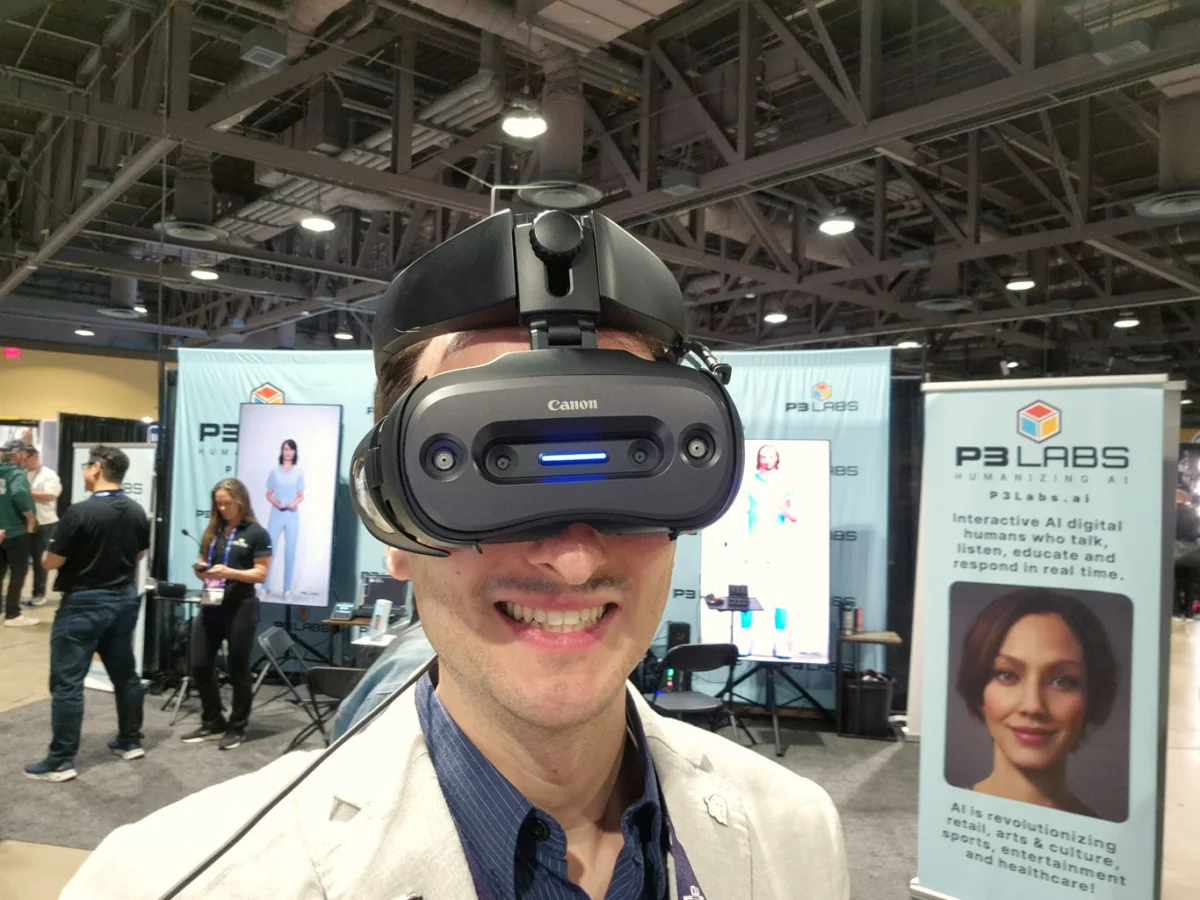
The MREAL X1 utilizes a video see-through (VST) architecture, similar to the Meta Quest 3 or the Apple Vision Pro, but with a design philosophy geared toward industrial safety and peripheral awareness. The headset features a flat front module and an open-periphery design, allowing the wearer to maintain natural situational awareness of their physical surroundings. For tasks requiring higher immersion, the device includes optional lateral blinders.
The technical specifications of the MREAL X1 include:

- Resolution: 1920 x 2160 pixels per eye.
- Field of View: 58 degrees horizontal by 60 degrees vertical.
- Connectivity: Tethered via a proprietary interface box to a high-performance laptop.
- Mounting: A halo-style strap system with multi-point adjustments for ergonomic fit.
Despite its high price point, the X1’s hardware reflects its 2022 launch window. The resolution and field of view are now surpassed by consumer-grade hardware costing a fraction of the price. However, Canon argues that the value of the MREAL system lies in its integration with professional CAD software and its ability to render high-fidelity digital twins for automotive and architectural engineering.
Chronology and Evolution of the Canon MREAL Line
Canon’s involvement in mixed reality is not a recent development. The company has been a pioneer in the "MR" nomenclature since the early 2010s.

- 2012-2013: Canon launched its first MREAL systems, which were among the first to successfully merge high-resolution video pass-through with computer-generated imagery for industrial design.
- 2020-2021: The release of the MREAL S1 marked a significant reduction in the size of the hardware, moving from bulky, helmet-like devices to a more compact, mobile-friendly form factor.
- 2022-Present: The MREAL X1 was introduced to provide a wider FOV than the S1 while lowering the barrier to entry for small-to-medium enterprises (SMEs).
The current presence at AWE 2026 suggests that Canon is in a transitional phase. While the X1 remains the commercial standard for the company, the development of the handheld prototype indicates a search for new utility in the enterprise sector that avoids direct competition with the "all-in-one" standalone headsets dominating the current market.
Technical Analysis and Market Comparison
Industry analysts at AWE noted that Canon’s hardware faces significant pressure from the "prosumer" and high-end enterprise sectors. When compared to the Varjo XR-4, which offers a 120-degree FOV and nearly 4K-per-eye resolution at a similar price point, the MREAL X1 appears dated. Technical assessments of the X1 during the expo highlighted issues with motion blur during rapid head movements and a visible lag in the pass-through feed, which can contribute to vestibular discomfort.

The reliance on an external "interface box" between the headset and the PC is another point of contention. While this box likely handles signal processing and ensures data integrity for high-bandwidth video, it adds a layer of "cable clutter" that modern "WiFi 6E" or "Thunderbolt" tethered headsets have largely eliminated.
However, market expert Karl Guttag has previously noted that while the combination of features and price in the MREAL line can be perplexing to general tech observers, Canon’s strength lies in its optics and its established relationships within the Japanese manufacturing sector. For specific assembly-line simulations and high-precision engineering tasks, the MREAL ecosystem offers a level of software stability and professional support that consumer-facing companies often lack.

Broader Impact and Future Outlook
The implications of Canon’s latest demonstrations are twofold. First, the handheld prototype suggests that there is a growing market for "ambient" or "casual" XR—experiences that do not require the commitment of wearing a headset. This could open doors for XR in retail, tourism, and public education where hygiene and ease of use are paramount.
Second, the aging specs of the MREAL X1 highlight a looming crisis for "legacy" XR providers. As the performance gap between $500 consumer headsets and $20,000 enterprise headsets closes, companies like Canon must innovate rapidly in optics and sensor fusion to justify their premium pricing. Canon representatives at the event confirmed that they are exploring the use of their new, smaller optical modules for future wearable headsets, suggesting that a successor to the X1 may be in development with a focus on significantly reducing the device’s footprint.

Ultimately, Canon’s strategy appears to be one of specialization. By focusing on the unique needs of museums with handheld units and the specific requirements of heavy industry with the MREAL line, the company is attempting to bypass the "platform wars" between Meta, Apple, and Google. Whether this niche strategy can survive the rapid commoditization of high-end VR hardware remains a critical question for the company’s 2027 outlook.
About the Author