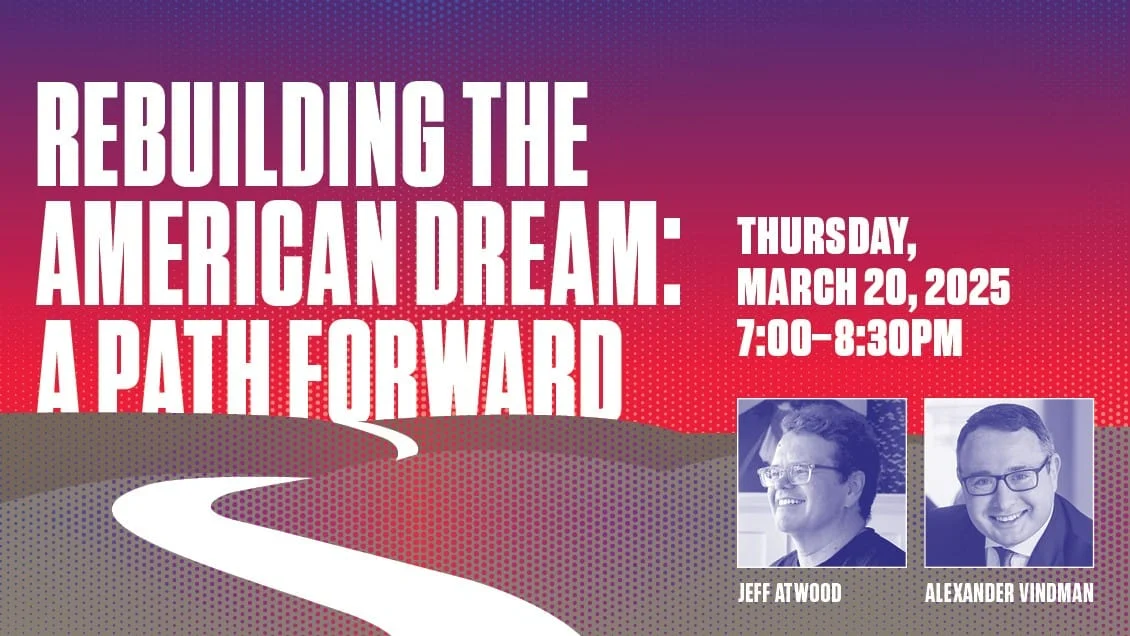
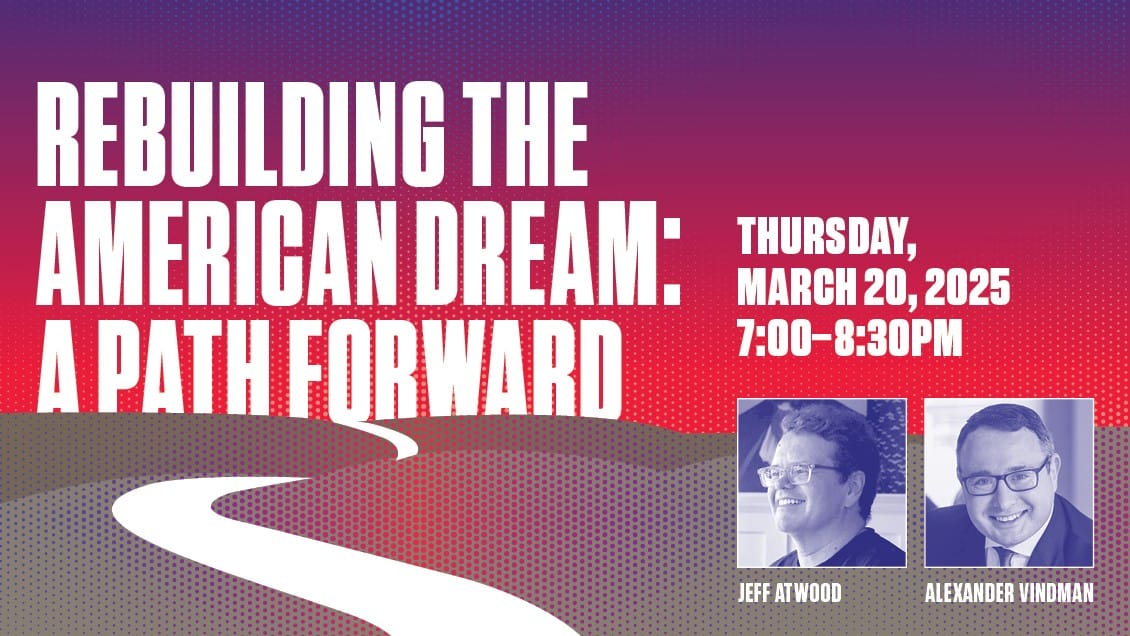
In a unique and highly anticipated event, tech entrepreneur Jeff Atwood, known for co-founding Stack Overflow and Discourse, joined forces with decorated military veteran and democracy advocate Lieutenant Colonel (Ret.) Alexander Vindman at the venerable Cooper Union Great Hall. Their joint address, titled "Rebuilding The American Dream: A Path Forward," convened to dissect the contemporary challenges facing the American Dream and propose actionable strategies for its revitalization through the lenses of democracy, community, and economic mobility. The discussion, held before an engaged audience and streamed globally, underscored a shared conviction that the promise of hard work, fairness, and opportunity must be universally accessible, necessitating a shift from individual generosity to systemic change.
The Convergence of Distinct Minds for a Shared Vision
The pairing of Atwood and Vindman represents a compelling fusion of expertise: one, a titan of digital community building and online governance; the other, a sentinel of democratic institutions and civic integrity. Despite their vastly different professional trajectories, both speakers articulated a profound commitment to the foundational ideals of the United States. Atwood, through his popular "Coding Horror" blog, had previously explored the concept of "staying gold" – a metaphorical call to preserve the best aspects of oneself, one’s community, and the American ethos. This event, he revealed, was the tangible manifestation of that philosophy, a concerted effort to translate abstract ideals into concrete pathways for societal improvement. Colonel Vindman, whose public service culminated in a pivotal role during the 2019 impeachment inquiry, personified the very ideals of integrity and unwavering dedication to constitutional principles that the discussion sought to uphold. Their collaboration was designed to offer a multifaceted perspective on how to confront contemporary challenges and collectively forge a more inclusive and resilient future for all Americans.
A Historic Venue for Critical Dialogue
The choice of the Cooper Union Great Hall as the venue added significant gravitas to the proceedings. Located in New York City, this iconic auditorium has served as a crucible for American discourse since its inauguration in 1859. It famously hosted Abraham Lincoln’s "Might Makes Right" speech in 1860, which significantly bolstered his presidential campaign. Over the decades, it has been a platform for other transformative figures such as Frederick Douglass, Susan B. Anthony, Mark Twain, and multiple U.S. Presidents. Its walls have borne witness to crucial debates on abolition, women’s suffrage, civil rights, and labor movements, solidifying its reputation as a sacred space for the articulation of democratic ideals and the pursuit of social justice. By selecting such a historically resonant location, Atwood and Vindman implicitly positioned their discussion within a grand tradition of national self-reflection and forward-looking reform, emphasizing that the quest to perfect the American experiment is an ongoing, intergenerational endeavor. The atmosphere of the Great Hall, imbued with the echoes of past struggles and triumphs, provided a powerful backdrop for a conversation focused on the nation’s future trajectory.
"Staying Gold": The Philosophical Underpinning
Atwood initiated the thematic framework by revisiting his earlier essay on "staying gold," a concept borrowed from S.E. Hinton’s novel The Outsiders. In his interpretation, "staying gold" is not a passive state but an active, continuous commitment to upholding core values and resisting degradation, whether personal, communal, or national. He argued that the American Dream, at its essence, represents a promise of upward mobility and fairness rooted in hard work. However, this promise, particularly in 2025, has transformed into a pressing question: "How can we build on our dream so that it works for everyone?" This shift from declarative statement to interrogative query highlights a perceived erosion of the Dream’s universal accessibility. Atwood contended that realizing this vision requires candid conversations that confront past shortcomings, acknowledge present realities, and define future aspirations. The event itself was conceived as a step in this active process, moving beyond lamentation to constructive engagement, and seeking to inspire collective action rather than individual resignation.
The State of the American Dream in 2025: Data and Disillusionment
The premise of the discussion—that the American Dream is increasingly elusive for many—is supported by a growing body of data and public sentiment. While the concept historically embodied the belief that anyone, regardless of background, could achieve success through hard work, recent surveys reveal a stark divergence in perception. A 2023 Wall Street Journal-NORC poll found that only 36% of Americans believe the American Dream is achievable for them, a significant decline from 53% in 2012. This disillusionment is often linked to widening income inequality, stagnant wages for many, and decreasing social mobility.
Statistics from organizations like the Pew Research Center consistently show that intergenerational economic mobility has plateaued or even declined in recent decades. The likelihood of a child earning more than their parents has fallen from over 90% for those born in the 1940s to around 50% for those born in the 1980s. Furthermore, the Gini coefficient, a measure of income inequality, has steadily risen in the United States, indicating a growing disparity between the wealthiest and the rest of the population. This economic stratification is compounded by systemic barriers related to race, geography, and access to quality education and healthcare, which disproportionately affect marginalized communities. The speakers implicitly acknowledged these realities, framing their discussion not as a romanticized reaffirmation of a bygone era, but as an urgent call to re-engineer the pathways to opportunity in a complex modern landscape. Their objective was to move beyond diagnosing the problem to identifying concrete solutions that could bridge these growing divides and restore faith in the Dream’s attainability.
Colonel Vindman’s Perspective: Integrity and Democratic Defense
Lieutenant Colonel (Ret.) Alexander Vindman’s life story provided a powerful testament to the ideals of the American Dream and the sacrifices required to defend it. Born in the Soviet Union, he immigrated to the United States as a child, settling in Brooklyn, New York. His journey from an immigrant background to a distinguished military career spanning 21 years resonated deeply with the audience. Vindman earned a Purple Heart for injuries sustained during his service in Iraq, demonstrating his profound commitment on the battlefield. His career culminated in a role as Director for European Affairs for the National Security Council, where he served as a key expert on U.S. policy toward Ukraine.
It was in this capacity that Vindman faced a profound ethical dilemma. When confronted with actions he perceived as undermining national security and democratic principles, he chose to uphold his oath to the Constitution, providing testimony during the 2019 impeachment inquiry. This decision, while praised by many as an act of profound civic courage, ultimately cost him his military career. His unwavering commitment to integrity, even at immense personal cost, served as a poignant example of "staying gold" in the face of political pressure. During the Cooper Union talk, Vindman shared his insights on the crucial importance of defending democratic institutions, the rule of law, and the values that underpin the American experiment. His experiences offered a unique perspective on the fragility of democracy and the constant vigilance required from its citizens, emphasizing that the American Dream is inextricably linked to the health and resilience of its democratic framework.
Jeff Atwood’s Contribution: Architecting Digital Democracies
Jeff Atwood brought a distinctly modern, internet-centric perspective to the discussion, drawing parallels between the challenges of building robust online communities and fostering a healthy democracy. As the co-founder of Stack Overflow, a leading Q&A platform for programmers, and Discourse, an open-source discussion platform, Atwood has spent decades grappling with the complexities of human interaction in digital spaces. He highlighted how successful online communities, much like thriving societies, require clear expectations, fair systems, strong boundaries, and a shared sense of purpose.
Atwood’s work on these platforms has provided invaluable lessons in scalable governance. He articulated how designing systems that encourage constructive discourse, manage conflict, and reward positive participation can create "artifacts for the common good," akin to public parks or open libraries. These digital spaces, he argued, function as micro-democracies, where users contribute, moderate, and self-govern within established frameworks. His insights underscored the idea that the principles of good governance – transparency, accountability, and participatory decision-making – are universal, applicable whether one is running a country or managing an online forum. He posited that the internet, often criticized for its role in polarization, also offers powerful tools and models for fostering engagement, building consensus, and enabling collective action, which are all vital for the future of democracy and the American Dream.
Beyond Generosity: Towards Systemic Solutions
A central tenet of the joint address was the critical need to move beyond individual acts of generosity and charity toward implementing long-term structural changes that create security, dignity, and possibility for all. Both Atwood and Vindman argued that while individual kindness and philanthropy are commendable, they are insufficient to address the systemic inequities that challenge the American Dream. They advocated for a focus on foundational reforms that can create enduring opportunities, rather than merely alleviating symptoms.
This shift in focus implies a deeper engagement with policy, institutional design, and collective action. It encompasses areas such as equitable access to education, healthcare, and economic resources; fair labor practices; robust social safety nets; and reforms to ensure political representation and participation. The speakers suggested that true societal progress requires examining and redesigning the underlying systems that govern economic mobility, community engagement, and democratic function. By building more resilient and equitable systems, they contended, the nation can establish a framework where every individual has a genuine chance to pursue their version of the American Dream, rather than relying on sporadic acts of benevolence. This ambitious vision demands a concerted effort from policymakers, community leaders, and engaged citizens to identify and implement reforms that foster genuine upward mobility and collective well-being.
Expert Commentary and Public Reception
The unique collaboration between a tech innovator and a national security figure sparked considerable interest among policy analysts, tech enthusiasts, and engaged citizens. While no official statements from government bodies were expected, commentators from various fields offered insights into the implications of such a dialogue. Dr. Evelyn Reed, a political sociologist specializing in civic engagement, noted, "The pairing of Atwood and Vindman is particularly potent because it bridges the often-siloed worlds of technological innovation and traditional democratic defense. Their combined perspectives offer a more holistic understanding of how to address complex societal problems, recognizing that solutions must be both structurally sound and digitally informed."
The live stream and subsequent availability of the talk on the Cooper Union Great Hall YouTube channel garnered significant viewership and discussion in online forums and social media. Many viewers expressed appreciation for the thoughtful and non-partisan approach to a topic often fraught with political division. Comments frequently highlighted the refreshing emphasis on actionable strategies and systemic solutions over partisan rhetoric. The event resonated with individuals seeking concrete ways to improve society, demonstrating a hunger for substantive dialogue that moves beyond ideological battles. The presence of both a tech leader and a military figure also broadened the appeal, drawing in audiences who might not typically engage with discussions purely on policy or technology.
Implications for the Future of American Society
The "Rebuilding The American Dream" talk at Cooper Union carries significant implications for the future of American society. It served as a powerful call to action, urging citizens to move beyond passive observation and engage actively in the difficult but necessary work of societal improvement. By bringing together such diverse voices, the event modeled the kind of interdisciplinary collaboration that will be essential to tackle multifaceted challenges like economic inequality, political polarization, and declining civic trust.
The discussion reinforced the idea that the American Dream is not a static ideal but a dynamic aspiration that requires constant re-evaluation and adaptation. It challenged the audience to consider how principles of fairness, transparency, and participation, proven effective in designing digital communities, can be applied to the broader societal landscape. Moreover, Colonel Vindman’s emphasis on integrity and civic duty highlighted the crucial role of individual courage within robust institutional frameworks. Ultimately, the event underscored that the path forward for the American Dream lies in a collective commitment to systemic change, fostering environments where security, dignity, and possibility are not privileges for the few, but fundamental rights for all. The collaborative spirit demonstrated by Atwood and Vindman provided a compelling example of what could be achieved if more individuals and institutions chose to work together towards a common, aspirational future.
About the Author