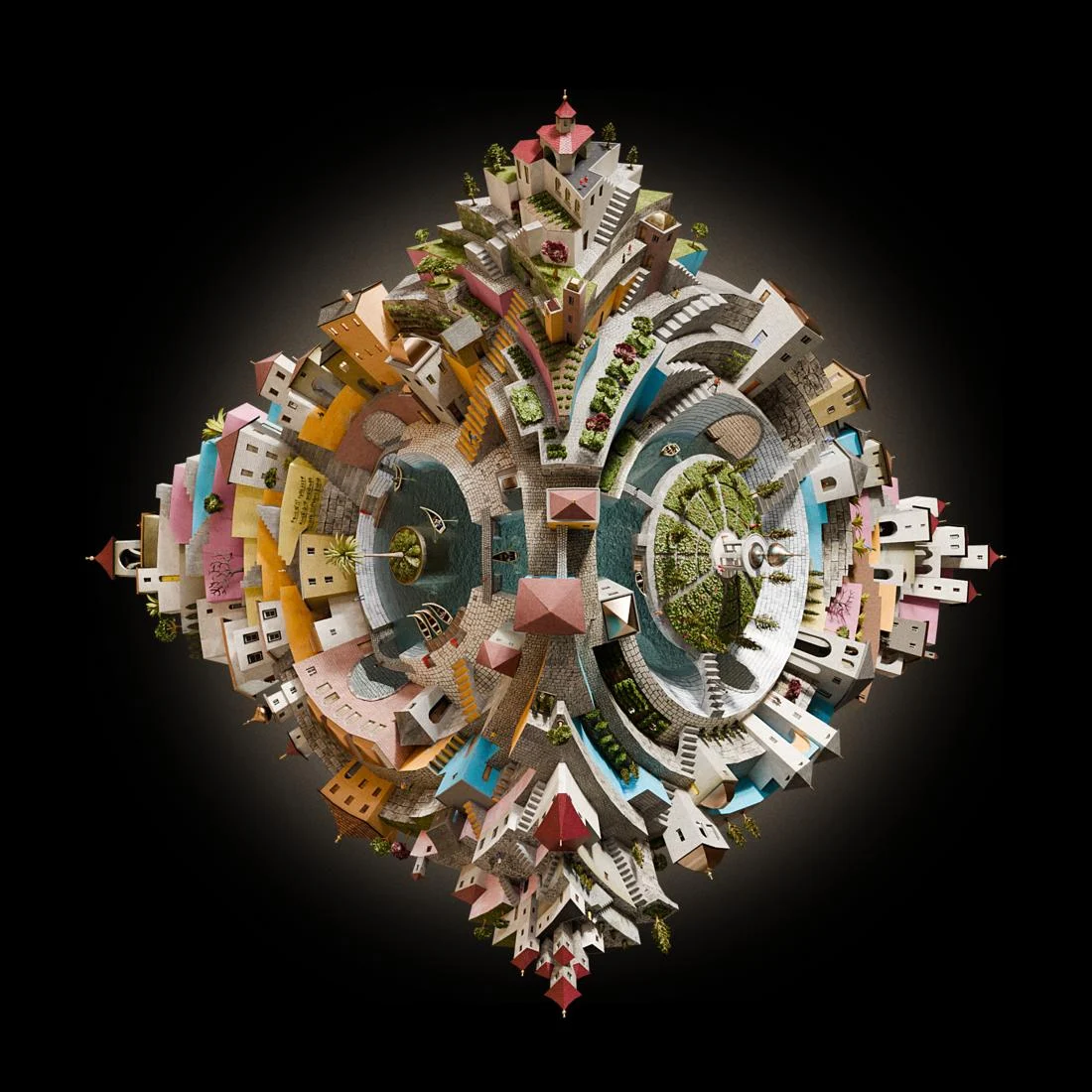
The digital art community is buzzing this week following the unveiling of a remarkable 3D rendering project, "The Tetrahedral Planetoid," inspired by the iconic impossible constructions of M.C. Escher. This intricate artwork, a testament to the creative potential unlocked by advanced 3D modeling software, was prominently featured on BlenderNation, a leading online platform for Blender users and enthusiasts. The piece, submitted by an artist whose identity has not yet been publicly disclosed but whose work has garnered significant attention on the Blender Artists forum, showcases a complex geometric structure that seems to defy conventional physics, much like Escher’s celebrated lithographs and woodcuts.
Genesis of an Impossible Geometry
M.C. Escher, a Dutch graphic artist renowned for his mathematically inspired woodcuts, lithographs, and mezzotints, created a body of work that explored themes of infinity, tessellation, impossible constructions, and the contemplation of symmetry. His ability to translate abstract mathematical concepts into visually arresting images has captivated audiences for decades. "The Tetrahedral Planetoid" appears to draw heavily from Escher’s fascination with polyhedra and his penchant for depicting structures that exist in a perpetual state of visual paradox. While Escher himself did not create a specific piece titled "The Tetrahedral Planetoid," the artwork directly evokes the spirit and visual language of his most famous works, such as "Belvedere" and "Waterfall," where architectural elements twist and turn in ways that challenge our perception of gravity and spatial logic.
The emergence of such a project within the Blender community is not unexpected. Blender, a free and open-source 3D creation suite, has become an indispensable tool for artists, animators, and designers worldwide. Its capabilities extend from modeling and sculpting to rendering, animation, visual effects, and game development. The platform’s accessibility and continually evolving feature set have fostered a vibrant ecosystem of creativity, allowing artists to realize increasingly ambitious and complex visions. The Blender Artists forum, as highlighted by BlenderNation’s weekly features, serves as a crucial incubator for talent, a space where artists can share their progress, receive feedback, and gain exposure.
The Technical Prowess of "The Tetrahedral Planetoid"
The visual complexity of "The Tetrahedral Planetoid" suggests a sophisticated understanding of 3D modeling techniques. Achieving the seamless integration of interlocking geometric forms, the precise manipulation of light and shadow to enhance the illusion of impossible architecture, and the creation of a cohesive and atmospheric scene all point to a high level of skill. Artists working with software like Blender often employ a combination of techniques, including polygonal modeling, sculpting, procedural texturing, and advanced rendering engines.
The rendering itself would likely have involved significant computational resources. Modern 3D rendering, especially for photorealistic or highly stylized imagery, can require hours, if not days, of processing time, depending on the complexity of the scene, the resolution of the output, and the chosen rendering engine. Blender offers two primary built-in renderers: Eevee, a real-time render engine that provides near-instantaneous feedback, and Cycles, a physically based path tracer that delivers highly realistic results but requires more rendering time. The quality of "The Tetrahedral Planetoid" suggests that Cycles, or a similar advanced rendering solution, was likely employed to achieve its depth and intricate detail.
Community Reaction and Emerging Trends
The showcasing of "The Tetrahedral Planetoid" on BlenderNation is part of a long-standing tradition of highlighting exceptional community contributions. Bart, the editor of BlenderNation and a veteran of the Blender community with a history dating back to its early days and its open-sourcing, has consistently curated and amplified the work of talented individuals. This weekly spotlight serves not only as recognition for the artists but also as an inspiration for others within the community.

The positive reception to "The Tetrahedral Planetoid" within the Blender Artists forum and on social media platforms underscores a growing interest in art that blends mathematical principles with artistic expression. This trend is observable across various digital art disciplines, from generative art and algorithmic design to architectural visualization and abstract 3D art. Escher’s enduring influence, combined with the democratizing power of digital tools, is enabling a new generation of artists to explore these complex themes with unprecedented fidelity and creative freedom.
Data and Contextual Analysis
While specific data on the creation of "The Tetrahedral Planetoid" is limited due to the artist’s anonymity, the broader context of the Blender community provides valuable insights. The Blender Artists forum, as of late 2026, hosts millions of registered users and sees tens of thousands of new posts and replies daily. This level of activity signifies a robust and continuously growing community. The Blender Foundation, the non-profit organization behind the software, reported significant growth in user engagement and contributions following major updates and successful crowdfunding campaigns, such as the one that led to the open-sourcing of Blender in the early 2000s. This consistent development and community support have propelled Blender to become a leading software in the 3D industry, competing with proprietary solutions.
The success of projects like "The Tetrahedral Planetoid" also highlights the evolving role of digital artists. They are no longer solely creators of static images or animations; they are often skilled technologists who leverage complex software to translate abstract ideas into tangible digital realities. The ability to understand and implement principles of geometry, physics, and visual perception is becoming increasingly crucial.
Potential Implications and Future Trajectories
The continued exploration of impossible geometries and mathematically inspired art within the digital realm has several implications. Firstly, it pushes the boundaries of visual storytelling and artistic expression. Artists are finding new ways to engage audiences by presenting them with paradoxes and visual puzzles that stimulate curiosity and contemplation.
Secondly, such projects often serve as informal benchmarks for software development and artistic technique. The challenges encountered in creating intricate and mathematically precise 3D models can drive innovation in software features, rendering algorithms, and workflow optimization. Artists experimenting with complex forms often contribute to discussions and feature requests that shape the future development of tools like Blender.
Furthermore, the intersection of art and mathematics, exemplified by "The Tetrahedral Planetoid," has potential applications beyond the purely aesthetic. Concepts explored in these artworks can inform fields such as architectural design, where understanding complex spatial relationships is paramount, or in the development of educational tools that aim to make abstract mathematical concepts more accessible and engaging. The ability to visualize complex mathematical structures in three dimensions can aid in research and problem-solving across various scientific disciplines.
As digital art continues to mature, the fusion of artistic vision with technical mastery, often inspired by historical masters like M.C. Escher, will undoubtedly lead to even more groundbreaking and thought-provoking creations. The ongoing contributions from the Blender community, amplified by platforms like BlenderNation, ensure that these artistic frontiers will continue to be explored and expanded upon, offering the world new perspectives on reality, perception, and the boundless potential of digital creativity. The future of digital art appears to be one where the impossible becomes not only visually plausible but also a source of profound artistic exploration and intellectual engagement.
About the Author