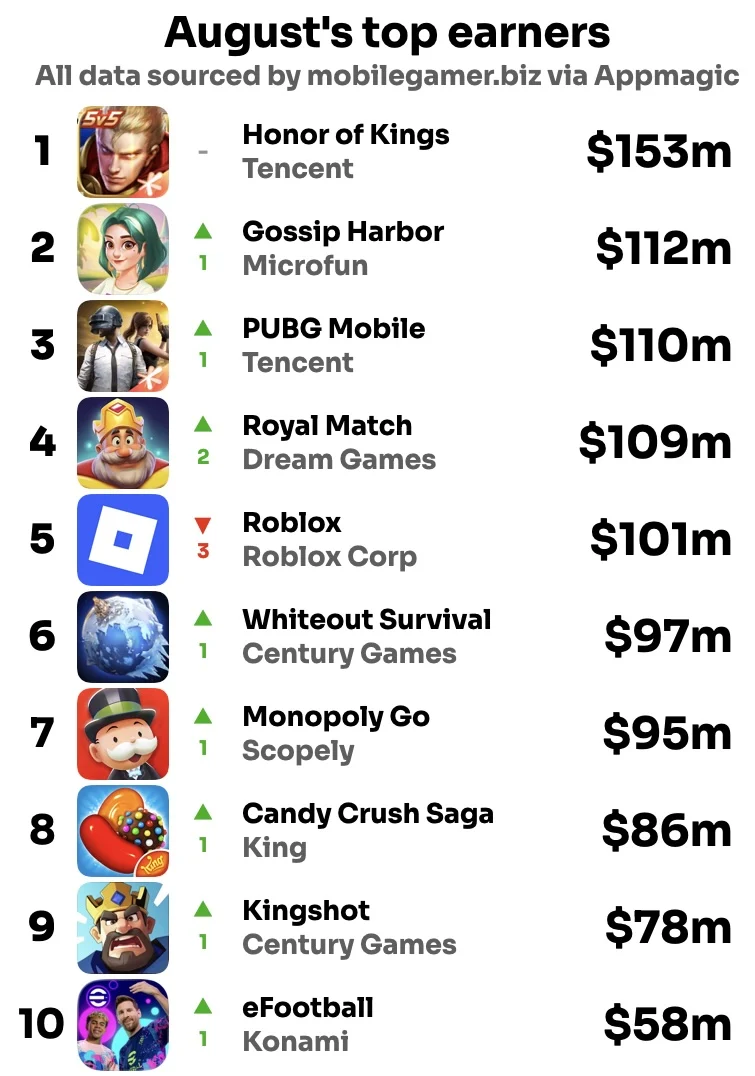
The global mobile gaming market witnessed a significant reshuffling of its top earners in August, as veteran titles demonstrated renewed resilience and emerging hits reached unprecedented financial milestones. According to the latest data from market intelligence firm Appmagic, the industry saw a return to form for several high-profile franchises, even as shifting player preferences and platform-level economic changes continued to influence the rankings. These estimates, which focus exclusively on in-app purchase (IAP) revenue, exclude advertising earnings, external web shop expenditures, the standard 30% platform fees collected by Apple and Google, and revenue generated from China’s fragmented third-party Android ecosystem.
Honor of Kings Reclaims Dominance in a Competitive Top Five
Tencent’s flagship MOBA, Honor of Kings, re-established its position at the pinnacle of the global charts, surpassing the $150 million monthly revenue mark. This recovery follows a period of relative volatility in June, where the title saw a temporary dip in spending. The rebound underscores the enduring appeal of the game in its primary Chinese market and its successful efforts to maintain player engagement through seasonal events and high-value cosmetic releases. Honor of Kings remains the benchmark for mobile monetization, maintaining a substantial lead over its closest competitors.
The most notable movement in the top tier came from Microfun’s Gossip Harbor. The merge-puzzler achieved a historic milestone by securing the second spot, generating an estimated $112 million in IAP revenue. This represents the game’s best-ever monthly performance, signaling a broader trend in the industry where "merge" mechanics are increasingly rivaling traditional "match-3" games for dominance in the casual sector. Gossip Harbor’s ascent is particularly impressive given its steady, albeit occasionally fluctuating, growth trajectory since early 2024.
Rounding out the top five, PUBG Mobile and Royal Match both experienced month-on-month growth, effectively leapfrogging Roblox. All titles in the top five bracket successfully cleared the $100 million revenue threshold, illustrating a concentrated accumulation of wealth among the industry’s elite "unicorn" titles. While Roblox saw a marginal dip in IAP revenue, analysts note that the platform’s overall health remains robust, as IAP figures often do not capture the full extent of its creator-driven economy.

Strategic Shifts and the Decline of Previous Market Leaders
The August data revealed a concerning trend for Whiteout Survival, developed by Century Games. The title has now recorded its fifth consecutive month of declining IAP earnings. Since reaching a peak of nearly $115 million in March, the game has steadily dropped to approximately $97 million in August. This cooling of player spending suggests that the initial surge of the survival-strategy genre may be reaching a saturation point, or that competition from newer entries is beginning to erode its core user base.
Similarly, Scopely’s Monopoly Go reported $95 million in August IAP revenue. While this marks the game’s strongest performance since January, it remains significantly below the $110 million to $130 million monthly figures seen during its peak in the latter half of 2025. However, industry experts caution that Monopoly Go’s IAP figures may be misleadingly low. Scopely has been a pioneer in directing players toward its proprietary web shop, allowing the developer to bypass the 30% commission charged by the Apple App Store and Google Play Store. Consequently, the total consumer spend on the franchise likely remains much higher than the IAP-only data suggests.
King’s Candy Crush Saga also showed signs of recovery following a sharp decline in June. The legendary puzzler generated $86 million in August, though it has yet to return to the $95 million monthly average it maintained throughout the first half of 2026. The volatility in Candy Crush’s earnings highlights the challenges even established titans face in maintaining consistent monetization in an increasingly crowded marketplace.
The Mid-Tier Landscape: Volatility and Anniversary Normalization
The rankings for positions 11 through 20 showcased a mix of dramatic falls and regional surges. The most prominent decline was observed in LastWar: Survival Game. Once a top-five mainstay, the title earned $56.7 million in August, marking its lowest revenue performance since its initial scaling phase in early 2024. This represents a precipitous drop from the $130 million to $150 million range the game commanded between late 2024 and early 2025. The decline of LastWar serves as a case study in the rapid lifecycle of "hyper-casual-to-midcore" hybrids that rely heavily on aggressive user acquisition.
In contrast, Konami’s eFootball saw its revenue normalize at $58 million after a record-breaking July. The previous month’s $69 million surge was largely attributed to global football fever and specific high-profile tournament tie-ins. Despite the month-on-month drop, the title remains a dominant force in the sports category, consistently outperforming its rivals in the mobile space.

Pokémon Go also experienced a predictable "anniversary hangover." Following its 10th-anniversary celebrations in July, which drove massive spikes in player spending, IAP earnings halved in August to a more standard $50.2 million. This return to baseline is typical for Niantic’s location-based hit, which relies on major seasonal events to drive revenue peaks.
Regional Outliers and the Rise of Specialized Titles
August proved to be a lucrative month for several titles with strong regional ties. Aniplex’s Fate/Grand Order surged 31 places in the rankings to hit 16th spot, fueled by a resurgence in spending among its dedicated Japanese player base. The game’s ability to generate $40.4 million years after its initial release speaks to the power of high-quality IP and deep "Gacha" mechanics in the Asian market.
Tencent’s mobile adaptation of Valorant also made significant waves. Operating exclusively in China, the iOS version of the tactical shooter pulled in nearly $38 million. Analysts suggest that if the game were to see a full global release or have its Android revenue in China fully accounted for, it would likely challenge the top five.
Outside the immediate top 20, two titles showed significant upward momentum:
- Pokémon TCG Pocket: The digital card game climbed 12 places to reach nearly $30 million in revenue.
- Hololive Dreams: Developed by QualiArts, this idol-themed title rose 14 places to hit $29 million, benefiting from the growing global intersection of virtual YouTubers and mobile gaming.
The Hoyoverse Slump: A Shift in the Ecosystem?
One of the more surprising developments in the August data was the collective decline of titles from Hoyoverse. Genshin Impact and Honkai: Star Rail both dropped eight positions in the rankings, earning $24 million and $23 million, respectively. Their newest title, Zenless Zone Zero, also slipped, racking up $20 million.

While Hoyoverse titles are known for their cyclical revenue patterns tied to "banner" updates and new character releases, the simultaneous dip across all three major franchises has sparked discussion about potential internal cannibalization. As the developer expands its portfolio, it appears that players may be splitting their time and budgets between the three titles rather than increasing their total spend across the ecosystem.
Broader Industry Implications and Future Outlook
The August revenue data highlights a maturing mobile market where the "middle class" of games is under increasing pressure. The concentration of revenue in the top five suggests that the barriers to entry for new titles are higher than ever, requiring not only innovative gameplay but also sophisticated multi-channel monetization strategies, including the use of web shops.
The rise of Gossip Harbor and the continued strength of Royal Match indicate that the casual market is shifting toward games that offer more complex progression systems and narrative elements than traditional puzzles. Meanwhile, the decline of previous "ad-heavy" strategy games suggests that players are becoming more discerning, gravitating toward titles with high production values and sustainable live-ops.
As the industry moves into the final quarter of the year, the focus will likely shift toward holiday-themed events and the potential impact of new hardware releases. For developers, the August results serve as a reminder that while the top of the chart is lucrative, maintaining a position there requires constant evolution and an acute understanding of regional spending habits. The continued dominance of Tencent and the emergence of specialized hits like Pokémon TCG Pocket suggest that the market remains bifurcated between massive, all-encompassing platforms and high-engagement niche titles.
About the Author