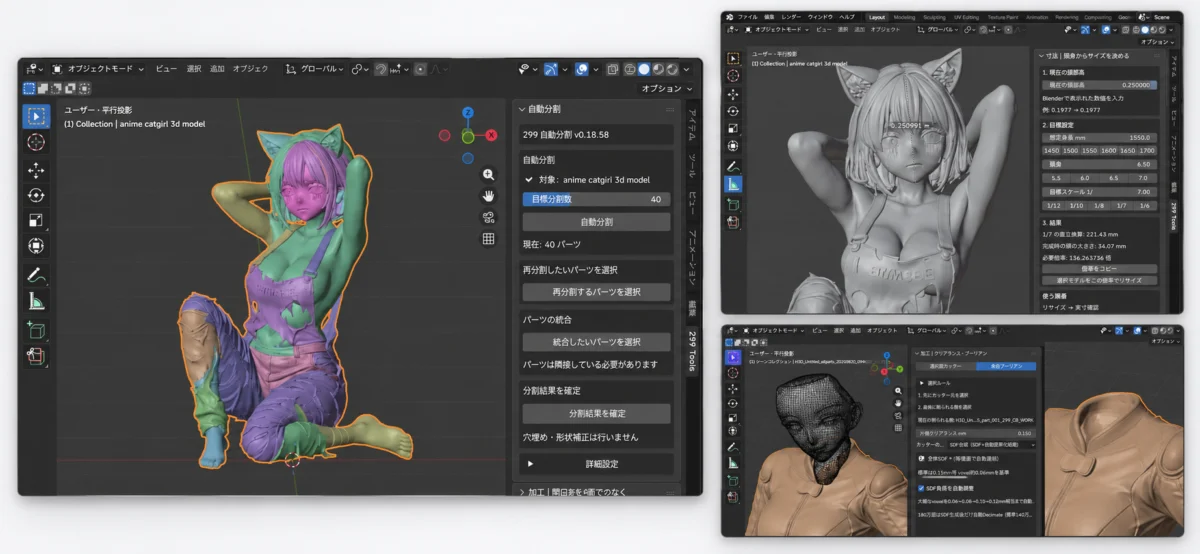
A significant new resource has been made available to the 3D printing and digital art communities: a free Blender add-on suite designed to simplify the preparation of figure models for 3D printing. Developed by 299 MODEL WORKS, the "299 Tools" suite aims to address the repetitive and often complex tasks involved in transforming digital meshes, particularly those generated by AI, into watertight and printable objects. The initial release, version 1.0.0, introduces seven distinct tools, each addressing a specific challenge in the 3D printing workflow for organic models.
The genesis of the 299 Tools suite is rooted in the practical experiences of its developer. 299 MODEL WORKS articulated that the tools were born out of "repetitive tasks encountered while turning AI-generated figure meshes into printable parts." This statement highlights a growing trend in digital creation: the increasing use of artificial intelligence for generating initial 3D models, which then require significant post-processing to become physically realizable through 3D printing. The suite’s focus on "figure models" further suggests an intended audience of hobbyists, independent creators, and small businesses involved in character design, miniature creation, and personal fabrication.
Core Functionality and Toolset Breakdown
Version 1.0.0 of the 299 Tools suite encompasses seven key utilities, though the provided information did not enumerate each individual tool. Based on the description of its purpose, it can be inferred that these tools likely address critical aspects of 3D model preparation for printing. These typically include:
- Mesh Repair and Watertightness: Ensuring that a 3D model is a closed volume without holes or non-manifold geometry is paramount for successful 3D printing. Tools in this category would automatically detect and attempt to fix such issues.
- Hollowing and Wall Thickness: For larger prints, hollowing out the interior of a model can save significant material and printing time. Tools for this purpose would allow users to specify wall thickness and ensure it remains consistent.
- Support Generation (or Preparation for Supports): While many slicer software packages generate supports, some add-ons can assist in pre-structuring models to optimize support placement or even generate basic support structures within Blender.
- Model Segmentation: Breaking down complex models into smaller, manageable parts is often necessary for printing large figures or for facilitating assembly. The mention of "Auto Segment" in the description suggests a tool designed for this purpose.
- Scaling and Orientation: Ensuring models are at the correct scale for printing and are oriented optimally on the build plate are fundamental steps.
- Detail Enhancement or Simplification: Depending on the source model, some tools might assist in either adding subtle details for printability or simplifying overly dense meshes to reduce processing time and file size.
The developer explicitly states that "Auto Segment is not designed for hard-surface models," reinforcing the suite’s specialization in organic, character-like meshes. This is a crucial distinction, as the geometric properties and common issues encountered with hard-surface objects (e.g., mechanical parts) differ significantly from those of figures.
Development Environment and Platform Availability
The 299 Tools suite has been developed and primarily tested within a specific technical environment:
- Blender Version: 5.0
- Operating System: macOS
- Hardware: Mac mini M2, 16 GB RAM
Crucially, the developer notes that "Windows and Linux have not yet been tested on actual hardware." This indicates that while the add-on might function on these platforms, official support and guaranteed performance are currently limited to macOS. This is a common scenario for new software releases, and future updates are likely to address broader platform compatibility as testing and development progress. The use of Blender 5.0 suggests the add-on is designed to leverage the latest features and APIs within that version of the popular open-source 3D creation software.

Licensing and Accessibility
A significant aspect of the 299 Tools suite is its licensing. The developer states that the tools are "free for personal and commercial use." Furthermore, "models and other works created using 299 Tools can also be used or sold freely." This permissive licensing model is highly beneficial for individual creators, small studios, and educational institutions, as it removes financial barriers to utilizing sophisticated preparation tools. It encourages widespread adoption and integration into various creative pipelines without the burden of licensing fees or restrictions on the commercialization of derived works. This aligns with the open-source ethos often associated with Blender itself.
The Growing Landscape of AI-Generated 3D Content and Printing
The emergence of the 299 Tools suite arrives at a pivotal moment for both AI-generated content and the 3D printing industry. AI technologies, such as text-to-3D and image-to-3D model generators, have seen rapid advancements in recent years. These tools can produce a vast array of visual concepts and initial mesh structures with unprecedented speed. However, the output from many of these AI models often suffers from common issues that render them unsuitable for direct 3D printing. These include:
- Non-Manifold Geometry: Meshes with holes, internal faces, or edges shared by more than two faces create ambiguities that 3D printers cannot interpret, leading to print failures.
- Interpenetrating Volumes: Parts of the mesh may overlap in ways that are not physically possible, requiring complex manual intervention to resolve.
- Inconsistent Wall Thickness: Areas that are too thin will not print reliably, while overly thick areas can waste material and time.
- Lack of Detail for Printing: AI models might generate smooth surfaces that lack the fine details necessary to be resolved by the resolution of a typical 3D printer.
- Excessive Polygon Count: High polygon counts can lead to performance issues in slicing software and increase processing times.
The 3D printing sector, meanwhile, continues its trajectory of growth, driven by advancements in printer technology (resolution, speed, material science) and increasing accessibility for consumers and professionals alike. Figurines, miniatures, and character models are among the most popular categories for hobbyist 3D printing. Therefore, a tool that bridges the gap between AI-generated creative potential and the practical demands of 3D printing is highly relevant.
Potential Impact and Broader Implications
The introduction of the 299 Tools suite, particularly its free and commercially permissive licensing, carries several potential implications:
- Democratization of 3D Printing Preparation: By offering powerful tools at no cost, the suite lowers the barrier to entry for individuals who might otherwise lack the technical expertise or financial resources to prepare complex organic models for printing. This could foster a new wave of independent creators and small-scale businesses.
- Acceleration of AI-to-Print Workflows: The suite directly addresses a bottleneck in the AI-driven content creation pipeline. By streamlining the preparation process, it allows artists and designers to iterate more quickly from concept generation to physical output. This could lead to a proliferation of unique 3D printable designs inspired by AI.
- Community Contribution and Development: As a free and open tool, the 299 Tools suite has the potential to foster community engagement. Users reporting bugs and suggesting improvements can contribute to its ongoing development, potentially leading to a more robust and feature-rich add-on over time.
- Competitive Landscape: While specific competing add-ons in the Blender ecosystem or standalone software solutions exist for mesh repair and preparation, the combination of specialized features for figure models and a free license positions the 299 Tools suite as a compelling option. Its success could influence the pricing and feature sets of commercial alternatives.
- Ethical and Copyright Considerations: The use of AI to generate figures also brings up broader discussions about intellectual property, copyright, and the role of human artists. While this add-on focuses on the technical preparation aspect, its widespread adoption indirectly supports the ecosystem of AI-generated art, prompting ongoing dialogue within the creative industries.
The developer’s provision of "English/Japanese manuals, and bug report" functionality indicates a commitment to user support and ongoing refinement. This suggests that the initial release is a foundation upon which further enhancements and bug fixes will be built, potentially expanding its capabilities and platform support. The developer’s stated development environment, while specific, is a starting point, and the community’s feedback will likely be instrumental in guiding future cross-platform testing and optimization.
In conclusion, the release of the 299 Tools suite by 299 MODEL WORKS represents a valuable contribution to the 3D printing and digital art communities. By providing a free, specialized set of utilities for preparing AI-generated figure models, it addresses a critical need, empowers creators, and potentially accelerates the integration of AI into physical fabrication workflows. The suite’s success will be measured not only by its technical efficacy but also by its adoption and the creative possibilities it unlocks for users worldwide.
About the Author