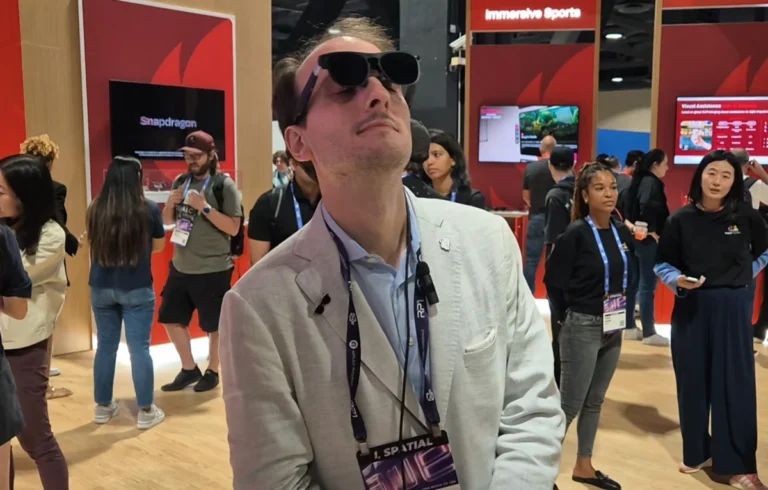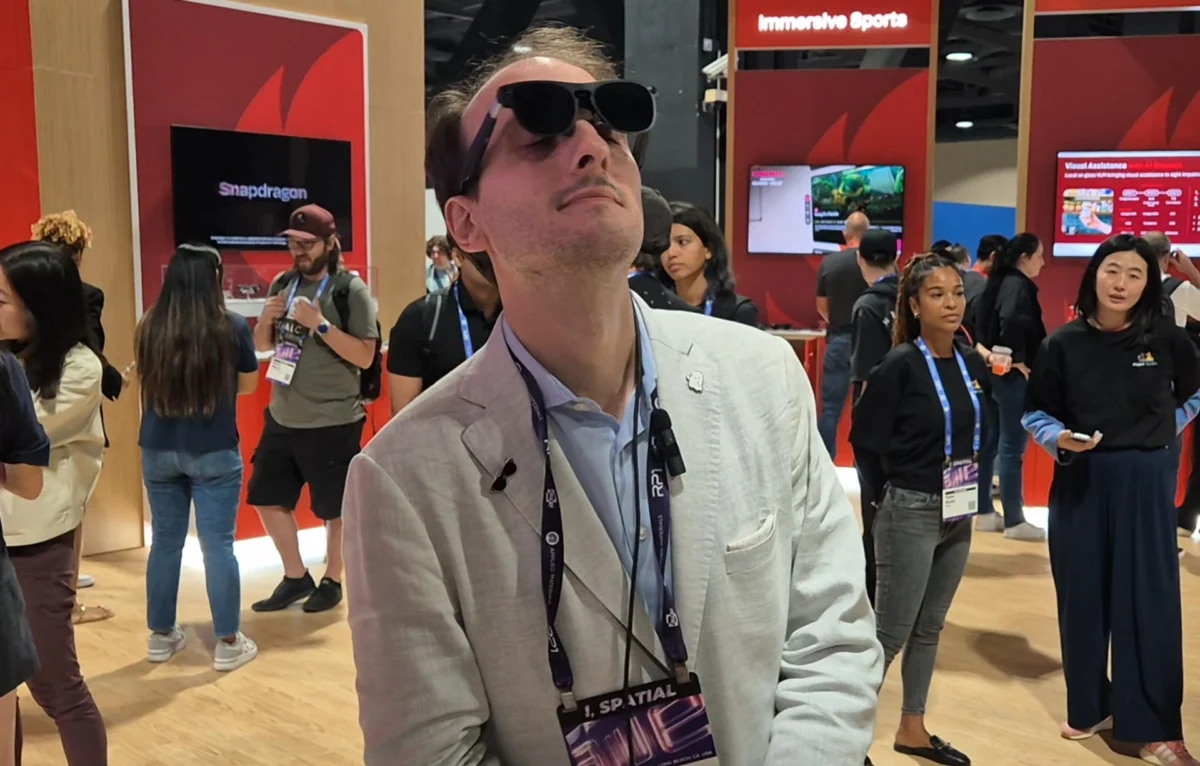
The Augmented World Expo (AWE) served as the launchpad for one of the most significant developments in the spatial computing sector this year with the debut of the XREAL Aura. Representing a landmark collaboration between Chinese hardware manufacturer XREAL, technology giant Google, and semiconductor leader Qualcomm, the XREAL Aura is positioned as the first consumer-oriented augmented reality (AR) glasses powered by the Android XR operating system. This strategic partnership aims to standardize the AR software ecosystem while maintaining the lightweight, wearable form factor that has become XREAL’s signature.

Architectural Design and All-in-Two Configuration
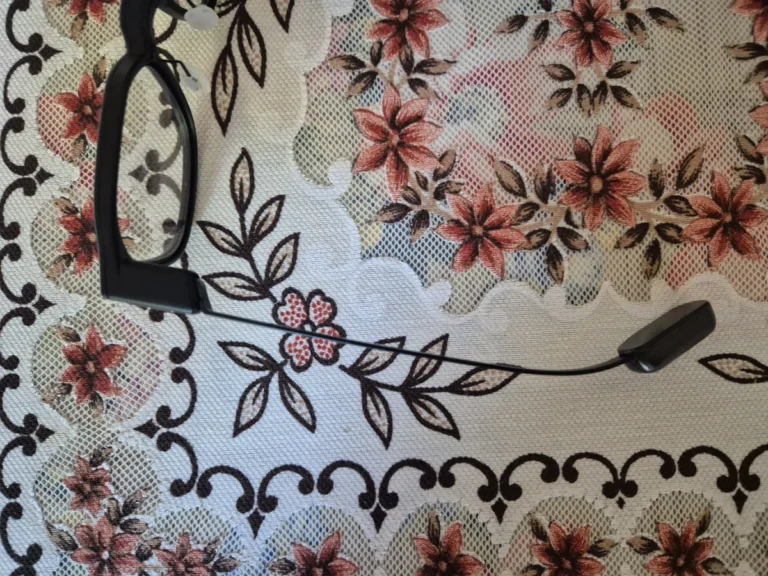
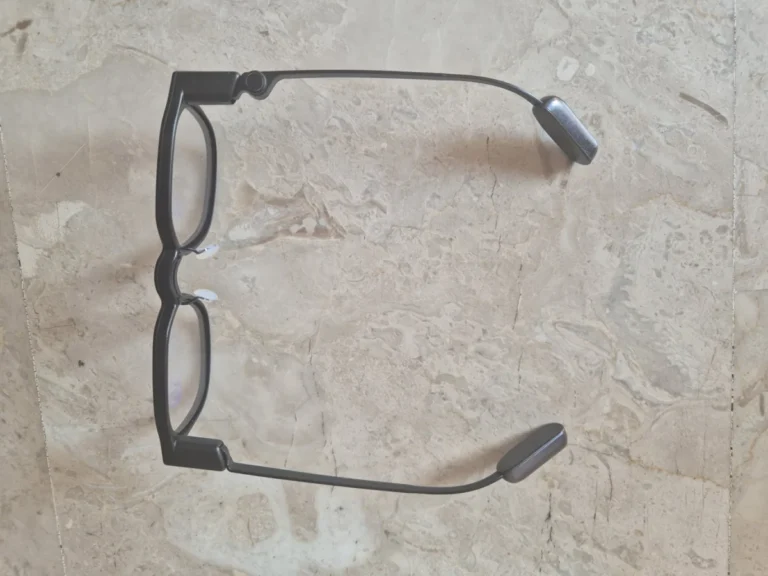
The XREAL Aura utilizes an "all-in-two" architecture, a design choice that separates the optical hardware from the computational engine. The system consists of a pair of lightweight glasses connected via a specialized cable to a pocket-sized computational "puck." By offloading the processor, battery, and cooling systems to the external unit, XREAL has managed to keep the eyewear weight at approximately 95 grams.

While this weight is significantly lower than that of traditional mixed-reality (MR) headsets like the Meta Quest 3 or Apple Vision Pro, it remains above the 50-gram threshold typically cited by ergonomic experts for all-day wearability. The glasses feature a bulky sunglasses aesthetic that appears natural from a frontal perspective, though the side profile reveals a thicker chassis necessitated by the prism optics and internal display hardware.

The computational puck, weighing roughly 300 grams, houses the Qualcomm Snapdragon Elite chipset. This dedicated unit includes a built-in touchpad for tactile navigation, providing an alternative to gesture-based controls. The separation of components prevents heat buildup on the user’s face, a common issue in standalone AR hardware, though testing units at AWE did exhibit some warmth on the forehead during prolonged high-performance sessions.

Optical Performance and Field of View
The XREAL Aura employs prism optics to project visuals from twin OLED displays, offering a resolution of 1920 x 1200 pixels per eye. Technical evaluations at the event highlighted a high pixel density that ensures text legibility in productivity applications, such as Google Docs, and vibrant color reproduction for multimedia consumption.

A defining feature of the Aura is its 70-degree diagonal field of view (FOV). In the current XR market, 70 degrees is often regarded as the minimum requirement for an immersive experience, moving beyond the "small window" effect seen in earlier 40-to-50-degree devices. However, the 16:10 aspect ratio of the displays prioritizes horizontal immersion over vertical. Consequently, while the horizontal FOV feels expansive, the vertical FOV remains somewhat constrained, leading to a "clipping" sensation when viewing tall virtual objects or immersive 360-degree content.

To bridge the gap between augmented and virtual reality, the Aura features electrochromic dimming. This technology allows the outer lenses to transition through five levels of transparency. At maximum opacity, the glasses mimic a VR environment by blocking out ambient light; at full transparency, they function as standard AR glasses. The system is designed to handle these transitions automatically based on the application being launched, though the prism optics mean that even at the clearest setting, the real world appears slightly darker than through standard glass.

Android XR and the Google Ecosystem Integration
The integration of Android XR marks a pivotal shift for XREAL, moving away from proprietary "Nebula" software toward a more robust, developer-friendly platform. The operating system provides a familiar interface for Android users, featuring a spatialized version of the Google Play Store.

During demonstrations, the device showcased seamless integration with Google’s suite of applications. Users can anchor 2D windows, such as Google Chrome or YouTube, in their physical environment and manipulate them using hand gestures. The software also incorporates Google’s Gemini AI, allowing for "vibe-coded" experiences and voice-activated assistance. For example, users can ask Gemini to analyze their surroundings through the integrated RGB camera or request the AI to draft documents within a spatial workspace.

To address privacy concerns associated with integrated cameras, XREAL has included a front-facing white LED. This "privacy light" illuminates whenever the RGB camera is active, signaling to bystanders that the device is capturing or analyzing visual data.

Tracking and Interaction Modalities
The XREAL Aura provides a full six-degrees-of-freedom (6DOF) experience, enabled by two dedicated tracking cameras mounted on the front corners of the frames. This allows virtual objects to remain spatially anchored as the user moves through a room. While the tracking is generally stable, early reports from AWE indicated occasional glitches when the user’s view was obstructed or during rapid head movements.

The primary interaction method is hand tracking, which supports gestures such as tapping, swiping, and pinching. Testing revealed that the hand tracking is accurate enough for UI navigation and casual interaction, though a slight latency was noted, suggesting the device may not yet be optimized for high-speed gaming. Notably, the tracking volume is concentrated in front of the user; because the device lacks downward-facing cameras, it cannot track hands resting at the user’s sides.

In addition to hand gestures and the puck’s touchpad, the Aura includes physical buttons on the frames for volume control, power, and menu invocation. The device also supports a "travel mode," which stabilizes visuals for use in moving vehicles, such as airplanes or trains.

Market Positioning and Competitive Analysis
The XREAL Aura enters a market currently bifurcated between high-end, heavy headsets and low-power smart glasses. By utilizing the all-in-two design and the Snapdragon Elite processor, XREAL is attempting to capture the middle ground—providing enough power for spatial computing without the bulk of a headset.

The move to Android XR is a direct challenge to Meta’s Horizon OS and Apple’s visionOS. By partnering with Google, XREAL gains access to a massive developer ecosystem, which is essential for solving the "content gap" that has plagued previous AR glasses. The success of the Aura will likely depend on whether developers create compelling "killer apps" that justify the tethered design and the projected price point.

Pricing and Availability Timeline
XREAL has opened preorders for the Aura through its official channels, with an expected launch window in the fall of 2026. While a specific MSRP has not been finalized, the company has stated the device will retail for "less than $1,500." Industry analysts expect the final price to land between $1,000 and $1,300, positioning it as a premium consumer device significantly more affordable than the Apple Vision Pro but more expensive than the Meta Quest 3.

As the XR industry moves toward more wearable form factors, the XREAL Aura represents a critical experiment in balancing computational power with ergonomic comfort. Its reliance on a wired connection to a puck remains a point of contention for some users, but for those seeking a portable, high-resolution spatial computing platform backed by the Google ecosystem, it stands as one of the most promising entries in the 2026 hardware cycle.
About the Author