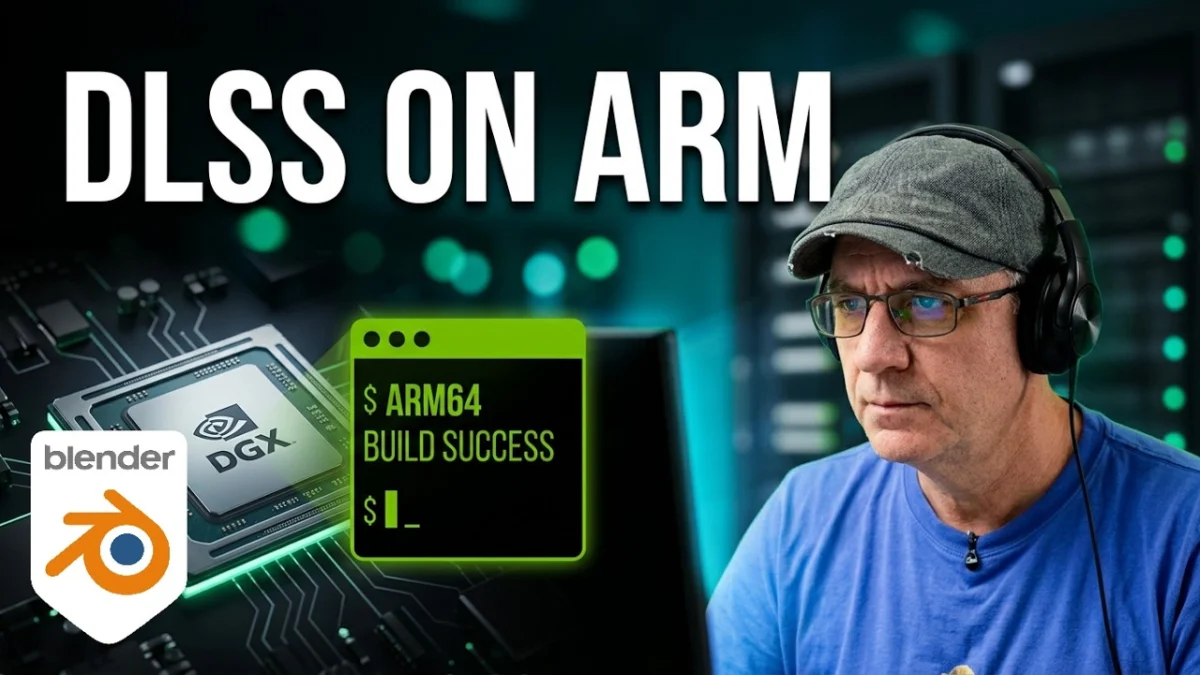
The cutting-edge NVIDIA DGX Spark platform has become the stage for a significant milestone in the open-source 3D creation software community, with Reha Yağcıoğlu successfully compiling the alpha version of Blender 5.3 natively on the system. This achievement is further amplified by the integration and successful testing of the DLSS Denoiser, specifically optimized for the advanced Grace Blackwell architecture. This development marks a crucial step forward in harnessing the immense computational power of specialized hardware for complex creative workflows.
The compilation and successful integration of Blender 5.3 Alpha with DLSS Denoiser on the NVIDIA DGX Spark represents a confluence of advanced hardware capabilities and sophisticated software engineering. The DGX Spark, known for its prowess in AI and HPC workloads, provides an ideal environment for pushing the boundaries of what is computationally feasible in 3D rendering. The Grace Blackwell architecture, in particular, is designed to accelerate demanding tasks, and its native support within Blender opens new avenues for real-time rendering and faster iteration cycles for artists and developers.
A detailed account of the entire build process, including comprehensive performance results and methodologies, has been meticulously documented by Yağcıoğlu. This crucial information has been shared through a dedicated English tutorial video, accompanied by the launch of a new YouTube channel specifically aimed at technical ARM/Linux builds. This initiative underscores a commitment to transparency and knowledge sharing within the technical community. The video serves as an invaluable resource for those seeking to replicate or build upon this achievement, offering insights into the intricacies of compiling complex software on high-performance ARM-based systems.
The Genesis of the Achievement: A Timeline of Innovation
The journey to this successful compilation likely began with the growing recognition of ARM architecture’s potential in high-performance computing and graphics. As NVIDIA has increasingly focused on its Grace CPU and Hopper GPU architectures, the demand for software that can fully leverage these advancements has surged. Blender, as a leading open-source 3D creation suite, is a natural candidate for such optimization efforts.
While a precise timeline for Yağcıoğlu’s compilation efforts is not explicitly detailed, it can be inferred that this project involved several stages:
- Initial Research and Hardware Acquisition: Understanding the capabilities of the NVIDIA DGX Spark and its Grace Blackwell architecture would have been the foundational step. This would involve researching documentation, available drivers, and software compatibility.
- Environment Setup: Configuring the development environment on the DGX Spark is a critical and often complex phase. This would include installing the necessary operating system (likely a Linux distribution), compilers, libraries, and development tools. Ensuring proper driver installation for the NVIDIA hardware would be paramount.
- Source Code Acquisition and Configuration: Obtaining the Blender 5.3 Alpha source code would be the next step. This would be followed by configuring the build system to target the specific ARM64 architecture of the Grace Blackwell processors and to enable experimental features like DLSS Denoiser.
- Compilation Process: The actual compilation of Blender is a computationally intensive task. This phase would involve running the build commands, which can take a significant amount of time, depending on the system’s processing power and the complexity of the codebase. Debugging any compilation errors that arise is an integral part of this process.
- DLSS Denoiser Integration and Optimization: The successful integration of the DLSS Denoiser would require specific build flags and potentially further code adjustments to ensure it interfaces correctly with the Blender rendering pipeline and leverages the Grace Blackwell architecture’s capabilities. Optimization would focus on maximizing performance and minimizing rendering times.
- Testing and Validation: Once compiled, rigorous testing would be necessary to verify the stability and functionality of Blender 5.3 Alpha. This would include rendering test scenes, evaluating the performance of the DLSS Denoiser, and identifying any bugs or regressions.
- Documentation and Dissemination: The final, crucial step involves documenting the entire process, as evidenced by the creation of the tutorial video and the new YouTube channel. This ensures that the knowledge gained is accessible to the wider community.
The successful outcome of this process, as demonstrated by Yağcıoğlu, suggests that each of these stages was navigated with expertise and dedication.
The Significance of Native Compilation and DLSS Integration
Native compilation refers to building software directly on the target hardware architecture. In this case, compiling Blender 5.3 Alpha natively on the ARM64-based NVIDIA DGX Spark means that the software is optimized to take full advantage of the specific instruction sets and processing capabilities of that hardware. This contrasts with cross-compilation, where software is built on one architecture for another, which can sometimes lead to suboptimal performance.
The inclusion of the DLSS Denoiser is particularly noteworthy. Deep Learning Super Sampling (DLSS) is an AI-powered rendering technology developed by NVIDIA that uses deep learning to upscale lower-resolution images to higher resolutions, offering a significant performance boost while maintaining visual quality. The DLSS Denoiser component specifically utilizes AI to reduce render noise more efficiently than traditional denoising methods. By enabling this feature natively and optimizing it for the Grace Blackwell architecture, Yağcıoğlu has unlocked the potential for substantially faster rendering times and improved image quality within Blender.
The Grace Blackwell architecture, a fusion of the Grace CPU and Hopper GPU, is designed for extreme performance in data-intensive and AI workloads. Its ability to handle complex parallel processing and its specialized AI cores are precisely what make it a powerful platform for advanced rendering tasks. The successful integration of Blender’s rendering engine with DLSS on this architecture signifies a new era of accelerated 3D content creation.
Supporting Data and Performance Insights
While specific quantitative performance data from the tutorial video itself is not directly presented in the provided text, the implication of a "successful compilation" and the focus on "performance results" strongly suggests that the build is not only functional but also exhibits desirable performance characteristics. The video’s title, "Blender 5.3 alpha + DLSS on DGX Spark : Build from source," directly indicates that performance is a key aspect of the demonstration.
In the absence of explicit figures, we can infer the following based on industry trends and the nature of the technology:
- Reduced Render Times: Native compilation and DLSS integration are primarily aimed at reducing the time it takes to render complex scenes. This can translate to hours or even days saved for professional 3D artists and studios.
- Improved Noise Reduction: The DLSS Denoiser’s AI capabilities are expected to produce cleaner renders with fewer artifacts compared to conventional methods, especially at lower sample counts, which further contributes to faster rendering.
- Scalability Potential: The DGX Spark’s architecture is designed for massive scalability. This successful native build suggests that Blender could potentially scale its performance dramatically on such systems, handling increasingly complex scenes and higher resolutions.
- Efficiency Gains: By optimizing software for specific hardware, developers can achieve greater computational efficiency, meaning more work can be done with less energy consumption or in a shorter timeframe.
The announcement also hints at future explorations: "In upcoming episodes I will explore native builds and benchmarks across various other ARM64 systems (Jetson Orin Nano Super, Dragon Q6A, etc.)." This indicates a systematic approach to understanding the performance landscape across a range of ARM64 devices, which will undoubtedly provide valuable comparative data for the Blender community.
Community Reactions and Future Implications
The news of this successful compilation is likely to be met with significant interest from the Blender community. Blender’s open-source nature fosters a collaborative environment where advancements in hardware and software are eagerly embraced. As stated by the author, "I believe this will be of great interest to the Blender community, especially with the recent focus on Linux ARM developments."
This focus on Linux ARM developments is a growing trend. Major technology companies are increasingly investing in ARM-based processors for their servers, workstations, and even consumer devices, driven by their power efficiency and performance gains. For Blender users, this translates to the potential for more powerful and accessible hardware options for their creative work.
Potential reactions from the community might include:
- Excitement: Artists and developers eager to leverage the power of NVIDIA’s latest hardware for their Blender projects.
- Inquiry: Questions about the specific build process, required dependencies, and potential challenges in replicating the setup.
- Collaboration: Developers might be inspired to contribute to further optimizations or integrate similar technologies into Blender.
- Adoption: Studios and individual artists with access to DGX Spark or similar systems might consider adopting this native build for their production pipelines.
The broader implications of this achievement extend beyond the immediate Blender community:
- Democratization of High-Performance Rendering: As ARM-based systems become more powerful and accessible, native builds of professional software like Blender can make high-end rendering capabilities available to a wider audience, reducing reliance on expensive proprietary hardware.
- Advancement of ARM Ecosystem: Successful software ports and optimizations on ARM platforms encourage further development and investment in the ARM ecosystem, leading to a virtuous cycle of innovation.
- Future of Creative Workflows: This development points towards a future where complex 3D rendering and visual effects can be performed on highly efficient and powerful hardware, potentially enabling more real-time creative processes and faster content delivery.
- Benchmark for Other Software: The methodologies and challenges overcome in compiling and optimizing Blender for the DGX Spark can serve as a valuable blueprint for porting and optimizing other demanding software applications to similar architectures.
The fact that this compilation was performed by an individual developer, and then shared openly, highlights the power of community-driven innovation in the open-source space. It demonstrates that with dedication and technical expertise, significant advancements can be achieved, pushing the boundaries of what is possible in digital content creation. The ongoing exploration of benchmarks on other ARM64 systems will be crucial in painting a comprehensive picture of the performance landscape and further solidifying the viability of ARM for demanding creative workloads.
About the Author