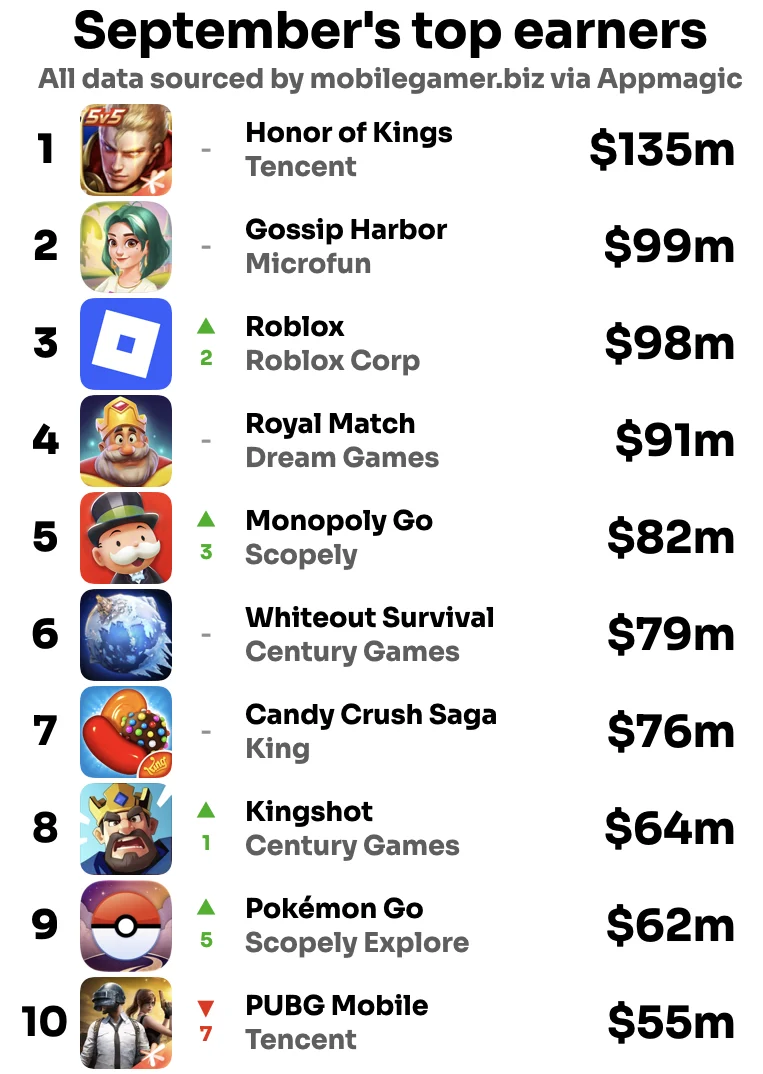
The global mobile gaming market in September 2024 exhibited a complex landscape of stabilizing legacy titles and significant fluctuations among high-growth contenders. According to the latest data from Appmagic, Tencent’s perennial leader, Honor of Kings, maintained its position at the pinnacle of the grossing charts despite experiencing its second consecutive month of revenue decline. The title generated approximately $134 million in in-app purchase (IAP) revenue, maintaining a substantial lead over its closest competitor, Gossip Harbor. This performance comes amid a broader industry trend where several top-performing titles saw slight dips in revenue, partially attributed to September having one fewer day than August, which mathematically impacts monthly aggregates for games with steady daily active user (DAU) spending.
The revenue estimates provided by Appmagic specifically track IAP earnings and exclude critical revenue streams such as in-game advertising, spending via external web shops, and the 30% platform fees collected by Apple and Google. Furthermore, these figures do not account for revenue generated within China’s extensive third-party Android ecosystem, suggesting that the total economic footprint of these titles, particularly those developed by Chinese giants like Tencent and NetEase, is significantly higher than the reported IAP figures.
The Battle for the Top Tier: Honor of Kings and Gossip Harbor
Honor of Kings continues to be the primary engine of Tencent’s mobile gaming division. Although the title saw its revenue figures contract for the second month in a row, its $134 million haul remains the benchmark for the industry. The game’s ability to sustain such high levels of monetization, even during seasonal downturns, underscores the effectiveness of its live-ops strategy and its deeply entrenched player base in the MOBA (Multiplayer Online Battle Arena) genre.
In a notable shift for the casual gaming sector, Microfun’s Gossip Harbor secured the runner-up spot for the second consecutive month. The merge-game sensation earned $99 million in September, a decrease from its $112 million peak in August. Despite this slight dip, Gossip Harbor has firmly established itself as a heavyweight in the mobile market, signaling a broader shift in consumer preference toward narrative-driven merge mechanics. The game narrowly outperformed Roblox, which also fell just below the $100 million threshold this month.

The performance of Roblox in 2024 provides a stark contrast to its viral success in 2023. During the previous summer, Roblox benefited from viral trends such as "Steal a Brainrot" and "Grow a Garden," which propelled monthly earnings to over $150 million. This year, however, the platform’s summer peaks reached just over $100 million. While still a massive commercial success, the lack of a singular, dominant viral experience this season has resulted in more modest growth compared to previous years.
Analyzing Historical Lows for Industry Stalwarts
September proved to be a challenging month for several established titles that have historically dominated the top 10. Dream Games’ Royal Match, which has consistently surpassed the $100 million mark for nearly three years, dipped below that threshold in September. The game recorded its lowest estimated IAP revenue since June 2023, signaling a potential cooling of the match-3 market or a shift in player spending habits toward newer titles.
Similarly, King’s Candy Crush Saga reported its lowest monthly IAP earnings since April 2022. This decline follows a strong performance in the spring and a secondary peak in August. The volatility in Candy Crush’s revenue suggests that even the most resilient "evergreen" titles are susceptible to market fatigue and the increasing competition for player time and discretionary spending.
In the 4X strategy and social casino space, Scopely’s Monopoly Go remained stable but significantly lower than its early-year peaks, hovering between $80 million and $85 million. This represents a plateau following a sharp drop in February. Meanwhile, Century Games’ Whiteout Survival experienced a concerning month-on-month decline, with September’s $79 million total marking its poorest performance since June 2024.
Volatility and Event-Driven Revenue Spikes
The middle of the top 10 chart was characterized by extreme volatility, particularly for Pokémon Go and PUBG Mobile. Niantic’s Pokémon Go has exhibited a "spiky" revenue pattern throughout the summer. After earning $30 million in June, the title surged to $99 million in July—driven largely by global "Pokémon Go Fest" events—before plunging to $46 million in August and recovering to $62 million in September. This pattern highlights the game’s heavy reliance on large-scale, time-limited live events to drive monetization.

Tencent’s PUBG Mobile followed a similar trajectory. The tactical shooter leapt to approximately $100 million in earnings during July and August but retracted to $55 million in September. This volatility is often tied to the release cycle of "Royale Passes" and high-value cosmetic collaborations, which can cause dramatic shifts in monthly revenue totals.
The Mid-Tier Landscape: 11-20 Performance
The rankings from 11 to 20 featured a mix of steady performers and titles in significant decline. Tencent’s Delta Force and Moon Active’s Coin Master remained relatively flat, earning $51 million and $47 million respectively. However, the most dramatic story in this bracket remains the continued fall of Last War: Survival.
- Delta Force (Tencent): $51m
- Coin Master (Moon Active): $47m
- Last War: Survival (FunFly): $43m
- eFootball (Konami): $41m
- Gardenscapes (Playrix): $37m
- Township (Playrix): $35m
- TfT: Golden Spatula (Riot): $34m
- Royal Kingdom (Dream Games): $33m
- Dragon Ball Z: Dokkan Battle (Bandai Namco): $32m
- Free Fire Max (Garena): $31m
FunFly’s Last War: Survival earned just over $43 million in September, a staggering decline from the $135 million estimates recorded in February 2024. Industry analysts point to an ongoing lawsuit involving the title, which has reportedly led to the removal of high-cost IAPs and a slowdown in the rollout of new content. This legal friction has significantly hampered the game’s ability to monetize its core player base.
In contrast, Bandai Namco’s Dragon Ball Z: Dokkan Battle saw a meteoric rise, climbing 45 places in the rankings. Such jumps are typical for high-profile Japanese "gacha" games during anniversary celebrations or major character releases. Riot Games’ Teamfight Tactics (TFT): Golden Spatula also saw positive momentum, rising nine spots to 17th place.
Emerging Trends and Regional Successes
Outside of the top 20, several notable shifts occurred. HoYoverse’s flagship titles, Genshin Impact and Honkai: Star Rail, both climbed six spots to reach 22nd and 23rd place, each generating approximately $27 million. While these figures are lower than their historical peaks, both games maintain a highly loyal audience that responds predictably to new version updates.

Tencent’s mobile adaptation of Valorant saw a slight decline, dropping seven spots to 27th with $22 million in earnings. Meanwhile, long-standing Japanese titles Monster Strike and Puzzle & Dragons showed resilience, rising to 28th and 30th place respectively.
A significant new entry in the market is Zeus, a Korea-only RPG from Com2us. In its first full month on the charts, the title earned over $17 million. The success of Zeus highlights the continued strength of the South Korean mobile market and the ability of regional exclusives to generate significant revenue even without a global launch.
Broader Implications and Market Outlook
The September data suggests a period of recalibration for the mobile gaming industry. The decline in IAP revenue for "big three" titles—Royal Match, Candy Crush Saga, and Whiteout Survival—indicates that the market may be reaching a saturation point for traditional monetization models. Developers are increasingly looking toward alternative revenue streams, such as external web shops, to bypass the 30% platform fee. These web shops often offer players better value for their money, which could explain some of the "missing" revenue in IAP-only data sets.
Furthermore, the impact of legal challenges on games like Last War: Survival serves as a cautionary tale for the industry. As regulatory scrutiny over loot boxes and high-value microtransactions increases, developers may need to pivot toward more sustainable and transparent monetization strategies.
As the industry moves into the final quarter of 2024, the focus will likely shift toward holiday events and end-of-year updates. The performance of new entries like Zeus and the recovery of stalwarts like Pokémon Go suggest that while the market is volatile, there remains significant opportunity for titles that can successfully leverage cultural trends and live-ops excellence. The ongoing dominance of Tencent, despite slight revenue dips, reinforces the importance of scale and diverse portfolios in navigating the increasingly competitive mobile landscape.
About the Author