The global mobile gaming market experienced a series of significant shifts in September, characterized by the continued dominance of established battle royale titles, a cooling period for sandbox giants, and a volatile hyper-casual sector driven by rapid genre iteration. According to the latest data from Appmagic, which tracks downloads across major digital storefronts while excluding the fragmented Android market in China, the industry is witnessing a transition where long-term intellectual property (IP) collaborations and fast-follow development cycles are dictating the leaderboard. While the top of the charts remains occupied by familiar names like Garena’s Free Fire Max and Roblox, the rapid ascent and descent of niche puzzle games suggest a market that is increasingly sensitive to user acquisition (UA) trends and viral mechanics.
Dominance of Battle Royale and the Impact of IP Crossovers
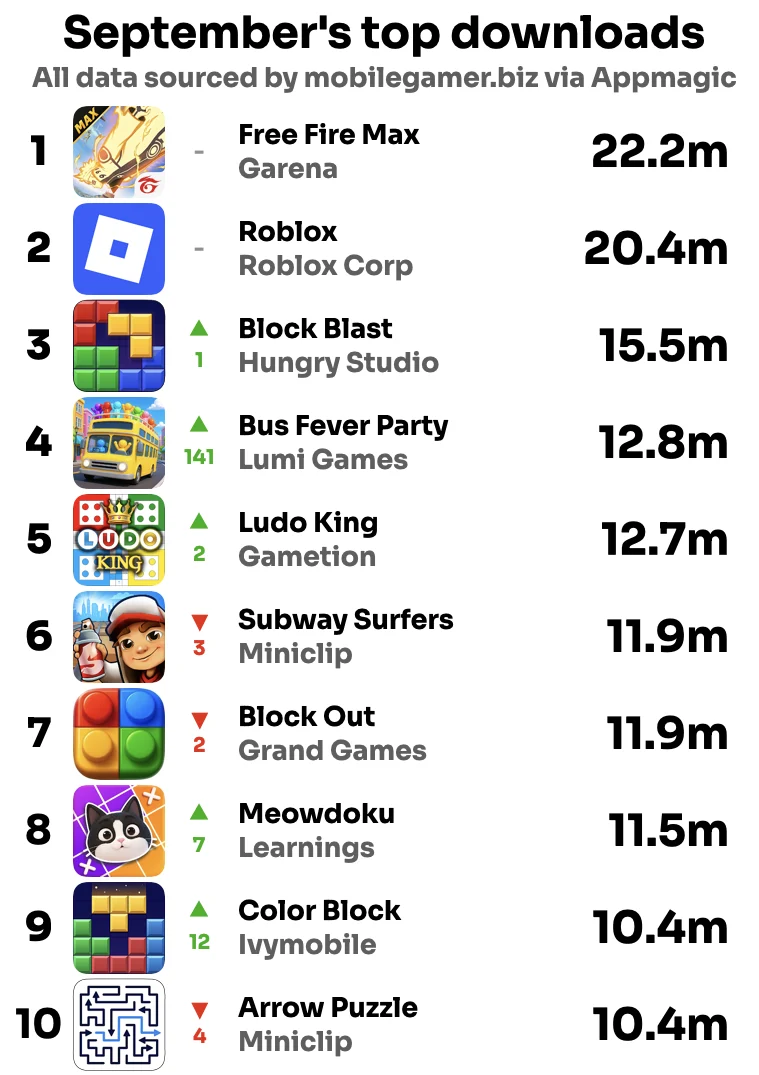
Garena’s Free Fire Max maintained its formidable position at the top of the global charts, fueled largely by its high-profile collaboration with the Naruto franchise. The crossover event, which integrated iconic characters and themed cosmetic items into the battle royale experience, allowed the game to sustain a steady momentum that has been consistent since the first quarter of the year. In September, Free Fire Max recorded approximately 22 million installs, a figure that aligns with the monthly performance metrics the title has posted since March. This stability underscores the effectiveness of Garena’s live-ops strategy, which relies heavily on localized events and global IP partnerships to maintain player interest in highly competitive regions such as Southeast Asia, Latin America, and India.
In contrast, Roblox, a perennial leader in the sandbox and social platform category, saw a second consecutive month of declining downloads. After reaching a peak of nearly 23 million installs in July, the platform dipped to just over 20 million downloads in September. When viewed through a year-over-year lens, the decline is even more pronounced. During the summer months of 2025, Roblox was consistently generating upwards of 35 million monthly downloads. Industry analysts suggest that this year’s inability to replicate those figures may point toward a maturing market for sandbox platforms or a shift in the seasonal habits of its primary demographic. Despite the dip, Roblox remains a dominant force in terms of active user engagement and monetization, even as its acquisition pace slows compared to previous peaks.

The Volatile Landscape of Hyper-Casual and Puzzle Gaming
The hyper-casual and puzzle segments remain the most dynamic areas of the mobile ecosystem, characterized by sudden spikes in popularity and the rapid emergence of new sub-genres. Hungry Studio’s Block Blast has solidified its presence in the top tier, posting its third consecutive month in the 15 million install range. The game’s success highlights a broader trend where minimalist, easy-to-learn puzzle mechanics continue to capture a massive global audience.
However, the most notable movement in September came from Lumi Games’ Bus Fever Party. The title experienced a meteoric rise, jumping 141 places in the monthly rankings to secure nearly 13 million installs. This surge appears to have come at the expense of its predecessor or competitors in the same niche; Bus Traffic Fever, which held a spot in the top ten in August, plummeted 23 places in September. This "winner-takes-all" dynamic in specific puzzle niches suggests that players are quick to migrate to newer iterations of a successful concept, particularly when those new versions offer refined mechanics or more aggressive advertising campaigns.
Other mainstays showed signs of stabilization or slight regression. Subway Surfers, the veteran endless runner from SYBO and Miniclip, returned to its baseline of approximately 12 million monthly installs following a brief spike in August. Similarly, Grand Games’ Block Out, which had a strong showing in August with 14m downloads, saw its numbers contract to just under 12m for the month of September.
Chronology of Market Shifts and the Rise of Genre Iteration
The evolution of the charts from July through September reveals a clear pattern of "fast-follow" development. This is perhaps most evident in the rise of Meowdoku, published by Learnings. The game, which blends Sudoku mechanics with a "cozy" feline aesthetic, returned to the top ten with 11.5 million downloads, marking its most successful month to date. The success of Meowdoku has not been without controversy, as the title has been linked to ongoing discussions regarding cloning in the mobile industry. Reports suggest that Meowdoku may have been heavily inspired by the "Queens" logic puzzle popularized on the LinkedIn gaming platform.

This trend of "homage" or "inspiration" is further exemplified by Ivy Mobile’s Color Block. The game climbed 12 places in September to reach the ninth spot globally. A review of Ivy Mobile’s historical portfolio reveals a strategy centered on iterating on existing hits, with titles that mirror the mechanics of popular games like Arrows, Pixel Flow, and Magic Sort. Color Block itself has undergone several identity shifts since its initial 2024 launch, originally appearing as Block Puzzle Bricks before settling on its current branding. This ability to pivot and rebrand is a common tactic among developers looking to optimize for App Store Search (ASO) and shifting consumer preferences.
Performance Analysis: Ranks 11 Through 20
The middle tier of the top 20 rankings shows a mixture of steady performers and rising stars. Grand Games’ Magic Sort, despite losing its top-ten status, remained a strong contender at 11th place with 8.7 million downloads. Voodoo, a titan of the hyper-casual space, maintained a double presence in this bracket with Mob Control (8.4m) and Paper.io 2 (8.38m). Both titles represent Voodoo’s shift toward "hybrid-casual" games that combine simple mechanics with deeper progression systems to improve long-term retention.
- Magic Sort (Grand Games): 8.7 million
- Mob Control (Voodoo): 8.4 million
- Amaze Go (Learnings): 8.39 million
- Paper.io 2 (Voodoo): 8.38 million
- Vita Mahjong (Learnings): 8.38 million
- Block Craft 3D (Wildlife): 8.2 million
- Gossip Harbor (Microfun): 7.9 million
- Football League 2026 (Mobile Soccer): 7.7 million
- Brain Puzzle 3 (SmallStep Tech): 7.5 million
- 8 Ball Pool (Miniclip): 7.48 million
Notable movers in this category include Gossip Harbor, which rose 12 places as the merge-game genre continues to find a dedicated audience, and SmallStep Tech’s Brain Puzzle 3, which broke into the top 20 for the first time after a 39-place jump. Conversely, titles like Mystery Dumpling, which enjoyed a brief period in the spotlight in August, fell 19 places to 36th, illustrating the difficulty of sustaining a viral launch in the current market environment.
The Case of Gangstar: Mirage City and Market Volatility
One of the most striking examples of market volatility in September was the performance of Tencent’s Gangstar: Mirage City. In August, the title—which draws heavy inspiration from the Grand Theft Auto series—burst onto the scene with over 12 million downloads, securing a comfortable spot in the top ten. However, the game failed to sustain this interest. By September, its download numbers plummeted to just 3.5 million, causing it to fall out of the top 100 entirely.

This sharp decline highlights the challenges associated with "burst" marketing strategies. While large-scale publishers like Tencent can drive massive initial downloads through high-budget advertising and cross-promotion, maintaining that momentum requires a gameplay loop that can compete with established giants. In the case of Gangstar: Mirage City, the initial curiosity surrounding a high-fidelity mobile open-world experience did not translate into the sustained acquisition needed to remain on the global leaderboard.
Broader Industry Implications and Future Outlook
The data from September suggests several key takeaways for the broader mobile gaming industry. First, the success of Free Fire Max demonstrates that high-quality IP collaborations remain one of the most effective tools for defending a market-leading position. As user acquisition costs continue to rise on both iOS and Android, leveraging an existing fanbase from anime or traditional media provides a significant advantage.
Second, the "cloning" and "inspiration" debates surrounding titles like Meowdoku and Color Block indicate that the barriers to entry for simple puzzle mechanics are lower than ever, leading to a crowded market where speed-to-market is often prioritized over original design. Developers are increasingly looking at non-traditional gaming platforms, such as LinkedIn or social media applets, as testing grounds for mechanics that can be scaled into full mobile releases.
Finally, the decline of Roblox from its 2025 highs and the rapid fall of Gangstar: Mirage City suggest that the global audience is becoming more discerning. While players are willing to try new experiences, the games that stay at the top are those that can successfully navigate the transition from a "novelty" to a "service." As the industry moves into the final quarter of the year, the focus will likely shift toward holiday-themed live-ops and the next wave of high-profile crossovers as developers attempt to capture the seasonal surge in consumer spending and device activations.
About the Author