

The vastness of the cosmos, spanning an estimated 93 billion light-years in diameter for the observable universe and containing potentially trillions of galaxies, each home to billions of stars, presents a profound scientific and philosophical puzzle: if life is common, why haven’t any other forms of intelligent life in the universe contacted us by now? This question lies at the heart of the Fermi Paradox, a compelling contradiction between the high probability of extraterrestrial civilizations and the stark lack of empirical evidence for their existence.
The Genesis of the Paradox: "Where is Everybody?"
The Fermi Paradox is named after Italian-American physicist Enrico Fermi, who, during a casual lunch conversation in 1950 with fellow scientists Emil Konopinski, Edward Teller, and Herbert York, famously posed the question, "Where is everybody?" Given the age of the universe, estimated at 13.8 billion years, and the sheer number of stars and planets, it seemed statistically improbable to Fermi that Earth would be the sole planet to harbor advanced intelligent life. The sun is a relatively young star, approximately 4.6 billion years old, implying that many stars and their planetary systems would have had a multi-billion-year head start in developing life. If even a small fraction of these worlds gave rise to intelligent civilizations capable of interstellar travel or communication, the galaxy, and indeed the observable universe, should be teeming with their signs. Yet, humanity’s sophisticated instruments and dedicated search efforts have yielded only silence.
Estimating Cosmic Companions: The Drake Equation

Central to the high estimates of extraterrestrial civilizations is the Drake Equation, formulated in 1961 by astronomer Frank Drake. This probabilistic argument attempts to estimate the number of active, communicative extraterrestrial civilizations in the Milky Way galaxy. The equation is expressed as:
N = R* * fp * ne * fl * fi * fc * L
Where:
- N: The number of civilizations in our galaxy with which communication might be possible.
- R*: The average rate of star formation in our galaxy (stars per year). Current estimates place this around 1.5 to 3 stars per year.
- fp: The fraction of those stars that have planets. Observations from exoplanet surveys, particularly by missions like Kepler, suggest that nearly all stars have planets, making this fraction close to 1.
- ne: The average number of planets that can potentially support life per star that has planets. This variable is heavily debated, with estimates ranging from 0.01 to 1 or higher, depending on definitions of habitability. The discovery of exoplanets in stellar habitable zones has increased optimism for higher values.
- fl: The fraction of those planets that could support life that actually develop life at some point. This is a critical unknown, dependent on the ease of abiogenesis (the origin of life from non-living matter).
- fi: The fraction of planets with life that go on to develop intelligent life. This step, requiring specific evolutionary pressures and environmental stability, is also highly uncertain.
- fc: The fraction of civilizations that develop technology that releases detectable signs of their existence into space. This relates to a civilization’s technological maturity and communication methods.
- L: The length of time for which such civilizations release detectable signals into space. This factor is perhaps the most speculative, as it depends on a civilization’s longevity, sustainability, and desire to communicate.
The immense uncertainty in the values of fl, fi, fc, and especially L means that N can range from a single civilization (us) to millions. If L is very small, due to civilizations rapidly destroying themselves or transcending physical existence, then N could indeed be very low, explaining the Great Silence.
The Cosmic Timeline: A Head Start for Others?

The universe’s timeline further exacerbates the paradox. The first stars began forming merely a few hundred million years after the Big Bang. These early stars, larger and shorter-lived, eventually produced heavier elements necessary for rocky planets and life. By approximately 9 billion years ago, or about 4.8 billion years before our Sun formed, the galaxy already possessed sufficient metallicity to support planet formation. This means countless planetary systems could have formed billions of years before Earth, offering a substantial evolutionary head start for any life emerging there. Given that complex, multicellular life took roughly 4 billion years to evolve on Earth, an extra billion years could translate to civilizations vastly more advanced than our own, potentially capable of galaxy-spanning endeavors.
The Great Filter: Where Life’s Journey Ends
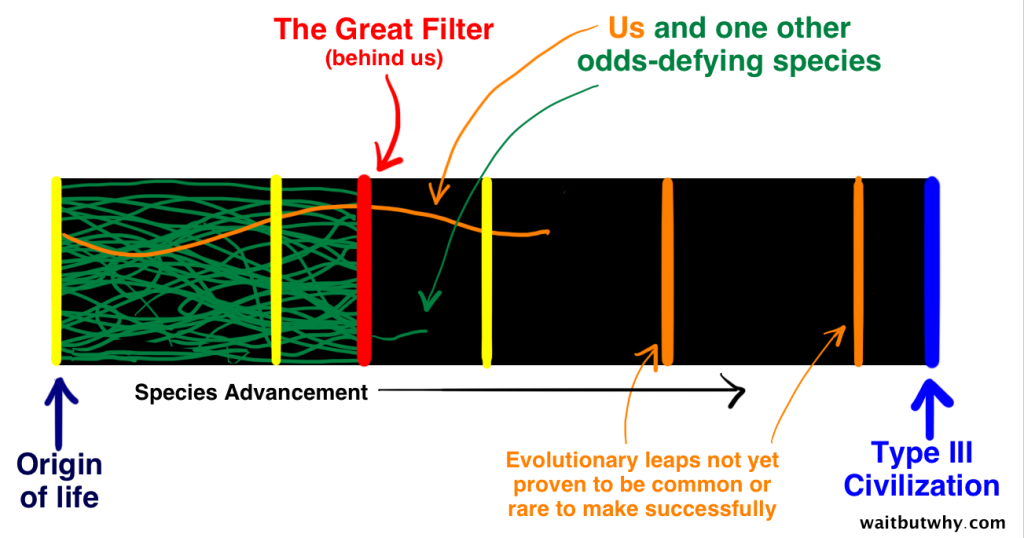
One of the most compelling explanations for the Fermi Paradox is the "Great Filter" theory, proposed by economist Robin Hanson. This theory posits that at some point in the evolutionary journey from abiogenesis (pre-life) to a Type III civilization (capable of harnessing the energy of an entire galaxy, according to the Kardashev scale), there exists a "wall" or barrier that all, or nearly all, attempts at life hit. This stage is extremely unlikely or impossible for life to get beyond. The critical question for humanity then becomes: is the Great Filter behind us, or is it still ahead?
Wait But Why, a popular science blog, effectively categorizes the Great Filter into three main possibilities:
-
The Filter is Behind Us (We are Rare): This optimistic scenario suggests that one or more extremely improbable steps in life’s evolution have already occurred on Earth, making our existence exceptionally rare.

- The Origin of Life (Abiogenesis): The transition from non-living matter to self-replicating life might be incredibly difficult, a "miracle" that happened only once or very rarely. The specific conditions on early Earth that allowed complex organic molecules to form and self-assemble might be unique.
- The Evolution of Complex Life (Eukaryotes and Multicellularity): The development of eukaryotic cells from simpler prokaryotes, and then the subsequent emergence of multicellular organisms, were pivotal and lengthy processes on Earth. It took billions of years for complex life to appear after the first single-celled organisms. These steps might represent severe bottlenecks.
- The Rise of Intelligence and Technology: Even with complex life, the evolution of tool-using, problem-solving intelligence capable of developing advanced technology might be highly improbable. Many species on Earth are complex but have not developed advanced technology.
If the filter is behind us, humanity has overcome immense odds, and our continued existence suggests a relatively open future, albeit one possibly devoid of cosmic companions.
-
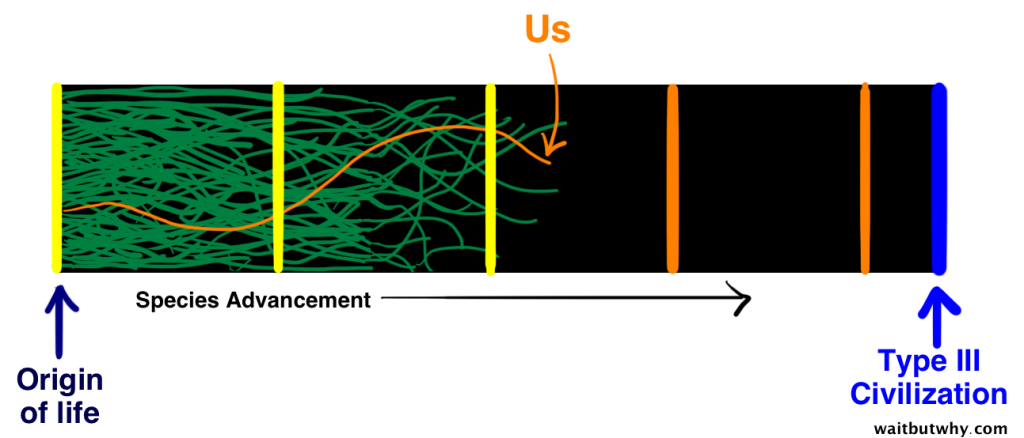
The Filter is Ahead of Us (We are Doomed): This pessimistic, yet arguably more common, interpretation suggests that a catastrophic barrier awaits all intelligent civilizations once they reach a certain level of technological advancement.
- Self-Destruction through Technology: This is a frequently cited filter. Civilizations might develop technologies (e.g., nuclear weapons, advanced bioweapons, uncontrolled artificial intelligence, nanotechnology gone awry) that inevitably lead to their demise. The current global challenges of climate change, resource depletion, and the proliferation of destructive technologies could be viewed as early warning signs of such a filter.
- Resource Depletion and Environmental Collapse: Advanced industrial civilizations require vast resources. Unsustainable consumption and pollution could render a planet uninhabitable, leading to societal collapse and extinction before interstellar capabilities are achieved.
- Cosmic Catastrophes: While less likely to be a universal filter for all civilizations, phenomena like gamma-ray bursts, asteroid impacts, or supervolcanic eruptions could wipe out life on individual planets before it reaches interstellar capability. However, for it to be a Great Filter, it would need to be something that universally prevents civilizations from spreading.
If the filter is ahead, then humanity’s future is precarious, and our current technological trajectory might be leading us directly towards an inevitable collapse.
-
We Are Alone (No Other Life Exists): This extreme view posits that life itself, or intelligent life specifically, is so incredibly rare that Earth is unique, at least within our observable cosmic neighborhood. This would mean
florfiin the Drake Equation are infinitesimally small. While exoplanet discoveries have shown that planets are abundant, and many exist in habitable zones, the specific conditions required for the long-term stability and evolution of complex life might be far more stringent than currently understood.
Beyond the Filter: Other Hypotheses
While the Great Filter provides a powerful framework, other hypotheses attempt to explain the Great Silence:
-
The Zoo Hypothesis: Proposed by John Ball, this theory suggests that extraterrestrial civilizations are aware of humanity but deliberately choose not to contact us, treating Earth as a protected wilderness area or a scientific experiment. They might adhere to a "Prime Directive" of non-interference, allowing indigenous life to evolve naturally without contamination or influence. Our current inability to detect them would be a testament to their advanced stealth capabilities.
-
The Planetarium Hypothesis: Developed by Stephen Baxter, this radical idea suggests that the universe we perceive is a simulated reality, designed to appear empty of other life. A powerful, unseen intelligence might be running this simulation, and for reasons unknown, has chosen to exclude overt signs of other civilizations.
-
Technological Singularity and Transcendence: This hypothesis, aligned with the original article’s personal theory, posits that advanced civilizations eventually undergo a technological singularity, leading to a profound transformation. They might shed their physical forms, merging into vast, hyper-efficient computational networks or migrating into simulated realities. As Jeff Atwood and Seth Shostak suggest, such post-biological intelligences might prioritize efficiency and information processing over large-scale physical construction or interstellar colonization. "Why build planet-size anything when the real action is in the small things? Small spaces, small units of time, everything gets smaller." If intelligence evolves towards microscopic or purely digital forms, they would be virtually undetectable by our current methods, operating within "the infinite spaces between" observable phenomena. Their goals and existence would be so alien to our own physical reality that we wouldn’t even know what to look for.
-
Lack of Interest in Communication/Travel: Perhaps advanced civilizations simply lose interest in communicating with or traveling to less developed worlds. Their priorities might shift inward, focusing on internal development, art, philosophy, or solving problems within their own systems. Interstellar travel might be too energy-intensive, time-consuming, or dangerous to be worth the effort for most.
-
Too Far Apart/Too Short-Lived: Even if many civilizations exist, the sheer distances in the galaxy, combined with the finite speed of light, mean that signals could take millennia to travel between stars. If civilizations are also relatively short-lived (low
Lin the Drake Equation), they might rise and fall before their signals reach another star system, or before another civilization is ready to receive them. Our window for detection might be extremely narrow.
Current Efforts and Future Implications
Despite the enduring silence, humanity’s search for extraterrestrial intelligence (SETI) continues. Projects like SETI@home, the Allen Telescope Array, and the Breakthrough Listen initiative actively scan radio and optical wavelengths for artificial signals. These efforts represent a global scientific commitment to answering Fermi’s profound question. The discovery of thousands of exoplanets, many potentially habitable, fuels optimism that the universe is indeed teeming with worlds where life could arise.
The implications of finally answering the Fermi Paradox are immense. If we discover evidence of other intelligent life, it would fundamentally alter our understanding of our place in the cosmos, potentially ushering in an era of unprecedented scientific and philosophical advancement. It would provide crucial insights into the potential trajectory of technological civilizations and the commonalities or divergences of intelligent evolution.
Conversely, if the silence persists, it reinforces the possibility of a Great Filter. If the filter is behind us, humanity might be a truly unique cosmic experiment, placing an even greater responsibility on us to protect and sustain life on Earth. If the filter is ahead, it serves as a stark warning, urging us to navigate our technological and societal development with extreme caution to avoid the pitfalls that may have befallen countless potential civilizations before us. The quest to understand "Where is everybody?" is not just about finding aliens; it is fundamentally about understanding ourselves and our destiny in the vast, silent universe.
About the Author








