A significant development has emerged in the realm of 3D asset creation and game development integration, with the launch of a comprehensive new course designed to bridge the gap between Blender’s advanced modelling capabilities and the interactive demands of Unreal Engine. Titled "Blender to Unreal Engine 5: Playable Stylized Turret," this educational offering, developed by Luke of 3D Tudor, aims to provide artists with a complete workflow for transforming static 3D models into functional, game-ready assets. The course specifically targets the common challenges encountered when moving complex hard-surface models from design environments like Blender into real-time engines such as Unreal Engine, ensuring that assets not only look visually appealing but also behave correctly within a game environment.
The core of the course addresses a persistent hurdle faced by many 3D artists: the transition from a visually complete model in a DCC (Digital Content Creation) application to an asset that functions dynamically within a game engine. This often manifests as critical errors in animation, hierarchy, and interaction, where components that should remain stationary move unexpectedly, or articulated parts fail to respond to player input. The "Playable Stylized Turret" course posits that these issues stem from a lack of foresight during the modelling phase, where the intended in-game functionality is not considered from the outset.
Comprehensive Workflow: From Concept to Interactive Asset
The educational journey begins within Blender 5.2, where participants are guided through the entire process of creating a stylized hard-surface sci-fi turret. This encompasses the initial blockout of the model’s silhouette, progressing through the detailed construction of its mechanical components. Students will learn to meticulously build elements such as the foundational base, a stepped platform, the central turret housing, dual weapon arms, supporting legs, intricate paneling, connectors, and even flexible curved cables. The modelling techniques employed are practical and industry-standard, utilizing tools like bevels, Booleans, array modifiers, and curve objects, all while maintaining clean topology and clear visual readability essential for game asset optimization.
Crucially, the course emphasizes a design philosophy where the model’s intended behavior dictates its construction. Decisions regarding which parts should remain fixed (the base), which should rotate horizontally (the upper assembly), and which should pivot vertically (the weapon group) are integrated into the modelling process from the very beginning. This proactive approach influences key aspects such as mesh segmentation, the strategic placement of object origins, the meticulous planning of UV layouts, and the correct export procedures for the FBX file format, all of which are critical for a seamless import into Unreal Engine. This foresight prevents common issues where a model’s pivot points are incorrectly set, leading to erratic rotations or unintended movements once imported into the game engine.
Harnessing Baked Masks for Advanced Shading and Materialization
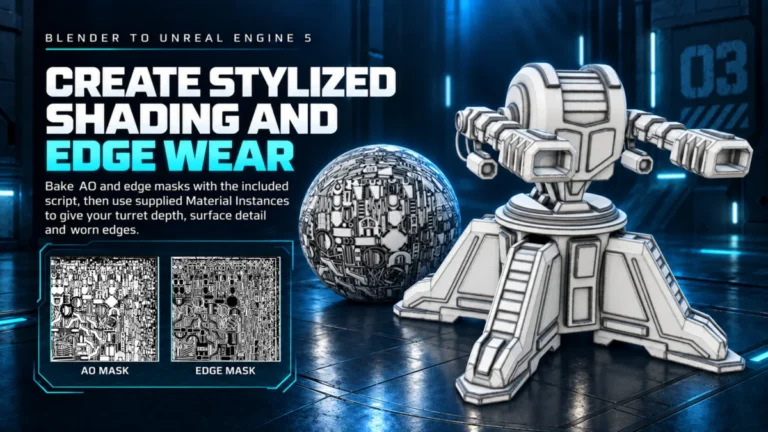
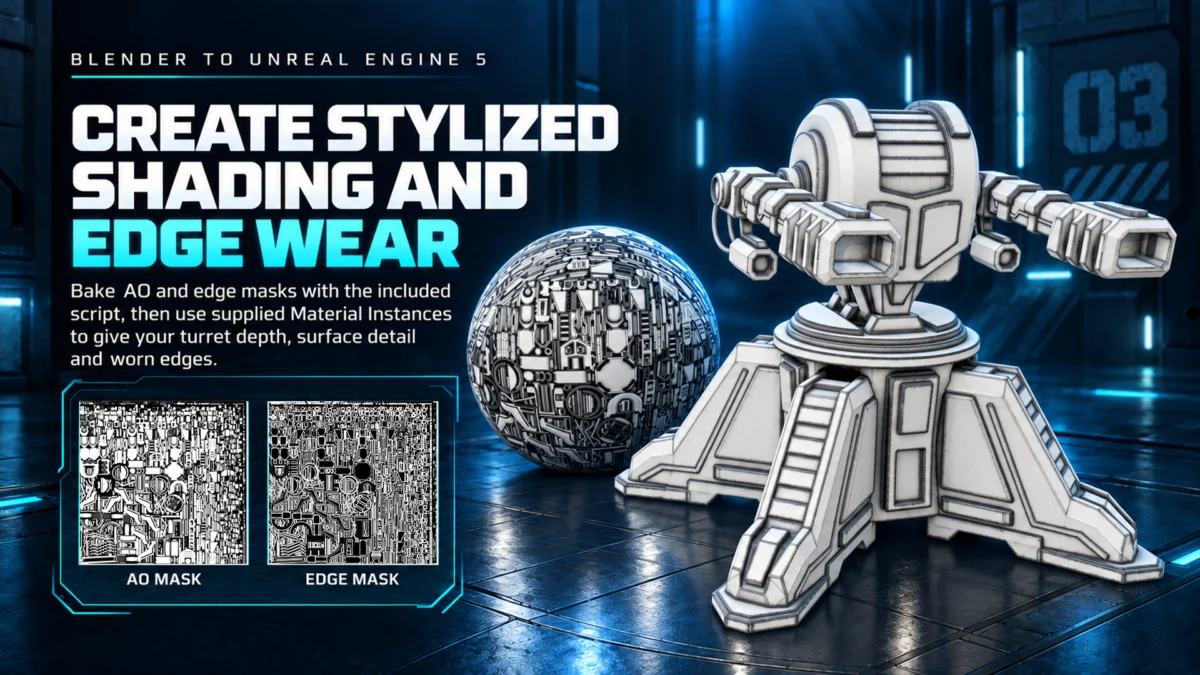
A pivotal stage in the course involves the transformation of baked masks into sophisticated material instances within Unreal Engine. Once the turret model has a finalized and optimized UV layout, an accompanying Blender script is provided. This script automates the generation of essential texture maps, specifically ambient occlusion (AO) and edge masks. The ambient occlusion map plays a crucial role in enhancing the visual depth and realism of the model by accentuating recessed areas and points of contact, creating subtle shadows that define the form.

The edge mask, a more specialized map, is designed to drive a stylized worn-edge effect within the Unreal Engine Material Instances. This allows for a visually appealing and consistent aging or weathering treatment across the turret’s surfaces, giving it a lived-in, battle-hardened appearance without requiring complex manual painting.
Upon transitioning to Unreal Engine 5.8, students will be guided through the process of assigning these prepared materials to the imported turret meshes. The course leverages Unreal Engine’s Material Instance system, allowing for easy customization and iteration. By replacing exposed texture parameters within these instances with the generated AO and edge masks, artists can achieve a sophisticated visual style. This results in a final look that artfully combines distinct regions of light and dark metal, vibrant blue accent panels, and subtle green emissive details, all contributing to a cohesive and stylized aesthetic. The integration of these baked maps significantly streamlines the texturing process, ensuring high-quality visual fidelity with optimized performance.
Implementing Player Control with Unreal Engine Blueprints
The culmination of the course lies in transforming the visually complete and textured asset into a fully interactive element within Unreal Engine. The imported turret components are meticulously assembled into a player-controlled Pawn, a fundamental building block in Unreal Engine for interactive characters and objects. This involves setting up the correct hierarchy and relationships between the different parts of the turret to ensure they respond independently and correctly to player input.
The course demonstrates how to implement intuitive controls using Unreal Engine’s Blueprint visual scripting system. Players will learn to associate specific keyboard inputs with distinct actions: pressing ‘A’ and ‘D’ keys will control the horizontal rotation of the upper turret assembly, while ‘W’ and ‘S’ keys will manage the vertical aiming of the weapon systems. Furthermore, the implementation of firing mechanics is covered, with the spacebar triggering a line trace from each muzzle, simulating projectile firing.
The provided "target-range" project serves as a practical testing ground. This starter project includes a pre-built environment with moving and respawning targets, a scorekeeping system, a countdown timer, and a Heads-Up Display (HUD). The student’s objective is to integrate their newly created and controlled turret into this existing challenge, demonstrating the successful connection between their asset and the gameplay framework. This approach underscores the course’s focus on asset integration rather than building an entire game from scratch, maintaining a manageable scope and delivering a tangible, playable outcome.
Course Resources and Launch Offer
The downloadable resources accompanying "Blender to Unreal Engine 5: Playable Stylized Turret" are extensive and designed to support learners at various stages. They include eight detailed turret reference renders to inspire and guide the modelling process. The indispensable Blender script for baking AO and edge masks is also provided, automating a crucial part of the workflow. For the Unreal Engine side, participants receive the target-range starter project, pre-made materials and Material Instances, and additional gameplay-support assets. Finally, completed reference projects in both Blender 5.2 and Unreal Engine 5.8 are included, allowing students to compare their work and troubleshoot any issues.

The target range project, while providing a ready-made environment, is structured to facilitate learning rather than bypass it. Students are still responsible for the core tasks: creating the turret model, developing its UVs, generating the necessary masks, structuring the moving components, assigning Material Instances, building the Pawn hierarchy, implementing aiming controls, and programming the dual-muzzle firing logic.
To commemorate the launch, "Blender to Unreal Engine 5: Playable Stylized Turret" is being offered at a significant discount. For a limited time, the course is available for $9.99, representing a 60% reduction from its standard price. This promotional offer is accessible using the code TURRETBLASTOFF and is valid until September 23, 2026, at 18:00 EET. This pricing strategy is common for new course releases, aiming to attract a broad audience and gather early user feedback.
The launch of this course comes at a time when the demand for skilled 3D artists capable of producing game-ready assets is consistently high across the gaming industry. The integration of stylized art directions with robust technical implementation is a sought-after skill set, particularly with the increasing prevalence of stylized aesthetics in both indie and AAA game development. Courses that effectively bridge the gap between artistic creation and technical execution in engines like Unreal Engine 5 are therefore highly valuable.
Broader Implications for Game Development Workflows
The implications of this course extend beyond individual artists. For game development studios, particularly those with smaller teams or those focusing on stylized graphics, adopting efficient workflows like the one presented can significantly accelerate asset production. The emphasis on planning for in-game functionality from the initial modelling stages can prevent costly rework and delays during the integration and testing phases. This holistic approach, where modelling, texturing, and interactive scripting are considered in tandem, represents a mature and professional development pipeline.
The focus on baked masks, a technique that has seen a resurgence in popularity for its ability to achieve detailed and stylized looks efficiently, highlights a modern approach to material creation. By automating the generation of these masks and integrating them seamlessly with Unreal Engine’s Material Instances, the course provides a scalable solution for creating visually rich assets. This is particularly beneficial for projects requiring a large number of similar assets, where consistency and efficiency are paramount.
Furthermore, the clear distinction made between creating a single playable asset and developing an entire game from scratch is a pragmatic approach that resonates with many aspiring game developers. It allows learners to focus on mastering a specific, yet crucial, aspect of game development, building confidence and foundational skills that can be applied to larger projects in the future. The structured learning path, culminating in a tangible, playable outcome, provides a strong sense of accomplishment and practical understanding.
In conclusion, the "Blender to Unreal Engine 5: Playable Stylized Turret" course represents a timely and valuable educational resource. By addressing the critical intersection of 3D modelling, real-time rendering, and interactive design, it equips artists with the knowledge and practical skills necessary to produce professional-grade, game-ready assets. The comprehensive workflow, combined with practical resources and a strategic launch offer, positions this course as a significant contribution to the ongoing evolution of 3D asset creation for interactive media.
About the Author