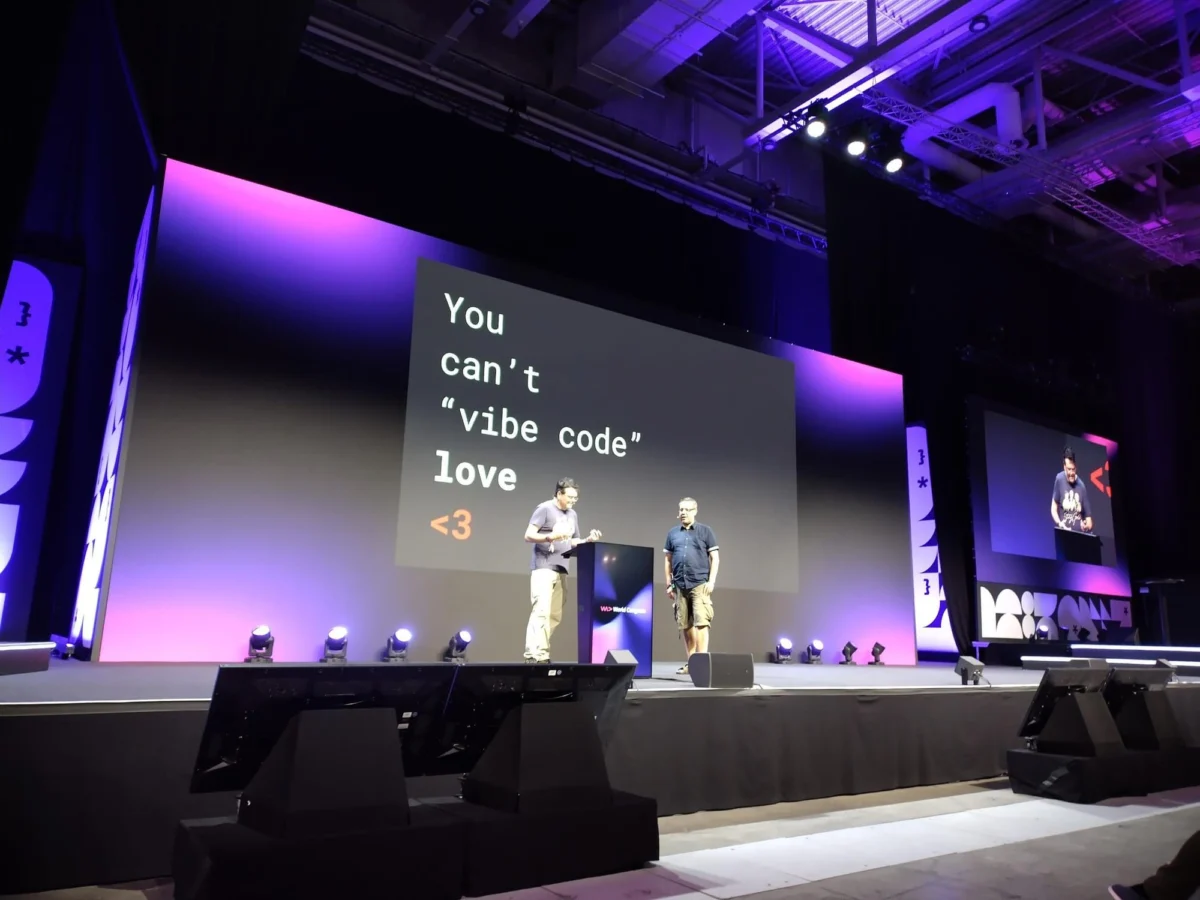
Berlin, Germany – In a highly anticipated address at the WeAreDevelopers World Congress, tech luminaries Jeff Atwood, co-founder of Stack Overflow, and Ben Dumke-von der Ehe, an early and influential community hire at the platform, presented a thought-provoking session titled "None of Us Is As Dumb As All of Us: Community And Knowledge Go Hand In Hand." Delivered on Friday, July 10th, at the CityCube in Berlin, their joint presentation delved into the evolving landscape of developer knowledge sharing, the historical impact of Stack Overflow, and the transformative, yet potentially disruptive, role of Large Language Models (LLMs) on the future of open knowledge and community building.
The decision for Atwood, known for his infrequent speaking engagements, particularly international ones, to accept the invitation to WeAreDevelopers underscored the critical nature of the topics at hand. His acceptance was contingent on the co-presentation of Ben Dumke-von der Ehe, a testament to their unique professional and personal connection and their shared, albeit distinct, perspectives on the evolution of developer communities. This collaboration provided a rich, multifaceted view of the challenges and opportunities facing the tech world as artificial intelligence rapidly integrates into daily development workflows.
The Genesis of a Collaboration: WeAreDevelopers World Congress
The WeAreDevelopers World Congress stands as one of Europe’s premier gatherings for developers, engineers, and tech innovators, regularly attracting thousands of attendees and featuring a roster of global industry leaders. Known for its focus on cutting-edge technologies, practical coding insights, and forward-looking discussions on the future of software development, the event provides a significant platform for influential voices. Berlin, a vibrant European tech hub, served as an apt backdrop for a discussion on the global impact of community-driven knowledge.
Atwood’s selective approach to public speaking engagements meant that the invitation from WeAreDevelopers arrived at a confluence of factors — the right timing, the right location (given Dumke-von der Ehe’s residence in Berlin), and the right co-presenter. This specific alignment highlighted a shared urgency between Atwood and Dumke-von der Ehe to articulate their perspectives on the intersection of human collaboration and artificial intelligence. The organizers readily agreed to the contingency, recognizing the unique value of bringing these two pivotal figures together on stage. Their combined experience offered an unparalleled historical perspective on the growth of one of the internet’s most vital knowledge resources for developers and a keen insight into its future trajectory amidst technological disruption.
A Story of Shared Impact: The Human Element of Stack Overflow
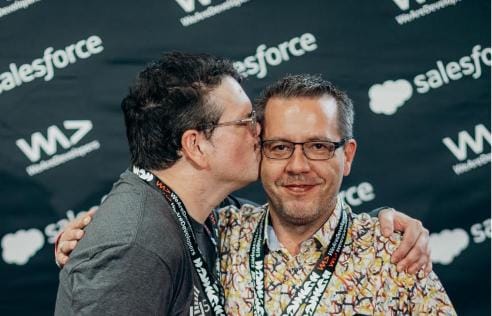
At the heart of their presentation was a deeply personal narrative illustrating the profound impact of community. Atwood shared that the long version of his story with Ben involved them changing each other’s lives, humorously encapsulating the short version as "unicorns." This anecdote hinted at the serendipitous and often magical connections forged within vibrant online communities. Ben Dumke-von der Ehe, an early community hire at Stack Overflow, played a crucial role in shaping the platform’s early culture and structure. His journey, which included leaving Stack Overflow, returning, and then departing again, reflects the dynamic nature of careers within the tech ecosystem and his enduring commitment to the principles of open knowledge.
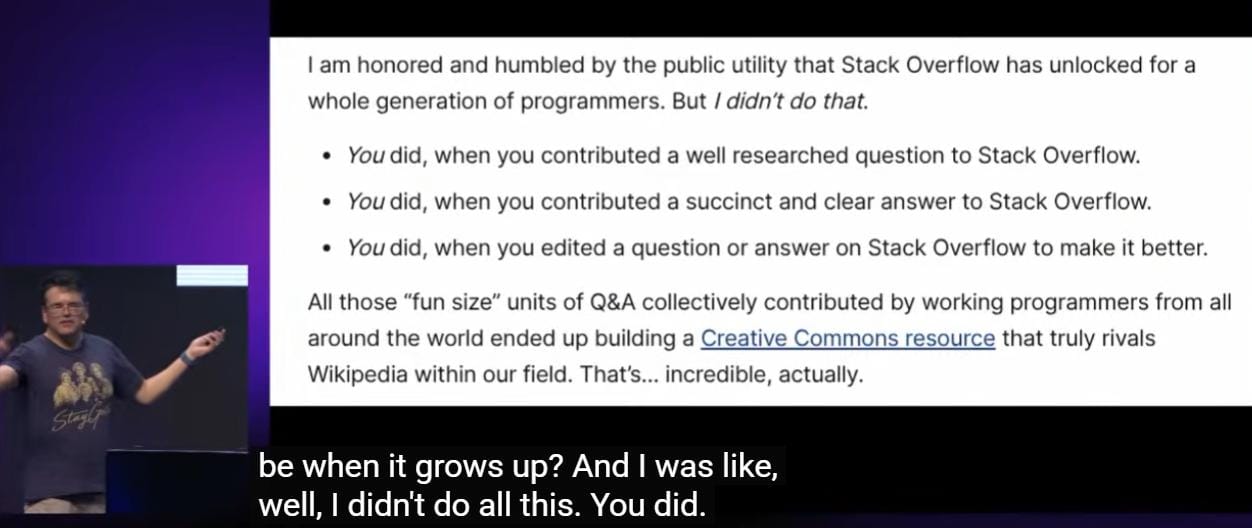
Atwood openly acknowledged his significant debt, stating, "I’m mostly doing this presentation because I owe you so much," not only to Ben but to "everyone who participated on Stack Overflow." This sentiment underscores a core principle that underpinned Stack Overflow’s success: collective effort. The platform was built together, under a bedrock Creative Commons license (specifically, CC BY-SA, which has evolved through versions like 2.5, 3.0, and 4.0 over time). This licensing framework was crucial in respecting and protecting the intellectual contributions of millions of developers who poured their expertise into building what became an immensely influential dataset and a global "commons" of programming knowledge. This commitment to open licensing allowed the content to be freely shared, adapted, and built upon, fostering an ecosystem of learning and collaboration that transcended geographical boundaries.
Stack Overflow’s Vision and the LLM Revolution
The presentation articulated Stack Overflow’s foundational vision, which, surprisingly, aligns in some ways with the capabilities now offered by LLMs. Atwood reiterated the platform’s higher-level goals, emphasizing that "Passively searching and reading highly ranked Stack Overflow answers as they appear in web search results is arguably the primary goal of Stack Overflow." He further elaborated that if the platform functioned optimally, "98% of programmers should get all the answers they need from reading search result pages and wouldn’t need to ask or answer a single question in their entire careers. This is a good thing! Great, even!" This long-held objective was about maximizing efficiency in knowledge retrieval, ensuring developers could quickly find solutions without the friction of asking new questions.
One of the most significant challenges that plagued platforms like Stack Overflow from their inception was the "Gordian knot" of duplicate questions. As Atwood explained, "When you’re asking a question on a site that doesn’t allow duplicate questions, the problem space of a site with 1 million existing questions is rather different from a site with 10 million existing questions… or 100 million." The sheer volume made asking a truly unique question increasingly difficult, forcing users to navigate a "vast, enormous field of prior art questions without stepping on any of the vaguely similar looking landmines." This phenomenon, known to many community moderators, often led to frustration and a perception of elitism or gatekeeping, despite its underlying purpose to maintain a clean, organized knowledge base.
Enter Large Language Models. Atwood highlighted their transformative power in addressing this long-standing issue. LLMs possess the unprecedented ability to "map a duplicate question using entirely different words to an existing answer," a capability that was once considered almost impossible for traditional search algorithms. This capacity to understand semantic similarity beyond keyword matching represents a huge net positive. The immediate benefits are clear: significantly less duplication across knowledge bases, faster access to relevant answers, and a streamlined information retrieval process for developers. This advancement directly contributes to the core goal of efficiency that Stack Overflow itself championed.

The Paradox of Progress: AI’s Impact on the Knowledge Commons
Despite the undeniable efficiencies brought by LLMs, Atwood and Dumke-von der Ehe posed a critical question that resonated deeply with the audience: "But what happens to the commons when everyone is privately whispering to LLMs?" This query struck at the heart of a looming paradox. While LLMs excel at retrieving and synthesizing existing knowledge, their rise could inadvertently undermine the very mechanisms that generate new, high-quality, and openly accessible information.
The concern extends beyond mere information retrieval to the health and vitality of developer communities. Ben Dumke-von der Ehe’s personal experience vividly illustrates this point. He "had so much fun becoming a programmer, and got hired for doing things he loved" largely through his active participation in the Stack Overflow community. These communities are not just repositories of answers; they are spaces for learning, mentorship, peer interaction, and the development of professional networks. They foster a sense of belonging and provide opportunities for individuals to gain recognition, refine their communication skills, and even discover career paths through their contributions.
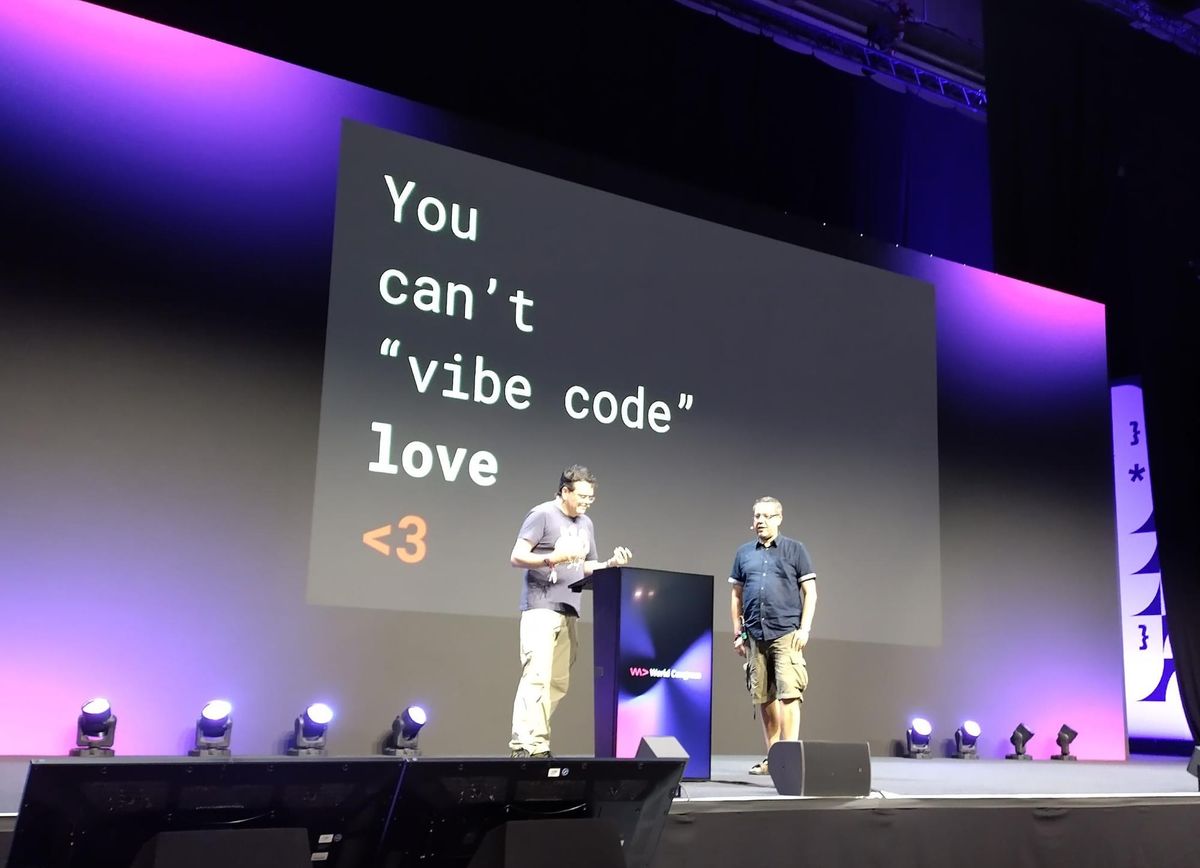
The presenters emphasized that "You can’t ‘vibe code’ love." This evocative phrase captures the intangible, human elements of collaborative learning that are difficult, if not impossible, to replicate through solitary interaction with an AI. The spontaneous exchange of ideas, the collaborative debugging sessions, the shared frustrations and triumphs, and the organic mentorship that occurs within a vibrant community are essential components of a developer’s growth. If developers increasingly turn to private AI assistants for every query, the collective engagement that fuels these "commons" risks diminishing, potentially leading to a quieter, more isolated learning experience. This shift could impact not just individual learning but also the broader culture of innovation that thrives on open exchange.
The Future of Knowledge Creation and AI Training Data
The most profound implication raised by the presentation centers on the sustainability of knowledge creation itself. Atwood and Dumke-von der Ehe challenged the audience to consider: "Where exactly will the LLMs get their next set of training data from, if we don’t build for and protect the commons together?" This question highlights a fundamental dependency. Current LLMs are trained on vast datasets of human-generated content, much of which originates from open, community-driven platforms like Stack Overflow, Wikipedia, and countless open-source projects. If the shift towards private AI interactions leads to a reduction in public contributions and the erosion of these open knowledge bases, the quality and relevance of future AI models could suffer.
This creates a critical feedback loop: AI models consume existing human knowledge, but if they also inadvertently disincentivize the creation of new public knowledge, they could eventually starve themselves of fresh, diverse, and cutting-edge training data. The ethical dimension of this relationship is also significant. Many commercial AI applications leverage data contributed freely by individuals under open licenses, raising questions about attribution, compensation, and the sustainable future of these data ecosystems. The call to "share knowledge – and love – with each other" serves as an urgent reminder that knowledge creation is an ongoing, collaborative act that requires conscious nurturing and protection. It underscores the concept of a "philomath," a lover of learning and study, suggesting that the intrinsic human desire to share and grow knowledge is a vital force that must be preserved.
Broader Implications and Industry Reactions
The Atwood-Dumke-von der Ehe presentation at WeAreDevelopers Congress ignited a crucial conversation with far-reaching implications for the entire tech industry.
For Developer Communities: The challenge is to adapt. Existing platforms like Stack Overflow, Reddit, and various specialized forums must innovate to remain relevant and foster engagement beyond simple Q&A. This could involve focusing on more complex problem-solving, facilitating deeper discussions, promoting collaborative project work, and integrating AI tools in ways that augment human interaction rather than replace it. The emphasis might shift from basic information retrieval to advanced knowledge synthesis, mentorship, and the cultivation of niche expertise that AI models, for now, cannot fully replicate.
For Stack Overflow and Similar Platforms: The future likely involves a hybrid model. While LLMs handle routine queries, platforms could focus on fostering discussions around novel problems, emerging technologies, ethical considerations in coding, and advanced architectural patterns. They might also leverage AI internally to improve moderation, identify gaps in knowledge, and personalize learning paths, thereby enhancing the community experience. The company behind Stack Overflow has already begun exploring ways to integrate AI, such as their OverflowAI initiatives, aiming to create tools that work alongside human contributors.
For AI Developers and Companies: There is a growing responsibility to address the source of their training data. Discussions around fair use, licensing, attribution, and potential mechanisms for contributing back to the commons are becoming increasingly vital. This could involve financial contributions to open-source projects, direct partnerships with knowledge platforms, or the development of AI models that actively encourage and reward human contribution rather than simply consuming it. The long-term sustainability of AI development hinges on a robust and continuously refreshed pool of human-generated knowledge.
For the Tech Industry as a Whole: The overarching implication is the need to find a sustainable balance between the efficiency gains offered by AI and the preservation of human skill development, social learning, and the invaluable "commons" of open knowledge. While AI can accelerate individual productivity, the collective intelligence and collaborative spirit of human communities remain indispensable for innovation, problem-solving, and the ethical evolution of technology. The presentation served as a potent reminder that technology, at its best, should empower human connection and creativity, not diminish it.
Conclusion
The joint presentation by Jeff Atwood and Ben Dumke-von der Ehe at the WeAreDevelopers World Congress was more than just a retrospective on Stack Overflow; it was a prescient call to action regarding the future of knowledge sharing in an AI-dominated world. While Large Language Models offer undeniable benefits in streamlining information access and resolving common programming questions, the potential erosion of the open knowledge commons and the human communities that build it poses a significant threat. Their message underscored that the unique human elements of collaboration, mentorship, and shared passion – the "love" of coding and learning – cannot be replicated by algorithms. As the tech industry continues to embrace AI, the critical challenge will be to consciously foster and protect the environments where knowledge is not just consumed, but actively created, shared, and nurtured by human interaction, ensuring that the wellspring of future AI training data, and indeed, future innovation, continues to flow.
About the Author