The global mobile gaming landscape in the third quarter of 2026 has demonstrated a complex interplay of maturing legacy titles, regulatory pressures, and a shifting balance between gaming and non-gaming application revenue. According to the latest market intelligence from Sensor Tower, the world’s top 10 mobile games generated a collective $3.8 billion in gross in-app purchase (IAP) revenue during Q3 2026. While this figure represents a staggering sum, it reflects a 3% decline compared to the second quarter, suggesting a slight cooling of the post-pandemic spending surge or a reallocation of consumer discretionary income toward emerging non-gaming utility and AI-driven applications.

Dominance of Legacy Titles and the Rise of the Merge Genre
Tencent’s perennial heavyweight, Honor of Kings, maintained its position as the world’s highest-grossing mobile title, securing $556 million in revenue for the quarter. The game’s longevity is attributed to its deep integration into the Chinese social fabric and a consistent cadence of content updates that have kept its massive player base engaged for over a decade. However, the most significant movement in the top ranks came from Microfun’s Gossip Harbor. The title ascended from fourth to second place, generating $444 million. This surge underscores a broader industry trend where "Merge 2" and "Merge 3" puzzle games are capturing a larger share of the casual market, often at the expense of traditional Match-3 titles.
Whiteout Survival and Royal Match followed in third and fourth places, earning $392 million and $386 million, respectively. Both titles saw a marginal slip in rankings, reflecting the hyper-competitive nature of the mid-core and puzzle segments. Meanwhile, Pokémon Go experienced a dramatic resurgence. On the strength of its 10th-anniversary live events and global "Go Fest" initiatives, the augmented reality pioneer jumped from 21st to ninth place. Its Q3 revenue of $319 million more than doubled its Q2 performance, proving that well-executed live-service events remain a potent tool for revitalizing legacy IP.

Roblox also solidified its top-tier status, climbing to eighth place with $322 million. The platform’s growth was driven by a 56% quarter-on-quarter revenue increase and a 27% rise in downloads. Industry analysts point to Roblox’s expanding suite of developer tools and its successful push into older demographic brackets as the primary catalysts for this sustained momentum.
Analyzing the 2026 New Launch Pipeline
The year 2026 has been a prolific period for new releases, with AppMagic identifying 158 mobile games that have already surpassed the $1 million IAP revenue milestone. Leading this cohort is the 4X strategy title Last Asylum: Plague, which has amassed $77.1 million in lifetime revenue. Interestingly, while it eventually led the pack, it took 18 days to reach its first million, a relatively slow start compared to high-profile RPGs.

In contrast, Arknights: Endfield and Hololive Dreams reached the $1 million mark within just 48 hours of launch, generating $72.9 million and $48.8 million in lifetime revenue, respectively. The fastest-ever ascent to the million-dollar mark in 2026 was achieved by the Chinese shooter "Battle: Future," which hit the milestone in a single day. This disparity highlights a fundamental truth in mobile publishing: RPGs and IP-driven shooters often benefit from massive "day-one" surges driven by pre-registration campaigns, whereas strategy and puzzle games—such as Hollywood Merge, which took 40 days to reach $1 million—rely on long-term user acquisition and retention to build their revenue base.
AppMagic’s data reveals that while IP-based games reach the $1 million mark 2.4 times faster than original titles, their median lifetime revenue is only 30% higher. This suggests that while a known brand reduces the initial barrier to entry, the long-term commercial success of a game remains dependent on core gameplay mechanics and monetization loops rather than brand recognition alone.

Global Platform Dynamics and Player Growth
A comprehensive 108-page report from Google’s CEE apps lead, Mariusz Gąsiewski, utilizing Newzoo data, projects that mobile will account for 56.6% of all global games revenue by the end of 2026. This places mobile significantly ahead of console (21.9%) and PC (21.5%). The sheer scale of the mobile audience continues to dwarf all other platforms. Of the 3.7 billion active gamers worldwide, 2.31 billion play on Android and 795 million on iOS. For comparison, Steam hosts 401 million players, followed by PlayStation (365 million), the Epic Games Store (311 million), Nintendo (247 million), and Xbox (231 million).
Mobile is also forecasted to maintain the highest growth trajectory in the industry, with a projected player growth rate of 3.9% in 2026, outpacing PC (3.5%) and console (3%). This growth is expected to remain consistent through 2029, driven largely by increasing smartphone penetration in emerging markets and the continued refinement of cloud gaming services that allow high-end experiences on mobile hardware.

Regulatory Challenges in the Asia-Pacific Region
The "App Store Tax" debate reached a new flashpoint in South Korea this quarter. The country’s Media and Communications Commission imposed a combined fine of $47.6 million on Google and Apple for violating local app payment regulations. Google was ordered to pay KRW 42.9 billion ($32 million), while Apple was fined KRW 20.81 billion ($15.6 million).
The regulator’s investigation concluded that both tech giants had unfairly restricted developers from using external payment systems. Furthermore, even when third-party options were presented, the platforms reportedly charged a 26% commission, which the commission deemed excessive and anti-competitive. Both companies have been ordered to facilitate clearer links to external payment options. While Apple has expressed disagreement and is currently reviewing its legal options, the ruling sets a significant precedent for other jurisdictions looking to curb the dominance of the mobile duopoly.

Corporate Financial Performance: Capcom and Xbox
Capcom’s financial results for the first half of the fiscal year (ending September 30) showcase a company firing on all cylinders. The Digital Contents segment, which encompasses its gaming division, saw revenue rise 70.8% year-on-year to ¥85.1 billion ($538.4 million). Total net sales for the company rose 49% to ¥120.8 billion ($764.2 million).
Capcom’s success was driven by robust unit sales, which reached 36.86 million, up from 23.85 million the previous year. Key performers included Resident Evil Requiem, which moved over 8 million units, and Pragmata, which finally saw a successful release with 2.7 million units. The company’s strategy of leveraging its deep back catalog alongside high-quality new releases has allowed it to maintain high margins despite the increasing costs of AAA development.

Conversely, Microsoft’s Xbox division reported a 2% decline in revenue for the quarter. While this is an improvement over the 10% decline seen in the previous quarter, it highlights ongoing challenges in hardware sales, which plummeted 14%. Xbox CEO Asha Sharma noted that while first-party content growth was a bright spot, it was not enough to fully offset the decline in third-party content revenue and fluctuating Game Pass performance.
However, the "Minecraft" franchise remains a cornerstone of Microsoft’s gaming business, reaching all-time highs in both player engagement and revenue during the quarter. Looking ahead, Microsoft expects a recovery in the December quarter, with content and services revenue projected to grow in the mid-to-high single digits, likely bolstered by holiday season releases and hardware bundles.

Emerging Success Stories and Strategic Investments
Several independent and mid-tier titles have reported significant milestones this quarter. Aniimo, a creature-collector backed by FunPlus and developed by Pawprint Studio, has surpassed 15 million players across mobile, PC, and console since its mid-September launch. The game’s success is a testament to the enduring appeal of the monster-collection genre when paired with cross-platform accessibility.
Similarly, Playdigious reported that its mobile port of the roguelike kingdom builder 9 Kings reached 1 million downloads within just two weeks of launch. The game achieved the number one spot in the strategy charts in six countries and was featured as "Game of the Day" in over 170 territories, marking it as the publisher’s most successful free-to-try release to date.

In a move to foster future growth in underserved markets, Google Play has announced the 10 studios selected for its inaugural $1 million Indie Games Fund in Africa. The recipients include four studios from Nigeria, four from South Africa, and one each from Ghana and Kenya. These studios will receive non-dilutive funding and direct mentorship, a strategic move by Google to catalyze the mobile gaming ecosystem in a continent with the world’s fastest-growing youth population.
The Decade in Review: 2016 vs. 2026
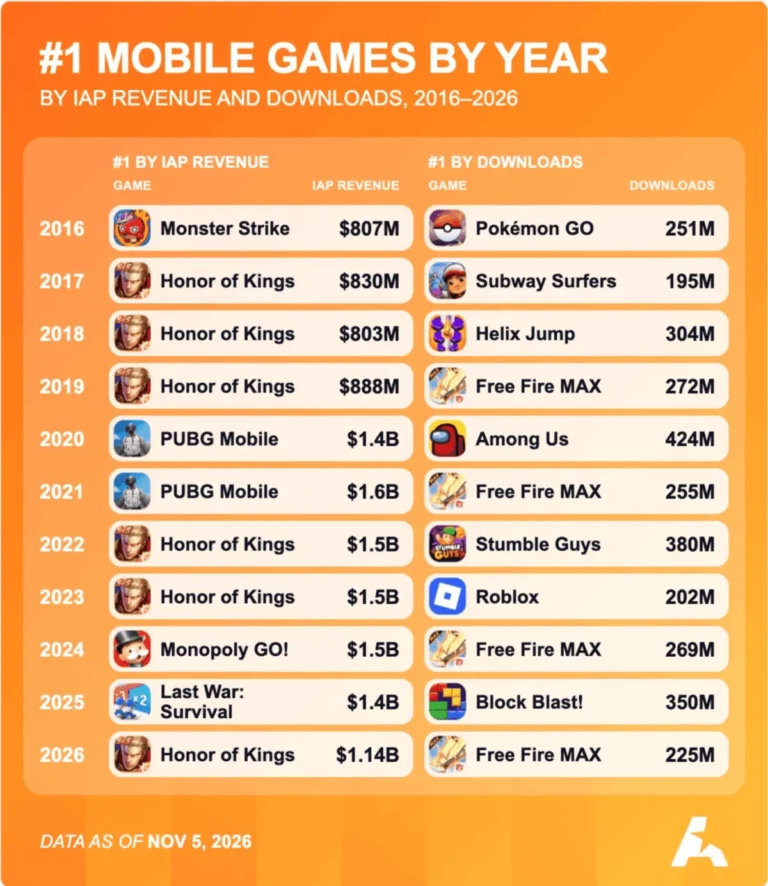
To commemorate its tenth anniversary, AppMagic released a retrospective analysis of the mobile market’s evolution over the last decade. The data reveals a profound shift in consumer behavior. In 2016, games held every single spot in the global top 15 grossing apps. By 2025, however, non-gaming app revenue—driven by the explosion of TikTok, Tinder, and AI tools like ChatGPT—overtook gaming revenue for the first time. In 2026, ChatGPT stands as the world’s most-downloaded app (990 million) and its third-highest-grossing application ($1.9 billion).

Despite the rise of non-gaming apps, specific gaming titles have shown remarkable resilience. Honor of Kings has been the decade’s most durable performer, topping the annual grossing charts six times. PUBG Mobile, which earned a modest $99 million in its debut year, has now generated a lifetime total of $9.1 billion. Other breakout hits of the decade include Royal Match ($4.7 billion) and Monopoly Go ($4.5 billion), both of which redefined their respective genres through aggressive user acquisition and social integration.
As the industry moves toward 2027, the focus is shifting toward sustainable growth and the integration of cross-platform play. While the Q3 3% revenue dip suggests a more cautious consumer, the record-breaking performance of titles like Gossip Harbor and the continued expansion of the mobile workforce—which now employs 123,000 people in Europe alone—indicates that the mobile sector remains the primary engine of the global games industry.
About the Author