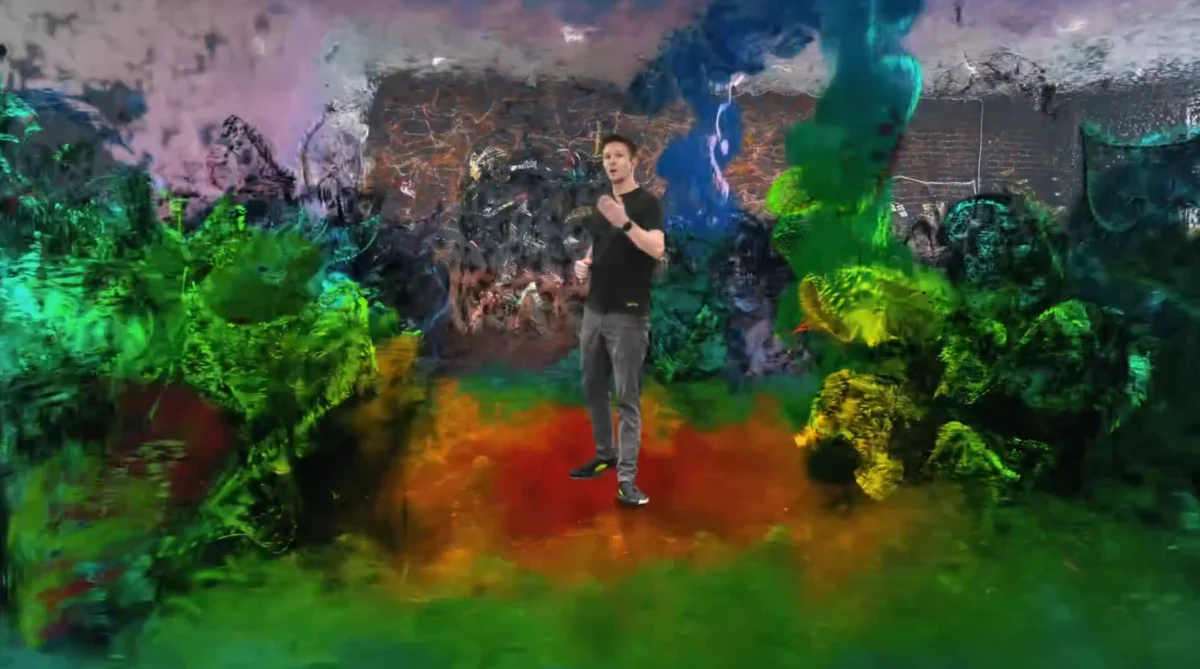
The burgeoning field of computer graphics and visual effects has been revolutionized by the emergence of Gaussian Splatting, a novel 3D scene representation technique that promises to deliver unprecedented levels of realism, particularly in capturing intricate details like reflections and translucency. This innovative technology, brought to prominence by a recent insightful overview from Corridor Crew, represents a significant leap forward from traditional methods of 3D scanning and rendering, potentially reshaping workflows across industries from film and gaming to architectural visualization and virtual reality.
The Dawn of Gaussian Splatting
Gaussian Splatting, while a relatively new term in widespread public discourse, has its roots in advanced computer vision research. The core concept involves representing a 3D scene not as a mesh of polygons or a point cloud, but as a collection of millions of three-dimensional Gaussians. Each Gaussian is defined by its position, orientation, covariance (which dictates its shape and size), and color. This approach allows for a highly detailed and efficient representation of complex geometry and surface properties.
Unlike traditional photogrammetry or mesh-based rendering, which can struggle with capturing fine details, view-dependent effects, and translucent materials, Gaussian Splatting excels in these areas. The ability to represent surfaces as semi-transparent, reflective, and possessing complex subsurface scattering directly within the splatting model opens up a new frontier for visual fidelity. This means that virtual objects and environments can more accurately mimic the way light interacts with real-world materials, leading to a more immersive and believable experience for the viewer.
The recent video from Corridor Crew, a prominent visual effects studio known for its educational content and cutting-edge work, served as a powerful catalyst for broader awareness of Gaussian Splatting. Titled "THIS is the Biggest Thing Since CGI," the video’s bold assertion underscores the transformative potential of this technology. By showcasing practical examples and explaining the underlying principles in an accessible manner, Corridor Crew has effectively highlighted how Gaussian Splatting can overcome limitations that have long plagued 3D content creation.
A Deeper Dive into the Technology
At its heart, Gaussian Splatting involves capturing a scene using multiple photographs from various viewpoints. These images are then processed to reconstruct the 3D geometry and appearance of the scene. The key innovation lies in how this information is stored and rendered. Instead of creating a dense mesh, the system generates millions of Gaussian "splats." These are essentially 3D probability distributions that describe the color and opacity at different points in space.
The rendering process for Gaussian Splatting is remarkably efficient. Because the Gaussians are rendered directly, rather than being converted into polygons, the system can handle an enormous number of detail points without the computational overhead associated with traditional meshing techniques. Furthermore, the anisotropic nature of Gaussians allows them to be stretched and deformed, enabling the representation of elongated or oriented features with high fidelity.
One of the most significant advantages of Gaussian Splatting is its ability to capture view-dependent effects. This means that how an object appears changes realistically as the viewer’s perspective shifts, a crucial element for photorealism. Reflections, refractions, and subtle surface textures that are challenging to replicate with polygon-based models are naturally handled by this technique. This is particularly important for materials like glass, water, and polished metal, where the interplay of light and surface is critical to their perceived realism.
The ability to represent translucency is another game-changer. Traditional methods often require complex shader networks and multiple rendering passes to simulate the way light penetrates and scatters within semi-transparent materials. Gaussian Splatting can, in many instances, capture these properties directly from the input imagery, leading to more accurate and computationally less expensive rendering of objects like frosted glass, leaves, or certain types of fabrics.
The Genesis and Evolution of 3D Scene Representation
To fully appreciate the impact of Gaussian Splatting, it’s essential to consider the historical trajectory of 3D scene representation. Early computer graphics relied on wireframe models, followed by the development of polygonal modeling. This approach involves breaking down objects into a series of interconnected triangles or quadrilaterals. While highly effective and still the dominant paradigm, polygon-based rendering faces inherent limitations. Achieving fine details often requires an extremely dense mesh, which can become computationally prohibitive. Furthermore, representing complex material properties like subsurface scattering or dynamic reflections can demand intricate shader programming and advanced rendering techniques.
Point clouds, collections of individual points in 3D space, offered an alternative, particularly for capturing scanned real-world data. However, point clouds lack inherent surface information, making it difficult to render smooth surfaces or handle complex material interactions without post-processing.
Photogrammetry emerged as a powerful technique for creating 3D models from photographs. It reconstructs geometry by identifying corresponding points across multiple images. While photogrammetry can produce highly detailed models, the resulting meshes can be dense and require significant cleanup and optimization for rendering. Moreover, capturing view-dependent effects and accurate material properties often necessitates additional work.
![[non-Blender] How go Gaussian Splats Work?](https://www.blendernation.com/wp-content/uploads/2026/04/splats.png)
Gaussian Splatting represents a paradigm shift by moving away from explicit geometric primitives like polygons and towards a more implicit, data-driven representation. It leverages the power of neural networks and sophisticated optimization algorithms to directly represent the visual characteristics of a scene, effectively "learning" the light transport and surface properties from input imagery. This data-driven approach is inherently more flexible and capable of capturing the nuances of real-world appearance.
Timeline of Development and Key Milestones
While the widespread recognition of Gaussian Splatting is recent, its conceptual underpinnings and development have been ongoing for several years within the research community.
- Early Research in Neural Radiance Fields (NeRF): The groundwork for many modern implicit 3D representations, including Gaussian Splatting, was laid by research into Neural Radiance Fields (NeRF). Introduced in 2020, NeRFs use neural networks to represent a scene as a continuous volumetric function, capable of rendering novel views with remarkable fidelity. This research demonstrated the potential of neural networks to capture complex scene geometry and lighting.
- Advancements in Differentiable Rendering: The development of differentiable rendering techniques, which allow gradients to be backpropagated through the rendering process, has been crucial for training implicit scene representations. This enables systems to optimize the parameters of a scene representation based on the difference between rendered and ground truth images.
- Emergence of Explicit Gaussian Representations: Building upon the success of NeRF and related implicit methods, researchers began exploring more explicit, yet still highly detailed, representations. This led to the development of techniques that directly optimize the parameters of 3D Gaussians.
- "3D Gaussian Splatting for Real-Time Radiance Field Rendering" (2023): A seminal paper published in 2023 by Kerbl, Head, and Torrance is widely credited with popularizing the specific "3D Gaussian Splatting" technique. This paper introduced an efficient method for training and rendering large-scale scenes using millions of Gaussians, achieving real-time performance on modern hardware and demonstrating superior quality and speed compared to previous methods.
- Industry Adoption and Awareness (2024-2026): Following the publication of key research papers and the release of accessible implementations, the technology began to gain traction within the professional VFX and graphics communities. Companies and research labs started experimenting with its capabilities. The Corridor Crew video in April 2026 served as a significant public awareness event, bringing the technology to a much wider audience and highlighting its potential impact.
Supporting Data and Performance Metrics
While precise quantitative data can vary depending on the specific implementation and hardware used, the performance gains and visual improvements offered by Gaussian Splatting are significant.
- Rendering Speed: Real-time rendering (30+ frames per second) of complex scenes with millions of Gaussians is now achievable on consumer-grade GPUs, a feat that was often impossible with comparable polygon-based or dense point cloud representations. This speed is crucial for interactive applications like virtual reality, real-time game engines, and interactive architectural walkthroughs.
- Data Size: Although representing a scene with millions of Gaussians can result in large data files, these are often more compact and easier to manage than extremely dense polygonal meshes derived from high-resolution scans. The data directly encodes visual information, reducing the need for complex material maps and shader setups.
- Capture Fidelity: Studies and practical applications have shown that Gaussian Splatting can achieve capture fidelity that rivals or surpasses traditional photogrammetry, particularly in capturing specular highlights, refractions, and fine surface details that are often lost or approximated in mesh-based reconstructions. The ability to capture view-dependent effects directly contributes to a higher perceived realism.
- Computational Efficiency: While the initial training of a Gaussian Splatting model can be computationally intensive, requiring powerful hardware and significant processing time, the subsequent rendering is highly efficient. This trade-off is often advantageous for production pipelines where the upfront cost can be amortized over many rendering iterations.
Industry Reactions and Implications
The rapid emergence of Gaussian Splatting has elicited a mixture of excitement and pragmatic evaluation from professionals across various industries.
In the Film and Visual Effects Industry: VFX supervisors and artists have expressed optimism about the potential for this technology to streamline workflows. Capturing realistic environments and assets with inherent detail and view-dependent properties could significantly reduce the time and cost associated with manual modeling, texturing, and shader creation. The ability to achieve photorealism more efficiently could allow for more ambitious visual effects and a higher output of detailed digital assets.
In the Gaming Industry: Game developers are keenly observing Gaussian Splatting’s real-time rendering capabilities. Integrating this technology could lead to more visually stunning and immersive game worlds, particularly in terms of environmental detail, lighting, and material interactions. The challenge lies in optimizing its integration into existing game engines and workflows.
In Architectural Visualization and Design: Architects and designers can leverage Gaussian Splatting to create highly realistic and interactive visualizations of their projects. The ability to accurately represent materials, lighting, and reflections can provide clients with a much more tangible understanding of the proposed designs, leading to better decision-making and client engagement.
In Virtual and Augmented Reality: The demand for high-fidelity, real-time rendering in VR/AR is immense. Gaussian Splatting’s capacity to deliver photorealistic scenes with complex visual phenomena makes it an ideal candidate for creating truly immersive and believable virtual environments and for accurately overlaying digital information onto the real world in AR applications.
Potential Challenges and Future Developments: Despite its promise, challenges remain. The large data sizes associated with highly detailed splatting models can pose storage and streaming issues. Further research is needed to standardize file formats and develop efficient streaming solutions. Additionally, integrating Gaussian Splatting into existing software pipelines and developing intuitive tools for artists to edit and manipulate these representations are ongoing areas of development. The ability to easily edit and modify Gaussian splatting scenes, compared to traditional meshes, is an area that requires further innovation.
Broader Impact and Future Outlook
The advent of Gaussian Splatting signifies a pivotal moment in the evolution of digital content creation. It moves beyond approximating reality to capturing and rendering it with a fidelity previously thought unattainable or prohibitively expensive.
The technology’s capacity to democratize high-fidelity 3D capture is also significant. As research progresses and tools become more accessible, individuals and smaller studios may gain the ability to create visually stunning 3D content that was once the exclusive domain of large, well-funded organizations.
Looking ahead, we can anticipate continued advancements in the speed and efficiency of Gaussian Splatting. Research will likely focus on further improving the quality of captured scenes, developing more robust methods for handling dynamic elements (like moving objects and characters), and creating seamless workflows for integration with existing 3D software. The ongoing exploration of neural rendering techniques, with Gaussian Splatting as a prominent example, suggests a future where the lines between captured reality and computer-generated imagery become increasingly blurred, offering unprecedented creative possibilities and immersive experiences. The "biggest thing since CGI" moniker, while bold, accurately reflects the profound impact this technology is poised to have on how we create, perceive, and interact with the digital world.
About the Author