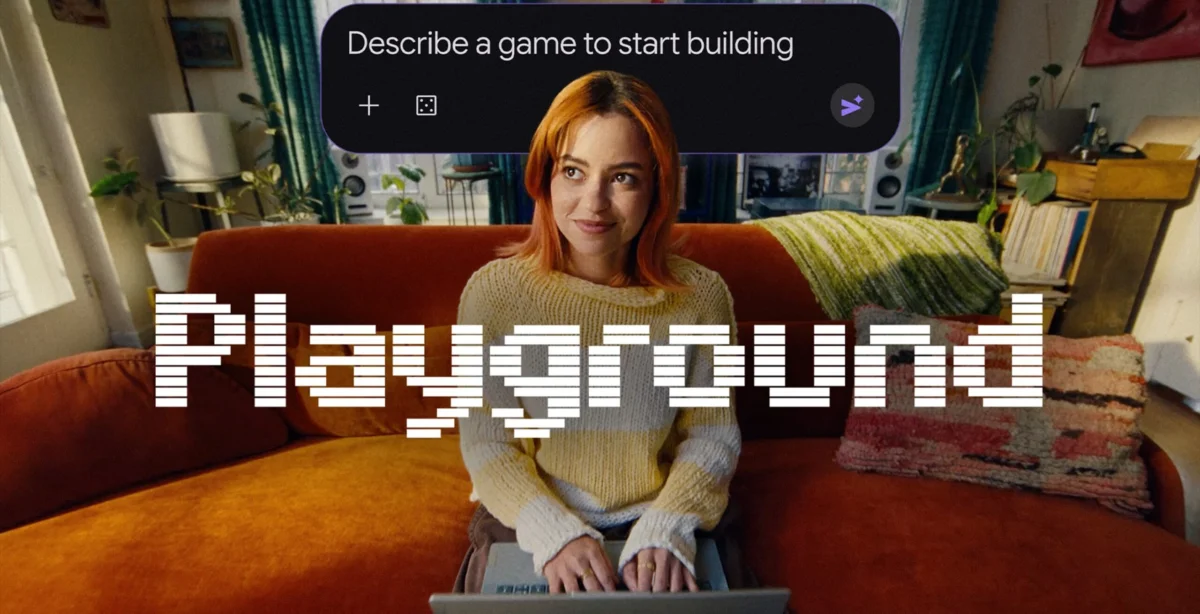
Google has officially entered the burgeoning field of AI-driven game development with the launch of Playground, an experimental browser-based platform designed to democratize game creation through natural language processing. The platform, which transitioned from a series of high-profile technical demonstrations earlier this year into a functional consumer tool, allows users to generate, modify, and share interactive digital experiences using simple text prompts. Currently available to users aged 18 and older within the United States, the tool represents a significant shift in Google’s gaming strategy, pivoting away from traditional cloud streaming toward the integration of generative artificial intelligence and user-generated content (UGC).
The launch of Playground follows the technical foundation laid by Project Genie, a research initiative Google unveiled in January that demonstrated the ability of AI models to create interactive, playable environments from static images or text descriptions. While Project Genie was largely viewed as a proof of concept, Playground serves as the commercial and social application of that technology. By visiting the dedicated domain, playground.google, eligible users can immediately begin crafting games, either by entering original prompts or by "remixing" existing templates provided by the community.
Technical Integration and the Unity Spark Partnership
A cornerstone of the Playground announcement is Google’s collaboration with Unity, the world’s leading platform for creating and operating interactive, real-time 3D content. Through an integration with Unity Spark—a new toolset currently in closed beta testing—Playground aims to bridge the gap between casual prompt-based creation and professional-grade game development. This partnership allows Playground to utilize the Unity runtime, providing the platform with advanced physics engines, complex 3D rendering capabilities, and sophisticated gameplay mechanics that go beyond the limitations of standard browser-based generative tools.
According to technical briefs released by Google, the integration of Unity Spark ensures that games created within Playground are not merely visual novelties but functional software with "pro-level" logic. This includes support for multiplayer environments and competitive leaderboards in specific genres. By leveraging Unity’s existing infrastructure, Google is positioning Playground as a scalable ecosystem where a simple text prompt can eventually be refined into a high-fidelity 3D experience.
Chronology of Google’s Gaming Evolution
The trajectory leading to Playground’s release highlights a multi-year effort by Google to find its footing in the global gaming industry, which is estimated to be worth over $180 billion.
- November 2019: Google launches Stadia, a high-end cloud gaming service intended to compete with consoles like PlayStation and Xbox.
- January 2023: Google officially shuts down Stadia servers, citing a lack of traction with players despite the service’s robust technical performance.
- January 2024: Google researchers debut Project Genie, demonstrating an AI model trained on thousands of hours of gameplay footage capable of generating interactive worlds.
- May 2024: YouTube expands "Playables," a collection of lightweight, instantly playable games integrated directly into the video-sharing platform, reaching over 50 international markets.
- Late 2024: The launch of Playground and the announcement of the Unity Spark partnership, signaling a focus on "No-Code" development and AI-assisted creativity.
This timeline suggests a strategic pivot from hosting third-party AAA titles to empowering a new generation of creators who may lack traditional coding skills but possess the creative vision to utilize generative AI.
Market Reaction and Economic Implications
The unveiling of Playground’s capabilities has already sent ripples through the financial markets, particularly affecting companies centered on user-generated content and game engines. Following the initial demonstrations of the technology that powers Playground, shares in Roblox Corporation, Unity Software Inc., and Take-Two Interactive experienced notable volatility. Market analysts suggest that investors are concerned about the "disruption of the barrier to entry." Historically, creating a game required specialized knowledge of C#, C++, or complex visual scripting. If Google can successfully automate these processes through AI, the intrinsic value of existing development platforms may be challenged.
Industry data indicates that the generative AI in gaming market is projected to grow at a compound annual growth rate (CAGR) of over 25% through 2030. Google’s move to tie Playground access to its Google One subscription service further underscores the company’s intent to monetize this technology through a recurring revenue model. Google One, which provides cloud storage and advanced AI features like Gemini, will soon serve as the primary gateway for international users to access Playground, effectively bundling game creation with other essential digital services.
Community Features and Moderation Framework
Playground is built with a social-first architecture. The platform includes a "Playground Explore" community gallery, where creators can publish their work for public consumption. This gallery functions similarly to social media feeds, utilizing proprietary algorithms to surface content that the system identifies as "fresh, creative, and fun." To foster a competitive environment, Google has integrated multiplayer support and global leaderboards, allowing users to challenge friends or the broader community within the browser interface.
Given the potential for AI to generate unpredictable or inappropriate content, Google has implemented a multi-layered safety screening process. Every game generated through a prompt undergoes an automated review to ensure compliance with community guidelines. Furthermore, the platform includes a reporting mechanism for users to flag content that violates safety standards. This emphasis on moderation is critical for Google as it seeks to maintain a brand-safe environment while navigating the legal and ethical complexities of AI-generated imagery and logic.
Competitive Landscape: Meta and the Rise of AI UGC
Google is not alone in its pursuit of AI-driven game creation. Meta, the parent company of Facebook and Instagram, recently announced "Horizon Create," a suite of tools designed for its Horizon Worlds metaverse platform. Similar to Playground, Horizon Create will allow users to build environments and gameplay loops using natural language prompts. Meta intends to allow these creations to be shared across its vast social ecosystem, potentially reaching billions of users.
The competition between Google and Meta highlights a broader industry trend toward the "democratization of digital labor." While Meta’s strength lies in its existing VR hardware and social graph, Google’s advantage stems from its dominance in web search, its sophisticated AI models (such as Gemini), and the ubiquity of the Chrome browser. The integration of YouTube Playables also provides Google with a ready-made distribution channel should it choose to merge Playground’s output with its video platform.
Analytical Outlook: The Future of the "No-Code" Movement
The introduction of Playground marks a pivotal moment for the "No-Code" movement within the software industry. By abstracting the complexities of game design—asset creation, physics calculation, and state management—into a text-based interface, Google is attempting to turn "players" into "developers."
However, several challenges remain. Professional developers have expressed skepticism regarding the depth of AI-generated mechanics, noting that while an AI can easily create a visual environment, the "feel" of a game—its balance, pacing, and nuance—remains difficult to automate. The collaboration with Unity is a direct response to this critique, providing a "pro-level" backend to support the AI’s front-end simplicity.
Furthermore, the legal landscape surrounding the data used to train these AI models remains a subject of intense debate. While Google has not disclosed the specific datasets used for Playground, the industry at large is facing scrutiny over copyright and intellectual property rights concerning the assets generated by AI.
Conclusion
Playground represents Google’s most ambitious attempt to date to redefine its role in the gaming world. By moving away from the "platform as a store" model of Stadia and toward a "platform as a tool" model, Google is betting on the creative potential of its user base. As the Unity Spark beta expands and the platform rolls out to Google One subscribers globally, the success of Playground will likely be measured by the quality and diversity of the games its community produces. For now, the platform stands as a high-stakes experiment in how artificial intelligence might permanently alter the relationship between those who play games and those who build them.
About the Author