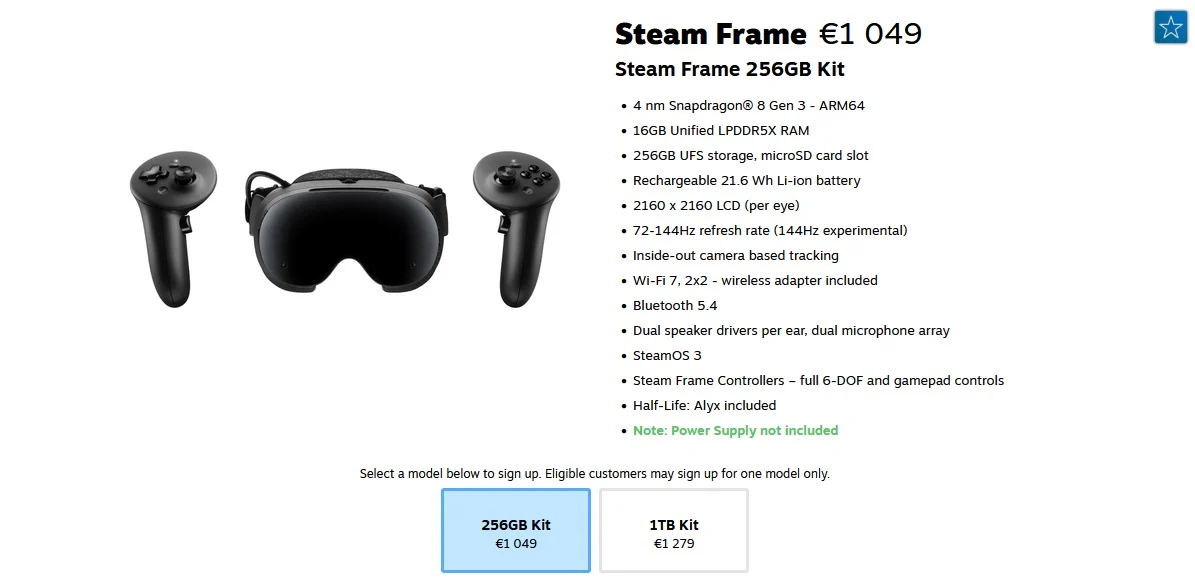
Valve Corporation has officially unveiled the pricing structure and launch details for the Steam Frame, its highly anticipated successor to the Valve Index and its first foray into the dedicated standalone virtual reality (VR) market. Positioned as a premium, high-performance device for enthusiasts and professional users, the Steam Frame enters the market with two primary storage configurations. The standard 256GB model is priced at $1,059 (€1,049), while the high-capacity 1TB version will retail for $1,299 (€1,279). Despite the difference in internal storage capacity, Valve has confirmed that the underlying hardware specifications and performance capabilities remain identical across both versions.
The announcement marks a significant shift in Valve’s hardware strategy, transitioning from the tethered, PC-dependent ecosystem of the 2019 Valve Index to a more versatile, standalone architecture. This move follows the commercial success of the Steam Deck, which demonstrated Valve’s ability to optimize PC-grade gaming experiences for mobile, Linux-based hardware.
Standalone Half-Life: Alyx and Technical Architecture
Perhaps the most significant technical revelation accompanying the launch is the inclusion of Half-Life: Alyx with every purchase. While the title has long been the gold standard for PC-based VR, Valve has developed a native 64-bit ARM build of the game specifically for the Steam Frame. This optimized version allows the game to run standalone on the headset without the need for a connection to a high-end gaming PC.
The porting of Half-Life: Alyx to an ARM-based architecture is a landmark achievement in XR (Extended Reality) development. The original game was built on the Source 2 engine and required substantial GPU and CPU resources to manage its complex physics and high-fidelity textures. By successfully migrating this experience to a standalone mobile chipset, Valve has established a new performance benchmark for the industry, potentially narrowing the graphical gap between mobile VR and desktop-based VR.

Modular Ecosystem and Accessory Integration
In a departure from the "all-in-one" design philosophy adopted by many of its competitors, Valve has introduced a modular approach to the Steam Frame’s functionality. The company has released a comprehensive list of first-party and third-party accessories designed to extend the capabilities of the base unit.
A primary highlight of this modular system is the passthrough camera module developed by Arcturus Vision. While the base Steam Frame is optimized for immersive VR, the Arcturus Vision add-on introduces high-quality color passthrough for mixed reality (MR) applications. Priced at approximately €157, the module is marketed toward users seeking high-fidelity environmental awareness and spatial computing capabilities.
Initial reports and technical demonstrations indicate that the Arcturus Vision module offers low-latency, high-resolution video passthrough, which significantly enhances the user’s ability to interact with physical objects while wearing the headset. Several prominent VR titles, including Cubism, Puzzling Places, and Table Space, have already been updated to support this module, providing day-one mixed reality experiences for early adopters.
Historical Context and Development Timeline
The release of the Steam Frame follows a multi-year development cycle characterized by industry speculation regarding "Project Deckard," the rumored codename for Valve’s wireless headset. To understand the significance of this launch, it is necessary to examine Valve’s hardware chronology:
- 2016: Valve partners with HTC to release the Vive, introducing the Lighthouse tracking system to the consumer market.
- 2019: Valve releases the Index, setting the standard for high-fidelity audio and finger-tracking controllers.
- 2022: The launch of the Steam Deck proves that Valve can successfully implement a custom Linux-based OS (SteamOS) for mobile gaming.
- 2024: The announcement of the Steam Frame integrates the lessons learned from the Steam Deck’s mobile efficiency with the Index’s high-end VR optics.
Industry analysts note that the Steam Frame arrives during a period often described as the "VR Winter," characterized by a cooling of venture capital investment and a stabilization of consumer adoption rates. By pricing the device above the $1,000 threshold, Valve is clearly targeting the "prosumer" and hardcore gaming demographics rather than attempting to compete directly with lower-cost, mass-market devices like the Meta Quest 3.

Market Positioning and Economic Implications
The $1,059 entry price places the Steam Frame in a unique market position. It is significantly more expensive than mainstream consumer headsets, which typically retail between $300 and $500, yet it remains considerably more affordable than enterprise-grade or luxury devices such as the Apple Vision Pro, which retails for $3,499.
Valve’s pricing strategy suggests a focus on hardware sustainability rather than aggressive loss-leader subsidies. Unlike competitors who may sell hardware at a loss to recoup costs through software sales, Valve appears to be leveraging its dominant position in the PC software market (via Steam) to offer a high-margin hardware product that appeals to its most loyal user base.
The "prosumer" designation is further supported by the device’s technical specifications, which emphasize high refresh rates, wide fields of view, and the flexibility of the SteamOS ecosystem. The inclusion of a 1TB storage option specifically caters to users who intend to maintain a large library of high-fidelity standalone titles, which are expected to grow in size as developers utilize the Steam Frame’s increased processing power.
Industry Reactions and Future Outlook
Early reactions from the XR development community have been largely positive, particularly regarding the standalone Half-Life: Alyx port. Developers view the existence of a high-performance ARM build of Source 2 as an encouraging sign that more "AAA" caliber games may eventually make the transition to standalone hardware.
However, some market analysts express caution regarding the device’s ability to drive mass-market adoption. While the Steam Frame is expected to sell out quickly among Valve’s core audience, its high price point may limit its impact on the broader consumer landscape. The success of the device will likely depend on the continued growth of the SteamOS VR ecosystem and the willingness of third-party developers to optimize their titles for Valve’s specific hardware configurations.

The Steam Frame represents a bold statement of intent from Valve. It reaffirms the company’s commitment to high-end hardware and its belief in the future of standalone VR as a viable platform for premium gaming. As reservations open and the first units begin to ship, the industry will be watching closely to see if the Steam Frame can provide the technical spark needed to transition the VR industry into its next phase of growth.
For those seeking more technical documentation or pre-order details, Valve has directed users to its official storefront, where full regional pricing and shipping timelines are currently being updated. The modular components, including the Arcturus Vision camera, are expected to be available simultaneously with the headset launch, ensuring a complete ecosystem for early adopters.
About the Author