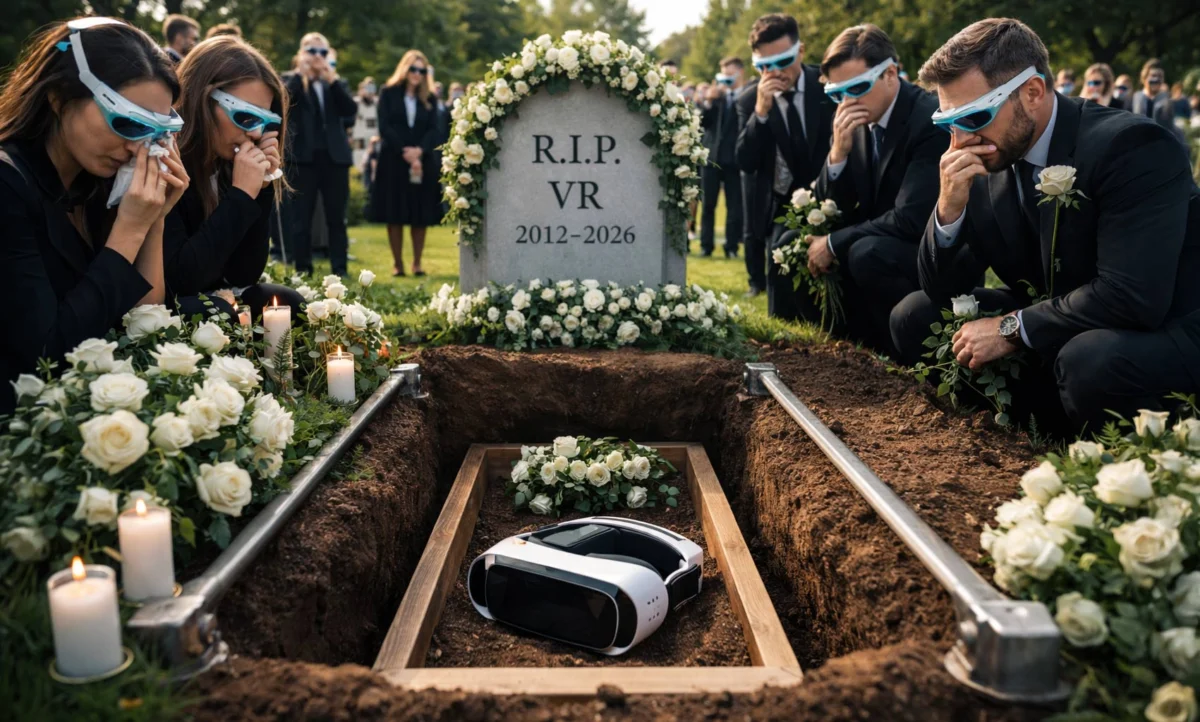
The global extended reality (XR) community has convened at the Santa Clara Convention Center for a definitive summit titled "The VR Funeral," an event marking the formal cessation of virtual reality development and the industry’s transition into a post-VR era. Organized through a massive collaboration between hardware manufacturers including Meta, HTC, and Pico, alongside industry bodies such as Augmented World Expo (AWE) and the VR/AR Association, the event, colloquially dubbed "The MRourning," serves as both a retrospective of the technology’s decade-long resurgence and a final administrative shutdown of immersive platforms. The proceedings signify a total industry pivot, with manufacturers scheduled to discontinue hardware production and sunset software runtimes in the coming weeks.
A Strategic Pivot from XR to Artificial Intelligence
The summit opened with a keynote address by Ori Inbar, the long-standing developer of the Augmented World Expo. In a presentation titled "XR is NOT going mainstream," Inbar detailed the systemic hurdles that prevented head-mounted displays (HMDs) from achieving the ubiquity of the smartphone. Citing market fatigue and the failure of the "Metaverse" concept to capture a sustainable consumer base, Inbar announced that AWE will be immediately rebranded as AIWE (Artificial Intelligence World Expo). This shift reflects a broader macroeconomic trend where venture capital and enterprise focus have migrated from spatial computing to generative AI.
This sentiment was echoed by legendary science fiction author Neal Stephenson. Stephenson, who originally coined the term "Metaverse" in his 1992 novel Snow Crash, participated in a session where he expressed a strategic preference for the linguistic and conceptual dominance of "Artificial Intelligence" over the immersive digital worlds he envisioned thirty years ago. The move is seen by analysts as the final symbolic severing of the link between science fiction aspirations and current Silicon Valley priorities.
Chronology of the MRourning Proceedings
The event followed a rigorous timeline designed to address various facets of the industry’s decline, from executive strategy to hardware ergonomics.
Morning Sessions: Executive Accountability and Market Reality
The morning began with a transparent Q&A session featuring Andrew Bosworth, Meta’s Chief Technology Officer. Bosworth provided a rare look into the decision-making processes at Reality Labs, Meta’s dedicated XR division. He reportedly displayed the randomized methods—symbolized by executive "strategy dice"—used to navigate the volatile VR market over the last four fiscal years. This was followed by a retrospective panel titled "How to Kill VR with Style," which analyzed the short lifecycles of several high-profile devices. Speakers included the engineering leads behind the Oculus Rift S, which saw a rapid discontinuation, and the Quest Pro, which struggled with market penetration upon its release.
Midday Sessions: Professional Transitions and Labor Shifts
Recognizing the displacement of thousands of specialized developers and "XR influencers," the summit transitioned into a career fair. A representative from McDonald’s Corporation took the stage to announce a dedicated recruitment pipeline for former VR professionals. This segment highlighted the stark reality of the "LinkedIn VR influencer" ecosystem; a subsequent panel of prominent social media figures admitted that despite years of promoting the profitability of Location-Based VR (LBVR) and enterprise B2B solutions, the sectors remained largely subsidized by venture capital rather than organic revenue.
Afternoon Sessions: Technical Post-Mortems and Safety Reports
The afternoon focused on the physical and technical limitations that hindered VR adoption. A panel conducted entirely by AI agents—trained on ten years of community forum debates—reiterated the cyclical arguments regarding content scarcity, hardware ergonomics, and price points. The International Red Cross provided a comprehensive report on the physical toll of long-term HMD use, citing instances of facial bruising associated with the Quest Pro’s weight distribution and neck strain caused by the front-heavy design of early consumer headsets.
Supporting Data: The Economic Context of the Decline
The decision to hold a formal "funeral" for the technology is supported by recent fiscal data. While the VR market saw a surge in interest following the 2021 rebranding of Facebook to Meta, the actual adoption rates have struggled to maintain momentum. According to market intelligence reports from firms like IDC, shipments of VR and AR headsets saw a significant decline of nearly 23.5% in 2023.
Furthermore, Meta’s Reality Labs division has reported cumulative losses exceeding $40 billion since 2020. Despite the release of the Apple Vision Pro in early 2024, which many hoped would provide a "halo effect" for the industry, consumer feedback has remained focused on the "gimmicky" nature of the technology and its lack of a "killer app." The $9,999.99 admission fee for The MRourning is intended to offset the massive logistical costs of decommissioning global server infrastructures for social VR platforms like AltspaceVR and Echo VR, both of which have seen their services terminated.
Hardware Legacy and Repurposing Initiatives
A notable segment of the event was sponsored by Pimax, a manufacturer known for high-specification enthusiast headsets. In a final display of hardware excess, the company unveiled the "Pimax SuperBig Q." The device features a 32K-per-eye resolution and is marketed as a multi-purpose appliance that doubles as a microwave and a water scooter. Analysts view this as an admission that the pursuit of raw technical specifications has reached a point of diminishing returns.
As part of the decommissioning process, attendees were provided with a "Digital Transition Kit" designed to help professionals scrub VR-related terminology from their resumes and LinkedIn profiles, replacing them with AI-centric keywords. Practical workshops also demonstrated how to repurpose existing hardware:
- Converting HMD shells into decorative flower pots.
- Utilizing weighted headsets as high-tech paperweights.
- Recycling optics for DIY telescope projects.
Official Responses and the Final Burial
The ceremony concluded with a symbolic burial of the Oculus Rift DK1, the device that ignited the modern VR era via Kickstarter in 2012. Palmer Luckey, the founder of Oculus, performed the interment. The event’s finale featured a brief appearance by Mark Zuckerberg, who announced the total rebranding of Meta Platforms Inc. to IAI (Innovative Artificial Industries). The name change signals a complete corporate divestment from the "Metaverse" in favor of a 100% focus on Large Language Models and autonomous systems.
"We gave the world the goggles, but the world preferred the screen," a spokesperson for the event organizers stated. "The MRourning is not just about the death of a product category; it is about the end of a specific vision of the future. We are moving from the virtual back to the literal."
Broader Impact and Industry Implications
The dissolution of the VR industry is expected to have immediate ripple effects across the tech sector. Education and medical training programs that had heavily invested in VR simulations are now tasked with migrating their curriculum to traditional 2D interfaces or AR-lite mobile solutions. Gaming conglomerates have already begun shifting development resources away from "VR-only" titles toward cross-platform AI-driven experiences.
While the "VR Funeral" marks a somber day for enthusiasts, the industry-wide consensus suggests that the "gimmick" phase of technology has concluded. By formally ending the VR era, companies believe they can finally address the "AI arms race" without the distraction of maintaining expensive, niche hardware ecosystems. The Santa Clara Convention Center, long a hub for XR innovation, will reportedly be converted into a data center for training neural networks following the conclusion of the event.
About the Author