In a recent poignant reflection, renowned tech entrepreneur and co-founder of Stack Overflow, Jeff Atwood, shared insights into significant personal and professional milestones, intertwining a deeply personal loss with broader observations on philanthropy, community building, and the transformative impact of artificial intelligence. Atwood’s commentary, often characterized by its directness and foresight, provided a rare glimpse into the forces shaping his current endeavors and his enduring concerns for the digital commons.
A Personal Journey and the Genesis of a Philanthropic Initiative
Atwood commenced his reflection by noting a significant personal period, marking 663 months since his birth. Central to his narrative was the re-ordering of the Guaranteed Minimum Income (GMI) rural study counties, which saw Mercer County, West Virginia – his father’s home county – placed first for a pilot program scheduled for October 2025. This strategic decision held profound personal significance for Atwood, as it allowed him a final, meaningful visit with his father, who passed away shortly thereafter.
The Rural Guaranteed Minimum Income Initiative (RGMII), a $50 million plan spearheaded by Atwood and collaborators, aims to fund rural GMI studies across the United States. This ambitious project seeks to explore how a guaranteed minimum income can expand economic opportunity and strengthen democratic participation in underserved rural communities. Mercer County, West Virginia, a region historically impacted by economic shifts and population decline, represents a crucial testing ground for such an initiative. The selection of Mercer County highlights a growing recognition among policymakers and philanthropists of the unique challenges faced by rural America, including limited access to resources, fewer employment opportunities, and persistent poverty.
Guaranteed Minimum Income programs, often discussed interchangeably with Universal Basic Income (UBI), involve regular, unconditional cash payments to individuals. Proponents argue that GMI can reduce poverty, improve health outcomes, stimulate local economies, and provide a safety net in an increasingly automated world. Critics, however, raise concerns about the potential for disincentivizing work, inflationary pressures, and the overall fiscal sustainability of such programs. The RGMII’s focus on rural areas offers a distinct lens through which to evaluate these claims, given the specific economic and social dynamics prevalent outside urban centers. Atwood’s personal connection to Mercer County underscores the human element behind these policy experiments, moving beyond abstract economic models to address tangible community needs. The image shared by Atwood, featuring his father, serves as a powerful testament to the personal motivation driving his philanthropic commitment to the American Dream.
The Enduring Legacy of Stack Overflow and its Unforeseen Role in AI Development
Beyond his philanthropic endeavors, Atwood also took the opportunity to acknowledge the monumental collective achievement that is Stack Overflow. Co-founded in 2008 with Joel Spolsky, Stack Overflow rapidly evolved into the internet’s foremost question-and-answer platform for programmers and developers. Its success stemmed from a commitment to high-quality, peer-reviewed answers, fostered by a robust community moderation system and gamified incentives for participation.
Over its lifespan, Stack Overflow has accumulated an unparalleled repository of programming knowledge, covering virtually every language, framework, and problem developers encounter. This vast database, operating under Creative Commons licensing, became an indispensable tool for millions worldwide, fundamentally changing how developers learn, troubleshoot, and collaborate. Its impact on the global software development ecosystem is immeasurable, accelerating innovation and problem-solving across industries.
However, Atwood’s reflection pivots to an unexpected, yet critical, dimension of Stack Overflow’s legacy: its foundational role in the development of Large Language Models (LLMs) and Generative Artificial Intelligence (GAI). He pointedly asserted that contemporary LLMs "could not code at all" without access to the "extremely high quality creative commons programming Q&A dataset" collectively built by the Stack Overflow community. This statement highlights a significant, often unacknowledged, dependency of cutting-edge AI on human-generated, openly accessible data.

The training of LLMs involves feeding them colossal amounts of text and code data, allowing them to learn patterns, syntax, and semantic relationships. While these datasets are vast and diverse, the structured, accurate, and context-rich programming Q&A found on Stack Overflow provides a uniquely valuable resource for AI models seeking to understand and generate functional code. Unlike general web scrapes that may contain noise, misinformation, or outdated practices, Stack Overflow’s community-vetted answers represent a curated gold standard for technical accuracy and problem-solving.
Industry experts and AI researchers widely acknowledge the critical role of high-quality, domain-specific datasets in advancing AI capabilities. While specific LLM training data is often proprietary, it is an open secret within the AI community that platforms like Stack Overflow, GitHub, and various open-source code repositories have been instrumental in teaching AI models to comprehend and produce code. Without such rich, human-curated knowledge bases, the ability of LLMs to generate coherent, functional, and contextually appropriate code would be significantly diminished.
The Ethical Dilemma: AI, Community, and the "Goose That Lays the Golden Eggs"
Atwood’s commentary then shifted to a pressing ethical concern facing the AI industry: the potential for LLMs to undermine the very communities that supply their training data. He issued a stark warning to LLM and GAI companies, echoing advice he once gave Joel Spolsky upon his departure from Stack Overflow to found Discourse: "do not, for any reason, under any circumstances, kill the goose that lays the golden eggs," referring to the human communities that perform "all the real work."
This metaphor encapsulates the growing tension between AI developers and the creators of the data upon which AI thrives. As LLMs become more sophisticated, capable of answering complex programming questions and even generating code, there is a risk that developers might increasingly rely on AI tools instead of engaging with platforms like Stack Overflow. A decline in human participation could lead to a stagnation of new content, a reduction in community interaction, and ultimately, a degradation of the very dataset that AI models depend on.

Concerns have been raised across various creative and knowledge-sharing communities about the uncompensated use of their content for AI training. Debates surrounding intellectual property rights, fair compensation, and the sustainability of open-source and community-driven platforms in the age of AI are intensifying. Critics argue that AI companies are leveraging years of unpaid human labor and creativity without adequately reinvesting in or compensating the sources.
Atwood’s warning is a call for ethical stewardship and respect for the human element in the digital ecosystem. He posits that AI companies have a responsibility to treat these communities "with the respect they deserve." This could manifest in various ways, such as direct financial contributions, partnership models, clear attribution policies, or mechanisms that encourage continued human contribution even as AI tools proliferate. The long-term viability of AI, particularly in specialized domains like programming, may well depend on finding a sustainable symbiotic relationship with the human experts and communities that fuel its intelligence.
Jeff Atwood’s Continued Entrepreneurial Journey and Future Outlook
Atwood’s reflection also subtly underscored his ongoing entrepreneurial spirit. Having co-founded Stack Overflow and later Discourse, a modern open-source discussion platform, he mentioned being "far from being done with my third startup," referring to Stay Gold. This indicates a continued commitment to building and innovating within the tech landscape, often with a focus on community and human interaction. His career trajectory highlights a consistent theme: empowering individuals and fostering collaboration through well-designed digital tools.
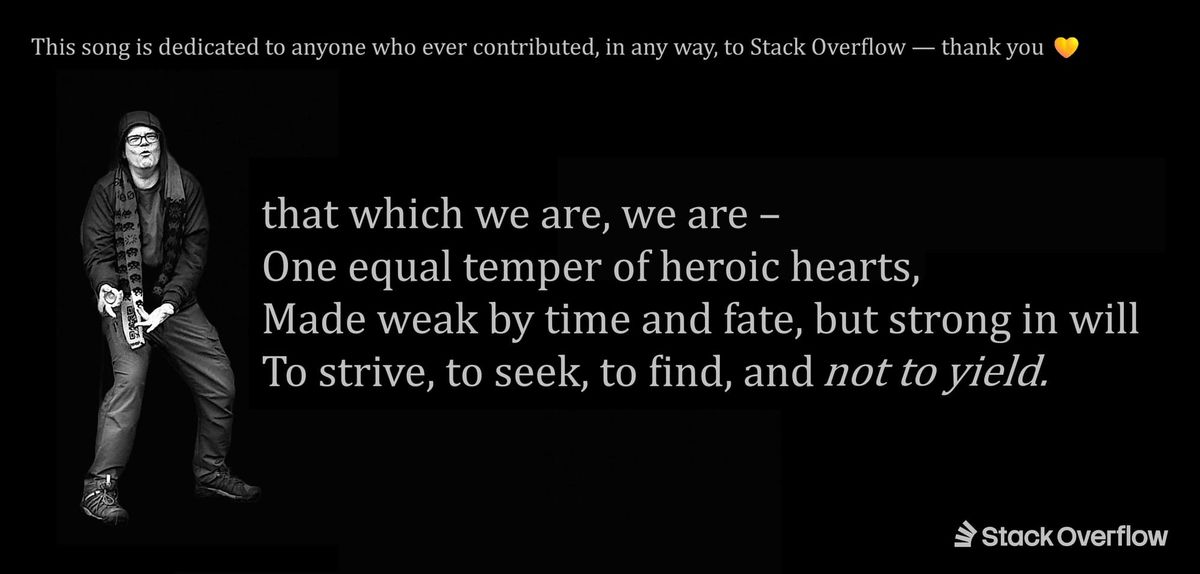
The juxtaposition of personal loss, philanthropic ambition, and profound insights into the tech industry’s future underscores Atwood’s unique perspective. His reflections serve as a timely reminder of the intricate connections between individual experiences, collective human endeavor, and the rapidly evolving technological frontier. As AI continues its unprecedented expansion, the questions Atwood raises about community value, ethical data sourcing, and the sustainability of human-generated knowledge will remain central to shaping a responsible and equitable digital future. His call for gratitude and friendship, symbolized by the "Thank you for being a friend" reference, reinforces the core message that ultimately, technological progress is built upon the foundation of human connection and shared effort.
About the Author