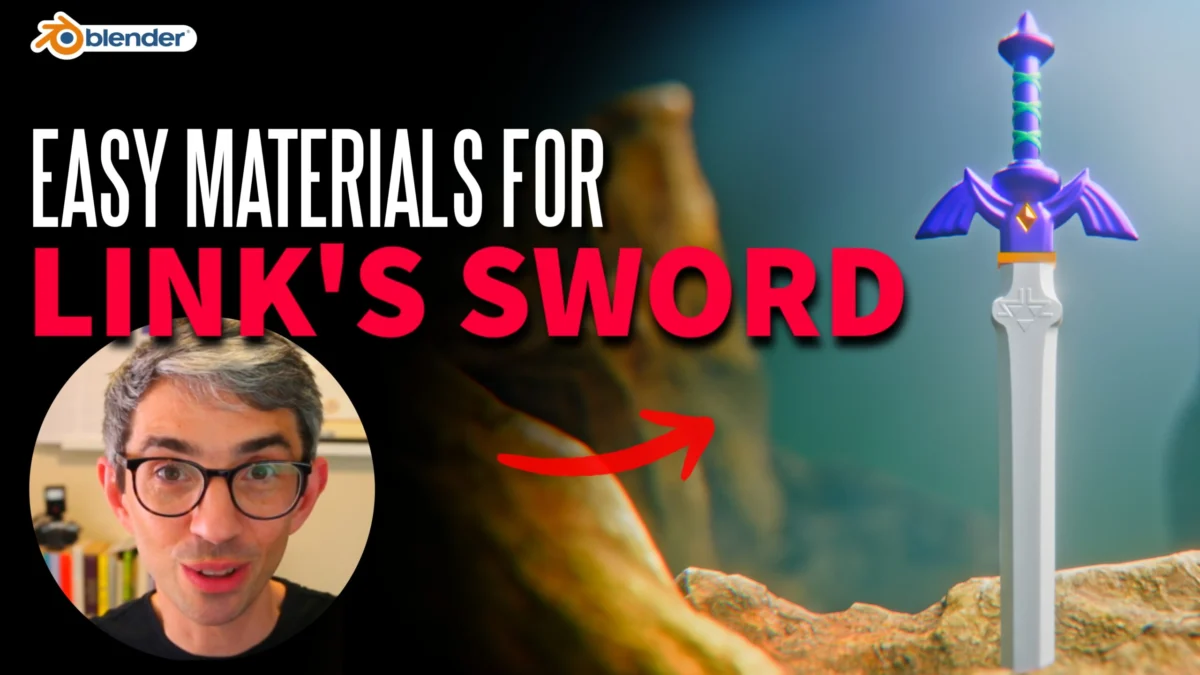
In a significant development for the 3D artistry community, BlenderNation has featured an in-depth tutorial by Chris Bailey, offering aspiring and experienced 3D artists a comprehensive guide to crafting the iconic Master Sword from The Legend of Zelda series. This detailed instructional content, released on October 30, 2026, focuses on a powerful, yet often underutilized, aspect of 3D modeling and texturing: procedural materials. Bailey’s approach emphasizes the creation of complex and visually stunning assets entirely from within Blender’s node-based shading system, eschewing traditional UV unwrapping and external texture files.
The tutorial, titled "Color The Master Sword For Beginners," is presented as a step-by-step video walkthrough, accessible via a prominent YouTube embed. This format allows viewers to follow along in real-time, observing Bailey’s techniques as he meticulously constructs the materials for the legendary blade. The core philosophy behind this tutorial is to empower artists to achieve high-fidelity results through proceduralism, a method that relies on mathematical algorithms and node connections rather than static image files. This not only offers immense flexibility and control but also results in highly scalable and resolution-independent assets.
The Power of Proceduralism: A Deeper Dive
Procedural materials are essentially sets of instructions that tell a rendering engine how to generate a surface’s appearance. Unlike image textures, which are pre-rendered bitmaps, procedural materials are generated on-the-fly, allowing for infinite variations and resolutions. This characteristic is particularly valuable in game development, animation, and architectural visualization, where assets may need to be rendered at various scales.
Bailey’s tutorial highlights several key advantages of this methodology:
- Resolution Independence: Procedural materials scale seamlessly without pixelation or loss of detail, making them ideal for high-resolution renders or projects intended for diverse display platforms.
- Flexibility and Iteration: Changes to parameters within the node network can instantly update the material, facilitating rapid iteration and experimentation. This significantly speeds up the creative process compared to re-editing and re-exporting texture maps.
- Reduced File Size: Instead of large texture image files, only the node network itself needs to be stored, leading to smaller project file sizes.
- Dynamic Control: Complex patterns, weathering effects, and intricate surface details can be generated algorithmically, offering a level of control often difficult to achieve with conventional texturing methods.
Deconstructing the Master Sword: A Procedural Journey
The Master Sword, a symbol of courage and power in the Zelda universe, presents a unique set of challenges and opportunities for procedural texturing. Its distinctive hilt, pommel, blade, and the iconic Triforce insignia embedded within its design require careful attention to detail. Bailey’s tutorial aims to break down these elements into manageable components, demonstrating how to build them using Blender’s powerful shader editor.
The tutorial’s scope, as indicated by its bonus content section, extends beyond the mere creation of the sword’s materials. It promises to guide viewers in constructing a fitting environment for the finished sword, further emphasizing the self-contained nature of the procedural workflow. This integrated approach ensures that the entire asset, from the smallest surface detail to the surrounding scene, can be generated using procedural techniques.
Key procedural concepts likely explored in the tutorial include:
- Noise Textures: Fundamental for creating organic variations, scratches, imperfections, and subtle surface roughness. Nodes like Noise Texture, Musgrave, and Voronoi can be combined and manipulated to simulate a wide range of natural phenomena.
- Color Ramps and Gradients: Essential for controlling color transitions, defining areas of highlight and shadow, and creating gradients that mimic worn metal or polished surfaces.
- Mathematical Operations: Nodes such as Math, Mix RGB, and Vector Math are crucial for blending, distorting, and combining various procedural inputs to achieve desired effects.
- Geometry-Based Inputs: Using nodes like Texture Coordinate, Generated, and Object coordinates to map procedural patterns onto the 3D model in a consistent and predictable manner.
- Principled BSDF Shader: The core shader in Blender, which allows for the simulation of various surface properties like metallicness, roughness, and subsurface scattering, all of which can be driven by procedural inputs.
The choice of the Master Sword as a subject is particularly astute. Its relatively simple geometry allows beginners to focus on the material creation process without being overwhelmed by complex modeling. Simultaneously, the iconic status of the sword provides a tangible and recognizable goal, motivating learners. The tutorial’s title, “Color The Master Sword For Beginners,” directly addresses a primary audience segment, suggesting a pedagogical approach that prioritizes accessibility.
Background and Context: The Rise of Proceduralism in 3D Art
The advancement of 3D software, particularly Blender, has seen a dramatic increase in the sophistication and accessibility of procedural texturing tools. Historically, creating realistic materials relied heavily on photographic textures and manual painting. While these methods remain valuable, the limitations in scalability and flexibility became increasingly apparent as digital art production demanded more dynamic and adaptable workflows.
Blender, being an open-source and community-driven platform, has been at the forefront of democratizing advanced 3D techniques. The continuous development of its node-based shader editor, coupled with a vibrant community that shares knowledge and develops innovative tools, has made proceduralism a viable and often preferred method for many artists.
The release of this tutorial by Chris Bailey, featured on BlenderNation—a prominent hub for Blender-related news and resources—underscores the growing importance of procedural workflows. BlenderNation’s consistent coverage of tutorials, news, and artwork from the Blender community has established it as a key authority. Their decision to highlight Bailey’s work indicates a recognition of its educational value and its relevance to current industry trends.
Chronology of a Tutorial Release
While the exact timeline of the tutorial’s creation is not detailed, its release on October 30, 2026, places it within a period of intense activity and innovation in the 3D graphics landscape. The dated header suggests this is part of a series or a planned content release schedule. The use of a "Community Reporter" as the author indicates a collaborative model where external contributors share their expertise with the BlenderNation audience.
The structure of the BlenderNation article itself provides a brief chronological marker:
- Categorization: Identified under "Videotutorials," signifying its format and purpose.
- Author and Date: "Community Reporter" on "October 30, 2026."
- Featured Image: A thumbnail of the rendered Master Sword, likely the end result of the tutorial.
- Descriptive Text: A brief synopsis and a quote from the tutorial creator, offering a glimpse into the content.
- Video Embed: The primary medium for the tutorial.
- Author Information: Further details about the contributor.
This organized presentation is typical of educational content platforms, aiming to provide users with clear access to information and the learning materials themselves.
Supporting Data and Industry Trends
The adoption of procedural techniques is not limited to hobbyists. Major studios and industries are increasingly integrating proceduralism into their pipelines. For instance, in game development, procedural generation is used for creating vast, explorable worlds, complex character outfits, and intricate environmental details. Software like Houdini is a prime example of a powerful procedural toolset that has revolutionized visual effects and game content creation.
While Bailey’s tutorial focuses on Blender’s internal tools, the underlying principles are transferable. The ability to generate high-quality assets without relying on external texture artists or large asset libraries offers significant economic and logistical advantages. Data from industry surveys often points to the demand for artists proficient in procedural workflows, highlighting the continued relevance of such skills. For example, reports from the Game Developers Conference (GDC) and SIGGRAPH consistently feature discussions and presentations on procedural content generation, emphasizing its role in pushing the boundaries of visual fidelity and efficiency.
Potential Reactions and Broader Implications
The release of such a detailed and accessible tutorial is likely to be met with enthusiasm from the Blender community. Artists seeking to expand their skillset, particularly in material creation, will find this an invaluable resource. For beginners, it offers a clear pathway to understanding complex node setups without the initial hurdle of UV mapping, a process that can be daunting.
The broader implication of tutorials like this is the continued democratization of high-quality 3D art creation. By providing free, accessible, and expert-led instruction, platforms like BlenderNation and creators like Chris Bailey are empowering individuals worldwide to produce professional-grade work. This fosters innovation, encourages artistic expression, and lowers the barrier to entry for careers in the digital arts.
Furthermore, the emphasis on purely procedural materials aligns with a growing trend towards sustainable and efficient digital asset creation. As projects become larger and more complex, the ability to manage assets efficiently and maintain high visual quality becomes paramount. Proceduralism offers a robust solution to these challenges.
The tutorial’s success could also inspire further development in Blender’s node system and encourage more artists to share their procedural techniques. This collaborative ecosystem is a cornerstone of Blender’s strength, and each new contribution enriches the collective knowledge base.
In conclusion, Chris Bailey’s tutorial on creating the Master Sword using procedural materials in Blender represents a significant contribution to the educational resources available to 3D artists. By demystifying complex shading techniques and demonstrating their practical application on an iconic asset, Bailey is not only teaching a skill but also fostering a deeper understanding of the power and potential of procedural workflows in modern 3D art creation. The ongoing advancements in Blender and the community’s dedication to sharing knowledge ensure that such tutorials will continue to shape the future of digital artistry.
About the Author