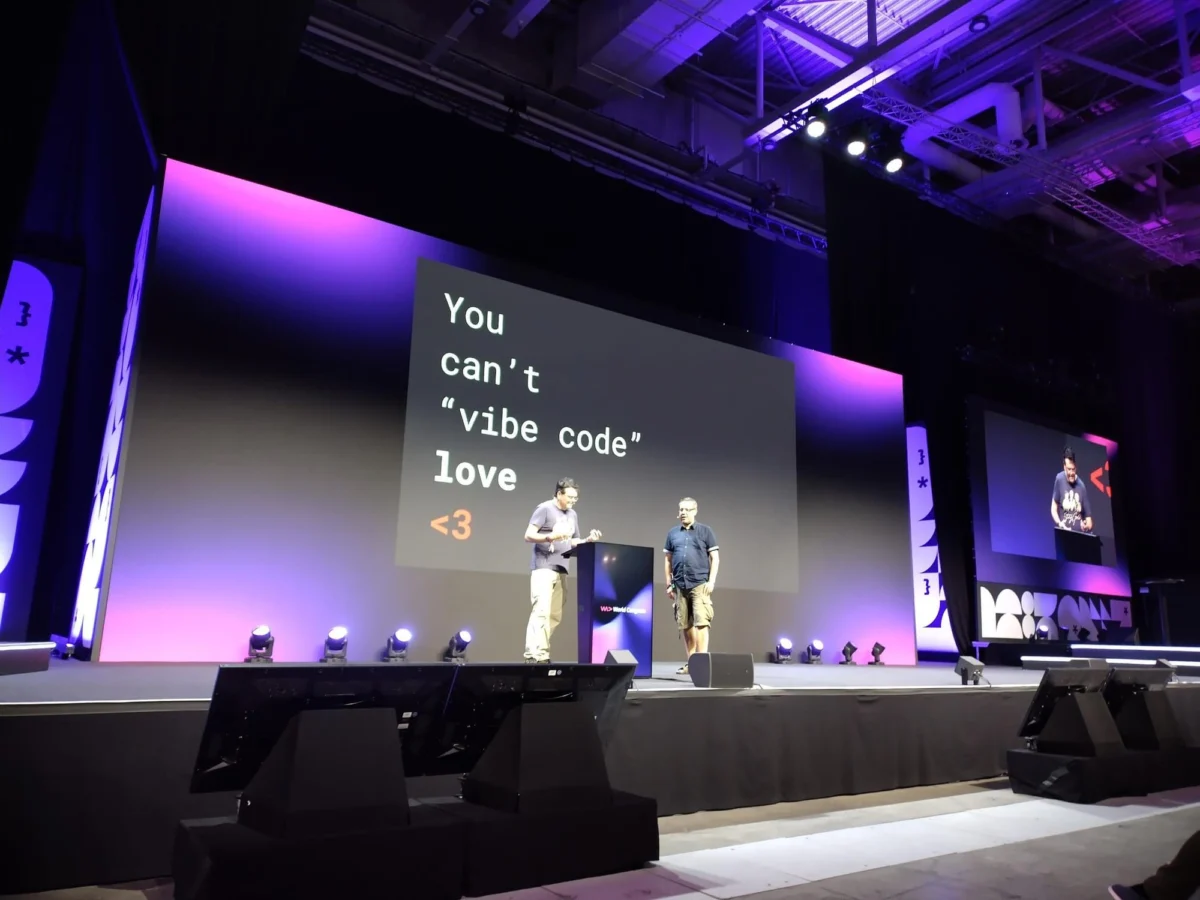
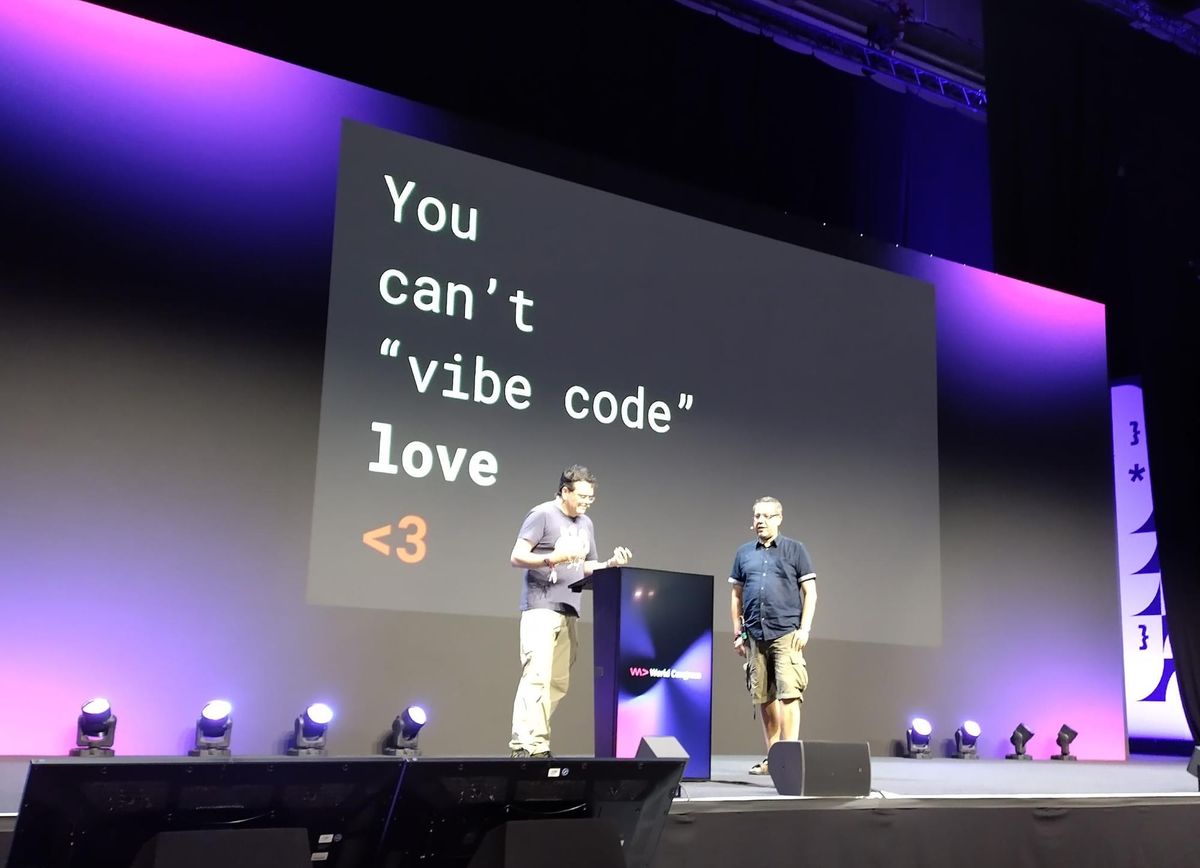
Berlin, Germany – The intersection of human collaboration and artificial intelligence took center stage at the WeAreDevelopers World Congress, where technology luminary Jeff Atwood, co-founder of Stack Overflow, delivered a compelling presentation alongside long-time Stack Overflow community member Ben Dumke-von der Ehe. Their joint address, held on Friday, July 10th, at Berlin’s CityCube, delved into the foundational principles of community-driven knowledge sharing and critically examined the transformative, yet potentially disruptive, influence of Large Language Models (LLMs) on these vital digital commons. The presentation, titled "None of Us Is As Dumb As All of Us: Community And Knowledge Go Hand In Hand," offered a nuanced perspective on the future of developer interaction and information dissemination.
The Genesis of a Collaborative Presentation
The opportunity for Atwood to speak at the WeAreDevelopers World Congress, a prominent global event attracting thousands of developers, industry leaders, and tech enthusiasts, arose approximately a year prior. Atwood, known for his selective engagement in speaking circuits, particularly international ones, accepted the invitation under a specific condition: that Ben Dumke-von der Ehe, an early and influential community hire at Stack Overflow based in Berlin, co-present with him. This contingency underscored Atwood’s belief in the importance of diverse perspectives and his deep respect for Dumke-von der Ehe’s contributions. The organizers readily agreed, setting the stage for a unique dialogue that combined Atwood’s entrepreneurial vision with Dumke-von der Ehe’s firsthand experience within the Stack Overflow community.
WeAreDevelopers World Congress, established as one of the largest developer conferences globally, serves as a crucial platform for exploring emerging technologies, best practices, and the future trajectory of the software development industry. Annually, it brings together a vast network of professionals, fostering networking, learning, and collaborative exchange. The inclusion of Atwood and Dumke-von der Ehe’s discussion on community and AI’s impact highlighted a growing concern within the tech sector about maintaining the human element in an increasingly automated world.
A Decade of Collaboration: The Stack Overflow Legacy
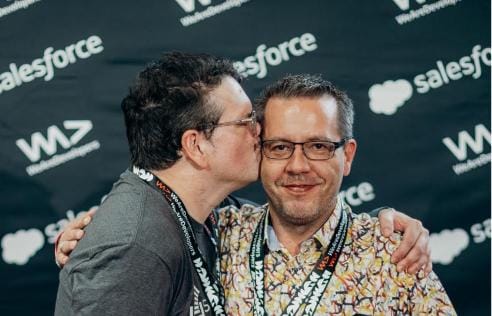
The heart of Atwood and Dumke-von der Ehe’s presentation resonated with a deeply personal narrative—the story of their initial encounter and their shared journey within the Stack Overflow ecosystem. Atwood candidly stated on stage, "The long version of this story is that we changed each others’ lives. The short version is: unicorns." This evocative remark alluded to the often-unforeseen connections and profound impacts forged within vibrant online communities. Dumke-von der Ehe’s own account of his experience with Stack Overflow, which he has shared publicly, illustrates how his passion for coding and community engagement led to an early role at the company, demonstrating the platform’s capacity to identify and cultivate talent from its user base. His journey, marked by initial employment, a departure, and a subsequent return before another departure, speaks volumes about the dynamic nature of such pioneering tech ventures and the deep personal ties formed within them. Atwood’s acknowledgment, "I’m mostly doing this presentation because I owe you so much," underscored the profound gratitude and respect he holds for Dumke-von der Ehe and, by extension, every contributor to Stack Overflow.
Stack Overflow, launched in 2008 by Jeff Atwood and Joel Spolsky, rapidly evolved into an indispensable resource for programmers worldwide. Its core premise was simple yet revolutionary: a community-driven Q&A platform where developers could ask technical questions and receive answers from peers, moderated by the community itself. This model fostered an environment of collective intelligence, where expertise was pooled, validated, and continuously refined. A cornerstone of Stack Overflow’s success and its enduring legacy is its commitment to open knowledge, embodied by its bedrock Creative Commons license. This license ensures that the vast repository of code snippets, explanations, and solutions contributed by millions of developers remains accessible and reusable, respecting the intellectual effort put into building this monumental "commons." The dataset generated by Stack Overflow has become an unparalleled global resource, influencing how developers learn, problem-solve, and collaborate.

LLMs: A Double-Edged Sword for Developer Productivity
The presentation pivoted to an examination of Large Language Models (LLMs), acknowledging their undeniable prowess in transforming various aspects of information retrieval and problem-solving, particularly within the programming domain. Atwood highlighted a key benefit: LLMs’ ability to efficiently intercept and resolve common programming questions. This aligns perfectly with Stack Overflow’s long-term vision, as articulated by Atwood in previous writings, where the ultimate goal is for developers to find answers instantly through search, minimizing the need to ask new questions. "If Stack Overflow is working like it’s supposed to, 98% of programmers should get all the answers they need from reading search result pages and wouldn’t need to ask or answer a single question in their entire careers," Atwood reiterated, underscoring this as a positive outcome.
One of the most significant challenges that plagued large Q&A platforms like Stack Overflow was the persistent issue of duplicate questions. As the platform expanded from one million to ten million, and eventually to hundreds of millions of questions, the task of asking a truly unique question became increasingly daunting. Navigating this immense "field of prior art" without inadvertently duplicating existing content was, as Atwood described, "mission almost impossible." LLMs, with their advanced natural language understanding and semantic mapping capabilities, offer a powerful solution to this Gordian knot. They can identify semantically similar questions, even if phrased entirely differently, and direct users to existing, well-vetted answers. This capability represents a monumental leap forward in efficiency, promising less redundancy and faster access to solutions, which is undeniably a "huge net positive" for developer productivity. Industry reports, such as those from Gartner and Forrester, have consistently highlighted the increasing adoption of AI tools in developer workflows, citing benefits like accelerated coding, improved debugging, and enhanced knowledge discovery, largely due to LLMs’ ability to process and synthesize vast amounts of information quickly.
The Erosion of the Commons: A Looming Threat
Despite the clear benefits, Atwood and Dumke-von der Ehe’s presentation raised a critical concern regarding the long-term implications of over-reliance on LLMs: "But what happens to the commons when everyone is privately whispering to LLMs?" This question strikes at the heart of community-driven knowledge ecosystems. When individual developers turn primarily to private AI assistants for answers, the collective process of asking, answering, refining, and curating knowledge on public platforms diminishes. This shift threatens to erode the very communities where programmers traditionally learn from each other, engage in peer review, and build professional networks—the very environment where individuals like Ben Dumke-von der Ehe found joy, purpose, and even employment through their contributions.
The potential for this erosion extends beyond mere social interaction. It raises fundamental questions about the future of knowledge generation itself. If LLMs are primarily trained on existing public datasets, such as Stack Overflow, what happens when the rate of new, human-generated contributions to these public commons declines? Where will the "next set of training data" originate if active, vibrant communities are no longer producing and validating novel information? This creates a feedback loop where AI models, starved of fresh human insight, might eventually stagnate, merely recirculating existing knowledge without contributing to its growth.
Furthermore, the qualitative aspects of community interaction—mentorship, nuanced discussions, the joy of collaborative problem-solving, and the informal learning that arises from diverse perspectives—cannot be replicated by algorithms. As Atwood poignantly put it, "You can’t ‘vibe code’ love." This phrase encapsulates the irreplaceable human element: the emotional connection, the camaraderie, and the shared passion that fuel innovation and personal growth within developer communities. The experience of contributing to an open platform, receiving feedback, and seeing one’s knowledge help others fosters a sense of belonging and accomplishment that a solitary interaction with an AI cannot provide. This sentiment is echoed by many developers who express concerns about the potential isolation that could result from an over-reliance on AI, emphasizing the value of human connection in their professional development.
Broader Implications and a Call for Balance
The discussion at WeAreDevelopers extends far beyond the confines of Stack Overflow, touching upon the broader implications for open-source development, academic research, and any field reliant on collective intelligence. The Creative Commons licensing model, which underpins platforms like Stack Overflow and numerous open-source projects, was designed to protect and promote the sharing of knowledge. The rise of commercial LLMs that often ingest vast public datasets without always clear attribution or reciprocal contribution back to the commons presents a complex ethical and practical challenge. There’s a growing debate among intellectual property lawyers and AI ethicists about fair use, data provenance, and the sustainability of open knowledge ecosystems in the age of generative AI.
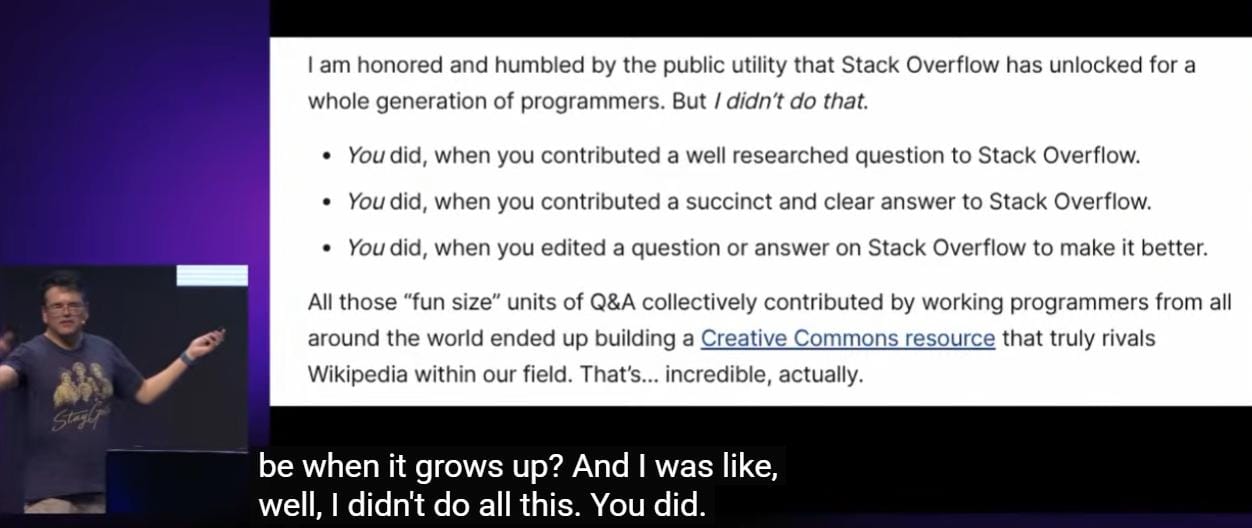
Atwood and Dumke-von der Ehe’s presentation served as a vital call to action for the developer community and tech industry leaders. It urged a conscious effort to protect and nurture the digital commons, recognizing that while AI offers powerful tools for efficiency, it should not come at the expense of human collaboration and the continuous creation of new knowledge. The challenge lies in finding a harmonious balance: leveraging AI for its unparalleled efficiency in information retrieval and problem resolution, while simultaneously investing in and fostering the human communities that generate that foundational knowledge.
The future of knowledge sharing, and indeed the future of innovation, hinges on this delicate balance. How will we continue to share knowledge – and, crucially, the "love" for learning and creating – with each other, if the platforms and communities that facilitate such exchange are allowed to wither? The WeAreDevelopers World Congress provided a crucial platform for this discussion, prompting attendees to consider not just the technological advancements before them, but also the enduring value of human connection, collaboration, and the shared pursuit of knowledge in an increasingly AI-driven world. The legacy of Stack Overflow, built on the collective efforts of millions, stands as a testament to what is possible when a community comes together. The imperative now is to ensure that this spirit of collaboration continues to thrive, adapting to new technologies while safeguarding the very essence of human ingenuity.
About the Author