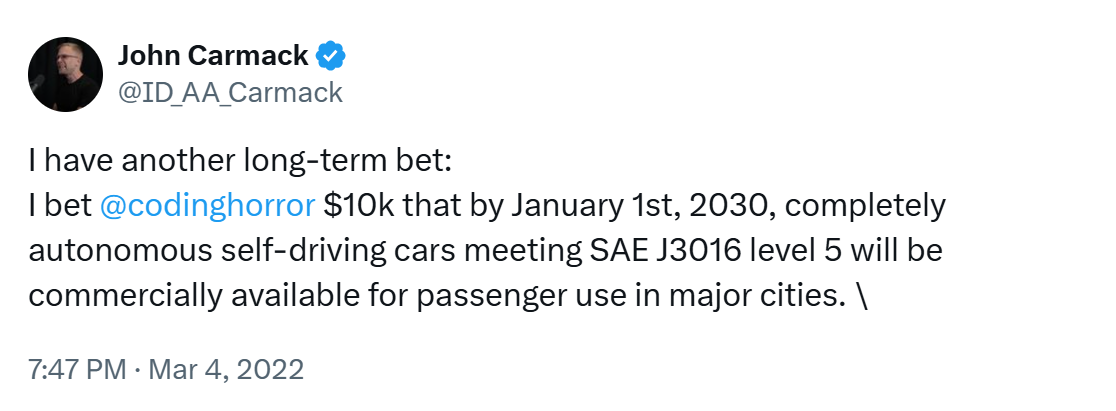
In a move that has captured the attention of the technology world, prominent software developer and writer Jeff Atwood, known for his "Coding Horror" blog, has announced a friendly yet significant wager with legendary programmer and game developer John Carmack. The bet, set at $10,000 (with potential adjustments for inflation to ensure its impact in 2030), hinges on the commercial availability of completely autonomous, SAE J3016 Level 5 self-driving cars for passenger use in major U.S. cities by January 1st, 2030. The proceeds will go to a 501(c)(3) charity of the winner’s choice, transforming a technological debate into a philanthropic endeavor.
Atwood publicly declared his position, betting against the realization of this ambitious goal, citing a belief that the inherent complexities of achieving full autonomy are widely underestimated. Conversely, Carmack, a celebrated figure for his groundbreaking work in computer graphics and virtual reality, is betting for the proposition, demonstrating a clear conviction in the rapid advancement of artificial intelligence and robotics. This high-profile wager not only sets a tangible deadline for a long-promised technological revolution but also serves as a compelling public challenge, intended by Atwood to inspire innovation within the STEM fields.
Unpacking the Bet’s Core: SAE J3016 Level 5 Autonomy
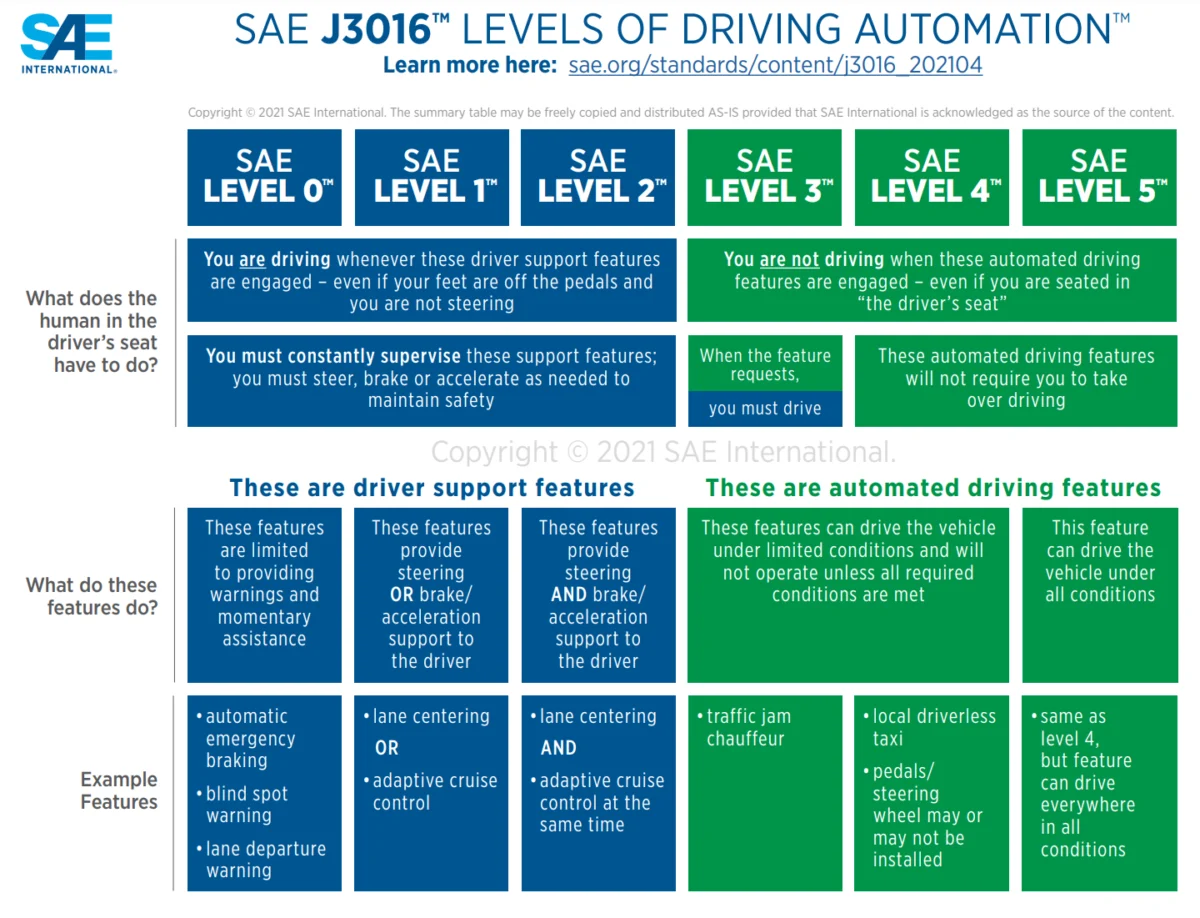
The crux of the wager lies in the precise definition of "completely autonomous," as outlined by the Society of Automotive Engineers (SAE) International’s J3016 standard. This standard categorizes driving automation into six levels, from Level 0 (no automation) to Level 5 (full automation). For the bet, Level 5 signifies a vehicle’s ability to perform all driving tasks under all conditions, without any human attention or interaction, save for extreme natural disasters or emergencies. A passenger would simply enter the vehicle, select a destination, and the car would handle every aspect of the journey. This includes navigating complex urban environments, adverse weather conditions, and unpredictable scenarios, effectively removing the need for a steering wheel, pedals, or even a human driver at all.
This definition is crucial because it differentiates Level 5 from currently available advanced driver-assistance systems (ADAS) or even Level 2 and Level 3 systems. Level 2 systems, such as Tesla’s Autopilot or General Motors’ Super Cruise, require continuous human supervision, with the driver ready to take control at any moment. Level 3 systems, while allowing for "eyes off" driving in specific conditions, still necessitate the driver to be available to intervene. Even Level 4 systems, which can operate autonomously within a defined operational design domain (ODD), still require human intervention outside that domain. Level 5, therefore, represents a paradigm shift, where the vehicle is truly an autonomous agent, capable of operating anywhere a human driver could.
The "major cities" stipulation further refines the bet’s scope, referring to any of the top 10 most populous cities in the United States. These typically include New York City, Los Angeles, Chicago, Houston, Phoenix, Philadelphia, San Antonio, San Diego, Dallas, and Austin. Deploying Level 5 autonomous vehicles in such dense, diverse, and often chaotic urban environments presents an immense challenge, involving intricate traffic patterns, varied infrastructure, diverse road users (pedestrians, cyclists, scooters), and unpredictable events. This requirement elevates the difficulty beyond mere highway driving or controlled suburban routes, demanding an unprecedented level of AI robustness and sensor reliability.
The Current Landscape of Autonomous Driving
As of the announcement, the autonomous vehicle industry stands predominantly at SAE Levels 2 and 3, with limited deployments of Level 4 technology in highly controlled operational design domains. Companies like Waymo (an Alphabet subsidiary) and Cruise (majority-owned by General Motors) have made significant strides, operating fully driverless robotaxi services in specific areas of cities like Phoenix, San Francisco, and Austin. These services, however, are still confined to geofenced areas, often limited by weather conditions, and operate with extensive back-end support and continuous mapping. They represent Level 4 autonomy, capable of handling most situations within their defined operational domains but not truly "anywhere, anytime" Level 5 functionality.
Tesla, a prominent player, offers its "Full Self-Driving" (FSD) beta software, which, despite its name, is officially classified as a Level 2 system. It requires constant driver supervision and hands on the wheel, prompting debate and regulatory scrutiny over its capabilities and marketing. While Tesla’s approach relies heavily on camera-only vision and neural networks, other companies often integrate a suite of sensors including lidar, radar, and ultrasonics, arguing for redundancy and robustness in diverse conditions.
The progress in autonomous driving has been remarkable since the early 2000s, spurred by initiatives like the DARPA Grand Challenge. However, the journey from Level 4 to Level 5 is widely considered to be exponentially more difficult than all preceding levels combined. This "last mile" problem involves tackling "edge cases"—unforeseen, rare, or complex scenarios that are difficult to program for and test exhaustively. These can range from unusual road debris, erratic human behavior, ambiguous signage, to severe and sudden weather changes.
Historical Context and Previous Predictions
The dream of self-driving cars is nearly as old as the automobile itself, appearing in science fiction and futurist visions throughout the 20th century. Early concepts often envisioned automated highways and robotic chauffeurs, yet the underlying technology remained elusive. The modern era of autonomous vehicle research truly began to accelerate in the early 2000s, most notably with the DARPA Grand Challenge series. These competitions, starting in 2004, pushed academic and industry teams to build autonomous vehicles capable of navigating desert courses and later, simulated urban environments. The success of these challenges, particularly the urban challenge in 2007, demonstrated the feasibility of autonomous navigation and laid the groundwork for companies like Google (which launched its self-driving car project, later Waymo, in 2009).
For over a decade, many industry leaders and tech evangelists have made optimistic predictions about the imminent arrival of fully autonomous vehicles. Elon Musk, CEO of Tesla, famously predicted in 2016 that a Tesla would drive itself from Los Angeles to New York by the end of 2017 without human intervention, a goal that remains unmet. Similar timelines from other companies have often been pushed back, underscoring the formidable technical and regulatory hurdles. The repeated delays highlight the gap between incremental improvements in driver-assistance features and the leap to truly human-level, unsupervised autonomy. This history of ambitious predictions followed by revisions provides a critical backdrop to Atwood’s skepticism.
Challenges to Achieving Level 5 by 2030
Achieving Level 5 autonomy in major cities within the next six years presents a multifaceted challenge, encompassing technical, regulatory, and societal hurdles.
Technical Hurdles:
- Perception in All Conditions: Autonomous vehicles rely on sensors (cameras, lidar, radar) to perceive their environment. These systems struggle significantly in adverse weather conditions like heavy rain, snow, fog, or blinding sunlight. Robust perception that mimics human vision and judgment across all environmental variables remains a major obstacle.
- Edge Cases and Unpredictability: The real world is infinitely complex. Autonomous systems must be able to handle "edge cases" – rare, unusual, or unanticipated scenarios that are difficult to train for and test. Examples include unexpected animal behavior, complex construction zones, hand signals from traffic controllers, or unusual road debris. The sheer number of these scenarios makes exhaustive testing virtually impossible.
- Human Interaction and Intent Prediction: Humans are often irrational and unpredictable. Level 5 vehicles must not only react to human drivers, pedestrians, and cyclists but also anticipate their intentions, even when those intentions are ambiguous or illogical. This requires advanced AI with a deep understanding of human psychology and social norms, a capability still far from perfected.
- Sensor Fusion and Redundancy: Integrating data from multiple sensor types (sensor fusion) to create a comprehensive and reliable understanding of the environment is critical. Ensuring this system is robust enough to handle sensor failures or degraded performance in diverse conditions, while maintaining safety, is a monumental engineering task.
- Computational Power and Energy Efficiency: Processing the vast amounts of data generated by sensors in real-time, especially for Level 5 operation, requires immense computational power. Doing so efficiently, particularly for mass-market deployment, is an ongoing challenge.
Regulatory and Legal Hurdles:

- Standardization and Certification: There are currently no universal standards or certification processes for Level 5 autonomous vehicles across all jurisdictions. Developing and implementing such frameworks, which would involve rigorous testing and validation, is a time-consuming process.
- Liability and Ethics: In the event of an accident involving a fully autonomous vehicle, determining liability (manufacturer, software provider, owner, etc.) is a complex legal question. Furthermore, programming ethical decision-making into AI, particularly in unavoidable accident scenarios, raises profound philosophical and legal dilemmas.
- Public Acceptance and Trust: Despite the potential safety benefits, public trust in autonomous vehicles remains a significant barrier. High-profile accidents, even if rare, can severely undermine public confidence and slow adoption.
Societal Hurdles:
- Infrastructure Adaptability: While Level 5 aims for universal operation, existing city infrastructure is not optimized for autonomous vehicles. Changes to signage, road markings, and communication systems could aid deployment but would require massive investment and coordination.
- Cybersecurity: Autonomous vehicles are essentially computers on wheels, making them vulnerable to cyberattacks. Ensuring robust cybersecurity measures to prevent hacking and malicious control is paramount for public safety.
Expert Perspectives and Industry Outlook
The industry itself is divided on the feasibility of Level 5 autonomy by 2030. Many researchers and engineers acknowledge the monumental nature of the challenge. Some, like Atwood, express caution, emphasizing the exponential increase in difficulty as one approaches true human-level intelligence in driving. They point to the "long tail" of unexpected events that AI systems struggle with, arguing that achieving 99% safety is relatively straightforward, but reaching 99.9999% requires solving problems that are fundamentally different and far more complex.
On the other hand, proponents like John Carmack likely draw their optimism from the relentless pace of innovation in AI, machine learning, and sensor technology. They might argue that breakthroughs in areas like generative AI, reinforcement learning, and advanced simulation could accelerate progress, allowing systems to learn and adapt to unforeseen scenarios more rapidly. The billions of dollars poured into autonomous vehicle research and development by tech giants and automotive manufacturers also fuel this optimism, suggesting that sustained investment will eventually yield the desired results.
Companies like Waymo and Cruise, while cautious about making Level 5 predictions, continue to expand their Level 4 operations, incrementally tackling complexity. Their strategy involves meticulously mapping and testing within specific ODDs, gradually expanding their operational envelope. This measured approach suggests that a widespread, truly "anywhere, anytime" Level 5 system across all major U.S. cities within six years is an exceedingly ambitious target, even for industry leaders.
Implications of the Bet’s Outcome
The outcome of the Atwood-Carmack bet, irrespective of the financial stakes, will carry significant symbolic weight.
If Atwood Wins (No Level 5 by 2030): This would underscore the profound difficulty of achieving truly ubiquitous full autonomy. It would likely lead to a recalibration of industry expectations, perhaps shifting focus towards more specialized Level 4 deployments or a greater emphasis on advanced driver-assistance systems that augment, rather than replace, human drivers. It might also temper public enthusiasm, reinforcing a more realistic timeline for the complete transformation of personal mobility. The implication would be that while progress is undeniable, the final leap to human-equivalent autonomy is a longer journey than many optimists currently envision.
If Carmack Wins (Level 5 Achieved by 2030): This would represent a monumental technological triumph, signaling a profound breakthrough in artificial intelligence and robotics. The commercial availability of Level 5 vehicles in major cities would fundamentally alter urban planning, transportation infrastructure, and daily life. It would validate the aggressive investment in AI and autonomous systems, potentially accelerating the adoption of similar technologies in other domains. The economic and societal impact would be transformative, promising increased safety, reduced congestion, and enhanced accessibility for millions. It would signify a major inflection point in the history of technology, fulfilling a long-held futuristic vision.
Beyond the immediate result, the bet highlights the importance of setting audacious goals as catalysts for innovation. Atwood himself views it as a challenge, an invitation for engineers and researchers to "prove me wrong." This competitive spirit, common in the tech world, often drives progress by providing clear, measurable objectives.
Beyond the Bet: The Future of Mobility
Regardless of whether Level 5 is fully realized by 2030, the ongoing pursuit of autonomous driving is irrevocably shaping the future of mobility. The advancements made in sensor technology, AI algorithms, and mapping are already enhancing vehicle safety and efficiency, even in human-driven cars. Features like adaptive cruise control, lane-keeping assistance, and automatic emergency braking, which are derivatives of autonomous driving research, are becoming standard.
The broader implications extend to urban design, with the potential for reduced parking needs, optimized traffic flow, and new forms of shared mobility. Autonomous delivery services, long-haul trucking, and specialized industrial vehicles are likely to see widespread adoption even before personal Level 5 cars. The debate between Atwood and Carmack, therefore, is not just about a specific technological milestone, but about the pace and trajectory of a fundamental societal shift.
Atwood’s broader technological perspectives, as occasionally shared on his blog—such as his skepticism regarding virtual reality’s world-changing potential in our lifetimes, contrasting it with the promise of augmented reality—further contextualize his cautious stance on Level 5 autonomy. He approaches complex technological problems with a pragmatic, often critical, eye, focusing on the real-world deployment challenges rather than just theoretical possibilities. His parallel project to update a foundational BASIC programming book, with proceeds also going to charity, reflects a commitment to fundamental technological education and practical impact.
The $10,000 wager between Jeff Atwood and John Carmack is more than just a bet between two tech luminaries; it’s a public declaration of a critical technological frontier. It crystallizes a long-standing debate within the industry: how quickly can humanity solve the immense complexities required for machines to drive truly autonomously, everywhere, all the time? As the calendar marches towards January 1st, 2030, the world will watch to see if this ambitious vision of fully self-driving cars transforms from a promise into a widespread reality, validating Carmack’s optimism or Atwood’s profound skepticism.
About the Author