The vastness of the universe, estimated to be 13.8 billion years old with countless galaxies, stars, and exoplanets, presents a profound cosmological riddle: if life is statistically probable, why has humanity not yet encountered any other intelligent civilizations? This fundamental question lies at the heart of the Fermi Paradox, a compelling contradiction that challenges our understanding of life’s prevalence beyond Earth.
Origins of the Fermi Paradox
The paradox takes its name from Nobel laureate physicist Enrico Fermi, who, during a casual lunch conversation in 1950, famously asked, "Where is everybody?" Given the immense age of the universe and the sheer number of stars, many of which are older than our Sun, it seems logical that intelligent life should have had ample time to evolve and spread across the galaxy. If even a small fraction of these civilizations developed spacefaring capabilities, they should have had sufficient time to colonize or at least visit every star system, including our own. The lack of any observable evidence – no alien probes, no interstellar transmissions, no signs of advanced mega-structures – stands in stark contrast to this expectation.
This dilemma is further amplified by the Drake Equation, formulated by astronomer Frank Drake in 1961. This probabilistic argument estimates the number of active, communicative extraterrestrial civilizations in the Milky Way galaxy. While its variables are largely speculative, ranging from the rate of star formation to the fraction of planets where intelligent life emerges and develops detectable technology, even conservative estimates often suggest a considerable number of potential civilizations. The dissonance between these high theoretical probabilities and the observational null result forms the crux of the Fermi Paradox.
The Great Filter: A Barrier to Interstellar Civilization
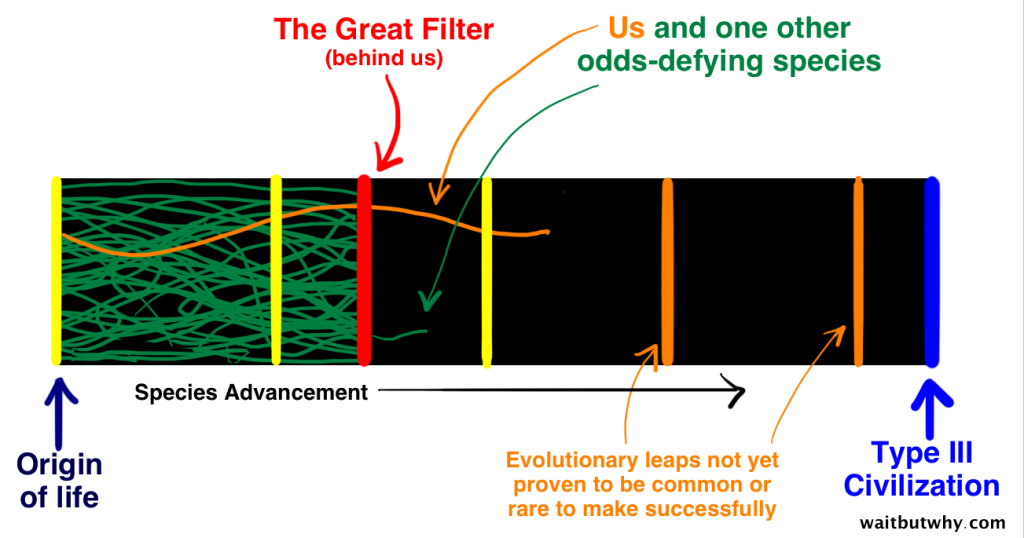
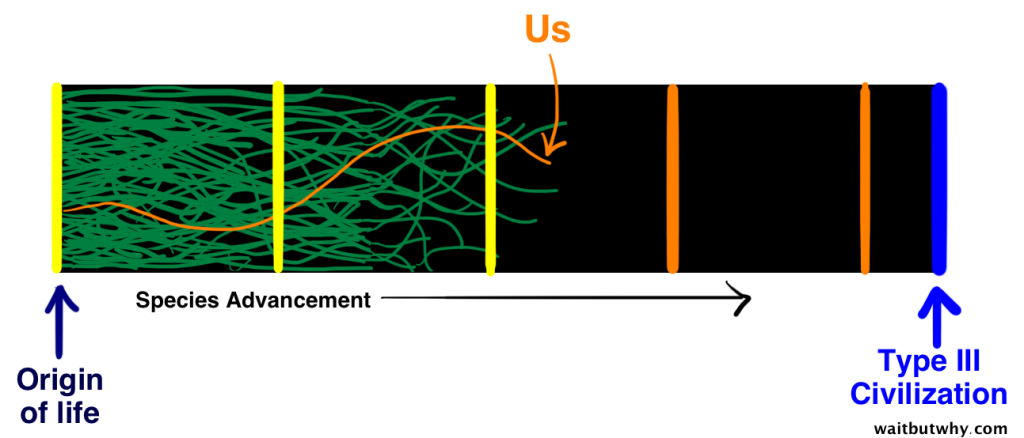
One of the most widely discussed explanations for the Fermi Paradox is "The Great Filter" theory, proposed by economist Robin Hanson. This theory posits that at some critical stage in the long evolutionary journey from pre-life to advanced, interstellar-capable civilization, there exists an extremely improbable or impossible barrier that almost all attempts at life fail to overcome. This "filter" could be a single, incredibly difficult step, or a series of challenging hurdles, making the emergence of space-faring intelligent life extraordinarily rare.
The location of this Great Filter carries profound implications for humanity. It could lie in our past, suggesting that the emergence of complex, intelligent life on Earth was an exceptionally rare event. Alternatively, the filter could be in our future, implying that advanced civilizations inevitably face a catastrophic event or develop a self-destructive tendency that prevents long-term survival or interstellar expansion.
Possible Locations of the Great Filter:
-
A Past Filter (We are unique): This scenario suggests that one or more steps in the evolution of intelligent life are extraordinarily difficult, and Earth has already passed them.

- Abiogenesis: The transition from non-living matter to self-replicating life might be far rarer than we assume. The conditions required for the spontaneous generation of life from inorganic compounds could be incredibly specific and fleeting.
- The rise of complex multicellular life: After abiogenesis, life remained unicellular for billions of years. The leap to complex multicellular organisms, with specialized cells and tissues, represents another significant hurdle.
- The development of intelligence: Even among multicellular life, the emergence of high-level intelligence capable of abstract thought, tool-making, and scientific inquiry is rare. On Earth, only one species, Homo sapiens, has achieved this to a significant degree.
- Technological breakthroughs: The development of advanced technology, particularly radio astronomy and space travel, required a specific set of circumstances and intellectual advancements.
If the Great Filter is indeed behind us, it means humanity is exceptionally fortunate, potentially one of the few, if not the only, advanced civilizations to have navigated these early, difficult stages. This perspective suggests a universe largely devoid of intelligent peers, placing humanity in a uniquely precious and perhaps solitary position.
-
A Present Filter (The "Zoo Hypothesis" or "Planetarium Hypothesis"): This less common but intriguing possibility suggests that extraterrestrial civilizations are aware of us but choose not to make contact.
- The Zoo Hypothesis: Proposed by John Ball, this theory posits that advanced alien civilizations are deliberately avoiding contact with Earth, treating our planet as a protected nature reserve or zoo. This non-interference policy could be due to ethical considerations, a desire to observe our natural development, or simply a lack of interest in civilizations deemed too primitive.
- The Planetarium Hypothesis: This goes further, suggesting that our observable universe might be a simulated reality created by an advanced civilization, preventing us from seeing signs of external life.
While these theories offer imaginative solutions, they require a high degree of coordination among multiple alien civilizations and offer no direct evidence.
-
A Future Filter (The inevitable catastrophe): This is the most sobering possibility, suggesting that advanced civilizations inevitably face a barrier that prevents their long-term survival or expansion.
- Self-destruction: As civilizations advance technologically, they may develop the means to destroy themselves through nuclear warfare, unchecked environmental degradation, artificial intelligence run amok, or other existential risks. Humanity itself faces many such challenges.
- Resource depletion: Rapid technological growth might outpace the availability of planetary resources, leading to collapse before interstellar travel is feasible.
- Technological Singularity and Transcendence: Perhaps advanced civilizations reach a point where they transcend their physical forms, merging into vast computational networks or entering a purely digital existence. In such a state, they might have no interest in or physical means for interstellar communication or travel as we understand it.
- Cosmic threats: While less likely to be a universal filter for all civilizations, phenomena like gamma-ray bursts, supernovas, or asteroid impacts could wipe out developing life forms on a regional scale.
If the Great Filter lies in our future, it means that humanity may be rapidly approaching a critical juncture. Our continued survival and potential for interstellar expansion depend on our ability to overcome these looming existential threats.
The Time Travel Analogy
The absence of extraterrestrial visitors draws a compelling parallel to the hypothetical absence of time travelers from the future. Many argue that if time travel were physically possible and achievable, humanity (or some future intelligent species) would surely have invented it by now, given the vast span of time that has already unfolded. The logical expectation would be evidence of future visitors, yet none has been definitively observed. This leads some to conclude that time travel, at least to the past, might be fundamentally impossible.
Similarly, the lack of alien contact, despite the universe’s age and scale, implies that either intelligent life is extremely rare, or there are fundamental barriers to interstellar communication or travel. While absence of evidence is not evidence of absence, the silence is deafening enough to prompt deep scientific and philosophical inquiry. Carl Sagan once speculated that time travelers might simply be disguising their presence or are not recognized as such, a notion that could also apply to extraterrestrial life.
Limitations of Our Cosmic View
It is crucial to acknowledge the severe limitations of humanity’s observational capabilities. The "observable universe" – the portion of the cosmos from which light has had time to reach us – is vast, spanning an estimated 93 billion light-years in diameter. However, this is still an infinitesimally small fraction of the entire universe, which may be infinite. Our methods for detecting alien life are also rudimentary, largely relying on radio signals (SETI) or indirect observations of exoplanet atmospheres.
The immense distances between star systems mean that any signal we receive would be from the distant past, and any signal we send would take thousands or millions of years to reach potential recipients. Furthermore, our search parameters are biased by our own understanding of life and technology. We search for signals similar to our own, or for Dyson spheres (hypothetical mega-structures built around stars), which might be far too simplistic an expectation for truly advanced civilizations.
The "Small and Fast" Hypothesis: A New Perspective on Advanced Life
Technologist and author Jeff Atwood, known for his "Coding Horror" blog, has advanced a unique hypothesis regarding the Fermi Paradox, drawing inspiration from the evolution of technology itself. Atwood suggests that truly advanced civilizations might not build grand, visible mega-structures, but rather trend towards the "small and fast."
This theory posits that as technology progresses, it typically miniaturizes, becomes more efficient, and operates at faster speeds. Consider the evolution of computers, from room-sized mainframes to ubiquitous nano-scale processors. Atwood proposes that this trend might extend to intelligent life itself. Instead of sprawling empires across star systems, advanced civilizations might prioritize efficiency and speed over sheer scale.
Seth Shostak, a senior astronomer at the SETI Institute, echoes this sentiment, arguing against the assumption that highly visible construction projects are an inevitable outcome of intelligence. "Why build planet-size anything when the real action is in the small things? Small spaces, small units of time, everything gets smaller," Shostak states. He suggests that the engineering of the small, rather than the large, might be the true hallmark of advanced intelligence. Smaller machines are faster, require less energy, and allow for faster internal communication due to the speed of light.
Under this hypothesis, advanced societies might be building nanobots, or even transcending physical forms entirely, entering "the infinite spaces between" – perhaps a purely digital or energetic existence that operates on scales far beyond our current detection capabilities. Such civilizations would have little incentive or need to rearrange stars or broadcast their presence across vast cosmic distances. They would be inherently difficult, if not impossible, to detect with our current instruments, which are designed to look for large-scale energy consumption or electromagnetic signals we can interpret. If intelligent life eventually becomes sub-atomic, quantum, or purely informational, our search methods are fundamentally flawed.
Implications for Humanity and the Search for ET
The Fermi Paradox and its potential solutions, including the Great Filter and the "Small and Fast" hypothesis, force humanity to confront its place in the universe. If the Great Filter is behind us, we are incredibly rare and perhaps alone, placing immense value on the preservation of our unique civilization. If it lies ahead, we must recognize the existential challenges that could lead to our own demise or transformation before we achieve interstellar status.
The "Small and Fast" hypothesis offers a different, perhaps more humbling, perspective. It suggests that alien civilizations may not be absent, but rather have evolved beyond our ability to perceive them, making our search akin to looking for an elephant with a microscope. This encourages a rethinking of our search strategies, perhaps moving beyond traditional radio astronomy to explore more subtle, less energy-intensive signs of intelligence, or even considering the possibility that the "silence" is a testament to advanced life’s ultimate discretion.
Ultimately, the cosmic silence continues to fuel both scientific inquiry and profound philosophical contemplation. Whether we are alone, part of a galactic zoo, or simply too primitive to perceive our advanced neighbors, the ongoing quest to answer Fermi’s simple yet powerful question remains one of humanity’s most compelling endeavors. The answer, if ever found, will fundamentally reshape our understanding of life, intelligence, and the destiny of our species.
About the Author