Nearly two decades into the mobile advertising revolution, the unassuming banner ad continues to demonstrate remarkable resilience and effectiveness. Despite persistent whispers of "banner blindness" and the rise of more visually striking formats like playable and video advertisements, banner ads remain a fundamental component of the mobile advertising ecosystem. Far from fading into obsolescence, these digital stalwarts are experiencing steady growth, mirroring the expansive trajectory of the mobile advertising industry itself.
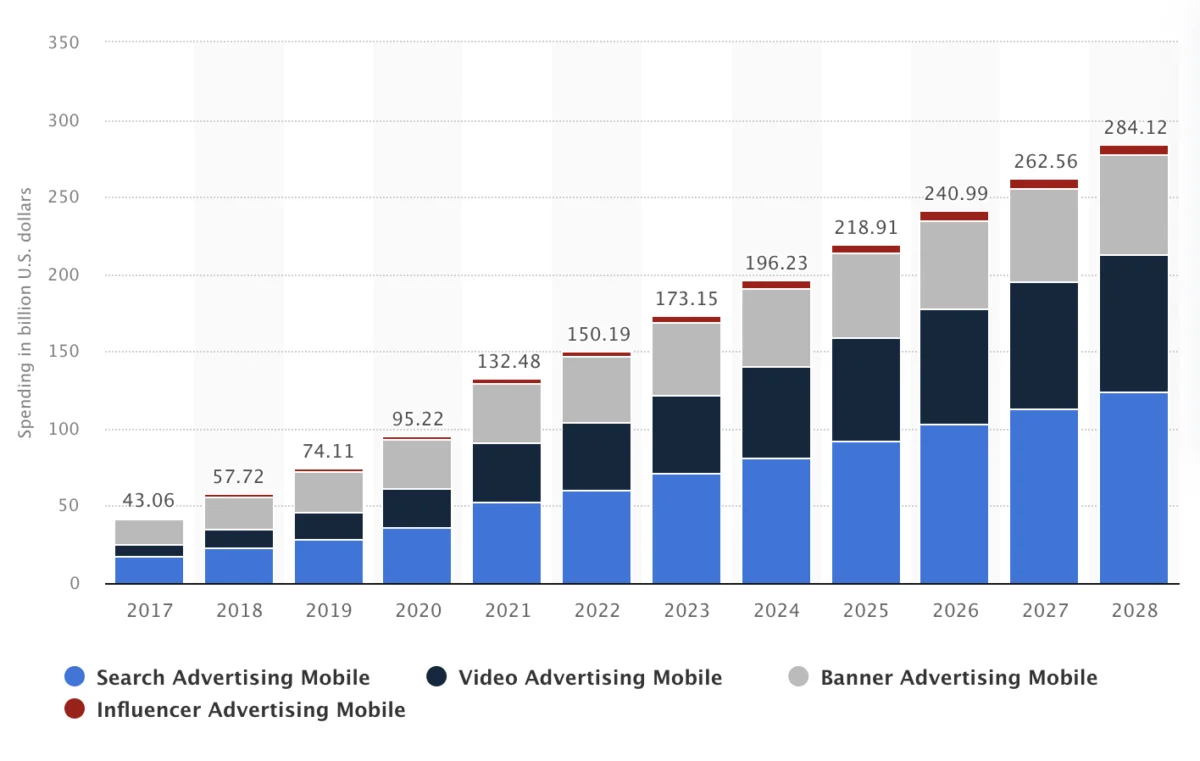
Mobile Advertising Spending in the United States: A Forecast by Format (2017-2028)
The financial commitment to mobile advertising in the United States paints a clear picture of market expansion. Projections from Statista indicate a significant and sustained increase in overall mobile advertising expenditure. By 2028, total spending is anticipated to reach approximately $284.12 billion USD. This robust growth is distributed across various formats, with mobile search advertising and mobile video advertising consistently commanding the largest shares of the market. However, even within this competitive landscape, mobile banner advertising and influencer marketing, while representing smaller portions, are also projected to see consistent upward trends. This suggests that while more immersive formats may capture headlines, the foundational banner ad continues to secure a vital and growing segment of advertiser investment.
A stacked bar chart visually representing mobile advertising spending in the United States from 2017 to 2028, categorized by Search Advertising Mobile (blue), Video Advertising Mobile (dark blue), Banner Advertising Mobile (gray), and Influencer Advertising Mobile (red). The chart illustrates a consistent year-over-year increase, culminating in an estimated $284.12 billion in 2028. Search and video advertising dominate the spending, with banner and influencer advertising occupying smaller but growing segments. The data originates from Statista.
Source: Statista
The Enduring Appeal: Why Mobile Banner Ads Persist
Several key factors contribute to the sustained relevance and effectiveness of mobile banner ads in today’s crowded digital advertising environment. One of the most significant drivers is the inherent value of screen real estate. As devices have evolved from larger desktop monitors to smaller smartphone screens, the perceived value and impact of advertising space have increased proportionally. This shrinking canvas has, paradoxically, enhanced the performance of mobile banner ads compared to their desktop counterparts. Research indicates a correlation between smaller screen sizes and improved message recall and ad recognition, suggesting that users are more likely to notice and retain information presented in a compact format on their mobile devices.
While the allure of highly engaging, full-screen video and playable ads is undeniable for driving conversions and immediate user action, their effectiveness often lies in the mid-to-lower funnel stages of the customer journey. For advertisers seeking to build broad awareness and introduce their brand or product to a wider audience, banner ads serve as an indispensable top-of-funnel tool. They offer a means of delivering quick, easily digestible information at a significantly lower cost per impression compared to more elaborate ad formats. This cost-effectiveness makes them an attractive option for brands aiming to maximize reach and exposure without incurring exorbitant expenses.
Furthermore, banner ads are particularly well-suited for brands that possess strong, recognizable logos and visual identities. The limited space available on a banner does not allow for extensive messaging, making it imperative for advertisers to rely on established visual cues to convey their brand. This characteristic allows for immediate brand association and recognition, even with minimal textual content.
Unpacking the Mechanics: How Banner Ads Continue to Deliver Value

The enduring success of mobile banner ads can be attributed to a confluence of benefits that serve both advertisers and app developers, particularly within the ad-supported application landscape.
-
Non-Intrusive Monetization and Enhanced User Experience: For mobile game developers and app creators, banner ads represent a crucial, non-disruptive monetization strategy. Their placement, often at the periphery of the user interface or during natural pauses in gameplay, allows for continuous revenue generation without detracting from the user’s core experience. This approach fosters sustained user engagement, which is paramount for long-term app success. From an advertiser’s perspective, this unobtrusive placement ensures visibility, especially when banners are strategically positioned on an app’s primary screen, acting as an effective awareness-building mechanism. They also serve as a direct pathway, driving clicks to landing pages or websites, thereby facilitating traffic generation.
-
Cost-Effectiveness and Impression Volume: The burgeoning global mobile ad spend, which surpassed $362 billion in 2023 according to Sensor Tower, underscores the industry’s confidence in mobile advertising. However, this heightened investment also fuels increased competition for premium ad inventory, leading to rising costs. In this context, banner ads emerge as a remarkably cost-effective solution. They deliver a substantial volume of impressions at a significantly lower cost compared to other ad formats. For app developers, this translates into a predictable and steady revenue stream without the need for costly in-app purchases or complex monetization models. Advertisers, in turn, can achieve broad reach and visibility for their campaigns by leveraging the cost-efficiency of banner placements.
-
Familiarity and User Comfort: The longevity of banner ads in digital advertising has fostered a high degree of user familiarity and comfort. App users have grown accustomed to their presence, recognizing them as a standard element of the mobile experience. This inherent familiarity contributes to their ability to attract attention and prompt action without causing undue irritation or interruption. Their unobtrusive nature, coupled with their consistent visibility, allows them to effectively capture user interest when strategically deployed.
-
Driving In-App Actions and Mid-Funnel Engagement: While more visually immersive ad formats may excel at driving immediate sales and app downloads, banner ads demonstrate a distinct strength in encouraging specific in-app actions. This makes them a valuable tool for advertisers seeking to foster mid-funnel engagement, encouraging users to interact with a brand or product in a less committal way. Testing banner ads for their ability to prompt actions such as signing up for a newsletter, visiting a specific section of an app, or engaging with a particular feature can yield significant insights into user behavior and campaign effectiveness.
-
Evolving Creative Potential: The notion of banner ads being inherently static and uninspired is rapidly becoming outdated. Advancements in creative technologies have empowered advertisers to develop more engaging and visually compelling banner ad campaigns. These ads can now incorporate animation, interactive elements, and even personalized content tailored to user preferences. The integration of AI tools further streamlines the creation process, enabling advertisers to rapidly develop high-performing banner ads by analyzing past user engagement data and identifying optimal creative strategies. This evolution ensures that banners can compete for user attention in a visually rich digital environment.
-
Facilitating A/B Testing and Optimization: The inherent simplicity and cost-effectiveness of banner ads make them an ideal format for rigorous A/B testing. Advertisers can easily experiment with different messaging, calls to action, visual elements, and placement strategies to identify the most effective combinations. This iterative process of testing and refinement allows for continuous optimization of campaigns, maximizing return on investment. Similarly, app developers can leverage A/B testing for banner placements to determine the optimal locations within their app that yield the highest revenue potential while maintaining a positive user experience.
-
Boosting Overall Revenue Streams: For app developers, banner ads contribute significantly to a diversified revenue stream, complementing other ad formats such as interstitials and rewarded ads. This multi-faceted approach to monetization can lead to greater financial stability and revenue optimization. For advertisers, the ability to scale campaigns cost-effectively through banners enhances brand visibility and broadens their reach, contributing to overall marketing objectives and potentially driving higher conversion rates across the entire marketing funnel.
Conclusion: A Strategic Component of the Mobile Marketing Toolkit
While banner ads may not be the singular solution for every advertising objective, their enduring presence and consistent performance in the mobile advertising landscape are undeniable. They offer a compelling combination of clear messaging, cost-effective impressions, and demonstrable in-app engagement, securing their position as a valuable asset even in an era dominated by video and interactive formats. Savvy advertisers and astute app developers recognize that overlooking banners would be a strategic misstep. Instead, they are strategically integrating these versatile ad units into their campaigns to achieve maximum impact, drive awareness, foster engagement, and ultimately, achieve their business goals. The humble banner ad, it appears, is far from obsolete; it remains a potent and adaptable tool in the modern mobile marketer’s arsenal.
About the Author