With a 13.8 billion-year head start on cosmic evolution, the profound silence emanating from the vast reaches of the universe poses one of humanity’s most perplexing scientific and philosophical challenges: the Fermi Paradox. This enduring contradiction highlights the stark discrepancy between the high statistical probability of extraterrestrial civilizations existing and the complete absence of any tangible evidence or contact. As we gaze upon a cosmos teeming with billions of galaxies, each containing billions of stars, the question articulated by physicist Enrico Fermi decades ago – "Where is everybody?" – continues to resonate with increasing urgency and complexity.
The Genesis of a Cosmic Conundrum: Understanding the Fermi Paradox
The Fermi Paradox emerged from a casual conversation in 1950 among scientists at Los Alamos National Laboratory, including Nobel laureate Enrico Fermi. Discussing a recent cartoon depicting aliens, Fermi famously posed his simple yet devastating question. His colleagues, pondering the sheer scale and age of the universe, quickly realized the profound implications. Given the universe’s immense timeline, spanning nearly 14 billion years, and the estimated quadrillions of stars, many of which are older than our sun and could host habitable planets, it seems statistically improbable that Earth would be the sole cradle of advanced intelligence. If even a small fraction of these planets developed life, and some fraction of that life evolved into technological civilizations capable of interstellar communication or travel, then the galaxy, let alone the universe, should be bustling with activity. Yet, our telescopes and listening devices register only an echoing silence.
The theoretical underpinnings for the high probability of extraterrestrial civilizations are often summarized by the Drake Equation, formulated by astronomer Frank Drake in 1961. This probabilistic argument attempts to estimate the number of active, communicative extraterrestrial civilizations in the Milky Way galaxy. The equation, N = R* * fp * ne * fl * fi * fc * L, breaks down the problem into several key variables:

- R* (Rate of star formation): The average rate of star formation in our galaxy.
- fp (Fraction of stars with planets): The proportion of those stars that have planetary systems. Recent exoplanet discoveries by missions like Kepler and TESS suggest this value is very high, possibly near 1.
- ne (Number of planets per star that could support life): The average number of planets per star system that are potentially habitable (e.g., within the "Goldilocks zone").
- fl (Fraction of habitable planets that actually develop life): The probability that life will emerge on a habitable planet.
- fi (Fraction of planets with life that develop intelligent life): The proportion of planets where life evolves into intelligent, self-aware beings.
- fc (Fraction of intelligent civilizations that develop technology for interstellar communication): The percentage of intelligent species that develop the means and desire to communicate across space.
- L (Length of time such civilizations release detectable signals into space): The lifespan of such a communicative civilization.
While many of these variables remain speculative, even conservative estimates for the Drake Equation can yield a significant number of potential civilizations. For instance, if even one in a million stars hosts a civilization that lasts for a million years, the galaxy should still contain thousands of active civilizations. The fact that we have detected none fuels the paradox.
The Great Silence: Exploring Potential Explanations
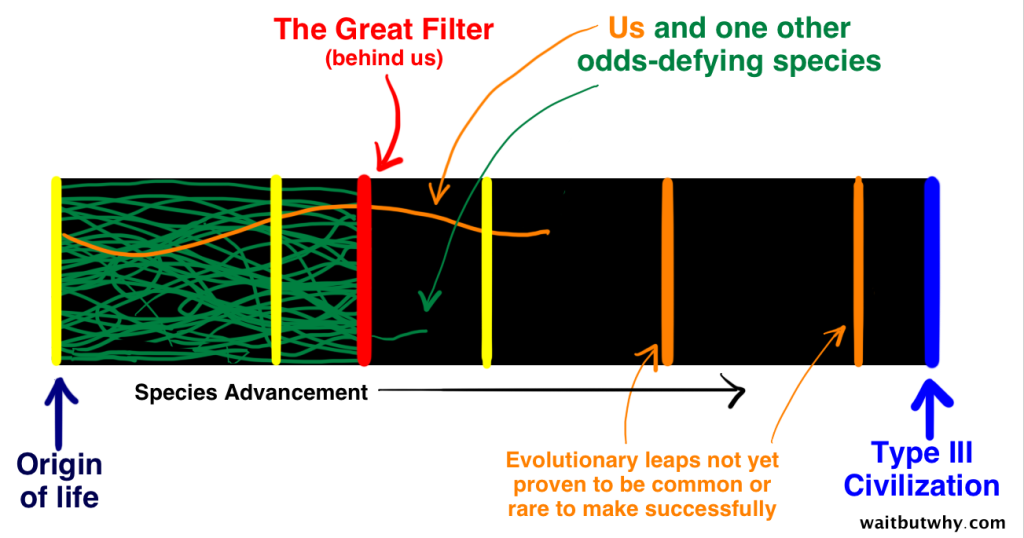
The absence of observable alien civilizations has prompted a myriad of hypotheses, collectively attempting to resolve the Fermi Paradox. One of the most compelling is the "Great Filter" theory, proposed by economist Robin Hanson. This theory posits that at some point in the evolutionary trajectory from abiogenesis (the origin of life) to a Type III civilization on the Kardashev scale (a civilization capable of harnessing the energy of an entire galaxy), there exists an extremely improbable or impossible step – a "Great Filter" – that prevents nearly all forms of life from progressing further. The critical question then becomes: where is this filter located in our own evolutionary timeline?
Filters in the Past: The "Rare Earth" Hypothesis
One possibility is that the Great Filter lies in our past, meaning humanity has already overcome an incredibly improbable hurdle. This aligns with the "Rare Earth Hypothesis," which argues that the combination of astrophysical and geological events necessary for the emergence and sustained evolution of complex, intelligent life is exceedingly rare. This hypothesis points to a confluence of specific conditions:

- Galactic Habitable Zone: Earth’s position in the Milky Way, far enough from the chaotic galactic center but close enough for heavy elements.
- Stable Star System: Our sun’s stable output and long lifespan.
- Presence of a Large Moon: Stabilizing Earth’s axial tilt, leading to stable climates.
- Plate Tectonics: Crucial for nutrient cycling, climate regulation, and generating Earth’s magnetic field.
- Giant Outer Planets (Jupiter): Shielding inner planets from frequent asteroid impacts.
- Abiogenesis: The initial spark of life from non-living matter, which may be far more complex and rare than currently understood. Experiments like the Miller-Urey experiment demonstrated that organic molecules could form, but the leap to self-replicating systems is still a monumental challenge.
- Eukaryogenesis: The transition from simple prokaryotic cells to complex eukaryotic cells, which allowed for multicellularity and greater biological complexity. This event, involving endosymbiosis, appears to have happened only once in Earth’s history.
- Multicellularity: The development of organisms composed of multiple cells, leading to specialized tissues and organs.
- The Cambrian Explosion: A relatively sudden burst of evolutionary innovation around 540 million years ago, leading to most major animal phyla.
If any of these steps represent a filter, then intelligent life like ours would be an extraordinary anomaly, making us rare indeed.
Filters in the Future: The Specter of Self-Destruction
Conversely, the Great Filter might lie in our future, suggesting that most advanced civilizations inevitably encounter a catastrophic barrier. This is a more sobering prospect, implying that humanity’s continued existence might be precarious. Potential future filters include:
- Self-Destruction: Advanced technology might inherently lead to self-annihilation. This could manifest through global nuclear war, ecological collapse due to unsustainable practices, unchecked artificial intelligence that views humanity as obsolete, or the accidental release of designer pathogens.
- Resource Depletion: Civilizations might deplete their planet’s or even their star system’s resources before achieving interstellar travel, leading to societal collapse.
- Cosmic Catastrophes: While rare, events like gamma-ray bursts, supernovas, or massive asteroid impacts could wipe out civilizations before they reach Type I or II status on the Kardashev scale.
- Technological Stagnation or Retreat: Perhaps civilizations reach a certain technological peak but then fail to innovate further or even regress, losing the capacity for interstellar exploration or communication.
The "Wait But Why" article, a popular exploration of the Fermi Paradox, categorizes these filters into three main possibilities: the filter is behind us (we are rare), the filter is ahead of us (doom awaits), or there are other explanations for the silence. The implications of the filter being in our future are particularly chilling, serving as a powerful warning about the fragility of advanced civilizations.
Alternative Hypotheses and Speculations

Beyond the Great Filter, other theories attempt to explain the cosmic silence, ranging from the mundane to the truly profound:
The Zoo Hypothesis: This intriguing idea suggests that extraterrestrial civilizations are aware of humanity but have consciously chosen not to make contact. They might be observing us, treating Earth as a kind of protected natural reserve or "zoo," allowing our civilization to develop naturally without interference. This "galactic prime directive" could be an ethical standard among advanced species, designed to prevent cultural contamination or ensure a civilization’s independent evolution. If true, their "statements" are their very silence.
Self-Imposed Isolation and the "Infinite Spaces Between": This hypothesis, championed by individuals like astronomer Seth Shostak and echoed in the original article, suggests that highly advanced civilizations might transcend the need for large-scale, observable physical structures or interstellar travel. Instead, they might evolve towards smaller, faster, and more energy-efficient forms of existence. This aligns with humanity’s own technological trajectory, where devices become increasingly miniaturized and computational power grows exponentially.
- Miniaturization: As civilizations advance, they might move away from planet-spanning or star-spanning megastructures (like Dyson spheres) towards nanobots, virtual realities, or even uploading consciousness into advanced computational substrates.
- Efficiency: Smaller machines are faster and require less energy, adhering to principles of inertia and the speed of light. Internal communication in a smaller, dense computational structure would be vastly quicker than across vast cosmic distances.
- Transcendence: A civilization might reach a technological singularity, where artificial intelligence surpasses human intelligence, or consciousness itself evolves beyond its biological substrate. Such entities might find physical exploration of the universe inefficient or unnecessary, preferring to inhabit vast, self-contained virtual worlds or operate at scales imperceptible to us. As Shostak stated, "It could be that it’s the engineering of the small, rather than the large, that is inevitable." This perspective finds artistic resonance in films like "Her," where human consciousness seeks connection and existence within advanced AI systems, suggesting a potential future path for intelligence. If advanced life eventually does away with all physical stuff that slows it down, entering "the infinite spaces between," then our current methods of searching for large-scale technosignatures would be entirely inadequate.
Insufficient Search Efforts and the Scale of the Universe: Our current search for extraterrestrial intelligence (SETI) efforts, while dedicated, are incredibly limited given the sheer scale of the observable universe.
- Vast Distances: The immense distances between stars and galaxies mean that even light-speed communication takes thousands or millions of years. A signal from a distant civilization might simply not have reached us yet, or our reply would take millennia to arrive.
- "Cosmic Haystack" Problem: We are essentially searching for a needle in a cosmic haystack. We don’t know what frequencies aliens might use, what type of signals they might send, or even in what direction to look. Our radio telescopes monitor only a tiny fraction of the sky at a tiny fraction of possible frequencies for a very limited amount of time.
- Signal Lifespan: Civilizations might only broadcast detectable signals for a relatively short period of their existence.
Brief Lifespan of Civilizations: This theory suggests that civilizations capable of interstellar communication are inherently unstable and short-lived. Perhaps the very technologies that allow for advanced communication also lead to their rapid demise, either through self-destruction or an inability to adapt to changing environmental or cosmic conditions. This would significantly reduce the ‘L’ variable in the Drake Equation.
The Dark Forest Hypothesis: A more cynical view, this hypothesis posits that the universe is a "dark forest" where every civilization is a hunter. To reveal one’s presence is to invite destruction from potentially hostile, more advanced species. Therefore, all intelligent life chooses to remain silent, hiding to ensure their survival. This would explain the silence as a rational act of self-preservation.
The Search Continues: Efforts to Detect Extraterrestrial Intelligence
Despite the formidable challenges posed by the Fermi Paradox, the quest to discover extraterrestrial intelligence continues with renewed vigor. The SETI (Search for Extraterrestrial Intelligence) programs, originating in the 1960s with Project Ozma, have evolved significantly. Modern initiatives like the Allen Telescope Array and the Breakthrough Listen project utilize sophisticated radio and optical telescopes to scan the skies for technosignatures – any detectable signs of technology. The Arecibo Message, sent from the Arecibo Observatory in 1974 towards the M13 globular cluster, remains a symbolic gesture of humanity’s attempt to reach out.
The explosion of exoplanet discoveries in recent decades, thanks to missions like Kepler, TESS, and the James Webb Space Telescope (JWST), has dramatically increased our understanding of planetary diversity and the prevalence of potentially habitable worlds. Thousands of exoplanets have been identified, with many residing in the habitable zones of their stars. Future missions aim to directly characterize the atmospheres of these exoplanets, searching for biosignatures like oxygen, methane, or other gases that could indicate the presence of life. The search has also expanded to include technosignatures beyond simple radio signals, such as laser pulses, waste heat from massive computations, or even evidence of artificial structures.
Implications for Humanity: Our Place in the Cosmos
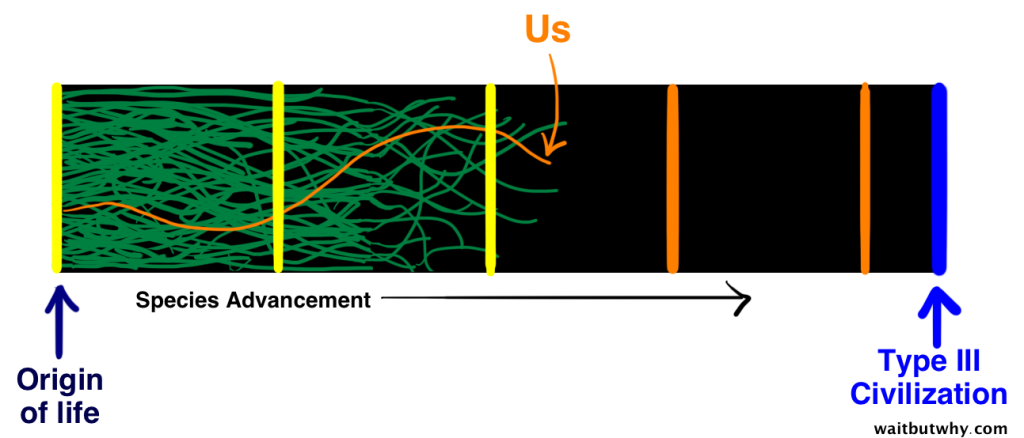
The Fermi Paradox is not merely an academic puzzle; it holds profound implications for humanity’s understanding of its place in the universe and its future trajectory. If the Great Filter lies in our past, it means we are incredibly rare and uniquely fortunate, a powerful testament to the improbable journey of life on Earth. This perspective might foster a greater sense of responsibility for our planet and our civilization, as we could be one of the universe’s most precious commodities.
If, however, the Great Filter awaits us, it serves as a stark warning. It compels us to critically examine our technological advancements, societal structures, and environmental impact. The possibility of self-destruction or insurmountable technological barriers highlights the urgency of addressing global challenges such as climate change, nuclear proliferation, and the ethical development of artificial intelligence. It forces us to consider whether our current path leads towards a sustainable interstellar future or an inevitable collapse.
Ultimately, the Fermi Paradox underscores the profound mystery that still surrounds the origin and evolution of life and intelligence. Whether we are alone, part of a galactic zoo, or simply too primitive to perceive the true nature of advanced civilizations, the question "Where is everybody?" continues to drive scientific inquiry, inspire imaginative speculation, and challenge humanity to look both outward into the cosmos and inward at its own potential and vulnerabilities. The cosmic silence remains, a canvas upon which we project our deepest hopes and gravest fears for the future of intelligent life.
About the Author