The landscape of content creation is undergoing a profound transformation, driven by the rapid advancement and adoption of Artificial Intelligence (AI). As businesses and individuals grapple with the ever-increasing demand for engaging, relevant, and high-quality content, AI-powered content generators are emerging as indispensable tools, promising efficiency, scalability, and enhanced creativity. This article delves into the burgeoning world of AI content generation, exploring its impact, the leading platforms available, and the implications for the future of digital communication.
The Evolving Content Creation Paradigm
In the digital age, content is king. From blog posts and social media updates to website copy, marketing materials, and video scripts, the need for a consistent stream of fresh and compelling content is paramount for engagement, brand building, and driving business growth. However, the traditional content creation process can be time-consuming, resource-intensive, and prone to creative blocks. This is where AI content generators step in, offering a compelling solution to these challenges.
These sophisticated tools leverage natural language processing (NLP) and machine learning algorithms to understand prompts, analyze vast datasets, and generate human-like text. They can assist in various stages of the content lifecycle, from brainstorming ideas and drafting initial copy to optimizing existing content for search engines and even generating entire articles from simple keywords. The efficiency gains are significant, allowing creators to produce more content in less time, thereby accelerating marketing campaigns, improving SEO rankings, and maintaining a stronger online presence.
Key Benefits Driving AI Content Generator Adoption
The widespread adoption of AI content generators is fueled by a confluence of benefits that address critical pain points in content creation:

- Increased Efficiency and Speed: AI can generate content significantly faster than human writers. This is particularly valuable for tasks requiring rapid output, such as social media updates, product descriptions, or responding to trending topics. Studies have shown that AI can reduce content creation time by up to 80% for certain tasks.
- Cost-Effectiveness: While initial investment in AI tools may be required, they can often be more cost-effective in the long run compared to hiring a team of human writers, especially for high-volume content needs. The ability to scale content production without a proportional increase in human resources presents a significant financial advantage.
- Overcoming Writer’s Block: For creators facing creative slumps, AI generators can provide a powerful starting point, offering fresh perspectives, diverse phrasing, and a wealth of ideas to spark inspiration.
- Enhanced SEO Performance: Many AI tools are designed with SEO best practices in mind, incorporating keyword research and optimization suggestions to help content rank higher in search engine results. This is crucial for driving organic traffic and improving online visibility.
- Scalability: AI content generators enable businesses to scale their content production exponentially, meeting the demands of growing audiences and expanding markets without compromising quality or speed.
- Consistency in Tone and Style: While AI can generate diverse content, it can also be trained to maintain a consistent brand voice and tone across all generated materials, ensuring brand coherence.
Top AI Content Generator Tools Shaping the Market in 2022 and Beyond
The market for AI content generators is dynamic and competitive, with numerous platforms vying for user attention. Based on their features, usability, and market impact, several tools stand out as leaders in the field.
1. Jasper AI (Formerly Jarvis)
Jasper AI has established itself as a frontrunner in the AI content generation space, renowned for its versatility and advanced capabilities. Originally known as Jarvis, the platform has evolved to offer a comprehensive suite of tools designed to assist writers, marketers, and entrepreneurs in creating a wide array of content.
Key Features:
- Boss Mode: This flagship feature allows users to command Jasper with natural language commands, enabling more intuitive and efficient content creation. Users can direct Jasper to write specific types of content, expand on ideas, or rewrite existing text.
- Templates: Jasper offers over 50 templates for various content needs, including blog post outlines, social media captions, ad copy, email subject lines, and video scripts.
- Content Improver: This tool helps to refine and enhance existing content by rephrasing sentences, adding descriptive language, and improving overall readability.
- Surfer SEO Integration: Jasper integrates seamlessly with Surfer SEO, a popular tool for content optimization, allowing users to create content that is both engaging and highly optimized for search engines.
- Brand Voice: Users can train Jasper to adopt a specific brand voice, ensuring consistency across all generated content.
Pros:
- Highly versatile and capable of generating a wide range of content types.
- User-friendly interface, especially with Boss Mode.
- Strong integration with SEO tools.
- Continuous updates and feature enhancements.
Cons:
- Can be one of the more expensive options on the market.
- Occasional need for human editing to ensure perfect nuance and accuracy.
Pricing:
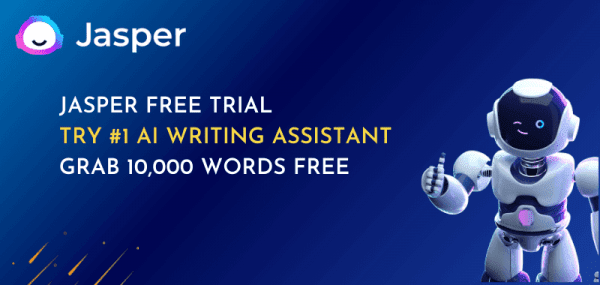
Jasper offers several pricing tiers, with its most popular plan, "Boss Mode," starting at $99 per month. This plan typically includes unlimited word generation and access to all features. They often provide special offers, such as a trial with 10,000 free credits for new users who sign up through specific affiliate links.
2. Copy.ai
Copy.ai has gained significant traction for its user-friendly interface and its ability to generate compelling marketing copy and social media content rapidly. The platform is particularly well-suited for small businesses and individuals looking for an accessible yet powerful AI writing assistant.
Key Features:
- Over 90 Templates: Copy.ai boasts an extensive library of over 90 templates catering to diverse needs, from website copy and product descriptions to blog post intros and email marketing campaigns.
- Freestyle Tool: This flexible tool allows users to input custom prompts and receive generated content tailored to their specific requirements.
- Blog Post Wizard: A dedicated tool to help users generate entire blog posts, from outlines to full drafts, streamlining the blogging process.
- Multilingual Support: Copy.ai supports multiple languages, expanding its utility for global businesses.
Pros:
- Extremely easy to use, making it ideal for beginners.
- Generous free trial and a competitive pro plan.
- Excellent for short-form marketing copy.
Cons:
- May require more editing for longer, more complex content compared to some advanced tools.
- The free plan has limitations on word count.
Pricing:
Copy.ai offers a free plan with limited daily runs and a 7-day free trial for its Pro plan. The Pro plan is priced at $49 per month, with a discounted rate of $420 per year (approximately $35 per month) when billed annually. Special offers often include free words and discounts on upgrades.

3. Frase.io
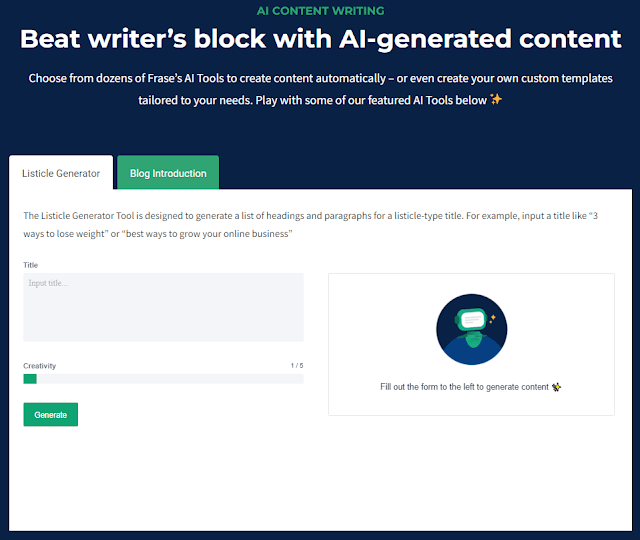
Frase.io differentiates itself by focusing on AI-powered SEO content optimization. It assists users in researching topics, creating content that ranks well, and optimizing existing articles for search engines.
Key Features:
- Content Brief Generation: Frase analyzes top-ranking content for a given keyword and generates detailed content briefs, outlining essential topics, questions to answer, and keywords to include.
- AI Writer: Integrates AI writing capabilities to help users draft content based on the generated briefs.
- Content Optimization: Provides tools to analyze existing content against SERP (Search Engine Results Page) data, offering suggestions for improvement.
- Research Capabilities: Offers extensive research tools to gather information and statistics for content creation.
Pros:
- Strong focus on SEO and content optimization.
- Excellent for creating data-driven and informative content.
- Helps to ensure content is comprehensive and addresses user intent.
Cons:
- The AI writing aspect might be less advanced than dedicated writing tools for creative prose.
- Primarily geared towards SEO professionals and content marketers.
Pricing:
Frase offers several plans, including Solo, Basic, and Team plans. The Solo plan starts at $14.99 per month (or $12 per month billed annually) for 4 document credits. The Basic plan is $44.99 per month (or $39.99 per month billed annually) for 30 document credits. An SEO add-on is available for an additional $35 per month.
4. Article Forge
Article Forge stands out for its unique approach, requiring only a keyword to generate a complete article. This makes it an attractive option for users seeking maximum efficiency with minimal input.
Key Features:
- Keyword-Based Generation: Users simply provide a keyword, and Article Forge generates a full article within seconds.
- Copyscape-Verified Content: The platform guarantees that all generated content passes Copyscape checks, ensuring originality.
- Multiple Languages: Supports content generation in various languages.
- Bulk Article Generation: Ability to generate multiple articles simultaneously.
Pros:
- Extremely fast and efficient for generating complete articles.
- Guaranteed plagiarism-free content.
- Affordable pricing for bulk content needs.
Cons:
- Content may require significant editing for tone, style, and factual accuracy.
- Less control over the narrative and specific angles compared to other tools.
Pricing:
Article Forge offers a 30-day money-back guarantee. Their plans include:
- Basic Plan: $27 per month, allowing up to 25,000 words per month.
- Standard Plan: $57 per month.
- Unlimited Plan: $117 per month.
5. Rytr.me
Rytr.me positions itself as a powerful yet affordable AI content writing assistant, ideal for small businesses, bloggers, and students. Its simplicity and cost-effectiveness make it a popular choice.
Key Features:

- User-Friendly Interface: Rytr is known for its intuitive and easy-to-navigate platform.
- Over 40 Use Cases: Offers a wide range of use cases, including blog ideas, email copy, social media posts, and ad copy.
- Built-in Plagiarism Checker: Includes a checker to ensure the originality of generated content.
- Multiple Languages and Tones: Supports content generation in over 30 languages and various tones of voice.
Pros:
- Generous free plan that allows for significant content generation.
- Very affordable paid plans.
- Simple and easy to learn.
Cons:
- The quality of generated content may vary and often requires refinement.
- Less advanced features compared to some premium tools.
Pricing:
Rytr offers a free plan that allows users to generate up to 5,000 characters per month. For more extensive use, paid plans include:
- Saver Plan: $9 per month, offering 50,000 characters per month.
- Unlimited Plan: $29 per month, providing unlimited characters and priority support.
6. Writesonic
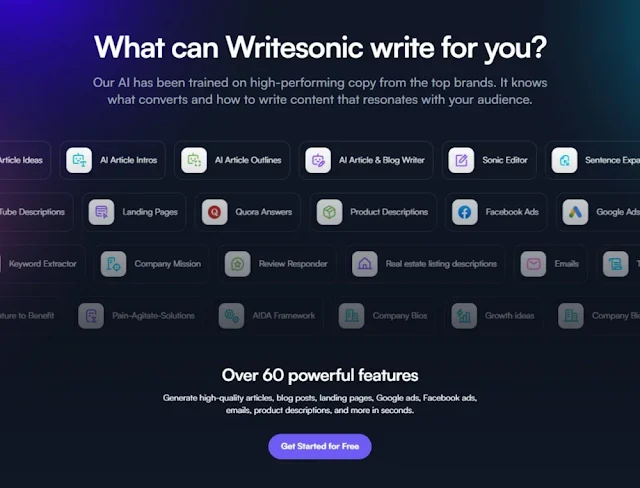
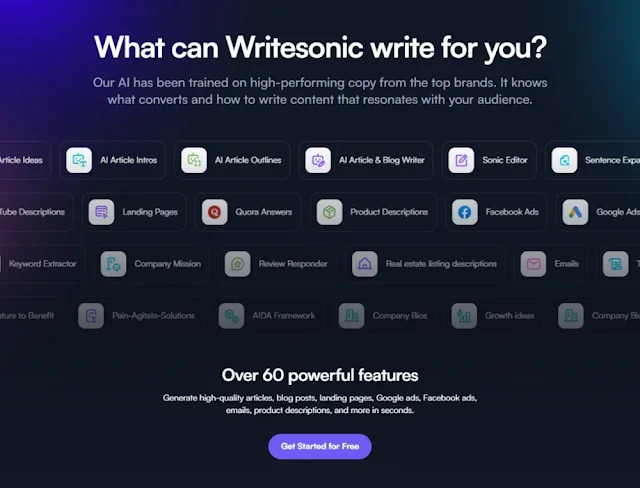
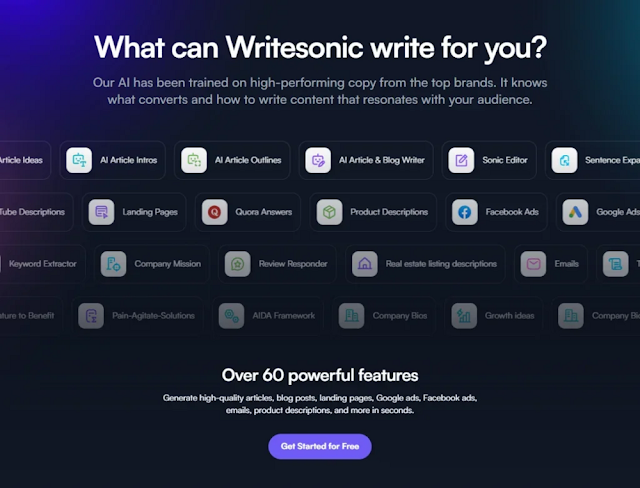
Writesonic is a free, user-friendly AI content generator designed to help individuals and small businesses create marketing copy, website content, and blog posts efficiently.
Key Features:
- Wide Range of Tools: Offers tools for generating ad copy, landing page copy, product descriptions, blog posts, and more.
- Article Writer: A dedicated feature to help create full blog posts and articles.
- Paraphrasing Tool: Assists in rephrasing existing content.
- Grammar and Plagiarism Checkers: Integrated tools to ensure content quality and originality.
Pros:

- Free plan with a decent credit limit for basic usage.
- Easy to use and navigate.
- Good for generating short-form marketing content.
Cons:
- The free plan is limited, and paid plans can become expensive for high-volume users.
- Content may require substantial editing for complex topics.
Pricing:
Writesonic offers a free trial with ten credits. Paid plans include:
- Short-form: Starting at $15 per month.
- Long-Form: Starting at $19 per month.
7. CopySmith
CopySmith is an AI content generator focused on producing quality content rapidly for both personal and professional use, including documents, blogs, and presentations.
Key Features:
- Content Variety: Capable of generating a broad spectrum of content types.
- Templates: Offers templates to expedite the content creation process.
- Team Collaboration: Designed with features that can support team workflows.
Pros:
- Quick content generation capabilities.
- User-friendly interface.
- Free trial available.
Cons:
- May not be as feature-rich as some of the more established competitors.
- Pricing can be a consideration for some users.
Pricing:
CopySmith provides a free trial. Paid plans include:
- Starter Plan: $19 per month.
- Professional Plan: $59 per month.
- Enterprise: Custom pricing available upon contact.
8. Hypotenuse.ai
Hypotenuse.ai is recognized for its AI writing software, particularly for e-commerce and generating product descriptions. It aims to simplify content creation for various needs.
Key Features:
- E-commerce Focus: Specializes in generating high-quality product descriptions and marketing copy for online stores.
- Article and Blog Content: Also capable of generating articles and blog posts.
- User-Friendly Interface: Designed for ease of use, making it accessible for beginners.
Pros:
- Excellent for e-commerce businesses needing product descriptions.
- Intuitive design.
- Offers a free trial.
Cons:
- Does not offer a perpetual free plan.
- May require more editing for non-e-commerce content.
Pricing:

Hypotenuse.ai offers a free trial. Paid plans include:
- Starter Plan: $29 per month.
- Growth Plan: $59 per month.
- Enterprise: Custom pricing.
9. Kafkai
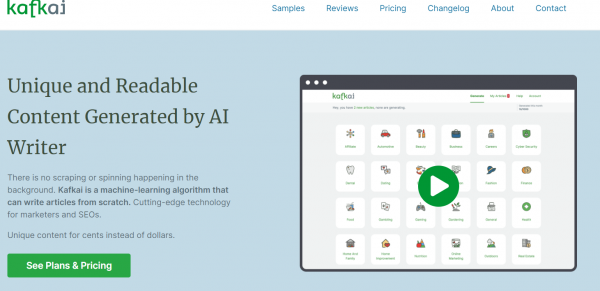
Kafkai is a leading AI writing tool specifically tailored for SEO professionals and marketers, focusing on producing niche-specific content efficiently.
Key Features:
- Niche-Specific Content: Trained on large datasets to generate content relevant to specific niches.
- User-Friendly Interface: Designed for ease of use and quick content generation.
- Personalization: Offers a degree of personalization in content output.
Pros:
- Effective for generating SEO-focused content.
- Good for creating niche-specific articles.
- Offers various pricing tiers based on article volume.
Cons:
- Content quality can vary and may need human oversight.
- Primarily targeted at SEO and marketing professionals.
Pricing:
Kafkai offers a free trial. Paid plans include:

- Writer Plan: $29 per month for 100 articles.
- Newsroom Plan: $49 per month for 250 articles.
- Printing Press Plan: $129 per month for 1,000 articles.
- Industrial Printer Plan: $199 per month for 2,500 articles.
10. Peppertype.ai
Peppertype.ai is an online AI content generator designed to be user-friendly, particularly for small business owners seeking a robust tool for various content needs.
Key Features:
- Versatile Content Generation: Capable of producing a wide range of content formats.
- Ease of Use: Emphasizes a simple and intuitive user experience.
- Blogging Focus: Particularly well-suited for generating blog content.
Pros:
- Ideal for small businesses and solopreneurs.
- User-friendly interface.
- Good for blog content creation.
Cons:
- No free plan available, only a free trial.
- Pricing can be a factor for budget-conscious users.
Pricing:
Peppertype.ai offers a free trial. Paid plans include:
- Personal Plan: $35 per month.
- Team Plan: $199 per month.
- Enterprise: Custom pricing.
The Broader Impact and Future Implications
The proliferation of AI content generators signifies a fundamental shift in how digital content is produced. This technological advancement has several significant implications:
- Democratization of Content Creation: AI tools lower the barrier to entry for content creation, empowering individuals and small businesses to compete with larger organizations by producing professional-quality content more affordably and efficiently.
- Evolution of Creative Roles: While AI can automate many writing tasks, it is unlikely to replace human creativity entirely. Instead, the role of human content creators is likely to evolve. They will shift towards higher-level tasks such as strategic planning, editing, fact-checking, adding unique insights, and ensuring the ethical and responsible use of AI-generated content.
- Challenges of Authenticity and Ethics: The rise of AI-generated content raises important questions about authenticity, plagiarism, and the potential for misinformation. As AI becomes more sophisticated, distinguishing between human-written and AI-generated content may become increasingly challenging, necessitating robust detection tools and ethical guidelines.
- Impact on SEO: Search engines are continuously adapting to the presence of AI-generated content. While AI can help optimize content for SEO, search algorithms are also being refined to prioritize high-quality, original, and valuable content, regardless of its origin. Over-reliance on unedited AI content may lead to penalties.
- Economic and Workforce Adjustments: The efficiency gains offered by AI may lead to shifts in the content creation workforce. Roles focused on repetitive writing tasks might decrease, while demand for AI prompt engineers, content strategists, and editors who can leverage AI tools effectively will likely increase.
Conclusion
AI content generators are no longer a futuristic concept but a present-day reality revolutionizing content creation. Platforms like Jasper AI, Copy.ai, Frase.io, and others are empowering creators with unprecedented efficiency and scalability. While these tools offer immense benefits, responsible and strategic implementation is key. The future of content creation lies in a symbiotic relationship between human ingenuity and artificial intelligence, where AI acts as a powerful assistant, augmenting human capabilities and enabling the creation of richer, more engaging, and more accessible content than ever before. As the technology continues to evolve, staying informed about these tools and their ethical implications will be crucial for anyone involved in the digital content landscape.
About the Author