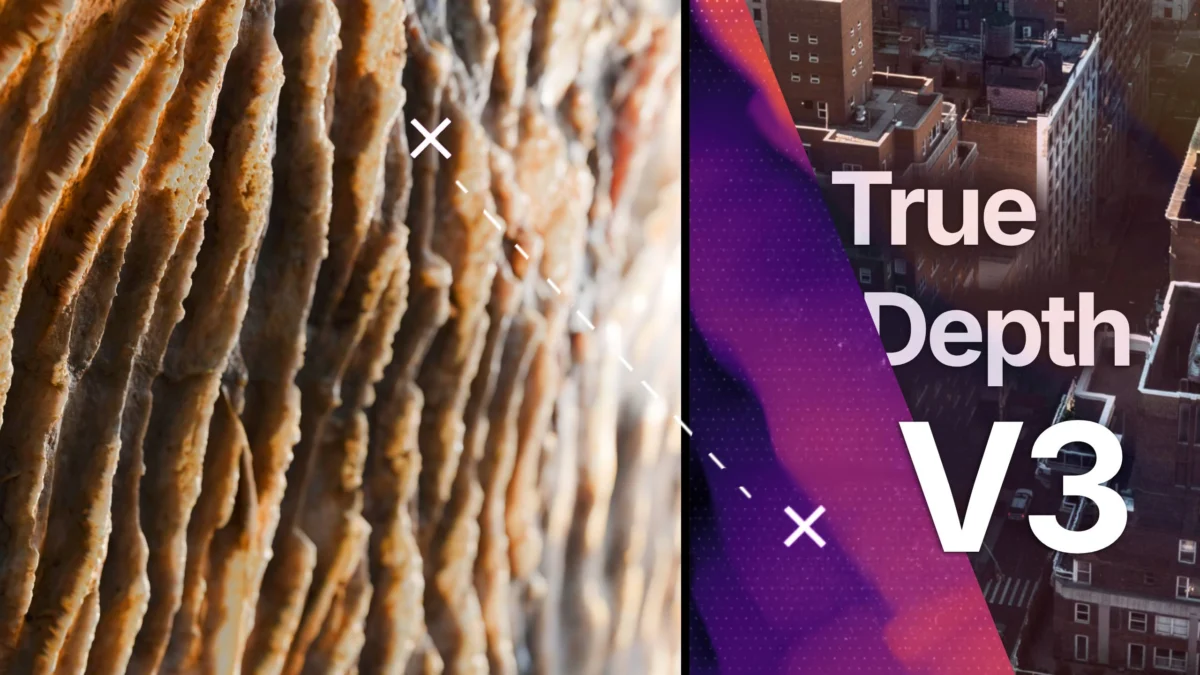
A significant advancement in the field of 3D content creation has been unveiled with the release of True Depth 3.0, a powerful add-on for the popular open-source 3D creation suite, Blender. This latest iteration dramatically expands the capabilities of turning two-dimensional images into three-dimensional models by leveraging sophisticated monocular depth estimation techniques. Building upon its foundational Flat Relief mode, True Depth 3.0 now introduces two entirely new, highly anticipated modes: Perspective and 360°. This substantial update, accompanied by a comprehensive video tutorial, signals a new era for artists and developers seeking to imbue their visual assets with unprecedented depth and dimension.
The core innovation behind True Depth lies in its ability to infer depth information from a single, two-dimensional image. This process, known as monocular depth estimation, employs artificial intelligence and machine learning algorithms trained on vast datasets to predict how far away each pixel in an image is from the camera. Historically, creating accurate 3D models from flat images required multiple viewpoints (stereoscopic vision) or manual sculpting, both of which are time-consuming and resource-intensive. True Depth aims to democratize this process, making it accessible to a wider range of users.
Evolution of Depth Estimation in True Depth
The journey of True Depth began with its Flat Relief mode, which effectively transforms a 2D image into a bas-relief-like 3D surface. This mode is particularly useful for adding subtle depth to images, creating effects like embossed textures or slightly raised elements. However, users quickly sought more dynamic and versatile applications.
Version 3.0 addresses this demand with the introduction of two groundbreaking modes:
-
Perspective Mode: This mode allows for the creation of true 3D models that exhibit realistic perspective shifts. When viewed from different angles, objects within the generated 3D scene will appear to recede or advance in a manner consistent with natural visual perception. This opens up possibilities for generating more immersive environments, character models, and detailed scenes from static imagery. The underlying algorithms in this mode likely analyze compositional cues, object sizes, and vanishing points within the 2D image to construct a spatially accurate 3D representation.
-
360° Mode: Catering to the burgeoning demand for virtual reality (VR) and panoramic content, this mode enables the generation of fully spherical 3D environments. Users can now convert panoramic 2D images into immersive 360° 3D spaces. This is a significant leap for VR content creators, architectural visualization, and virtual tours, allowing for the creation of interactive and explorable environments from existing imagery. The technical challenge here involves not only depth estimation but also the seamless stitching and reconstruction of a complete spherical volume, likely employing techniques that extrapolate depth information beyond the visible frame.
Underlying Technology and AI Advancements
The efficacy of True Depth 3.0 is directly attributable to the advancements in the underlying AI models powering its depth estimation. While the specific architectures are proprietary, it’s highly probable that the add-on utilizes state-of-the-art Convolutional Neural Networks (CNNs) or transformer-based models. These models are trained on massive datasets of images paired with their corresponding depth maps, learning to identify patterns and features that correlate with distance.
Key advancements in AI that likely contribute to True Depth 3.0’s improved performance include:
- Improved Feature Extraction: Modern neural networks are adept at identifying subtle visual cues such as texture gradients, object occlusion, and atmospheric perspective, all of which are crucial for accurate depth inference.
- Contextual Understanding: Advanced models can better understand the relationships between objects in a scene, leading to more consistent and plausible depth maps. For example, they can infer that an object partially hidden behind another is further away.
- Edge Refinement: Generating clean and well-defined 3D geometry from depth maps often involves sophisticated edge detection and refinement algorithms. True Depth 3.0 likely incorporates techniques to ensure smooth transitions and avoid artifacts.
- Scalability and Efficiency: The development team has likely optimized the AI models for performance within the Blender environment, ensuring that the generation process is reasonably fast and doesn’t excessively strain user hardware.
The Comprehensive Tutorial: A Gateway to New Possibilities

Accompanying the release of True Depth 3.0 is an extensive video tutorial. This pedagogical resource, as highlighted in the original announcement, serves as a crucial component for user adoption and effective utilization of the add-on. Tutorials are instrumental in bridging the gap between complex software features and user comprehension, especially for advanced tools like AI-driven 3D generation.
The tutorial likely covers:
- Installation and Setup: A clear walkthrough of how to install and configure the True Depth add-on within Blender.
- Mode Demonstrations: In-depth explanations and practical examples of how to use each of the new modes (Perspective and 360°), alongside a refresher on the existing Flat Relief mode.
- Parameter Tuning: Guidance on adjusting various settings and parameters to achieve optimal results for different types of input images. This could include options for controlling the strength of depth, smoothing algorithms, and output resolution.
- Workflow Integration: Demonstrations of how to integrate the generated 3D models into typical Blender workflows, such as texturing, rigging, animation, and rendering.
- Troubleshooting and Best Practices: Tips for common issues and advice on preparing input images for the best possible outcomes.
The availability of such a detailed guide is critical for democratizing the technology. Users, ranging from hobbyists to professionals, can learn to harness the power of True Depth 3.0 without needing extensive prior knowledge of AI or 3D modeling theory.
Potential Applications and Industry Impact
The implications of True Depth 3.0 extend across numerous industries:
- Game Development: Rapidly generating 3D assets for game environments and props from concept art or existing photographs can significantly accelerate development cycles. The 360° mode could be used to create immersive VR game worlds.
- Virtual and Augmented Reality (VR/AR): The ability to create 3D environments and objects from 2D sources is a game-changer for VR/AR content creation. Developers can build more realistic and interactive experiences with greater ease.
- Film and Animation: For visual effects (VFX) pipelines, True Depth could assist in quickly generating background elements, set extensions, or even rough character models that can be further refined.
- Architectural Visualization: Architects and designers can transform 2D architectural drawings or photographs into 3D walkthroughs or VR experiences, aiding in client presentations and design reviews.
- E-commerce: Businesses can create more engaging product visualizations by converting flat product images into interactive 3D models, allowing customers to view products from all angles.
- Digital Archiving and Preservation: Historical photographs or artworks could be converted into 3D models, offering new ways to preserve and interact with cultural heritage.
Data and Performance Considerations
While specific performance benchmarks for True Depth 3.0 are not yet widely available, the complexity of monocular depth estimation suggests that processing times and hardware requirements will vary. Factors influencing performance include:
- Input Image Resolution and Complexity: Higher resolution images with intricate details will naturally require more processing power and time.
- Depth Estimation Model: The sophistication and size of the AI model used will directly impact computational demands.
- Output Geometry Detail: The desired level of detail in the generated 3D mesh will also affect processing time.
- Hardware Specifications: Users with more powerful GPUs and CPUs will experience faster generation times.
It is common for AI-driven 3D generation tools to offer varying levels of detail or processing quality, allowing users to balance speed with fidelity. The inclusion of a comprehensive tutorial suggests that the developers have likely addressed common user pain points related to performance and workflow integration.
Community and Future Development
The release of True Depth 3.0 by a "Community Reporter" on platforms like BlenderNation indicates a strong connection to the Blender community. This suggests that the add-on is likely developed with user feedback in mind, and future updates may incorporate community-driven features and improvements. The open-source nature of Blender itself fosters a collaborative environment where tools like True Depth can thrive and evolve.
The evolution from Flat Relief to Perspective and 360° modes represents a significant leap in the capabilities of AI-powered 2D-to-3D conversion. As AI technology continues to advance, we can anticipate even more sophisticated and intuitive tools emerging, further blurring the lines between 2D and 3D content creation and opening up new frontiers for digital artistry and innovation. The True Depth add-on, with its robust features and comprehensive educational support, stands as a testament to this exciting technological trajectory.
About the Author