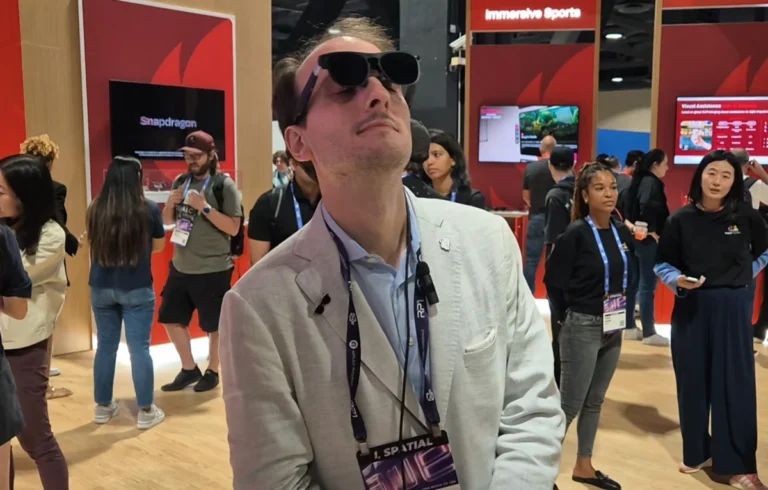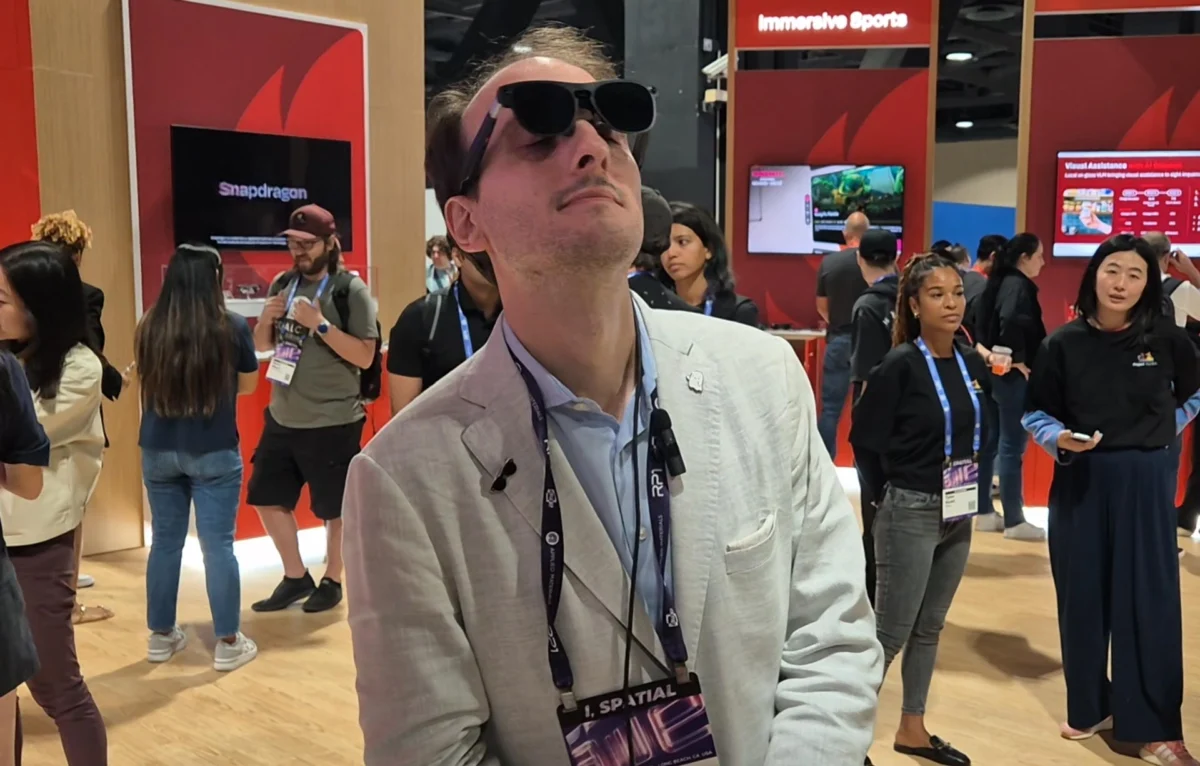
The landscape of spatial computing has reached a significant milestone with the unveiling of the XREAL Aura, a device representing a strategic collaboration between Chinese manufacturer XREAL, Google, and Qualcomm. Debuting at the Augmented World Expo (AWE), the XREAL Aura is positioned as the first consumer-oriented augmented reality (AR) glasses to run on the newly developed AndroidXR operating system. This launch marks a pivotal shift in the industry, moving away from closed ecosystems toward a more standardized platform designed to bring high-end spatial computing to a broader demographic.

The XREAL Aura distinguishes itself through an "all-in-two" architecture, a design choice that separates the optical display from the computational hardware. By offloading the processor and battery to a dedicated external "puck," XREAL has managed to maintain a lightweight form factor for the eyewear itself, weighing in at approximately 95 grams. This approach addresses the persistent industry challenges of thermal management and weight distribution, which have historically limited the long-term wearability of standalone AR headsets.

Technical Architecture and Specifications
The XREAL Aura is built upon a foundation of high-performance mobile hardware. The computational puck is powered by the Qualcomm Snapdragon Elite chipset, paired with 12GB of RAM and 256GB of internal storage. This configuration provides the necessary overhead for complex spatial mapping, AI processing, and high-fidelity rendering. The puck also houses a 5000mAh battery, providing the power required for extended sessions that would be impossible with on-board eyewear batteries.

The display system utilizes prism optics to project visuals onto 1920 x 1200 pixel displays per eye. This results in a high pixel density that ensures text legibility for productivity tasks, such as document editing in Google Docs. One of the most notable optical features is the 70-degree diagonal field of view (FOV). While many contemporary AR glasses are limited to a 50-degree FOV, the 70-degree threshold is widely regarded by industry analysts as the minimum requirement for a truly immersive "general-purpose" XR experience.

| Component | Specification |
|---|---|
| Chipset | Qualcomm Snapdragon Elite |
| Memory | 12GB RAM |
| Storage | 256GB Internal |
| Battery | 5000mAh (External Puck) |
| Resolution | 1920 x 1200 per eye |
| Field of View | 70° Diagonal |
| Weight | Glasses: 95g / Puck: 300g |
| Tracking | 6DOF Positional / Hand Tracking |
Electrochromic Dimming: The Convergence of AR and VR
A standout feature of the Aura is its integrated electrochromic dimming technology. This system allows the user to dynamically adjust the transparency of the outer lenses across five distinct levels. At maximum transparency, the device functions as a standard AR headset, overlaying digital information onto the user’s view of the physical environment. At maximum opacity, the lenses become nearly black, effectively transforming the device into a virtual reality (VR) headset.

This dual-mode capability is managed either manually via hardware controls or automatically by the AndroidXR operating system. When a user launches a VR-specific application, the system can trigger the dimming mechanism to isolate the user from external light. However, the prism optics necessitate a slight permanent tint, meaning the lenses never reach 100% transparency. While this does not impede navigation in well-lit environments, it remains a characteristic of the current optical design that differentiates it from completely clear smart glasses.

The AndroidXR Ecosystem and AI Integration
The software represents perhaps the most significant aspect of the Aura’s debut. By adopting AndroidXR, XREAL leverages Google’s extensive app ecosystem. Users have access to familiar tools such as Google Maps, YouTube, and Chrome, all optimized for a spatial environment. The interface utilizes a familiar 2D windowing system that can be anchored in 3D space, allowing for multitasking and a personalized spatial workstation.

Furthermore, the Aura features deep integration with Google Gemini, Google’s multimodal AI. The device includes a dedicated button to invoke the AI assistant, which can analyze the user’s surroundings via the onboard RGB camera. This enables "vibe-coded" experiences where the AI can generate or modify digital content based on real-world context. For example, during demonstrations, Gemini was used to draft documents and interact with spatial data in the "Molecule" application, showcasing the potential for AI to serve as the primary interface in AR.

Tracking and Interaction Methodologies
The XREAL Aura employs a comprehensive suite of sensors to facilitate interaction. Positional tracking is achieved through two dedicated cameras located on the front of the frames, providing six degrees of freedom (6DOF). This allows virtual objects to remain fixed in physical space as the user moves.

The device relies on three primary interaction methods:

- Hand Tracking: The system supports gesture-based control, allowing users to tap, swipe, and zoom without physical controllers. While highly accurate, the current iteration exhibits a slight latency that makes it more suitable for productivity and media consumption than for fast-paced gaming.
- Physical Controls: The computational puck features a built-in touchpad, providing a tactile alternative for navigating menus. The glasses themselves include buttons for volume, power, and menu invocation.
- Voice Control: Through Gemini integration, voice commands serve as a robust method for hands-free operation.
Market Positioning and Industry Implications
XREAL has announced that the Aura will be available for preorder with a launch slated for Fall 2026. While the final price has not been solidified, the company has indicated it will retail for less than $1,500. This places the Aura in a competitive bracket between high-end VR headsets like the Meta Quest 3 and premium spatial computers like the Apple Vision Pro.

The launch of the Aura is a clear signal of Google’s renewed commitment to the XR hardware space through its partnership with XREAL and Qualcomm. Following the discontinuation of Google Glass and the sunsetting of the Daydream platform, AndroidXR represents a third attempt to establish a dominant operating system for the next generation of computing.

Industry analysts suggest that the success of the XREAL Aura will depend heavily on the development of a "killer app"—a use case that justifies the $1,000+ investment for the average consumer. While the hardware is impressive, the tethered design remains a point of contention. Some users prefer the weight reduction afforded by the cable, while others find the physical connection to be a hindrance to the "glasses" aesthetic.

Conclusion
The XREAL Aura represents a sophisticated blend of mobility and power. By utilizing the AndroidXR platform and incorporating advanced features like electrochromic dimming and AI-driven interactions, XREAL is attempting to bridge the gap between niche enthusiast gear and mainstream consumer electronics. As the first of its kind, the Aura will serve as a bellwether for the viability of Android-based AR glasses in a market increasingly defined by the tension between immersive functionality and wearable comfort. The forthcoming Fall launch will be a critical test of whether the consumer market is ready to embrace a tethered, high-performance AR future.
About the Author