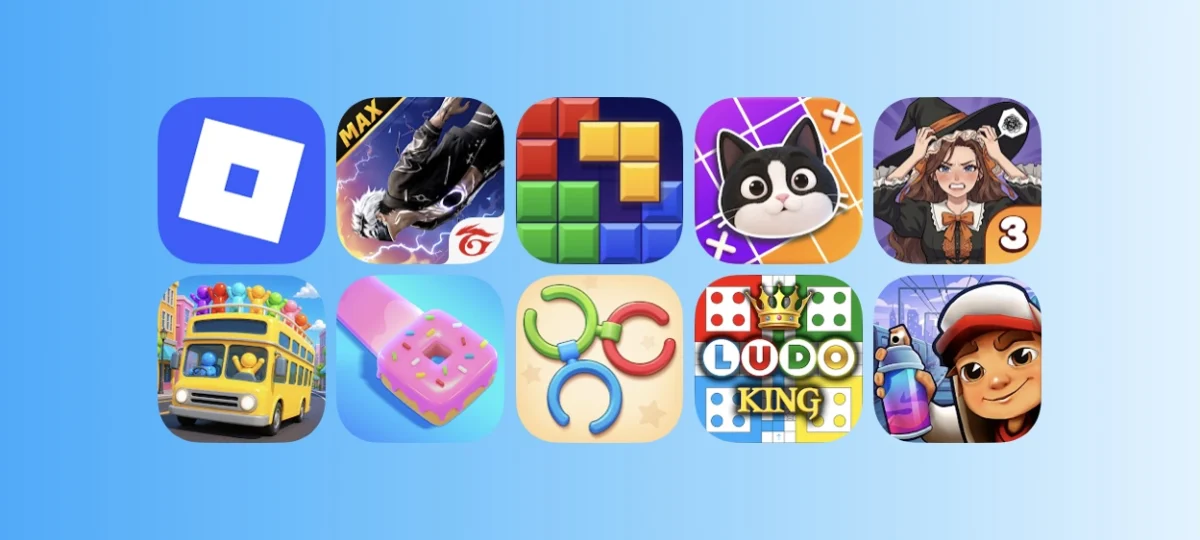
The mobile gaming landscape in October 2026 witnessed a significant reshuffling of the global leaderboard, as established giants and innovative newcomers vied for dominance in an increasingly crowded market. According to the latest data from Appmagic, which tracks installs across global storefronts excluding China’s fragmented third-party Android ecosystem, Roblox has reclaimed the coveted number one position. The user-generated content (UGC) powerhouse surpassed Garena’s Free Fire Max, signaling a potential shift in player engagement patterns as the year draws to a close. With 22.5 million downloads recorded in October, Roblox’s performance mirrors its July 2026 peak of 22.8 million, suggesting that the platform’s appeal is no longer strictly tied to traditional school holiday surges but has instead achieved a steady-state dominance among a maturing global audience.
The Battle for the Top Spot: Roblox vs. Free Fire Max
The transition at the top of the charts highlights two diverging trajectories for the industry’s biggest titles. Roblox’s ascent to 22.5 million installs represents a resilient recovery, nearly matching its performance from the same period in 2025. Industry analysts suggest that Roblox’s success is increasingly driven by its internal ecosystem of diverse mini-games, which allows it to function as a social network as much as a gaming platform. This "platform-as-a-service" model has insulated it from the volatility often seen in standalone titles.
Conversely, Free Fire Max, while still a titan of the industry, slipped to second place with 21.4 million downloads. This marginal decline is part of a broader trend observed since January 2026, where Garena’s premier battle royale has experienced a gentle but consistent downward slope in monthly installs. While the game maintains a massive active user base in Southeast Asia and Latin America, the saturation of the battle royale genre and increasing competition from localized shooters have slowed its once-unstoppable growth.
The Puzzle Renaissance: Block Blast and Meowdoku
The mid-tier of the top ten is currently dominated by puzzle and logic games, a genre that has seen a massive resurgence in 2026. Hungry Studio’s Block Blast secured the third spot with 18 million downloads. While this figure is a far cry from the game’s historic peaks in late 2024 and mid-2025, it marks a significant "V-shaped" recovery. After bottoming out in June 2026, the title has seen incremental growth every month, proving that effective user acquisition (UA) strategies and gameplay refinements can breathe new life into older hyper-casual hits.
One of the most remarkable stories of the month is Meowdoku, published by Learnings (Oakever Games). Despite ongoing legal scrutiny and public accusations regarding the cloning of game mechanics—specifically those found in LinkedIn’s popular "Queens" game—Meowdoku reached an all-time high of 17.3 million downloads in October, climbing three spots to fourth place. The game’s success underscores a persistent reality in the mobile market: accessibility and visual polish often trump origin disputes when it comes to mass-market adoption.

New Entrants and Rapid Climbers
October’s data introduced several new power players to the global stage. SmallStep Tech, a developer based in China, made a significant splash with Brain Puzzle 3. The game, which blends hidden object mechanics with logic-based puzzles, jumped to fifth place with 15.7 million installs. What makes Brain Puzzle 3 particularly notable is its diverse geographic appeal; unlike many titles that rely on a single dominant market, its player base is evenly distributed across the United States, Brazil, Indonesia, Mexico, and Russia.
Another standout performer was Rotate Rings by Singapore-based Nebula Studio. The title rocketed up 190 places to finish the month in eighth position with 12.6 million downloads. Rotate Rings is a prime example of a burgeoning trend in mobile development: taking a popular "playable ad" format—often used to market other games—and building a full, high-quality experience around it. Having only launched in mid-September, the game’s rapid ascent suggests that players are increasingly looking for the specific experiences promised in advertisements that they previously found missing in the final products.
The Revival of Legacy Hits and Regional Dynamics
The October charts also revealed the enduring power of legacy titles when paired with aggressive regional marketing. Voodoo’s Paper.io 2, a game that originally broke out in 2018, experienced a stunning revival to reach seventh place with 12.8 million downloads. This resurgence is almost entirely driven by the Indian market, which accounted for 44% of the game’s total installs over the last 30 days. October 2026 represented the game’s best monthly performance in over seven years, proving that the Indian mobile market remains the primary engine for pure download volume in the hyper-casual sector.
Meanwhile, industry staples like Ludo King and Subway Surfers maintained their presence in the top ten, though both saw slight declines. Ludo King slipped to ninth place despite consistent month-on-month growth, while Subway Surfers dropped five spots to tenth with 11.4 million downloads. The decline for Subway Surfers marks its second consecutive month of slowing installs, perhaps indicating a temporary fatigue for the classic runner as players pivot toward more complex puzzle-solving titles.
Analyzing the 11-20 Rankings: Growth and Volatility
Beyond the top ten, several titles showed strong momentum. Microfun’s Gossip Harbor rose eight spots to 11th place with 10.5 million downloads. The game’s success is attributed to its "merge-and-story" mechanic, which has become a highly lucrative sub-genre for attracting female demographics. Similarly, Magic Tiles 3 from Amanotes jumped 12 places to 18th, benefitting from seasonal music updates and renewed social media trends.
However, the "block puzzle" sub-genre showed signs of saturation. Ivy Mobile’s Color Block, a title heavily inspired by Block Blast, saw its downloads ease off by 800,000 month-on-month, landing in 15th place. Similarly, Grand Games’ Block Out and Easybrain’s Arrow Puzzle both posted declines, suggesting that while the genre is popular, the market may be reaching its limit for nearly identical gameplay experiences.

A noteworthy mention goes to MemeMix Challenge, an Android-only title that debuted in 21st place with 7.8 million installs. Its entry into the charts highlights the power of viral internet culture in driving immediate, high-volume downloads, even without a multi-platform release.
Chronology of Market Shifts: 2026 Trends
The data from October 2026 serves as a microcosm of the year’s broader shifts in the mobile gaming industry. In the first half of the year, the market was dominated by traditional battle royales and established runners. However, the third and fourth quarters have seen a decisive move toward "hybrid-casual" games—titles that combine the simple mechanics of hyper-casual games with the deeper retention hooks of mid-core titles.
- January – March: Dominance of Free Fire and PUBG Mobile; high volume but low innovation.
- April – June: The "Summer Slump" for traditional puzzles; Roblox begins its ascent as a social hub.
- July – September: The rise of the "Ad-to-Game" pipeline (e.g., Rotate Rings) and the explosion of the Indian market for legacy titles.
- October: Consolidation of the puzzle genre and the return of Roblox to the top spot.
Industry Implications and Future Outlook
The current state of the download charts suggests that the barrier to entry for new developers remains high, but not insurmountable. Success in late 2026 is increasingly dependent on "market-gap" identification—finding mechanics that are popular in advertising but underrepresented in the app stores.
Official responses from studios like Voodoo and Roblox Corp have consistently emphasized the importance of "ecosystem retention." For Voodoo, the focus has shifted from launching dozens of small games to revitalizing older IP through localized marketing in emerging economies. For Roblox, the focus remains on empowering creators to build experiences that rival standalone apps.
Looking ahead to November and December, industry experts anticipate a surge in downloads for titles that integrate social and competitive features. As the "fractured" Android market in China continues to evolve independently, the global data suggests a stabilizing market where quality of engagement is becoming as important as raw install numbers. The decline of "cloned" puzzle games in the 11-20 bracket may also signal a "flight to quality," where players gravitate toward the original innovators of a genre rather than the myriad of copycat titles that follow.
About the Author