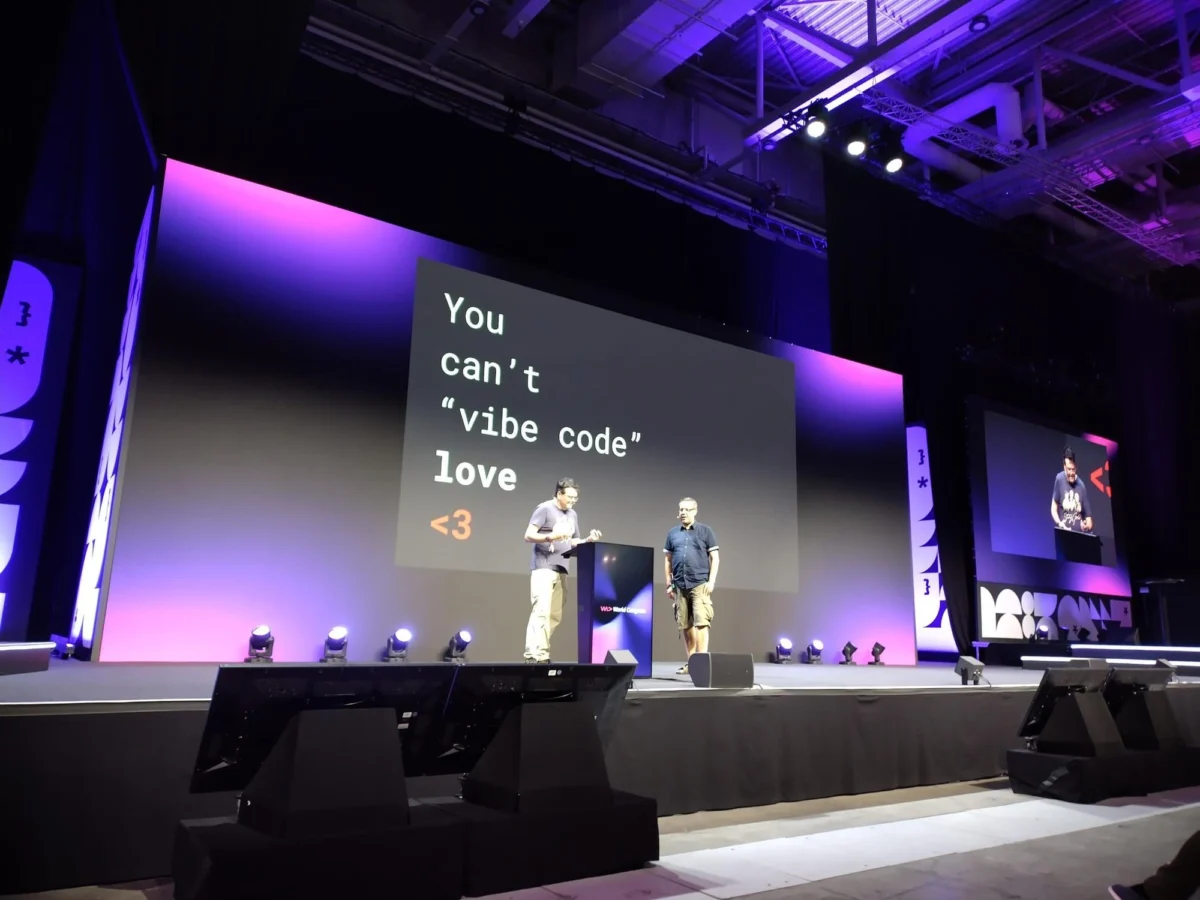
BERLIN – Jeff Atwood, co-founder of the seminal developer resource Stack Overflow and author of the popular Coding Horror blog, delivered a thought-provoking presentation at the WeAreDevelopers World Congress in Berlin on Friday, July 10th. Co-presenting with Ben Dumke-von der Ehe, an early community hire at Stack Overflow based in Berlin, Atwood addressed the evolving landscape of developer knowledge sharing, particularly in the wake of widespread adoption of Large Language Models (LLMs). The duo explored the profound impact of community-driven platforms like Stack Overflow and raised critical questions about the future of collaborative learning and the sustainability of public knowledge commons in an AI-dominated era.
The presentation, titled "None of Us Is As Dumb As All of Us: Community And Knowledge Go Hand In Hand," served as a capstone event at the prestigious WeAreDevelopers World Congress, one of Europe’s largest gatherings for developers, which annually attracts tens of thousands of attendees from across the globe. Held at the CityCube in Berlin, the congress provides a vital platform for discussions on cutting-edge technologies, industry trends, and the future of software development. Atwood, known for his incisive commentary on programming and technology, rarely accepts international speaking engagements. However, he stated that this particular invitation arrived at "just the right time, the right place, and with the right person," referring to his long-standing professional and personal connection with Dumke-von der Ehe. Atwood’s acceptance was contingent on Dumke-von der Ehe joining him on stage, a testament to their shared history and differing yet complementary perspectives on the subject matter. Both speakers felt compelled to discuss an issue they considered vital, offering nuanced insights shaped by their unique experiences within the developer community.
The Genesis of a Crucial Dialogue
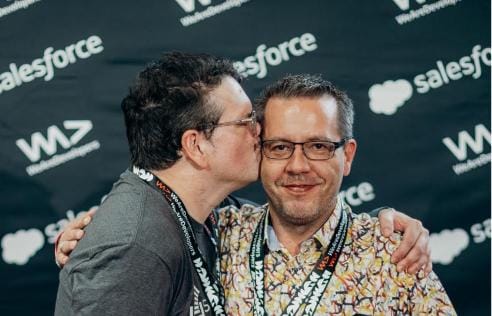
The collaboration between Atwood and Dumke-von der Ehe for this presentation was rooted in a significant personal and professional history, a narrative that formed the emotional core of their address. Atwood openly acknowledged a profound debt to Dumke-von der Ehe and the wider Stack Overflow community, stating, "I’m mostly doing this presentation because I owe you so much." The story of their initial meeting, which Atwood succinctly described as involving "unicorns" and a life-changing impact, highlights the human connections fostered by online communities. Dumke-von der Ehe’s journey, including his initial hiring at Stack Overflow as an early community associate, his departure, subsequent return, and eventual second departure, serves as a microcosm of the dynamic careers and relationships built within the platform’s ecosystem. His perspective, which has been shared in other forums, underscores the profound influence Stack Overflow had on his development as a programmer and the unique opportunities that arose from actively engaging with the community. These anecdotes were presented not merely as personal reflections but as evidence of the vibrant, interconnected human network that underpins successful knowledge-sharing platforms.
Stack Overflow’s Legacy: A Collaborative Commons
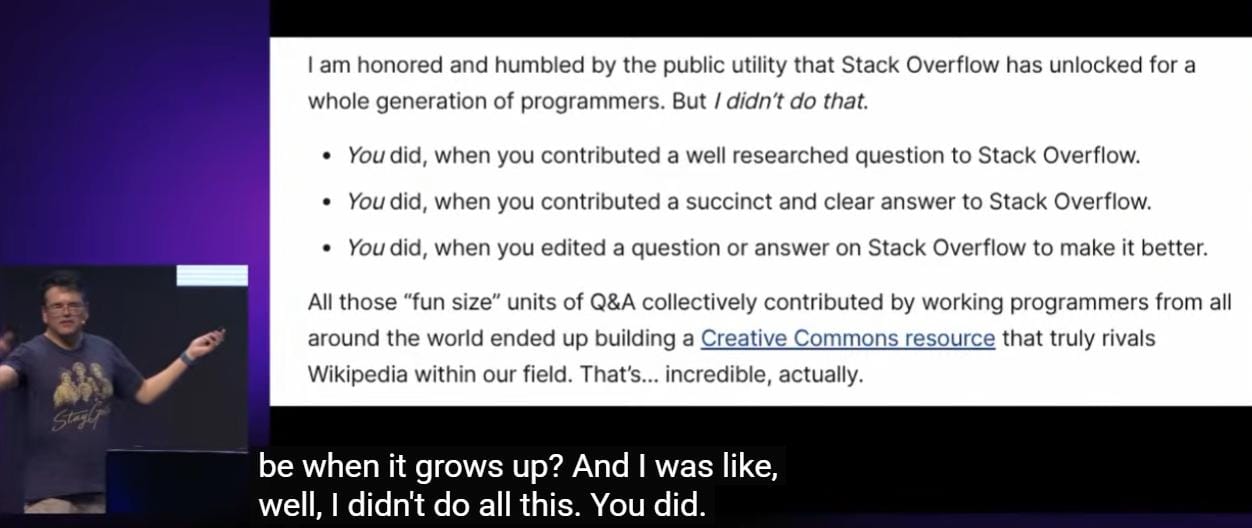
Founded in 2008 by Jeff Atwood and Joel Spolsky, Stack Overflow rapidly ascended to become an indispensable resource for programmers worldwide. Its core premise was simple yet revolutionary: a question-and-answer platform where developers could seek and provide solutions to coding challenges, collectively building a vast repository of practical knowledge. The platform’s success was largely attributed to its commitment to open knowledge and collaborative principles. All contributions to Stack Overflow are licensed under a bedrock Creative Commons license, specifically CC BY-SA (Creative Commons Attribution-ShareAlike). This licensing model was crucial, as it respected the intellectual effort of every contributor while ensuring that the accumulated knowledge remained freely accessible and shareable for the benefit of the entire developer community.
Over the past decade and a half, Stack Overflow has grown exponentially, boasting over 100 million unique visitors monthly and hosting more than 20 million questions and 30 million answers. It has become a de facto standard for developers seeking solutions, with studies consistently showing that a significant majority of programmers consult Stack Overflow weekly. This collective effort transformed the platform into what Atwood described as a "commons" – a shared resource built and maintained by its users. This "hugely influential Stack Overflow dataset" not only served as a daily problem-solving tool but also fundamentally reshaped how developers learned, collaborated, and advanced their skills, often democratizing access to expertise that was once siloed. The platform’s success exemplified the power of distributed collaboration in creating a public good of immense value.
LLMs and the Evolution of Knowledge Access
The advent and rapid proliferation of Large Language Models (LLMs) represent a paradigm shift in how information is accessed and processed, particularly within the programming domain. Tools like GitHub Copilot, powered by LLMs, can generate code, debug issues, and answer complex programming questions with remarkable speed and accuracy. Atwood acknowledged the transformative potential of these technologies, recognizing that LLMs can intercept "most (if not all) of the common programming questions." This development, he noted, aligns surprisingly well with some of Stack Overflow’s original, higher-level goals.

As Atwood previously articulated in a blog post titled "What Does Stack Overflow Want to Be When It Grows Up?", the platform’s primary objective was to enable passive knowledge consumption. "If Stack Overflow is working like it’s supposed to, 98% of programmers should get all the answers they need from reading search result pages and wouldn’t need to ask or answer a single question in their entire careers. This is a good thing! Great, even!" he wrote. LLMs, in this context, appear to be fulfilling this aspiration with unprecedented efficiency.
Furthermore, LLMs offer a powerful solution to a perennial challenge that plagued community-driven Q&A platforms: the incessant problem of duplicate questions. Atwood described this issue as a "gordian knot" that he once thought "basically impossible" to untangle. As a knowledge base expands from millions to tens of millions, or even hundreds of millions, of questions, the task of asking a truly unique question becomes exponentially more difficult. Users must navigate a "vast, enormous field of prior art questions without stepping on any of the vaguely similar looking landmines." LLMs, with their advanced semantic understanding, possess an unparalleled ability to map newly phrased questions, even those using entirely different terminology, to existing answers. This capability dramatically reduces duplication, streamlines the search for solutions, and ultimately delivers "more answers, faster," which Atwood unequivocally identifies as a "huge net positive."
The Paradox of Efficiency: A Threat to the Commons?
Despite acknowledging the significant benefits LLMs bring to individual productivity and the efficiency of knowledge retrieval, Atwood pivoted to the central and most pressing concern of his presentation: the potential erosion of the public knowledge commons. The paradox lies in the very efficiency of LLMs. If developers increasingly turn to private conversations with AI tools for their coding queries, what becomes of the collaborative spaces where knowledge was traditionally generated, curated, and shared? "But what happens to the commons when everyone is privately whispering to LLMs?" Atwood questioned, articulating a sentiment shared by many in the developer community.
The concern extends beyond mere usage statistics. Stack Overflow, like many other community-driven platforms, fostered a unique environment where programmers not only found answers but also learned from each other, engaged in peer review, and built professional networks. Dumke-von der Ehe’s experience, where he "had so much fun becoming a programmer, and got hired for doing things he loved" directly through his community involvement, exemplifies this symbiotic relationship. If private LLM interactions supplant these public forums, the informal learning, mentorship, and social capital derived from community participation could diminish significantly.
A critical implication of this shift is the future of training data for AI itself. The vast datasets that power today’s LLMs are largely built upon the very public commons that platforms like Stack Overflow created – content licensed under Creative Commons and freely available for use and adaptation. If new knowledge generation largely shifts to private, unshared interactions with AI, where will the next generation of LLMs find high-quality, human-generated, and community-validated data to learn from? The sustainability of AI’s own learning process depends on the continuous replenishment of this public wellspring of knowledge. This creates a feedback loop dilemma: LLMs thrive on community data, but their success might inadvertently stifle the very communities that produce that data.
The Future of Community and Collaborative Learning
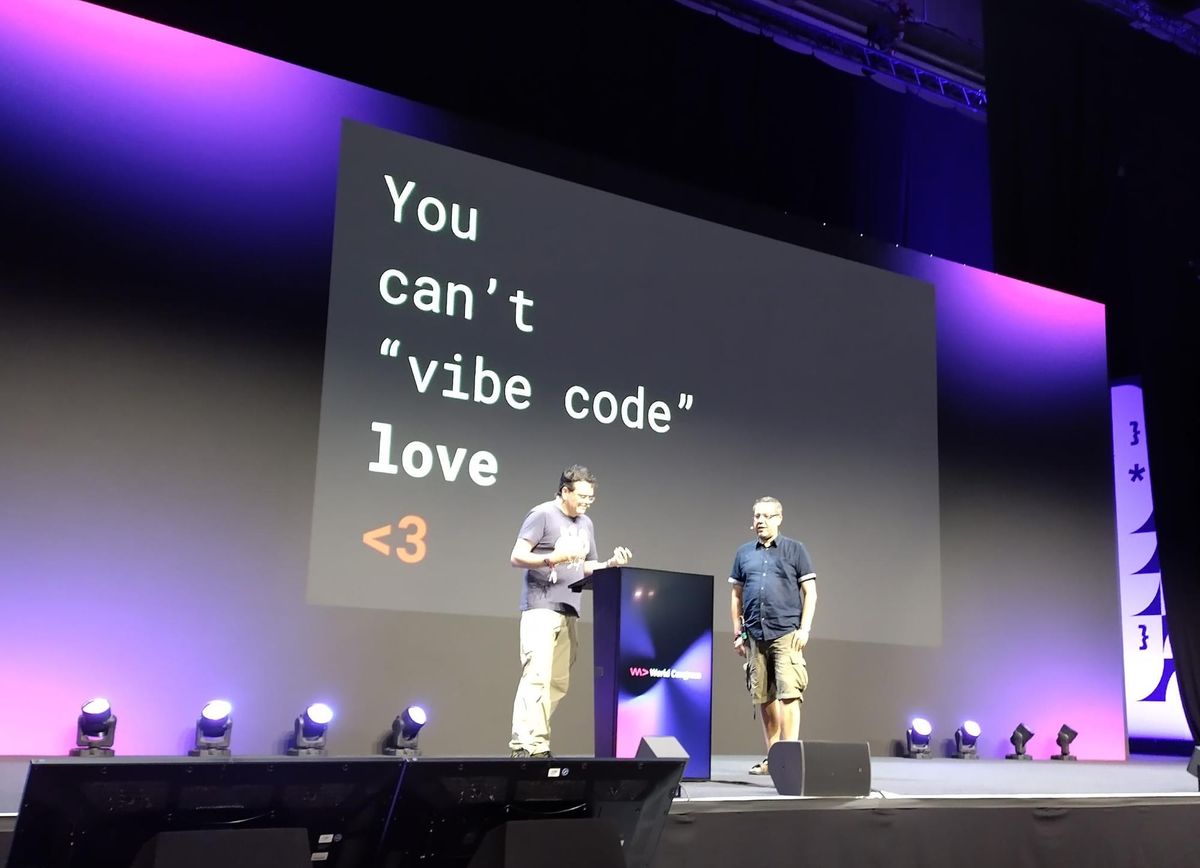
Atwood’s presentation underscored that coding is not merely a solitary act of problem-solving but a deeply social and collaborative endeavor. The concept of "vibe code love" articulated in the presentation, though metaphorical, speaks to the intangible yet crucial elements of community: shared passion, mutual support, informal mentorship, and the joy of collective creation. These elements are difficult, if not impossible, for an AI to replicate. "You can’t ‘vibe code’ love," Atwood stated, emphasizing that genuine connection and inspiration arise from human interaction.
The implications for developer education and career development are profound. While LLMs excel at providing immediate, functional answers, they may not foster the critical thinking, nuanced understanding, or problem-solving methodologies that come from engaging with diverse human perspectives, debating solutions, and learning from mistakes in a public forum. The community aspect of platforms like Stack Overflow allowed users to learn not just what the answer was, but why it was the answer, and how different approaches might yield different results – a depth of understanding often absent in a direct AI response.
Broader Impact and Implications
The discussion initiated by Atwood and Dumke-von der Ehe at WeAreDevelopers extends beyond the programming community, touching upon broader societal implications for knowledge creation and dissemination. The sustainability of open-source projects, the future of collaborative scientific research, and the very definition of public intellectual commons are all impacted by the rise of highly capable private AI agents. If the incentive structure shifts away from public contribution towards private consumption, the collective human endeavor to build shared knowledge bases could weaken.
The challenge, therefore, is to find a harmonious balance. How can the immense benefits of LLMs – increased efficiency, faster problem-solving, and the effective management of informational redundancy – be integrated without inadvertently dismantling the very communities that generate the foundational knowledge and foster the human connections essential for innovation? This question calls for proactive strategies to protect and nurture these commons, perhaps through new models of incentivization for public contribution, hybrid learning environments that integrate AI with human mentorship, or even legislative frameworks that recognize the value of community-generated data.
Looking Ahead: Preserving the Collaborative Spirit
The presentation by Jeff Atwood and Ben Dumke-von der Ehe served as a crucial call to action, urging the developer community and the broader tech industry to critically examine the long-term consequences of current trends. While the immediate gains from LLMs are undeniable, the imperative to "build for and protect the commons together" remains paramount. The continuous sharing of knowledge, and indeed, the "love" of collaborative creation, are not merely nostalgic ideals but essential ingredients for sustained innovation and human progress. The dialogue at WeAreDevelopers highlighted that navigating the future of knowledge in an AI-powered world requires not just technological advancement, but also a renewed commitment to the principles of community, collaboration, and the open exchange of ideas that have historically driven the developer ecosystem forward. The balance between individual efficiency and collective enrichment will define the next chapter of digital knowledge.
About the Author