The Foundation: Navigating the Digital World with NavMesh
Before any AI character can intelligently pursue a player, it must first understand the traversable areas within its environment. This foundational requirement is met by the Navigation Mesh, or NavMesh, a critical component in game development that defines the walkable surfaces for AI agents. In Unreal Engine 5, setting up a robust NavMesh is the preliminary step, as detailed in preceding guides such as "Setting up a NavMesh in Unreal Engine 5." A properly configured NavMesh provides the AI with a spatial map, allowing it to calculate optimal paths, avoid obstacles, and determine reachable points. Without a NavMesh, AI characters would be unable to move intelligently through complex level geometry, instead colliding with static objects or becoming trapped. The NavMesh acts as the AI’s "eyes" and "brain" for spatial awareness, translating the intricate 3D environment into a navigable graph that pathfinding algorithms can process efficiently. Its performance is crucial; a poorly optimized NavMesh can lead to AI stuttering, incorrect pathing, or even system performance degradation, impacting the overall player experience. Developers frequently dedicate considerable attention to fine-tuning NavMesh generation parameters, ensuring comprehensive coverage without unnecessary computational overhead.
Blueprint: The Visual Scripting Revolution in Game Development
Unreal Engine’s Blueprint visual scripting system is a powerful, node-based interface that allows developers to create gameplay mechanics without writing a single line of code. This intuitive system democratizes game development, enabling designers, artists, and less experienced programmers to implement complex behaviors rapidly. Blueprint graphs represent sequences of actions and events, where nodes act as functions or variables, and connections define the flow of execution and data. This visual approach significantly accelerates prototyping and iteration cycles, a major advantage in the fast-paced game development industry. For AI logic, Blueprint offers a clear and organized way to define behaviors, from simple movement to intricate decision-making processes. The ease with which developers can create, modify, and debug AI logic using Blueprint is a testament to its effectiveness, making it the preferred method for many tasks, including the AI following mechanic.
Deconstructing the AI Following Mechanism: A Step-by-Step Implementation
The process of enabling AI to chase the player builds upon existing AI movement logic, specifically by modifying the target destination. The initial setup, as concluded in the "Setting up a NavMesh in Unreal Engine 5" guide, would typically involve Blueprint nodes designed for the AI character to move to random points within its vicinity. This served as a basic demonstration of AI movement within the NavMesh.
-
Initial State: Random Movement Blueprint:
The starting point for this transformation involves a pre-existing Blueprint graph. This graph would generally include anAI MoveTonode, which is the core function responsible for commanding an AI pawn to move to a specified location or actor. In its previous configuration for random movement, thisAI MoveTonode would have been supplied with target coordinates generated by nodes likeGet Actor Location(which retrieves the AI’s own location as a reference point) andGetRandomReachablePointInRadius(which calculates a random, valid point on the NavMesh within a defined radius around the AI). These nodes collectively facilitated the AI’s aimless wandering, serving as a placeholder behavior before specific targeting was introduced. -
Refining the Target: Deleting Obsolete Nodes:
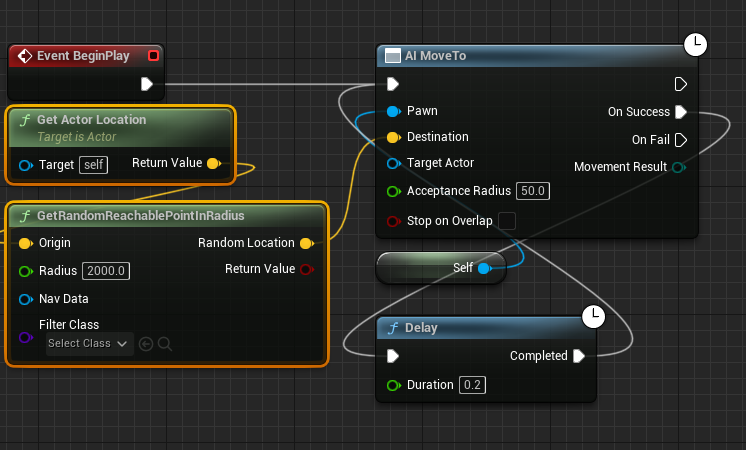
The first critical modification involves removing theGet Actor LocationandGetRandomReachablePointInRadiusnodes from the Blueprint graph. These nodes, while functional for random movement, are no longer relevant to the objective of player pursuit. Their purpose was to define a random destination around the AI’s current position. For the AI to follow the player, its target must dynamically update to the player’s real-time location. Deleting these nodes clears the path for the introduction of new logic that will precisely identify and track the player’s whereabouts. This step is crucial for transitioning from autonomous, undirected movement to directed, player-centric behavior. -
Identifying the Quarry: Introducing
Get Player Character:
With the random movement nodes removed, the next step is to introduce the mechanism for the AI to identify its target: the player. This is achieved by adding aGet Player Characternode to the Blueprint graph. This node is fundamental as it provides a direct reference to the currently controlled player character in the game world. In most single-player or local multiplayer scenarios, this node will reliably return the pawn or character controlled by the primary player. It acts as the AI’s sensory input, allowing it to "see" and acknowledge the player’s presence. Without this explicit reference, the AI would have no means of knowing where the player is located in order to pursue them.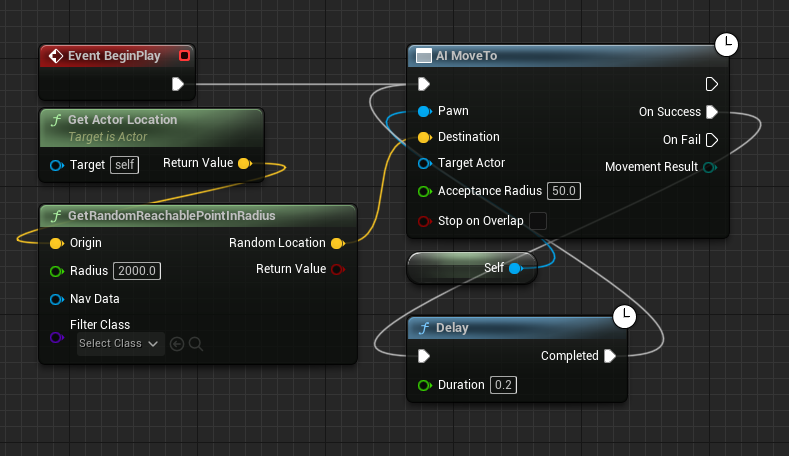
-
Establishing the Pursuit Path: Connecting
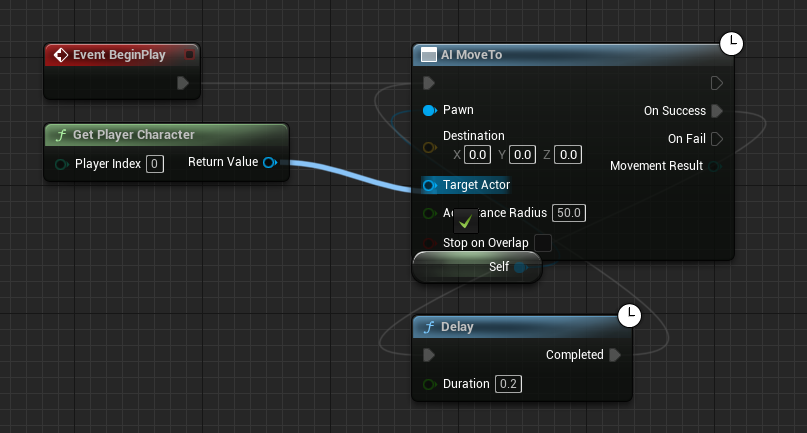
Get Player CharactertoAI MoveTo:
Once theGet Player Characternode is in place, the pivotal connection is made. The blueReturn Valueoutput pin from theGet Player Characternode, which represents the player character itself, is connected to the blueTarget Actorinput pin on theAI MoveTonode. This connection fundamentally alters the AI’s movement objective. Instead of moving to a fixed point or a randomly generated location, theAI MoveTonode now continuously receives the dynamic location of the player character as its target. Every time theAI MoveTonode is executed, it will calculate a path to the player’s current position, effectively initiating and sustaining the chase or follow behavior. This is the core logic that transforms a wandering AI into a player-aware entity. -
Robustness and Error Handling: Ensuring Persistent Pursuit:
In dynamic game environments, AI movement can sometimes encounter obstacles or temporary unreachability issues. For instance, the player might move into an area not covered by the NavMesh, or the AI might briefly get stuck. To prevent the AI from ceasing its pursuit under such circumstances, robust error handling is essential. This is achieved by connecting theOn Failexecution pin of theAI MoveTonode to theDelaynode that typically precedes theAI MoveTonode in a loop. TheOn Failpin fires an execution signal whenever theAI MoveTooperation cannot be completed successfully (e.g., if the target is unreachable, or an internal pathfinding error occurs). By looping thisOn Failsignal back to theDelaynode, the system ensures that even if a movement attempt fails, the AI will pause for a brief moment (defined by the delay duration) and then attempt to move towards the player again. This retry mechanism guarantees persistent pursuit, making the AI resilient to minor pathfinding hiccups and ensuring it continues to track the player regardless of transient environmental complexities. This simple yet effective error handling significantly enhances the reliability of the AI’s behavior. -
Finalizing Changes: Compile and Save:
The final, indispensable step after making any modifications to a Blueprint is toCompileandSavethe changes. Compiling processes the visual script into executable code that the engine can understand and run. Saving ensures that these compiled changes are permanently stored within the asset. Without compiling, the engine will not recognize the new logic, and without saving, the changes will be lost upon closing the editor. This step applies the newly configured AI following logic, making it active when the game is played in the editor or packaged for release. This best practice is fundamental to the iterative development workflow in Unreal Engine.
Beyond Basic Movement: The Impact on Game Design and Player Experience
While the technical implementation appears straightforward, the implications of this basic AI following system for game design are profound and far-reaching. This fundamental mechanic serves as the building block for a myriad of complex AI behaviors, significantly enhancing player immersion and gameplay dynamics.
-
Companion AI: This simple follow mechanic is the cornerstone for creating friendly AI companions. In role-playing games (RPGs) or adventure titles, a loyal NPC (Non-Player Character) can follow the player, providing support, carrying items, or contributing to narrative depth. By adjusting parameters such as follow distance, speed, and additional behavioral nodes (e.g., engaging enemies when the player is attacked), a basic follower can evolve into a sophisticated ally. Titles like "Fallout 4" and "The Elder Scrolls V: Skyrim" heavily rely on robust companion AI to enrich their open worlds.
-
Pursuit and Threat AI: Conversely, the same mechanic can be leveraged to create menacing adversaries. In horror games, stealth titles, or action-oriented combat scenarios, AI enemies that relentlessly chase the player create tension and demand strategic evasion. The persistent threat of a pursuing enemy, exemplified by creatures in "Alien: Isolation" or zombies in "Dying Light," significantly elevates the stakes and fosters a sense of urgency. The "On Fail" loop is particularly vital here, ensuring the threat remains constant even if the player briefly escapes to an unreachable area.
-
Escort Missions and Objective-Based AI: The follow behavior is critical for escort missions, a common quest type where players must guide an NPC to a specific location while protecting them. The AI follows the player’s lead, navigating the environment based on the player’s path. Furthermore, this can be adapted for objective-based AI, where an NPC follows a specific object or leader to achieve a mission goal, adding layers of complexity to quest design.
-
Dynamic World Interaction: Beyond direct player interaction, this AI pattern can be applied to environmental elements. For instance, a "swarm" of non-hostile creatures might follow a particular resource or environmental cue, making the world feel more alive and reactive. This contributes to ecological simulation within game worlds, providing a richer, more believable backdrop for player actions.
-
Stealth Mechanics: In stealth games, the AI’s ability to follow or patrol a path, combined with sensory inputs (sight, sound), dictates the challenge. Modifying the
AI MoveTotarget to be the player’s last known location, rather than their current one, can create sophisticated "search and patrol" behaviors that are essential for the genre. This adds a layer of predictability and challenge, allowing players to strategize around AI movement patterns.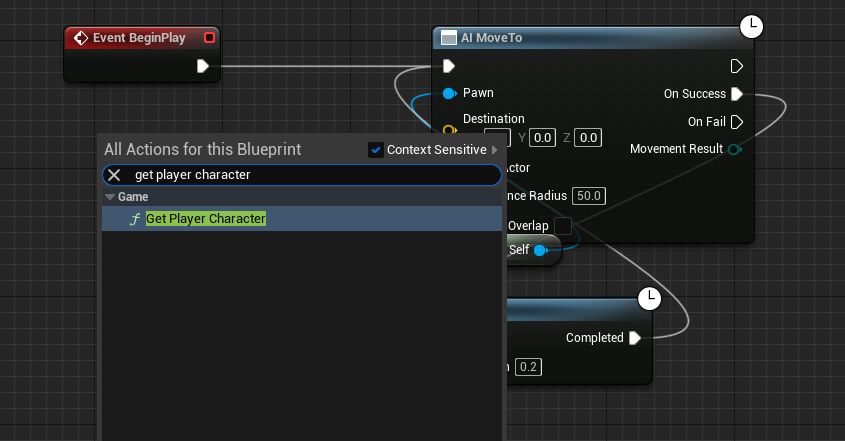
The Broader Implications for Game Development: Accessibility and Innovation
The ease of implementing such foundational AI mechanics in Unreal Engine 5 carries significant implications for the broader game development landscape.
-
Democratization of Development: Blueprint visual scripting lowers the barrier to entry for aspiring game developers. Individuals or small indie teams without extensive programming backgrounds can now implement complex features that were once exclusive to large studios with dedicated AI programmers. This fosters innovation and allows for a greater diversity of voices and ideas within the industry.
-
Rapid Prototyping and Iteration: The visual nature of Blueprint allows developers to quickly prototype AI behaviors, test them in real-time, and iterate on designs with unprecedented speed. This agile workflow is invaluable in game development, where design decisions often evolve throughout the project lifecycle. Designers can experiment with different AI speeds, target distances, and reaction times directly within the editor, drastically reducing development cycles.
-
Scalability and Performance: Unreal Engine 5 is designed for scalability, capable of handling highly detailed environments and numerous AI agents. The underlying C++ engine efficiently processes Blueprint logic, ensuring that even games with dozens or hundreds of following AI characters can run smoothly, provided the NavMesh and other environmental factors are optimized. This allows developers to create grander, more populated game worlds without compromising performance.
-
Foundation for Advanced AI: This basic follow mechanic is merely the first step. It can be extended with Behavior Trees, Utility AI, and other advanced AI systems available in Unreal Engine. Developers can layer decision-making processes, combat routines, social interactions, and environmental awareness on top of this core movement, creating truly intelligent and lifelike characters. The modular nature of Blueprint encourages this layering, allowing for incremental complexity.
Unreal Engine 5: A Catalyst for Innovation
Unreal Engine 5, with its cutting-edge features like Nanite virtualized geometry, Lumen global illumination, and its robust AI toolkit, positions itself as a powerhouse for game creation. The ability to implement core AI functionalities like player following with such relative ease underscores the engine’s commitment to developer-friendliness while not sacrificing power or flexibility. The engine’s continuous evolution, supported by a vast community and comprehensive documentation, ensures that developers have the resources needed to push the boundaries of interactive entertainment. The demand for highly engaging and intelligent AI in games continues to grow, mirroring advancements in real-world AI technologies. As players expect more dynamic and believable digital worlds, the tools provided by engines like UE5 become ever more critical for meeting these evolving expectations.
Conclusion
The implementation of AI characters that follow the player, while a common feature in contemporary games, represents a significant technical achievement foundational to creating engaging interactive experiences. In Unreal Engine 5, this core functionality is rendered accessible through a streamlined process involving a few intuitive Blueprint nodes. By understanding the role of the NavMesh, the power of Blueprint visual scripting, and the precise steps involved in targeting and robustly pursuing the player, developers can quickly integrate this dynamic behavior into their projects. This fundamental mechanic serves as a versatile building block, enabling everything from loyal companions and menacing adversaries to complex mission objectives, profoundly influencing game design and player immersion. As game development continues to advance, the accessibility and power of tools like Unreal Engine 5 ensure that even sophisticated AI behaviors are within reach, empowering a new generation of creators to craft rich, dynamic, and unforgettable virtual worlds.
About the Author