The integration of multi-sensory feedback in extended reality (XR) has taken a significant step forward with the formal introduction of Escents, a wearable scent-emission device developed by the technology startup Scentient. Showcased at the recent United XR Europe event, the device represents a sophisticated attempt to bridge the gap between visual-auditory immersion and the biological power of the human olfactory system. By utilizing a neck-worn form factor and a cartridge-based delivery mechanism, Scentient aims to standardize the use of smell in professional XR applications, ranging from healthcare simulations to high-end marketing installations.
The sense of smell is widely recognized by neuroscientists as one of the most primitive and potent human senses, directly linked to the limbic system, which governs emotion and memory. Despite this, digital olfaction has remained one of the most challenging frontiers in the immersive technology sector. While visual and auditory stimuli can be synthesized using a standardized set of primary components—such as the RGB color model or frequency modulation—olfaction lacks a universal "primary" set of scents. Consequently, Scentient’s Escents device utilizes a discrete vaporization system that relies on pre-computed chemical cartridges to replicate specific environmental odors.
Technical Architecture and Delivery Mechanism
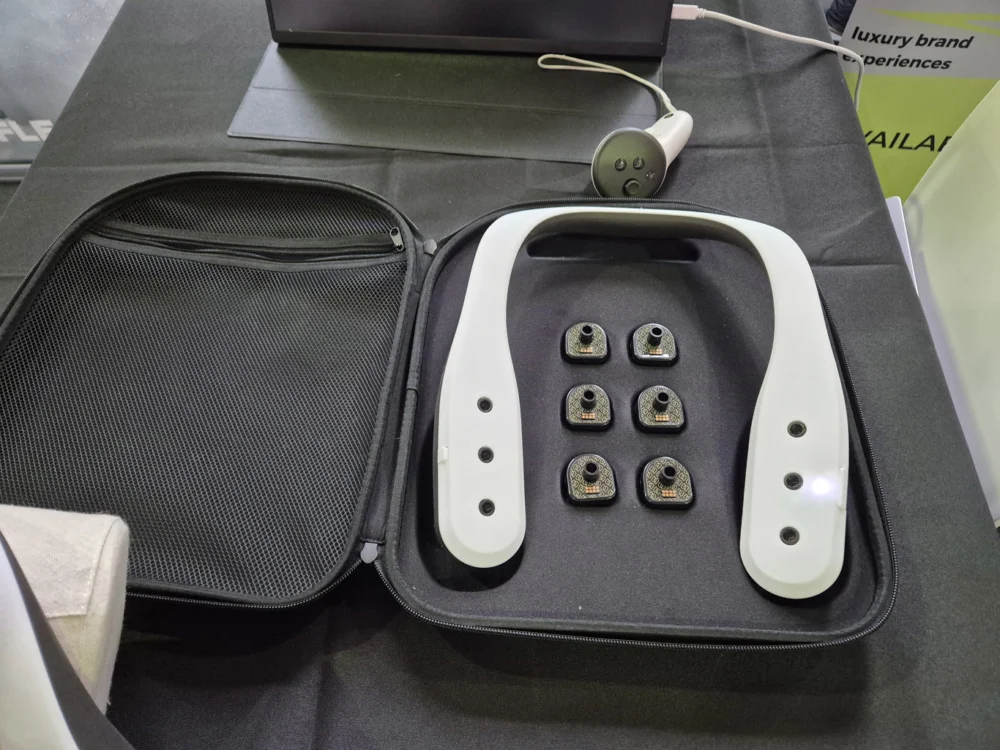
The Escents hardware is designed as a wireless collar that rests on the user’s shoulders, communicating via Bluetooth or Wi-Fi with standalone XR headsets such as the Meta Quest 3 or Pico 4. The internal architecture features six dedicated slots for scent cartridges. Each cartridge contains a specific synthesized fragrance that is vaporized and propelled toward the user’s nasal cavity via a controlled airflow system.

Unlike experimental methods that use electrical stimulation to trigger olfactory bulbs, Scentient’s mechanical approach focuses on the physical delivery of scent molecules. The device’s "breeze" effect—a subtle puff of air—serves as the carrier for these molecules, ensuring that the scent reaches the user with minimal latency once a virtual trigger is activated. This mechanical delivery is essential for maintaining "olfactory presence," where the arrival of a smell coincides precisely with the visual interaction of a virtual object.
The current iteration of the device supports a variety of fragrances, including jasmine, chocolate, pine, burnt wood, and industrial scents like petrol. Technical evaluations of the hardware highlight its ability to switch between these scents rapidly, a critical requirement for complex XR environments where a user might move from a forest setting to an industrial zone within seconds.
Chronology of Development: From Prototype to Product
The journey of the Escents device from a conceptual prototype to a market-ready product has spanned several years of iterative design. In late 2024, early versions of the hardware were demonstrated at AWE (Augmented World Expo) Europe. These early prototypes were characterized by a more utilitarian aesthetic and faced challenges regarding scent "saturation"—a common issue in digital olfaction where odors linger in the air or on the user’s clothing, muddling subsequent sensory inputs.

By the time of the United XR Europe event in 2025, Scentient had implemented significant refinements. The device now features a more ergonomic, streamlined chassis and a professional-grade carrying case, signaling its transition into a commercial-ready peripheral. Improvements in the vaporization and ventilation systems have also addressed the saturation problem; the current model is reported to clear scents more efficiently, allowing for distinct transitions between different olfactory triggers without the "residual ghosting" that plagued earlier iterations.
Design Philosophy: Ergonomics and Form Factor
The decision to utilize a neck-worn collar rather than a headset-mounted attachment reflects a strategic choice regarding weight distribution and user comfort. Headset-mounted peripherals often exacerbate the "front-heavy" nature of VR devices, leading to neck strain during prolonged use. By shifting the weight to the shoulders, Scentient allows for a more robust mechanical system and larger scent reservoirs without compromising the balance of the HMD (Head-Mounted Display).
However, this design choice introduces technical complexities. Because the emission source is located further from the nose than a headset-mounted device, the Escents system must use higher-velocity airflow to ensure the scent particles reach the user quickly. While this creates a "breeze" that may feel out of place in static environments, it provides an additional layer of tactile feedback that can enhance outdoor or movement-based simulations.

Performance Analysis and Scent Fidelity
The efficacy of the Escents system depends heavily on the chemical composition of its cartridges. In technical trials, organic scents such as pine and jasmine have demonstrated high levels of recognizability, though synthesized food scents like chocolate are often described as having a "chemical" profile. While these synthesized odors may not perfectly replicate their real-world counterparts, they serve as effective "sensory anchors" that reinforce the visual data provided by the VR headset.
A critical breakthrough in the latest model is the management of scent intensity. High-intensity scents, such as "burnt wood" or "smoke," have historically been difficult to manage in enclosed spaces. Scentient’s CTO, Ivan, has noted that the company’s focus has shifted toward balancing the concentration of vapor to ensure that even the strongest odors do not overwhelm the user’s senses for extended periods. This balance is achieved through precision-timed bursts of vaporization, rather than continuous emission.
Market Positioning and Professional Applications
Scentient has positioned Escents as a high-end tool for the B2B (Business-to-Business) sector. With a pre-order price of £999, the device is targeted at industries where olfactory realism provides tangible value:

- Healthcare and Therapy: Olfactory triggers are increasingly used in PTSD (Post-Traumatic Stress Disorder) therapy and memory care for patients with dementia. The ability to provide controlled, repeatable scents in a virtual environment offers a powerful tool for clinical psychologists.
- Safety Training: In industrial and firefighting simulations, the smell of smoke, gas, or specific chemicals can serve as a vital warning sign. Training personnel to recognize these odors in a safe, virtual environment can improve reaction times in real-world emergencies.
- Marketing and Retail: Luxury brands and food and beverage companies can utilize Escents to create multi-sensory "brand experiences" at trade shows or flagship stores, using scent to deepen consumer engagement and brand recall.
Broader Implications for the XR Industry
The move toward standardized olfactory hardware suggests that the XR industry is maturing beyond a focus on purely visual fidelity. As visual displays reach parity with human vision (the "Retina" standard), developers are looking toward haptics and olfaction to provide the next leap in immersion.
Industry analysts suggest that the success of devices like Escents will depend on the development of a robust software ecosystem. Currently, Scentient provides integration tools for the Unity Interaction Toolkit, allowing developers to map scent triggers to virtual objects with minimal coding. However, for digital olfaction to achieve mainstream adoption, a broader cross-platform standard may be required to ensure compatibility across different hardware ecosystems.
The Escents device is currently available for pre-order on Scentient’s official website, with the first batch of units expected to ship in the first quarter of 2026. As the company prepares for a full-scale rollout, the focus remains on expanding the library of available scent cartridges and refining the API (Application Programming Interface) to support more complex environmental interactions. While challenges remain in achieving perfect scent realism, Scentient’s latest hardware represents a significant milestone in the quest to build a truly five-sensory virtual reality.
About the Author