The field of cosmology, dedicated to understanding the origin, evolution, and large-scale structure of the universe, is increasingly benefiting from innovative computational and visualization tools. A recent compelling instance of this synergy involves the work of MohammadHossein Jamshidi, a researcher who has successfully integrated Blender, a widely recognized open-source 3D creation suite, into his cutting-edge cosmological computations. This development not only showcases Blender’s expanding capabilities beyond traditional artistic applications but also highlights a growing trend of scientific disciplines adopting powerful, accessible software for complex data analysis and visualization.
Jamshidi’s inspiration for employing Blender in cosmology stems from the creative and visually striking simulations produced by YouTube creator Seanterelle, particularly those leveraging Blender’s Geometry Nodes system. These simulations, characterized by their impressive performance and aesthetic appeal, sparked Jamshidi’s curiosity about their potential for quantitative scientific work. Geometry Nodes, a procedural node-based system within Blender, allows users to construct complex geometry and effects by connecting various nodes that represent operations. This approach offers a highly flexible and non-destructive workflow, ideal for iterative scientific modeling and visualization.
A Novel Application for Cosmic Microwave Background Research
In 2024, Jamshidi and his research team utilized Geometry Nodes as a pivotal tool within a significant project focused on the Cosmic Microwave Background (CMB). The CMB is the faint afterglow of the Big Bang, a ubiquitous bath of radiation that permeates the entire universe. Studying its subtle temperature fluctuations provides crucial insights into the early universe, its composition, and its evolution.
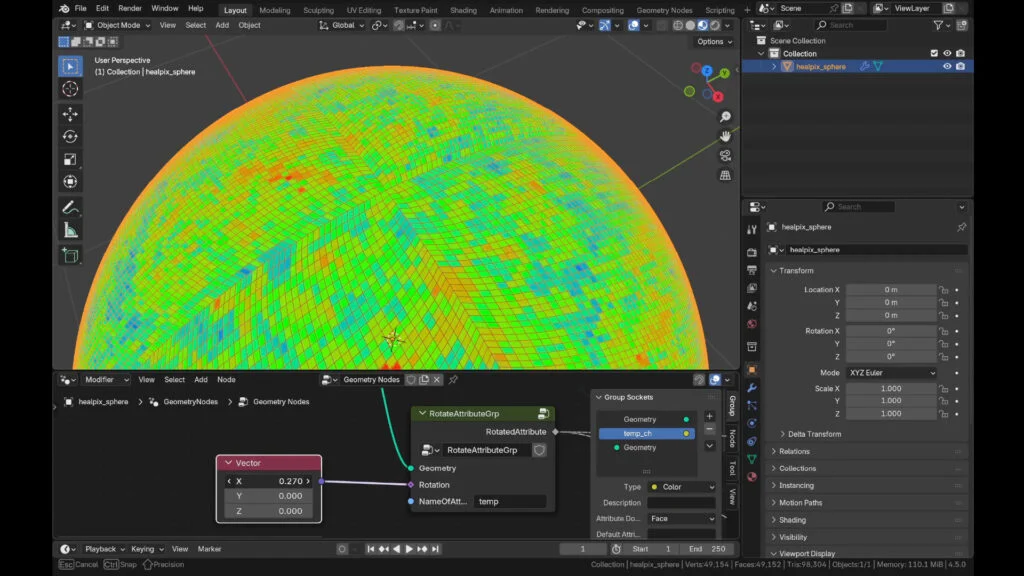
The specific challenge faced by Jamshidi’s team was the need for a robust method to visualize and quantify the overlap between specific regions on the CMB sky and the Galactic Mask. The Galactic Mask represents areas on the celestial sphere where CMB signals are obscured or contaminated by radiation from our own Milky Way galaxy. These "masked" regions are effectively blind spots for CMB observations, and accurately accounting for their extent is critical for precise cosmological parameter estimation.
"We needed a tool to visualize caps and stripes of different sizes on the CMB sky, to check how much of their areas overlap with the Galactic Mask," Jamshidi explained, detailing the necessity of this visualization. "This is crucial for understanding the areas where we can’t receive CMB light due to contamination by our Galaxy." The ability to precisely delineate and measure these overlaps is essential for calibrating observational data and ensuring the accuracy of scientific conclusions drawn from CMB studies.
Geometry Nodes: A Powerful Visualizer and Computational Engine
By harnessing the power of Geometry Nodes, coupled with a straightforward rigging system within Blender, Jamshidi’s team was able to construct a sophisticated visualizer that addressed this complex requirement. The Geometry Nodes system allowed them to procedurally generate and manipulate spherical representations of potential observational regions (caps and stripes) on the CMB sky. This procedural approach enabled them to easily adjust the size, position, and orientation of these regions, allowing for rapid exploration of different observational scenarios.
Furthermore, the integration of the Galactic Mask into this visualization framework provided a clear visual representation of the data loss or contamination in specific areas. The ability to dynamically calculate and display the percentage of overlap between the generated CMB regions and the Galactic Mask was a key achievement. This functionality goes beyond simple visual representation; it implies that Geometry Nodes were likely employed for computational tasks as well, such as calculating intersection areas and potentially even performing rudimentary algorithmic debugging.

Timeline and Development of the Approach
While the specific timeline for the project’s initiation and the development of the Blender-based solution is not detailed in the provided information, the statement that the work was undertaken "in 2024" places it within a recent period of active research. The inspiration from Seanterelle’s YouTube content suggests that Jamshidi’s exploration of Blender for scientific applications likely began prior to this. The progression from observing creative simulations to implementing a functional scientific tool signifies a deliberate and iterative development process.
The journey likely involved:
- Initial Exploration: Jamshidi’s initial engagement with Seanterelle’s work, understanding the potential of Geometry Nodes for complex scene generation.
- Conceptualization: Identifying the specific cosmological problem (CMB mask overlap) that could benefit from advanced visualization and procedural generation.
- Prototyping: Experimenting with Geometry Nodes to create basic representations of celestial objects and masks.
- Development and Refinement: Building the full visualizer, incorporating rigging for dynamic control and potentially scripting for more complex calculations.
- Application and Validation: Using the developed tool for the specific research project on the CMB and debugging algorithms.
Broader Implications for Scientific Visualization and Computation
The successful application of Blender in this cosmology research has significant implications for the broader scientific community. Traditionally, scientific visualization has relied on specialized, often proprietary, software packages that can be expensive and have steep learning curves. Blender, being open-source and free, democratizes access to powerful 3D creation and simulation capabilities.
Supporting Data and Context:
- The Cosmic Microwave Background (CMB): Discovered in 1964 by Arno Penzias and Robert Wilson, the CMB is a cornerstone of modern cosmology. Its temperature anisotropies, measured with remarkable precision by missions like COBE, WMAP, and Planck, have provided strong evidence for the Big Bang model, inflation, and the existence of dark matter and dark energy. The Planck satellite, for instance, mapped the CMB with unprecedented resolution, revealing temperature fluctuations of only a few parts per million.
- Galactic Contamination: The Milky Way emits significant radio and microwave radiation, which can overwhelm the faint CMB signals. This contamination is particularly problematic in the galactic plane, necessitating careful masking and foreground subtraction techniques in CMB analysis. The extent of this mask can vary depending on the specific frequency band and observational strategy.
- Geometry Nodes: Introduced in Blender 2.90 (released in August 2020), Geometry Nodes have revolutionized procedural content creation within the software. Their node-based architecture allows for the construction of complex geometric structures and animations without manual modeling, making them ideal for generating intricate patterns, simulations, and data visualizations.
Analysis of Implications:
- Accessibility and Cost-Effectiveness: The use of Blender lowers the barrier to entry for researchers who may not have access to expensive commercial visualization software. This is particularly beneficial for institutions with limited budgets and for individual researchers.
- Interdisciplinary Collaboration: The visual nature of Blender can foster better communication and collaboration between scientists and visual artists or developers, leading to more intuitive and impactful scientific communication.
- Rapid Prototyping and Iteration: The procedural nature of Geometry Nodes allows for rapid prototyping and iteration of visualization and analysis methods. Researchers can quickly test different hypotheses or data representations, accelerating the scientific discovery process.
- Algorithm Debugging: As Jamshidi mentioned, using Blender for algorithm debugging is a novel and powerful application. Visualizing the intermediate steps or outputs of an algorithm within a 3D environment can often reveal errors or unexpected behaviors that might be missed in purely numerical output. This is akin to using debugging tools in software development but applied to the conceptual and visual representation of scientific processes.
Potential for Future Scientific Applications
The success of Jamshidi’s work opens doors for numerous other scientific fields. Potential applications include:
- Astrophysics: Visualizing complex astrophysical phenomena like nebulae, star formation regions, and galaxy mergers.
- Particle Physics: Creating visualizations of particle collisions, detector simulations, and theoretical models.
- Biotechnology: Rendering intricate molecular structures, cellular processes, and medical imaging data.
- Geology and Environmental Science: Visualizing geological formations, climate models, and environmental impact simulations.
- Engineering: Simulating fluid dynamics, structural stress, and material behavior.
The use of Blender for cosmology research, as demonstrated by MohammadHossein Jamshidi, is a testament to the evolving landscape of scientific inquiry. It underscores the power of open-source tools in driving innovation and democratizing access to advanced computational and visualization capabilities. As Blender continues to evolve, its role in scientific research is poised to expand, illuminating complex phenomena and accelerating discoveries across a wide spectrum of disciplines. The journey from observing creative simulations on YouTube to employing a powerful 3D suite for understanding the universe’s origins is a compelling narrative of how artistic tools can profoundly impact scientific frontiers.
About the Author