Unreal Engine 5 (UE5) has marked a significant leap forward in real-time 3D creation, offering a suite of groundbreaking tools that empower developers to achieve unprecedented levels of photorealism and immersive experiences. Among its most revolutionary offerings is the MetaHuman character library, a collection of exceptionally high-fidelity digital humans provided free for use in a wide array of projects. These assets represent a paradigm shift in character development, streamlining a traditionally complex and resource-intensive process. This comprehensive guide outlines the precise steps required to integrate these advanced MetaHuman assets into an Unreal Engine 5 project, detailing the procedural workflow from initial access to final implementation.

The introduction of MetaHumans by Epic Games, the creators of Unreal Engine, addresses a long-standing challenge in digital content creation: the efficient production of believable, high-quality human characters. Historically, crafting a photorealistic digital human involved extensive modeling, sculpting, texturing, rigging, and animation work, often requiring a team of highly specialized artists and significant computational resources. This process could take months for a single character, pushing project budgets and timelines to their limits, particularly for smaller studios and independent creators. The "uncanny valley," a phenomenon where nearly human but not perfectly human characters evoke a sense of unease or revulsion, has also been a persistent hurdle, requiring meticulous attention to detail to overcome.
Epic Games’ vision for MetaHumans, first unveiled in 2021, was to democratize access to this high-end capability. By leveraging its acquisition of Quixel and its extensive library of Megascans assets, Epic developed a robust framework for generating and distributing digital humans that are not only visually stunning but also fully rigged and ready for animation. The MetaHuman Creator, a cloud-based application, allows users to design custom characters with incredible precision, adjusting everything from facial features and skin tone to hair and clothing, with results that are virtually indistinguishable from real actors. The MetaHuman character library, accessible directly within the Unreal Engine editor, provides a curated selection of these pre-configured, production-ready digital humans, ready for immediate deployment. This initiative aligns with Epic’s broader strategy to equip creators with tools that push the boundaries of real-time rendering, complementing other UE5 innovations like Nanite (virtualized micropolygon geometry for incredibly detailed assets) and Lumen (a fully dynamic global illumination and reflections system).
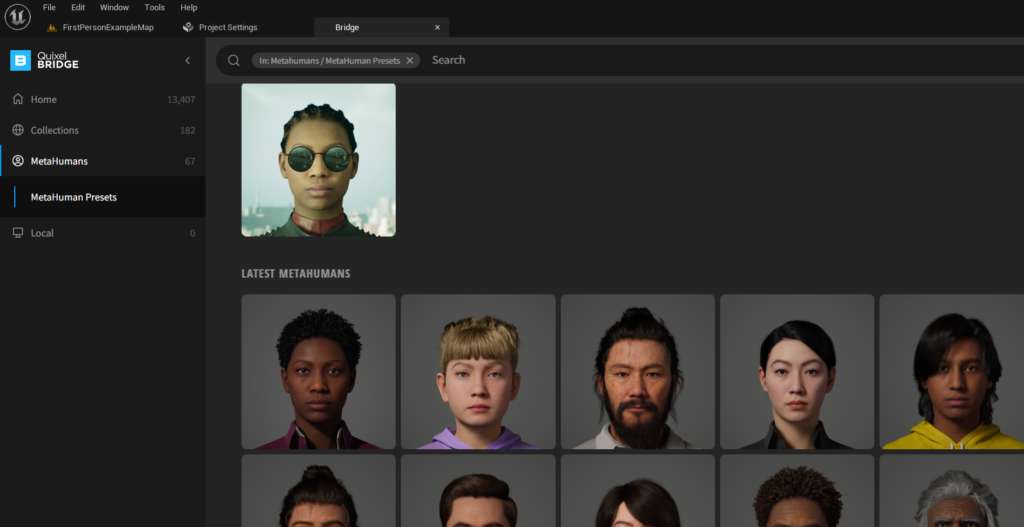
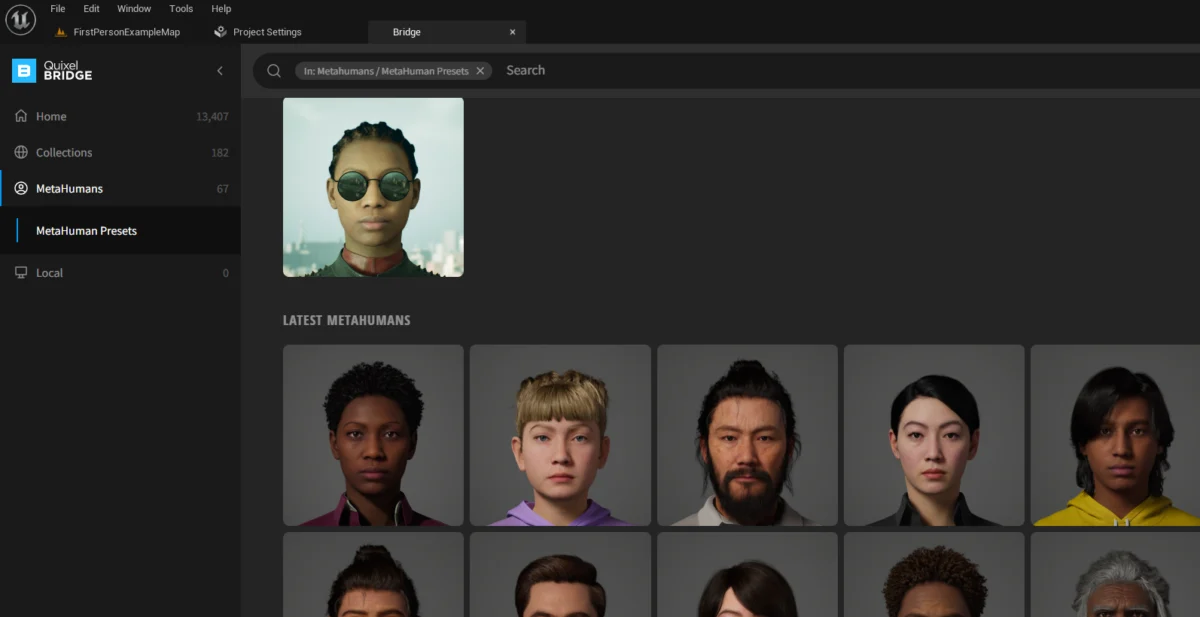
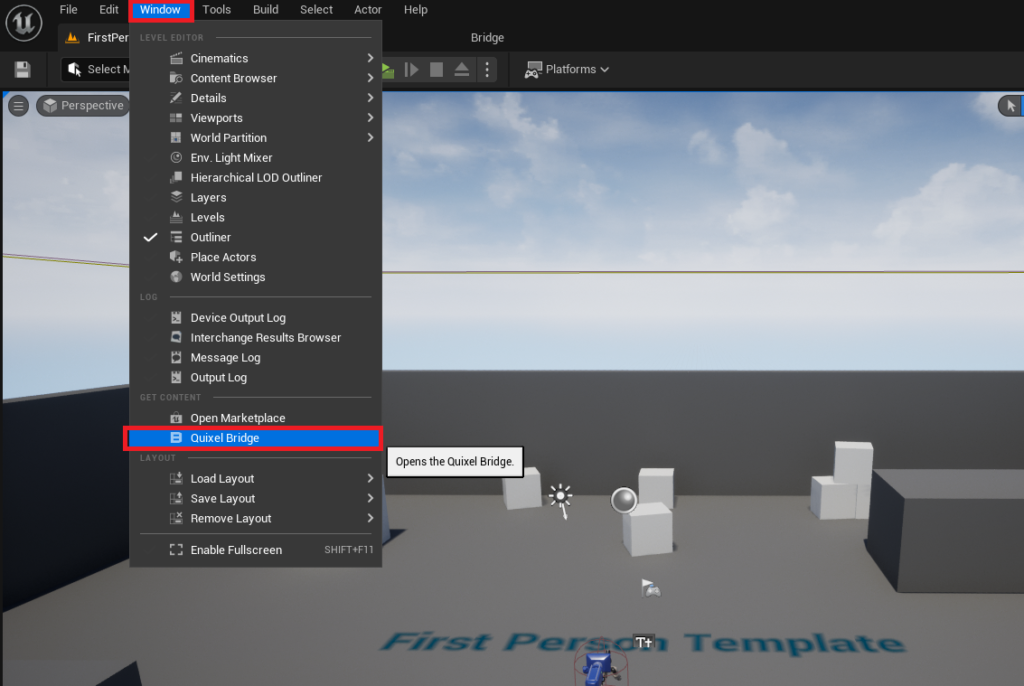
The integration process begins within the Unreal Engine 5 editor, acting as the central hub for all project assets and functionalities. The initial step involves accessing the MetaHuman library through the Quixel Bridge, an integral component of the Unreal Engine ecosystem. Quixel Bridge serves as a comprehensive content management system, offering seamless access to the vast Quixel Megascans library of high-quality 3D assets, surfaces, and environments, alongside the burgeoning MetaHuman collection. To open this gateway, users must navigate to the Window tab located at the top menu bar of the Unreal Engine editor. From the dropdown menu that appears, selecting Quixel Bridge will launch the dedicated Quixel Bridge interface directly within the editor environment. This integrated approach ensures a smooth workflow, eliminating the need to toggle between multiple applications.
Once the Quixel Bridge window has successfully loaded, the user interface will present various content categories. To specifically browse the digital human assets, the MetaHumans tab must be selected. This action filters the extensive library, displaying only the pre-configured MetaHuman characters available for download. The MetaHuman library boasts a diverse range of characters, each meticulously crafted with intricate details, ranging from varied demographics and ages to distinct stylistic presentations. Developers can browse through this collection, observing the exceptional fidelity of these digital assets, which are designed to meet the rigorous demands of modern game development, cinematic production, and virtual reality experiences. The visual quality of these characters, often rendered with 8K textures and complex skeletal rigging, showcases the power of UE5’s rendering capabilities.
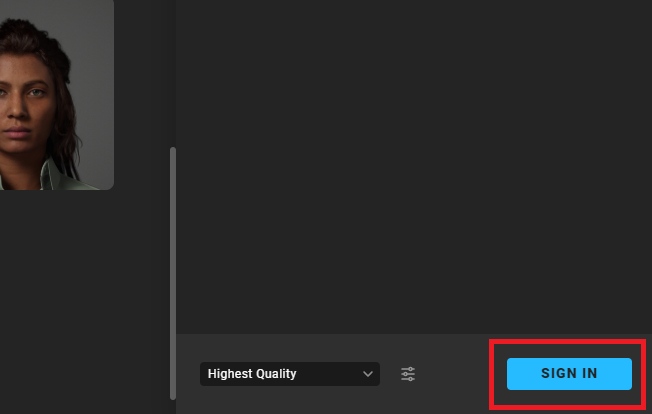
Before any MetaHuman can be downloaded and incorporated into an active project, an authentication step is required. Upon selecting any individual MetaHuman avatar from the grid display, a Sign In button will typically appear in the bottom-right corner of the Quixel Bridge window. This prompts users to log into their Epic Games account. This login is crucial as it grants full access to the comprehensive Quixel Megascans and MetaHuman libraries, leveraging the user’s existing Epic Games credentials. This seamless integration with the Epic Games ecosystem ensures that all content usage is properly licensed and tracked, reinforcing the free-to-use model for all Unreal Engine licensees. The authentication process is generally swift and secure, providing immediate access to the entire repository of assets once completed.
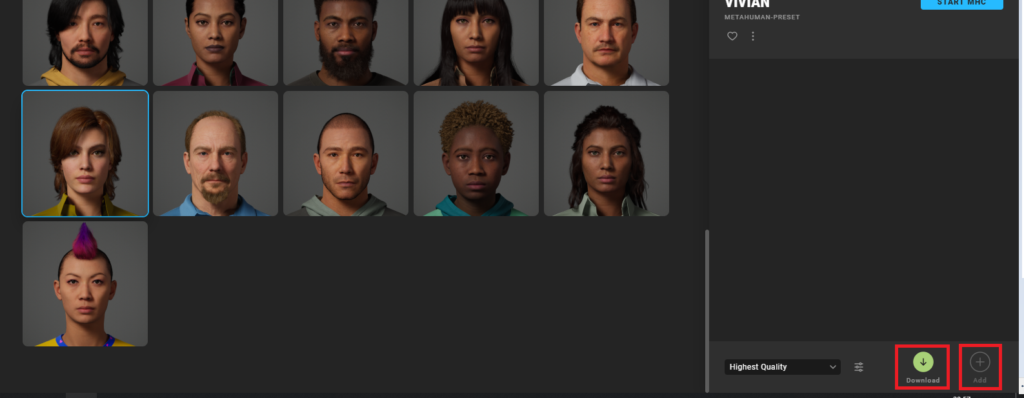
With successful authentication, the process of adding a MetaHuman character to the project can proceed. After selecting the desired MetaHuman avatar from the library, the Download button will become active. Clicking this initiates the download of the MetaHuman asset to the local system. Depending on the character’s complexity and the user’s internet connection, this download may take some time, as MetaHumans are comprised of numerous high-resolution textures, meshes, and animation data. Once the download is complete, the Download button will transform into an Add button. Clicking Add triggers the import process, integrating the MetaHuman’s various components directly into the open Unreal Engine project. During this phase, the editor will begin processing the extensive data, converting it into Unreal Engine-native formats and setting up the necessary asset structures within the project”s content directory.

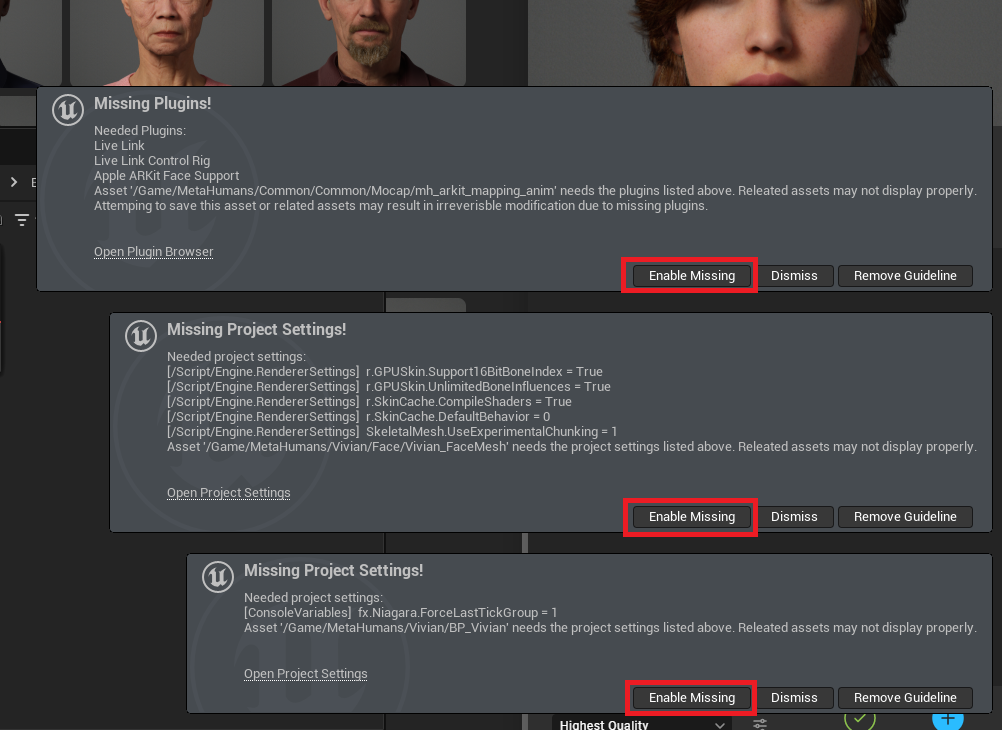
A critical phase in the integration involves the Unreal Engine editor configuring the project to properly support MetaHuman assets. As the MetaHuman is imported, notifications may appear in the bottom-left corner of the editor window, typically indicating "Missing plugins" or "Project settings need to be enabled." These prompts are essential and should be addressed by pressing Enable Missing. This action allows the editor to automatically activate the required plugins and adjust project settings that are vital for MetaHumans to function correctly. These typically include plugins such as MetaHuman, Live Link (for facial capture integration), Alembic (for complex animated geometry like hair grooms), and Groom (for realistic hair rendering). Without these components enabled, MetaHumans may not render correctly, or their advanced features, such as dynamic hair physics and intricate facial animation, might not function as intended. The editor automatically handles the dependencies, ensuring that all necessary modules are active.
Following the enablement of missing settings and plugins, the Unreal Engine editor will prompt the user to Restart Now. This restart is not merely a suggestion but a necessary step to apply all the newly enabled plugins and adjusted project settings effectively. Unreal Engine often requires a restart to fully initialize new modules and recompile shaders or configurations that depend on these changes. Neglecting this step can lead to rendering issues, crashes, or incomplete MetaHuman functionality. Upon clicking Restart Now, the editor will close and then relaunch, loading the project with all MetaHuman-specific configurations fully active. This ensures a stable and optimized environment for working with the high-fidelity characters.
Once the editor has successfully restarted, the newly imported MetaHuman asset can be located and utilized within the project. Users should navigate to the Content Drawer, which provides access to all project assets. Within the Content Drawer, a new folder titled MetaHumans will have been created. Inside this folder, a subfolder bearing the name of the specific MetaHuman character chosen during the download process will be present. The primary asset representing the fully configured MetaHuman character is typically a Blueprint asset, identifiable by the BP_ prefix in its filename (e.g., BP_MetaHumanName). This Blueprint encapsulates all the complex components of the MetaHuman: the various skeletal meshes for the body, face, eyes, teeth, and tongue; the advanced material instances for skin, hair, and clothing; the intricate hair grooms; and the control rig setups for animation. This modular design allows for extensive customization and performance optimization, as individual components can be swapped or adjusted.
The discovery of the BP_ MetaHuman blueprint within the Content Drawer signifies the successful integration of a production-ready digital human into the Unreal Engine 5 project. This blueprint can now be dragged and dropped directly into any level, instantly populating the scene with a highly detailed and fully rigged character. The underlying structure of these MetaHumans is meticulously designed; they are comprised of multiple meshes that collectively form the full character, all of which are expertly rigged to a common skeletal system. This rigging facilitates realistic animation, making them ideal candidates for player characters, non-player characters (NPCs), or cinematic protagonists. The ability to manipulate these characters with advanced animation tools, including control rigs and facial animation systems, offers unparalleled creative freedom.
The implications of MetaHumans extend far beyond mere character creation. This technology is a potent force for the democratization of high-end content production. Indie developers and smaller studios, who previously lacked the budget or expertise for creating photorealistic characters, can now access industry-leading assets, significantly elevating the visual quality of their projects. This shift can accelerate development cycles, allowing artists to focus on creative storytelling and animation rather than the arduous task of building characters from scratch. The impact on traditional character art pipelines is profound, suggesting a future where character artists may transition from foundational mesh creation to more specialized roles in customization, performance capture integration, and animation refinement.
Beyond gaming, MetaHumans are poised to revolutionize various sectors. In film and television, they offer a cost-effective solution for digital doubles, virtual actors, and complex crowd scenes, particularly valuable in virtual production environments where real-time visualization is paramount. Architectural visualization benefits from the inclusion of realistic human figures to enhance scene context and scale. Interactive experiences, training simulations, and even the burgeoning metaverse development stand to gain immensely from the ready availability of highly believable digital inhabitants. While the initial library provides pre-set characters, the forthcoming MetaHuman Creator tool promises even greater flexibility, enabling users to craft bespoke digital humans tailored to specific project requirements, further expanding the creative possibilities.
The computational demands of these high-fidelity assets are noteworthy. MetaHumans, with their complex geometry, high-resolution textures, and intricate rigging, require robust hardware to render optimally. However, Epic Games has engineered them with scalability in mind, incorporating various Levels of Detail (LODs) that automatically switch based on distance from the camera, allowing for performance optimization across different platforms and hardware configurations. Developers can further fine-tune performance by managing texture streaming, culling unnecessary details for distant characters, and leveraging UE5’s performance profiling tools.
In conclusion, the integration of MetaHuman characters into Unreal Engine 5 represents a monumental step forward in digital content creation. What was once an exclusive domain of large studios and specialized artists is now accessible to a broader community of creators. By following a straightforward sequence of steps—accessing Quixel Bridge, authenticating with an Epic Games account, downloading and importing the desired MetaHuman, and enabling necessary project configurations—developers can seamlessly introduce these cutting-edge digital humans into their projects. The resulting MetaHuman blueprint provides a fully rigged, highly detailed character, ready for animation and deployment, fundamentally transforming the landscape of real-time 3D production and empowering creators to realize their most ambitious visions with unprecedented ease and fidelity. This framework underscores Epic Games’ commitment to continually pushing the boundaries of what is possible in real-time graphics, offering tools that democratize access to the highest echelons of visual quality.
About the Author