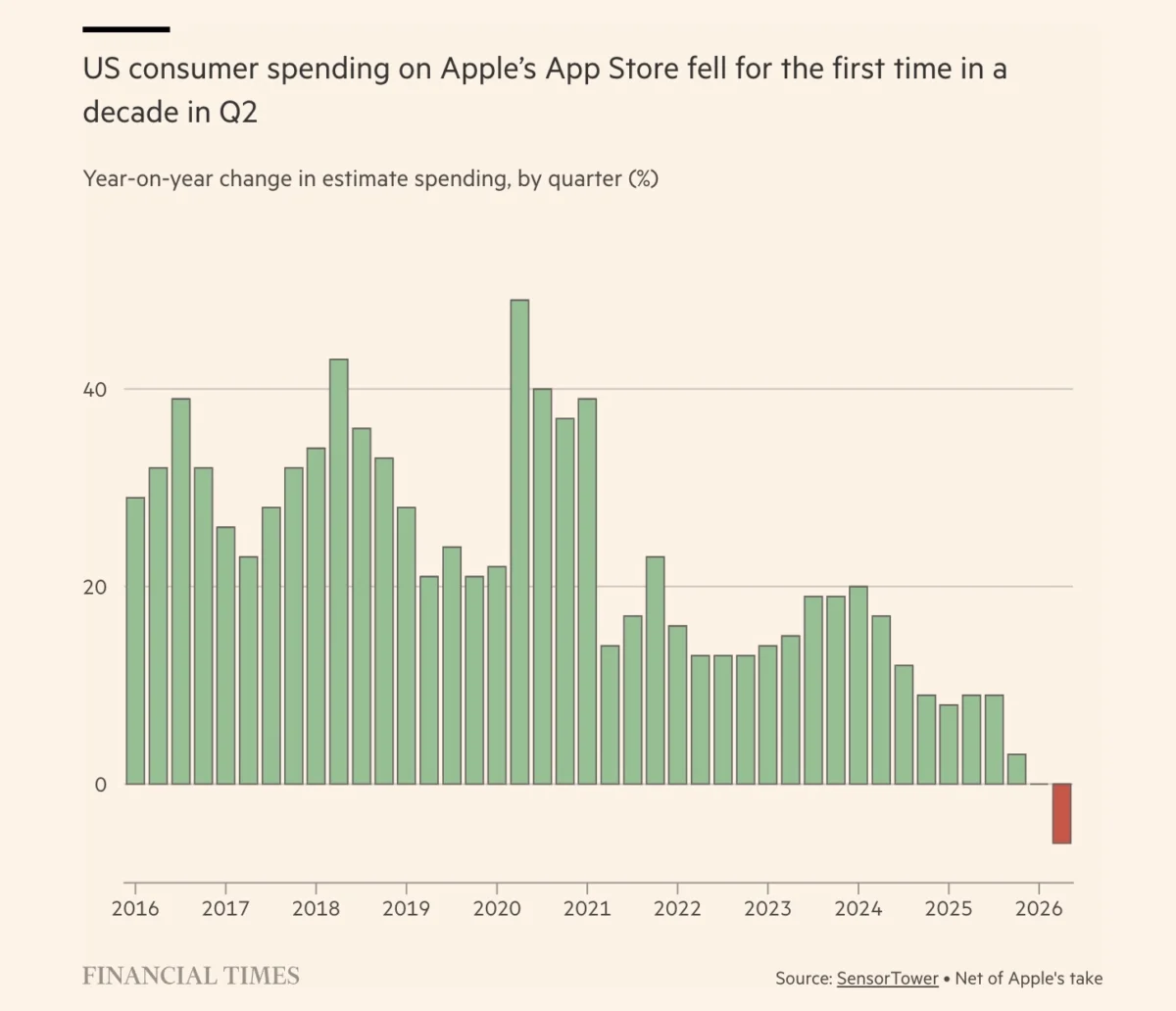
In a development that marks a significant turning point for the global mobile economy, consumer spending on Apple’s U.S. App Store recorded a year-on-year decline in the second quarter of 2026. According to the latest estimates from market intelligence firm Sensor Tower, this contraction represents the first such downturn in the ten years the company has tracked these metrics. For a platform that has long served as an unrivaled engine of growth for Apple’s Services division, the 6% decline in Q2 2026 stands in stark contrast to the 9% growth observed during the same period in 2025. This shift signals a potential cooling of the mobile software market and reflects the tangible impact of years of legal and regulatory challenges to Apple’s "walled garden" business model.
A Decadal Shift in the App Store Economy
Since its inception in 2008, the App Store has maintained an almost uninterrupted trajectory of upward growth. For more than a decade, the platform capitalized on the global transition to mobile-first computing, the rise of the "freemium" monetization model, and the explosive popularity of high-fidelity mobile gaming. However, the data for the second quarter of 2026 suggests that the historical insulation of the App Store from broader economic or structural headwinds may be coming to an end.
The 6% drop in U.S. consumer spending is not an isolated statistic but rather the culmination of several converging factors. While macroeconomic conditions and market saturation in the domestic smartphone sector have played peripheral roles, analysts point primarily to the fundamental restructuring of how developers collect payments. The shift away from Apple’s proprietary In-App Purchase (IAP) system—which historically mandated a 15% to 30% commission on digital goods—is now reflecting directly in the platform’s reported gross spending figures.
The Epic Games Catalyst and the Anti-Steering Mandate
Sensor Tower’s analysis attributes a significant portion of this decline to the lingering effects of Apple’s protracted legal battle with Epic Games. Although Apple largely prevailed on antitrust grounds in the U.S. courts, the litigation resulted in a permanent injunction regarding "anti-steering" rules. This injunction forced Apple to allow developers to include external links and buttons within their apps, directing users to alternative payment methods on the web.
By bypassing the App Store’s internal payment rails, developers are able to offer lower prices to consumers while retaining a larger share of the revenue. This movement has gained particular traction among high-revenue mobile games and subscription-based services, where the 30% "Apple Tax" significantly impacted profit margins. As more major publishers transitioned their most loyal and highest-spending users to direct-to-consumer web stores, the total volume of transactions processed through Apple’s system has begun to erode.
The firm noted that the App Store’s financial ecosystem has been "significantly impacted" by this ruling. The data suggests that while consumers may still be spending money on digital content, an increasing percentage of that capital is flowing outside the visibility and control of Apple’s traditional reporting mechanisms.
Global Regulatory Contagion and Commission Contraction
The downturn is not confined solely to the United States. Data from Appfigures indicates a broader trend of revenue contraction for Apple’s commission-based business. In the U.S. alone, Apple’s commission revenue is estimated to have contracted by 18% so far this year. This figure is particularly telling as it suggests that the decline in Apple’s "cut" is outpacing the decline in overall consumer spending, confirming that the move toward external payments is accelerating.
International markets are mirroring this trend. In Brazil and Japan, Apple has been forced to open its ecosystem to third-party payment processors and alternative storefronts due to local legislative actions and antitrust settlements. In Japan, specifically, new regulations aimed at fostering competition in the mobile software market have led to a measurable dip in Apple’s take-rate. Similarly, the European Union’s Digital Markets Act (DMA) has introduced a framework where Apple must allow third-party app stores and alternative billing, further diluting its monopoly on transaction processing in one of its most lucrative regions.
The Critique of the "Pay-to-Win" Ecosystem
The financial data has provided fresh ammunition for Apple’s most vocal critics, most notably Epic Games CEO Tim Sweeney. Reacting to the Sensor Tower report, Sweeney argued that Apple’s policies have fundamentally "broken" the mobile gaming industry. He characterized the 30% commission as a "junk fee" that has artificially inflated the price of in-app purchases for a decade.

Sweeney’s critique extends beyond simple transaction fees to the very architecture of discovery on the App Store. He pointed to Apple’s aggressive expansion of ads within App Store search results as a factor that has compromised the quality of the gaming experience. According to Sweeney, the current system has devolved into a "rigged pay-to-win system" that favors developers with the deepest pockets for user acquisition rather than those with the highest-quality products.
"On console, Sony, Nintendo, and Microsoft heavily promote the best games, and sales are merit-based," Sweeney stated, contrasting the mobile landscape with traditional gaming platforms. He argued that by extracting the majority of profits from developers, Apple has deprived creators of the ability to reinvest in their titles, leading to a stagnation in innovation across the mobile gaming sector.
The Roblox Controversy and Policy Consistency
In his public assessment of the Q2 2026 figures, Sweeney also highlighted what he perceives as inconsistencies in Apple’s enforcement of its own guidelines. He specifically cited Roblox, a platform that allows users to create and play millions of user-generated games within a single app. Sweeney claimed that Apple has historically "looked the other way" regarding Roblox’s business model—which functions similarly to an app store within an app—while strictly penalizing Epic Games for attempting to introduce a similar degree of marketplace freedom.
"When we challenged their monopoly openly, they blocked Fortnite from a billion users," Sweeney remarked. "But they look the other way on Roblox’s quiet violation of Apple policy because Roblox stays silent." This comparison underscores the ongoing tension between Apple and "metaverse" platforms that seek to operate their own internal economies, further complicating Apple’s role as the sole arbiter of digital commerce on the iPhone.
Financial Implications for Apple’s Services Strategy
For investors, the decline in App Store spending represents a potential headwind for Apple’s "Services" segment, which has been the company’s primary growth engine as iPhone hardware sales reached a plateau. The Services division—which includes the App Store, iCloud, Apple Music, and Apple Pay—has historically enjoyed high margins and recurring revenue.
If the 6% decline in spending becomes a multi-quarter trend, Apple may be forced to find new ways to monetize its massive install base. There are indications that the company is already pivoting in this direction by increasing the density of advertisements across its native apps and exploring higher-tier subscription bundles. However, these moves risk further alienating both developers and users, potentially accelerating the exodus to alternative platforms or external payment methods.
Future Outlook and the Path to Reform
The "reported gaming Apple crash," as Sweeney described it, serves as a stark warning for the future of the mobile ecosystem. As regulatory bodies in the U.S., EU, and Asia continue to scrutinize the power dynamics of digital gatekeepers, the era of the 30% commission and total platform control appears to be waning.
Analysts suggest that Apple may eventually be forced to adopt "wholesale changes" to its business model to address the "godawful mess" described by its critics. This could include a more transparent and lower-cost commission structure, improved organic discovery mechanisms that do not rely on ad spend, and a more cooperative relationship with the developer community.
The Q2 2026 data from Sensor Tower is more than just a financial blip; it is a reflection of a changing legal and social landscape. As the "walled garden" begins to see its first cracks in a decade, the mobile industry is entering an era of fragmentation and competition that will likely redefine how digital content is bought, sold, and discovered for the next ten years. Whether Apple can adapt its strategy to remain the dominant force in this new environment remains the central question for the tech industry’s immediate future.
About the Author