For billions of years, the universe has unfolded, a tapestry of stars, galaxies, and countless worlds, many of which could potentially harbor life. With a cosmic head start of approximately 13 billion years on Earth’s own evolutionary timeline, the profound question arises: if life is indeed common in the cosmos, why haven’t we encountered any other forms of intelligent life by now? This enduring enigma, known as the Fermi Paradox, challenges our understanding of life’s prevalence and the trajectory of advanced civilizations, prompting scientists and philosophers alike to ponder the vast silence that envelops our observable universe.
The paradox, famously articulated by physicist Enrico Fermi during a casual lunch conversation in 1950, highlights a stark contradiction. On one hand, astronomical estimates suggest a high probability for the existence of extraterrestrial civilizations. On the other, there remains a complete absence of any verifiable evidence for their existence, whether through direct contact, observable techno-signatures, or any other signs of alien intelligence. Fermi’s simple yet profound question, "Where is everybody?", encapsulates humanity’s bewilderment in the face of a seemingly empty cosmos.
The Immense Scale and Probabilistic Arguments for Life
To fully grasp the weight of the Fermi Paradox, one must consider the sheer scale of the universe and the probabilistic arguments for life. Our universe is approximately 13.8 billion years old. The Milky Way galaxy alone contains an estimated 100 to 400 billion stars. Beyond our galaxy, observations from telescopes like Hubble and the James Webb Space Telescope reveal trillions of galaxies, each teeming with billions of stars. Recent exoplanet discoveries, spearheaded by missions like Kepler and TESS, indicate that planets are not only common but that a significant fraction of stars host planets within their habitable zones – regions where conditions could allow for liquid water, a key ingredient for life as we know it.
Current estimates suggest there could be billions of potentially habitable planets in the Milky Way alone. If even a tiny fraction of these planets developed life, and an even smaller fraction evolved intelligent, technological civilizations, the numbers would still imply that our galaxy should be bustling with advanced societies. Given the age of the universe, many civilizations could have emerged billions of years before Earth, providing ample time for them to develop interstellar travel, construct vast megastructures, or send out detectable signals across the galaxy. The fact that Earth has not been visited, nor have we detected any such signals, is the crux of the paradox.
The Drake Equation: A Framework for Estimation
The intellectual journey into the Fermi Paradox is often framed by the Drake Equation, formulated by astronomer Frank Drake in 1961. This probabilistic argument attempts to estimate the number of active, communicative extraterrestrial civilizations in the Milky Way galaxy. The equation is expressed as:
N = R fp ne fl fi fc * L
Where:

- N: The number of civilizations in our galaxy with which communication might be possible.
- *R:** The average rate of star formation in our galaxy.
- fp: The fraction of those stars that have planets.
- ne: The average number of planets that can potentially support life per star that has planets.
- fl: The fraction of planets that could support life that actually develop life at some point.
- fi: The fraction of planets with life that go on to develop intelligent life.
- fc: The fraction of civilizations that develop a technology that releases detectable signs of their existence into space.
- L: The length of time for which such civilizations release detectable signals into space.
While the values for most of these variables are highly speculative, even conservative estimates for each factor typically yield a result of N being greater than one, implying that we should not be alone. The vast range of possible outcomes, from N=1 (us) to millions of civilizations, underscores the profound uncertainty but simultaneously highlights the statistical improbability of absolute cosmic solitude.
Historical Context: Fermi’s Lunch and Interstellar Colonization
Enrico Fermi’s original question in 1950 emerged during a discussion about UFOs and the feasibility of faster-than-light travel. His colleagues posited that extraterrestrials might exist and visit Earth. Fermi countered that if such civilizations existed and interstellar travel were even remotely possible, then given the age of the galaxy and the potential for exponential expansion, the Milky Way should have been thoroughly colonized or explored by now. Even at sub-light speeds, a civilization capable of building self-replicating probes could theoretically colonize the entire galaxy in a few million years – a blink of an eye in cosmic timescales. The absence of such evidence, therefore, was striking to Fermi.
This argument parallels another intriguing absence: the lack of evidence for time travelers from the future. Many have observed that if time travel were ever to become technologically feasible, one might expect visitors from advanced future societies. The absence of such visitors is often cited as an argument against the possibility of time travel, or at least against its widespread or unrestricted use. Like the Fermi Paradox, this lack of evidence doesn’t definitively prove impossibility but suggests profound limitations or filters at play.
The Great Filter: A Potential Explanation for the Silence
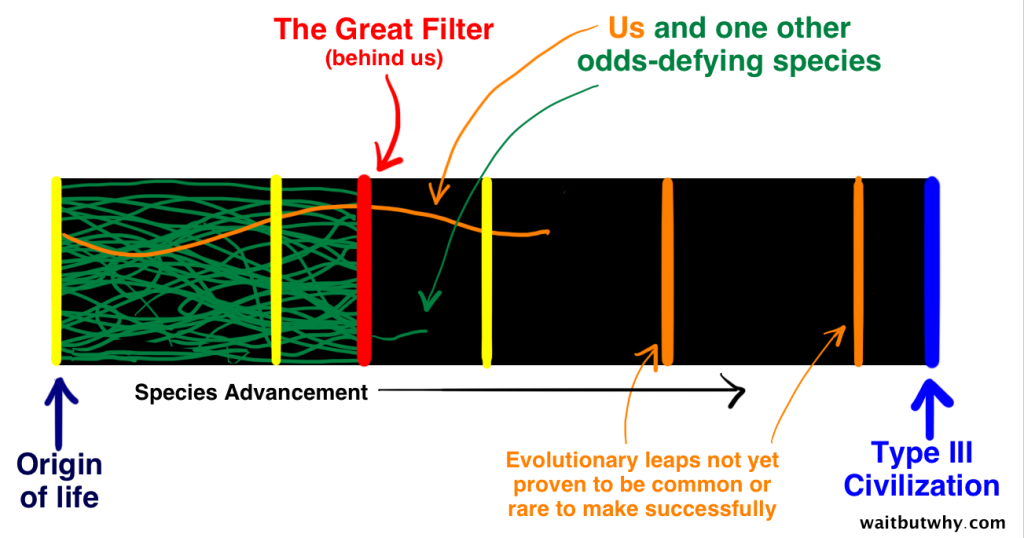
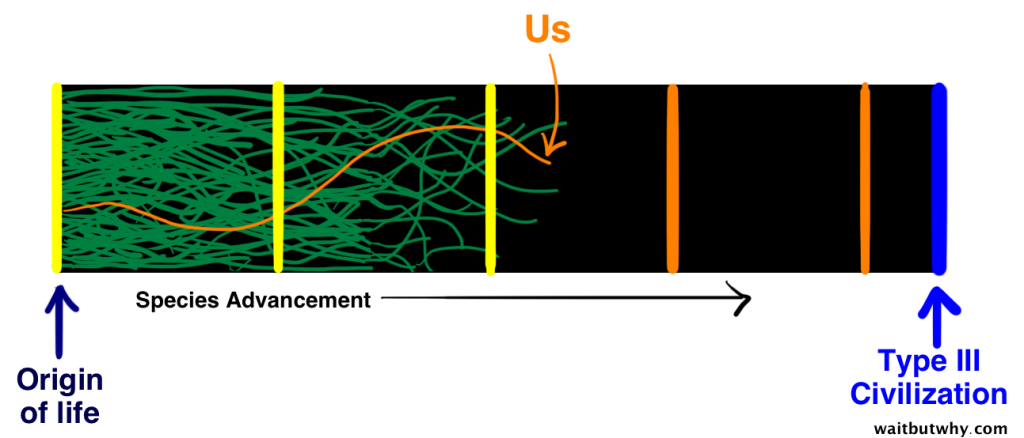
Among the most compelling explanations for the Fermi Paradox is the Great Filter theory, popularized by economist Robin Hanson and further elaborated upon by others. This theory posits that at some point in the long evolutionary journey from abiogenesis (the origin of life from non-living matter) to a Type III civilization (one capable of harnessing the energy of an entire galaxy, as per the Kardashev scale), there exists an extremely unlikely or impossible step—a "wall" that all, or nearly all, attempts at life hit. This "Great Filter" could be in our past, meaning we have already passed it, making us exceptionally rare. Alternatively, it could lie in our future, a looming catastrophe that awaits all advanced civilizations.
The implications of where the Great Filter lies are profound:
Scenario 1: The Filter is in Our Past (We Are Rare)
If the Great Filter is behind us, it means that one or more steps in the development of intelligent life are extraordinarily improbable. This scenario suggests humanity is incredibly rare, perhaps even unique, in the observable universe. Several potential past filters have been proposed:
- Abiogenesis: The initial spark of life from non-living matter might be far more improbable than currently understood. Despite laboratory experiments demonstrating the formation of organic molecules, the leap to self-replicating life remains a monumental hurdle.
- Complex Multicellular Life: The transition from simple single-celled organisms to complex multicellular life, and subsequently to intelligent life, took billions of years on Earth and involved multiple rare evolutionary innovations. The "Cambrian Explosion," for instance, represented an unparalleled burst of biological diversification.
- The Rare Earth Hypothesis: This hypothesis suggests that the specific conditions necessary for complex life to emerge and thrive—a stable star, a planet in the habitable zone, a large moon for planetary stability, a strong magnetic field, plate tectonics for nutrient cycling, and a low frequency of catastrophic impacts—are exceedingly rare in the universe. Our Earth might be a cosmic anomaly.
If any of these past filters are indeed the Great Filter, then the silence we observe is simply because there are very few, if any, other civilizations that have successfully navigated these early, difficult stages.
Scenario 2: The Filter is in Our Future (We Are Doomed)
This is the more unsettling possibility: the Great Filter lies ahead of us. If this is the case, it implies that most, if not all, civilizations eventually encounter a catastrophic barrier that prevents their long-term survival or expansion. This perspective casts a somber shadow on humanity’s future, suggesting that technological advancement may inevitably lead to self-destruction. Potential future filters include:
- Self-Annihilation: Advanced civilizations might inevitably destroy themselves through nuclear warfare, unchecked climate change, pandemics (natural or engineered), or the creation of runaway artificial intelligence that becomes hostile or uncontrollable.
- Resource Depletion: Civilizations might exhaust their planetary resources or fail to transition to sustainable practices before collapse.
- Technological Stagnation: Perhaps there’s a limit to how much progress a civilization can make, leading to a plateau from which it cannot escape, or a failure to overcome fundamental physical limitations (like the speed of light barrier for interstellar travel).
If the Great Filter is in our future, then the silence of the cosmos is not a sign of our uniqueness, but a stark warning. The absence of alien signals might mean that other civilizations have reached our current technological level—or even surpassed it—only to inevitably perish before they could become interstellar.
Scenario 3: They Are Out There, But We Can’t Detect Them (The "Silent" Filters)
A third category of explanations posits that advanced civilizations exist, but for various reasons, we have not detected them. These "silent filters" do not necessarily imply rarity or doom, but rather limitations in our observational capabilities, our assumptions about alien behavior, or the very nature of advanced life.
- Interstellar Travel is Impractical: The vast distances, immense energy requirements, and the sheer time involved might make interstellar travel prohibitively difficult, even for advanced civilizations. This would limit their physical spread and potential for direct contact.
- They Are Not Interested in Us: Advanced civilizations might consider us too primitive to contact, or they may adhere to a "Zoo Hypothesis," observing Earth without interference, much like we might study an ant colony in a nature preserve.
- They Are Too Alien: Their biology, intelligence, or communication methods might be so fundamentally different from ours that we wouldn’t recognize their signals or presence. Perhaps their form of communication is not electromagnetic, or their timelines of existence are vastly different from ours.
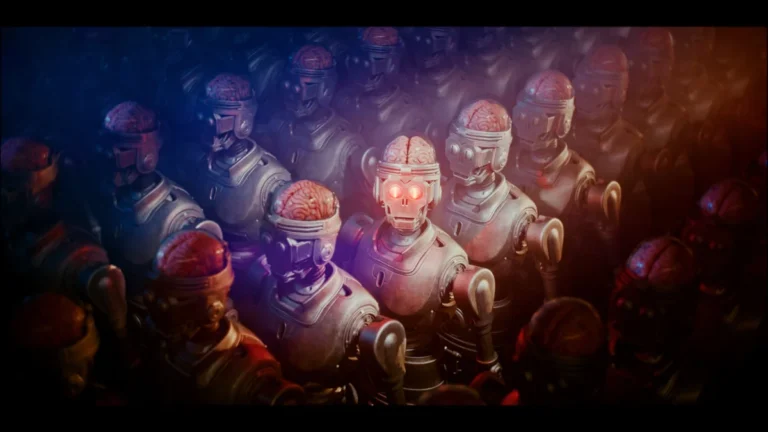
- The "Small and Fast" Hypothesis: This intriguing concept, articulated by scientists like Seth Shostak and explored by others, suggests that truly advanced civilizations might not build grand, visible megastructures. Instead, they might prioritize efficiency, miniaturization, and information. Just as computers have evolved from room-sized machines to microscopic processors, advanced life might transcend large-scale physical existence.
- Shostak argues, "Why build planet-size anything when the real action is in the small things? Small spaces, small units of time, everything gets smaller." He proposes that the "engineering of the small, rather than the large, is inevitable." Such civilizations might exist as vast networks of nanobots, or as post-biological intelligences inhabiting virtual realities or ultra-dense computational substrates. Their "footprint" in the universe would be minuscule, operating at scales we currently cannot observe, or within informational realms beyond our current detection capabilities. This idea aligns with the increasing understanding of information theory and the potential for life to transcend biological limitations. If the ultimate goal of evolution is information processing, then highly advanced beings might retreat into hyper-efficient, microscopic, or even simulated existences, rendering them invisible to our macroscopic search for radio signals or Dyson spheres.
- The Simulation Hypothesis: This extreme variant suggests that our entire reality is a sophisticated computer simulation created by an advanced civilization. In this scenario, the "aliens" are the programmers, and the absence of other life forms within our simulated universe is simply a parameter of the program.
The Ongoing Search and its Philosophical Implications
Despite the formidable challenges, the search for extraterrestrial intelligence (SETI) continues. Organizations worldwide employ radio telescopes to scan the skies for artificial signals, and projects like Breakthrough Listen are dedicated to comprehensive searches for techno-signatures. The vastness of the search space, however, means that our efforts are akin to sifting through a cosmic haystack for a needle.
The Fermi Paradox forces humanity to confront profound philosophical and existential questions. If we are rare, it imbues our existence with an immense significance and a solemn responsibility to preserve life on Earth. If the Great Filter lies ahead, it serves as a powerful warning, urging us to overcome our self-destructive tendencies and strive for sustainable, ethical technological advancement. If civilizations are merely beyond our current detection capabilities, it challenges our anthropocentric assumptions and opens our minds to radically different forms of intelligence and existence.
The silence of the cosmos remains one of the greatest mysteries, a void that prompts introspection and fuels scientific inquiry. Whether the answer lies in our past, our future, or in the subtle, unseen dimensions of advanced life, the quest to unravel the Fermi Paradox continues to shape our understanding of life, intelligence, and our unique place in the universe. The question "Where is everybody?" persists, a testament to humanity’s enduring curiosity and our profound yearning to know if we are truly alone.
About the Author