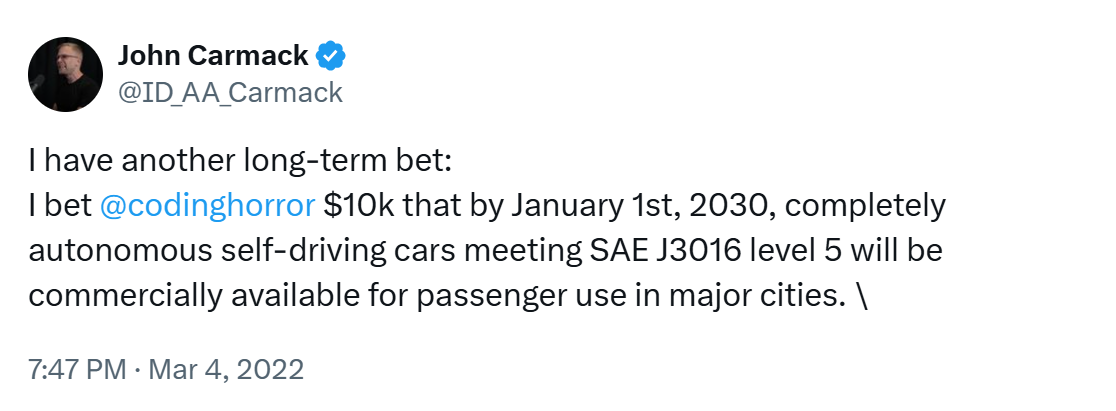
A friendly but significant wager has been publicly announced between two titans of the technology world, Jeff Atwood, co-founder of Stack Overflow and author of the popular Coding Horror blog, and John Carmack, legendary programmer behind seminal video games like Doom and Quake, and former CTO of Oculus VR. The bet, set at $10,000 to be donated to a 501(c)(3) charity of the winner’s choice, hinges on a single, audacious technological prediction: whether completely autonomous self-driving cars, meeting the rigorous SAE J3016 Level 5 standard, will be commercially available for passenger use in major U.S. cities by January 1st, 2030. Atwood is taking the position against, while Carmack is betting for, framing the debate as a compelling challenge to the tech community and a way to generate public interest in STEM fields.
The Core Proposition: Unpacking Level 5 Autonomy
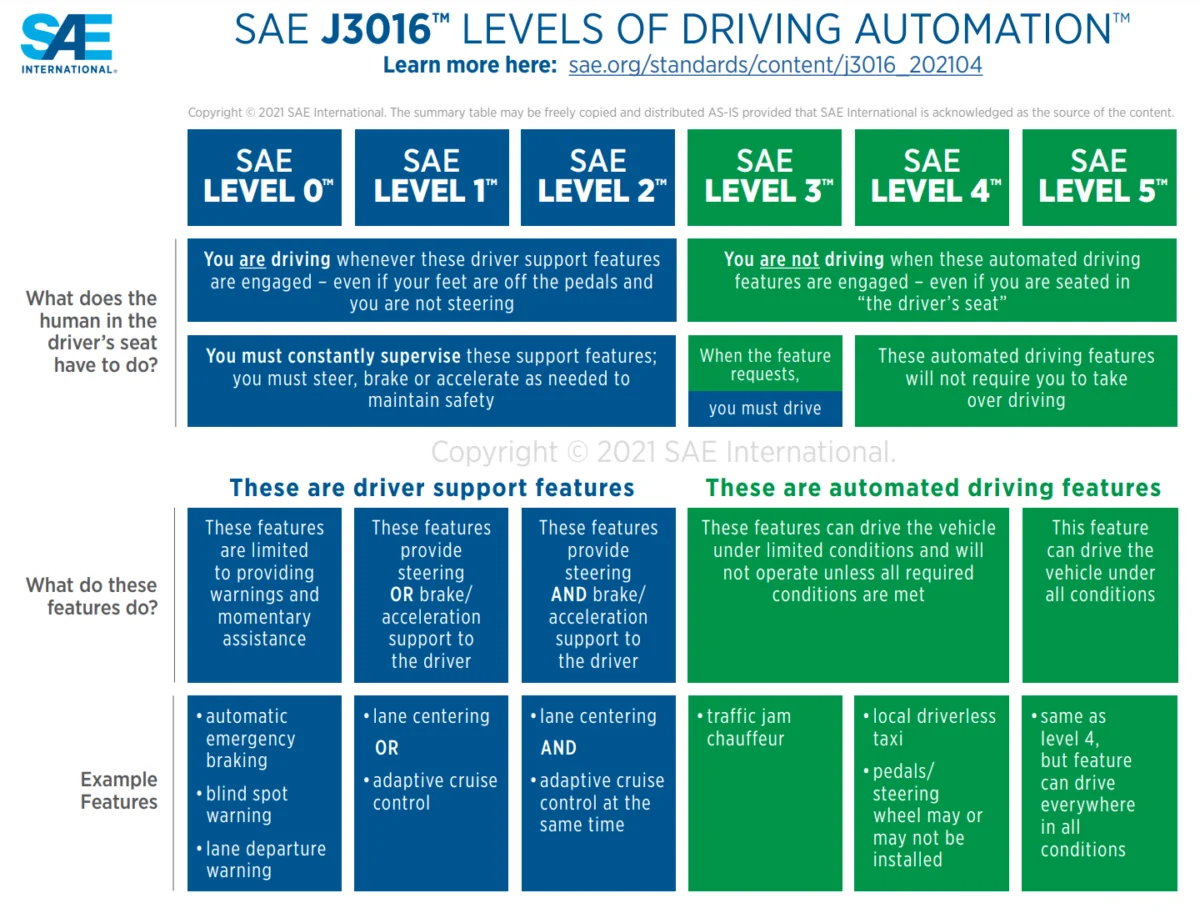
The crux of this bet lies in the precise definition of "completely autonomous" as outlined by the SAE J3016 standard. Level 5 autonomy represents the pinnacle of self-driving capability, where the vehicle is expected to perform all driving tasks under all conditions, without any human intervention whatsoever. This means a passenger simply enters the vehicle, selects a destination, and requires zero attention or interaction with the vehicle’s operation throughout the entire journey. The only exceptions are extreme natural disasters or emergencies that would incapacitate any vehicle. This stands in stark contrast to lower levels of autonomy, such as Level 2 (driver assistance systems requiring constant human supervision) or even Level 4 (high automation limited to specific operational design domains, like geofenced areas or certain weather conditions).
Furthermore, the bet specifies commercial availability for passenger use in "major cities," defined as any of the top 10 most populous cities in the United States. This includes dense urban environments like New York City, Los Angeles, Chicago, Houston, and Philadelphia, which present a complex array of driving challenges: unpredictable pedestrian and cyclist behavior, diverse infrastructure, varying weather patterns, and highly dynamic traffic situations. The combination of Level 5 capability and deployment in such challenging environments by 2030 makes this a particularly ambitious target. The financial stake, though substantial, is designed to be adjusted for inflation by 2030 to ensure its impact remains relevant, underscoring the long-term nature of this technological prognostication.
John Carmack: The Visionary Proponent
John Carmack’s optimistic stance on the rapid advancement of autonomous technology is consistent with his career trajectory as a relentless innovator. Known for pushing the boundaries of what’s technically possible, from pioneering 3D graphics engines to significant contributions in virtual reality, Carmack embodies the spirit of technological disruption. His belief that Level 5 autonomous vehicles will be a commercial reality in major cities within the next six years reflects a profound confidence in the accelerating pace of AI development, sensor technology, and computational power.
Proponents like Carmack often point to the exponential growth in machine learning capabilities, particularly in areas like computer vision and decision-making algorithms, as key enablers. They envision a future where sophisticated AI systems, trained on vast datasets of driving scenarios, can navigate even the most complex urban environments with superhuman precision and safety. The argument often posits that the sheer volume of data being collected by current semi-autonomous vehicles, combined with advancements in neural networks and simulation environments, will allow for rapid iteration and improvement. Furthermore, the immense economic incentives—from increased safety and reduced traffic fatalities to optimized logistics and personal productivity gains—are seen as powerful drivers for investment and regulatory adaptation, potentially accelerating the path to widespread deployment.
Jeff Atwood: The Pragmatic Skeptic
Conversely, Jeff Atwood’s bet against Level 5 autonomy by 2030 stems from a grounded perspective rooted in the practical complexities of software engineering and real-world implementation. As a seasoned software developer and analyst, Atwood frequently highlights the immense difficulty in translating theoretical technological prowess into reliable, robust, and universally applicable systems. His "underestimating how difficult fully autonomous driving really is" encapsulates a common sentiment among those who grapple with the "edge case problem" and the inherent unpredictability of the real world.
Atwood’s skepticism is not born of opposition to the technology itself; rather, he expresses enthusiasm for the potential benefits of self-driving vehicles, desiring a future where he can engage in activities other than driving. His position is a challenge, an encouragement for the industry to "prove him wrong" by overcoming the formidable technical hurdles. This aligns with his past observations on other hyped technologies, such as his pronounced pessimism regarding the transformative potential of Virtual Reality (VR) in our lifetimes, which he posits will be outshone by Augmented Reality (AR) and projection technologies. This pattern suggests Atwood evaluates technologies not just on their theoretical promise, but on the practicalities of widespread adoption, user experience, and the sheer computational and engineering effort required to achieve truly flawless operation in diverse, uncontrolled environments. The step from Level 4 (geofenced autonomy) to Level 5 (anywhere, anytime) is not merely incremental but represents a qualitative leap in complexity, demanding solutions for scenarios that are currently beyond the grasp of even the most advanced AI systems.
A Look Back: The Shifting Timelines of Autonomous Driving
The history of autonomous vehicle predictions is replete with optimistic timelines that have consistently proven challenging to meet. Early proponents in the 2000s, often fueled by DARPA Grand Challenge successes, envisioned widespread self-driving cars by the early 2010s. Google’s self-driving car project (now Waymo), launched in 2009, initially fostered significant optimism, with many believing fully autonomous cars were just around the corner. Elon Musk famously predicted that Tesla would have Level 5 autonomy by 2020, a target that has since been revised multiple times. These shifting timelines underscore the profound and often underestimated complexity of replicating human driving intelligence.
The journey from driver-assist features to true autonomy has been a gradual, iterative process, marked by significant breakthroughs but also by persistent setbacks. While Level 2 features like adaptive cruise control and lane-keeping assist are now common, and Level 3 systems (like Mercedes-Benz DRIVE PILOT in specific conditions) are slowly emerging, the leap to Level 4 and especially Level 5 has proven far more arduous than initially anticipated. The industry has learned that while a vehicle can perform well in 99% of situations, the remaining 1% of "edge cases"—unusual weather, unexpected road debris, erratic human behavior, construction zones, or nuanced social cues—are exponentially difficult to solve reliably and safely. Each incident, even minor ones, involving autonomous test vehicles draws intense scrutiny, highlighting the incredibly high bar for public trust and regulatory approval required for Level 5 deployment.

The Current State of Autonomous Driving Technology
As of the mid-2020s, the autonomous vehicle landscape is characterized by significant investment, ongoing development, and limited commercial deployment of lower-level autonomy. Companies like Waymo and Cruise (though Cruise has faced recent operational challenges) operate Level 4 robotaxi services in specific geofenced areas of cities like Phoenix, San Francisco, and Austin. These services demonstrate high reliability within their defined operational design domains, handling many complex urban scenarios without human intervention. Tesla’s Full Self-Driving (FSD) Beta, while marketed aggressively, remains a Level 2 driver-assistance system that requires constant human supervision and is not considered autonomous by industry standards.
The progress has been substantial, with vehicles now capable of navigating complex intersections, merging on highways, and reacting to many common traffic situations. However, even Level 4 systems are highly constrained. They often operate only in clear weather, during daylight hours, on pre-mapped routes, and with remote human oversight capabilities. The data gathered from these deployments is invaluable, but the sheer statistical improbability of encountering and safely handling every conceivable driving scenario presents a monumental data collection and algorithm training challenge. The transition from Level 4 to Level 5 means shedding all these constraints, requiring a system that can truly drive anywhere, anytime, without any human fallback, which is a fundamentally different engineering problem.
Technological and Regulatory Hurdles to Level 5
Achieving Level 5 autonomy by 2030 faces a gauntlet of technological and regulatory challenges. Technologically, the primary hurdles include:
- Perception in All Conditions: Current sensors (cameras, LiDAR, radar) struggle with adverse weather (heavy rain, snow, dense fog), extreme lighting (blinding sun, dark nights), and novel objects. Robust perception across all environmental conditions remains an unsolved problem.
- The "Edge Case" Problem: The number of unique, unpredictable scenarios a vehicle might encounter is practically infinite. Training AI to handle these "unknown unknowns" – from a mattress falling off a truck to a child chasing a ball into the street – requires not just vast data but sophisticated reasoning capabilities akin to human intuition.
- Human-Like Reasoning and Prediction: Autonomous systems need to predict the intentions of other human drivers, pedestrians, and cyclists, which often involves understanding social cues, body language, and implicit communication, something AI currently struggles with.
- Verification and Validation: Proving the safety and reliability of a Level 5 system to a degree that surpasses human driving in all conditions is an enormous task. Billions of miles of real-world and simulated driving would be required to statistically validate such a system, far exceeding what’s currently feasible.
- Computational Power and Energy Efficiency: Running the necessary AI models for Level 5 autonomy in real-time requires immense computational power, which must be energy-efficient enough for vehicle integration and sustained operation.
- Cybersecurity: A Level 5 autonomous vehicle presents a vast attack surface, and ensuring its invulnerability to hacking or malicious interference is paramount for public safety and trust.
Beyond technology, regulatory and legal frameworks are still catching up. There is no universal federal standard for autonomous vehicle deployment in the U.S., leading to a patchwork of state-level regulations. Establishing clear liability in the event of an accident involving a Level 5 vehicle, and developing a certification process that satisfies both public safety concerns and industry innovation, are complex undertakings that are unlikely to be fully resolved by 2030, particularly for a technology as transformative as Level 5. Public acceptance and trust, often eroded by high-profile incidents or even minor operational glitches, also play a critical role in the speed of adoption.
The Economic and Societal Stakes
The outcome of this bet, and the actual progress of Level 5 autonomy, carries immense economic and societal implications. If Level 5 autonomous vehicles become commercially available in major cities by 2030, the impact would be revolutionary:
- Safety: A significant reduction in traffic accidents and fatalities, as human error, which accounts for over 90% of crashes, is removed from the equation.
- Efficiency: Optimized traffic flow, reduced congestion, and more efficient use of road infrastructure.
- Mobility: Enhanced mobility for the elderly, disabled, and those unable to drive, fostering greater independence and access.
- Economy: A transformation of the transportation, logistics, and ride-sharing industries. New business models would emerge, while existing ones would be disrupted.
- Urban Planning: Potential for cities to repurpose vast areas currently dedicated to parking, leading to more green spaces or housing.
- Productivity: Commuters could reclaim hours previously spent driving, dedicating them to work, leisure, or rest.
However, the failure to achieve Level 5 by 2030 would mean a continuation of the current evolutionary pace, with more limited Level 4 deployments and continued human oversight for most driving scenarios. This would imply a slower realization of the full benefits, continued road fatalities at current rates, and ongoing challenges in urban mobility. It would also lead to a re-evaluation of investment strategies and perhaps a more cautious approach to future predictions within the tech industry, tempering some of the more exuberant forecasts.
Beyond 2030: What Comes Next?
Regardless of whether Atwood or Carmack wins their bet, the quest for truly autonomous vehicles will undoubtedly continue beyond 2030. The advancements made in AI, robotics, and sensor technology during this period will have ripple effects across numerous industries, even if Level 5 remains elusive. The debate itself serves as a valuable benchmark, focusing attention and resources on a critical technological frontier. The process of attempting to achieve Level 5 by 2030 will undoubtedly lead to significant improvements in lower-level autonomy, making vehicles safer and more capable even if they still require human supervision.
This friendly wager, orchestrated by two influential figures, transcends mere personal gain, directing the conversation toward the complex interplay of innovation, engineering realities, and societal impact. It highlights the profound challenges and immense potential inherent in the pursuit of machines that can truly "see" and "think" like humans in the most unpredictable of environments. As the deadline approaches, the world will be watching to see if the ambitious vision of Level 5 autonomy in our major cities can indeed become a tangible reality, or if the intricate difficulties of the real world will continue to defer its arrival.
About the Author