Immineal, an independent developer and researcher, has unveiled a compelling rendering experiment that delves into the nuanced physics of light interaction with transparent materials. Through a custom-built, standalone WebGL2 path tracer, Immineal demonstrates a significantly more accurate simulation of chromatic dispersion than is typically employed in many contemporary renderers. This innovative approach, accessible directly within a web browser, offers a tangible glimpse into the computational cost and visual fidelity achievable by precisely modeling how different wavelengths of light refract through substances like glass.
The core of Immineal’s experiment lies in its departure from conventional rendering techniques for simulating chromatic dispersion. Most RGB path tracers, including widely used engines like Blender’s Cycles, approximate this phenomenon by slightly adjusting the Index of Refraction (IOR) for the red, green, and blue color channels. This method, while computationally efficient, is a simplification. Real-world chromatic dispersion is a continuous function of wavelength, meaning that glass bends each specific wavelength of light by a unique amount, not just three discrete values. This approximation can lead to a less convincing visual effect, particularly in scenarios where dispersion is most prominent and desirable, such as in cut gemstones and prisms. Instead of a true spectral spread, the shortcut often results in a subtle red and blue fringe, a noticeable departure from physical reality.
Immineal’s solution involves a more computationally intensive yet physically accurate method. The standalone WebGL2 path tracer operates by selecting a single random wavelength of light for each ray traced, sampling from the visible spectrum between 380 and 780 nanometers. This ray then refracts through glass, with its path dictated by Cauchy’s dispersion equation, a well-established formula that describes the relationship between refractive index and wavelength: n(λ) = A + B/λ². By accumulating thousands of these spectrally accurate paths per pixel, the renderer gradually builds up an image. Finally, the accumulated spectral data is converted back into the familiar RGB color space using CIE 1931 color matching functions, a standard for representing human color perception.
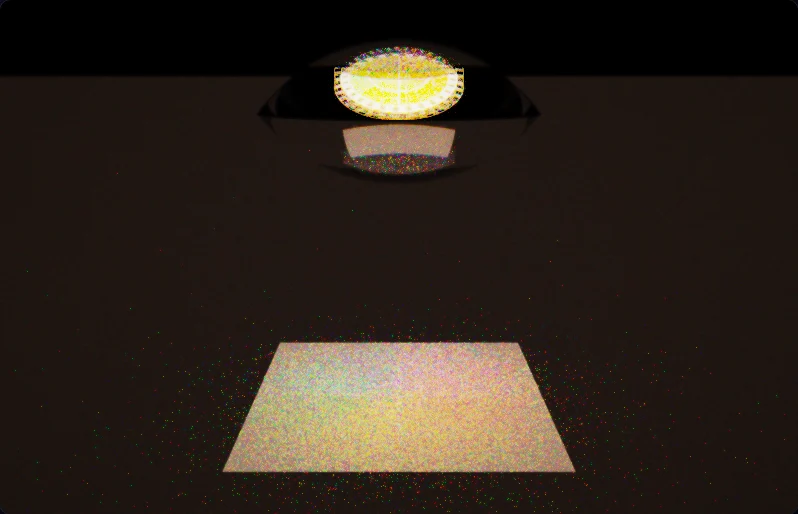
The demonstration features four pre-selected scenes, each designed to highlight the effects of chromatic dispersion: a prism, a cut gemstone, a biconvex lens, and a Cornell box. These scenes are rendered live in the browser, requiring no installation or complex setup, making the advanced simulation accessible to a broad audience of artists, developers, and enthusiasts. The availability of the source code further underscores Immineal’s commitment to transparency and collaborative advancement within the graphics community.
Background and Context: The Evolution of Rendering Realistic Optics
The accurate simulation of light behavior has been a long-standing pursuit in computer graphics. Early rendering techniques often relied on simplified models to achieve acceptable visual results within practical time constraints. As computing power has increased, so too has the ambition to simulate physical phenomena with greater fidelity. Chromatic dispersion, the phenomenon responsible for the rainbow-like separation of colors seen through a prism or in a diamond’s fire, is a prime example of a complex optical effect that challenges traditional rendering pipelines.
The development of physically based rendering (PBR) techniques, particularly the widespread adoption of path tracing, marked a significant leap forward. Path tracing, which simulates the paths of light rays from the camera into the scene, naturally lends itself to more accurate physical simulations. However, even within path tracing, computational efficiency often necessitates compromises. The standard approach to dispersion, as described by Immineal, is a testament to this balancing act between accuracy and performance.
Chronology of Development and Release
While a precise timeline for the development of Immineal’s WebGL2 path tracer is not publicly detailed, the experiment appears to be the culmination of research into advanced optical simulation methods. The release of this project to the public, shared via platforms like BlenderNation, indicates a desire to engage with the wider graphics community and solicit feedback. The availability of the code suggests a project that has reached a stable and demonstrative point, allowing others to explore its inner workings and potential applications.
Technical Deep Dive: Cauchy’s Equation and CIE 1931 Color Matching
Immineal’s reliance on Cauchy’s dispersion equation (n(λ) = A + B/λ²) is a significant aspect of the experiment’s accuracy. This empirical formula, named after French mathematician Augustin-Louis Cauchy, provides a more continuous and accurate representation of how the refractive index of a material varies with wavelength compared to a simple RGB channel sampling. The constants A and B are material-specific and can be derived from experimental data. For typical crown glass, for example, A is approximately 1.52 and B is around 0.004.
The subsequent conversion to RGB using CIE 1931 color matching functions is equally crucial. The CIE 1931 standard observer is a mathematical model of human color perception, defining three color matching functions (X, Y, and Z) that represent the average human eye’s response to different wavelengths of light. By integrating the spectral radiance distribution of the light rays with these color matching functions, Immineal’s path tracer can accurately translate the simulated spectral data into the tristimulus values that our eyes perceive as color. This process moves beyond simply blending red, green, and blue light and instead simulates how the human visual system interprets a spectrum of light.
Honest Limitations and Future Directions
Immineal is forthright about the limitations of this experimental renderer. The current iteration is restricted to four preset scenes and does not support mesh import, limiting its direct applicability for general 3D content creation. Furthermore, it employs Schlick’s Fresnel approximation for calculating reflections and refractions at dielectric interfaces, rather than the more computationally expensive full dielectric equations. Schlick’s approximation is a widely used and effective simplification, but it is still an approximation.
These limitations, however, serve a pedagogical purpose. Immineal explicitly states that the project is "a toy, not a renderer," designed to illustrate the computational overhead associated with physically accurate dispersion simulation. The fact that the simulation "converges slowly enough in places to show why doing this correctly in a production path tracer is expensive" is a key takeaway. This highlights the trade-offs that real-world rendering software must make between achieving perfect physical accuracy and delivering results within reasonable render times.
Analysis of Implications for the Graphics Industry
Immineal’s experiment, while a standalone project, has several implications for the broader computer graphics industry:
- Raising the Bar for Optical Simulation: By showcasing a more accurate method for simulating chromatic dispersion, Immineal encourages a re-evaluation of current rendering techniques. This could inspire developers of commercial and open-source renderers to explore more physically plausible approaches, even if it means increased computational cost.
- Web-Based Advanced Rendering: The successful implementation of a complex path tracer with advanced optical features within a WebGL2 environment demonstrates the growing potential of web-based rendering. This could lead to more accessible and interactive visualization tools, educational resources, and even real-time ray tracing experiences directly in the browser.
- Educational Value: The project serves as an invaluable educational tool. Artists and students can directly observe the visual impact of accurate chromatic dispersion and gain an appreciation for the underlying physics and computational challenges. The availability of the source code further enhances its learning potential.
- Future Research Avenues: The experiment opens doors for further research into optimizing spectrally accurate rendering. The challenge lies in finding ways to achieve these high levels of accuracy without prohibitive render times, potentially through advanced sampling techniques, denoising algorithms tailored for spectral data, or hybrid rendering approaches.
Potential Reactions and Community Engagement
While direct statements from major render engine developers regarding Immineal’s experiment are not available, the graphics community often reacts positively to such well-executed research projects. Independent developers and researchers often share their work on forums and social media, sparking discussions and inspiring innovation. It is plausible that developers of existing renderers might analyze Immineal’s methodology to identify areas for potential improvement in their own systems, particularly concerning the simulation of light through refractive materials. Enthusiasts and academics are likely to appreciate the transparency of the project and the clear demonstration of complex scientific principles.
Conclusion: A Glimpse into the Future of Realistic Rendering
Immineal’s WebGL2 path tracer is more than just a visual demonstration; it is a significant contribution to the ongoing discourse on achieving photorealism in computer graphics. By tackling the intricate physics of chromatic dispersion with a novel and accurate approach, the project not only provides a visually striking result but also offers valuable insights into the computational demands of physically based rendering. While its current form is experimental, it points towards a future where the subtle nuances of light, such as the precise spectral separation of colors, can be rendered with an unprecedented level of fidelity, accessible to a wider audience than ever before. The experiment underscores that the pursuit of perfect realism in computer graphics is a continuous journey, driven by innovation and a deep understanding of the physical world.
About the Author