The fiercely competitive landscape of independent game development has led veteran creator Keith to a period of profound introspection, prompting a re-evaluation of commercial aspirations in favor of deeply personal artistic endeavors. Despite a prolific career spanning nearly two decades, marked by a continuous improvement in game design, Keith observes a paradox where enhanced skill has coincided with diminished market reception. This trend, echoing broader industry concerns regarding market saturation and resource allocation, has seen recent titles like "Spellstorm" and "Scary World" struggle for visibility, pushing the developer towards projects driven by intrinsic artistic value rather than commercial viability.
The Evolving Crucible of Indie Game Development
Since his serious foray into indie development around 2006, a period of heightened optimism for independent creators, Keith has witnessed the sector transform dramatically. What was once a fertile ground for breakout successes now presents formidable barriers to entry and visibility. Discussions surrounding an "indie dev apocalypse" were prevalent even a decade ago, yet from the perspective of many independent creators, the challenging conditions have only intensified. Industry analysts frequently point to the exponential growth in game releases across platforms like Steam, mobile app stores, and digital marketplaces, leading to an unprecedented level of content saturation. This "discoverability crisis" means that even well-crafted games from experienced developers can vanish into obscurity without substantial marketing budgets, a luxury rarely afforded to truly independent creators who operate without millions in funding from publishers or venture capitalists.
This struggle is not confined solely to the indie sphere; the broader gaming industry, despite its colossal financial footprint, grapples with uneven distribution of attention and resources. The core issue, as many observers note, lies in how capital and consumer engagement are concentrated among a tiny fraction of titles and developers. This dynamic mirrors wider economic and societal trends where wealth and opportunity are increasingly hoarded, leaving a vast majority of participants vying for scarce attention.
"Scary World": A Brief, Promising Venture Lost in the Void
In the past year, Keith launched two distinct titles, "Scary World" and "Spellstorm," each meeting a disheartening market reception. "Scary World," conceived as a rapid development project, akin to an extended game jam, was brought to fruition in approximately six weeks. The developer expressed significant pride in "Scary World," perceiving it as a more accessible and enjoyable video game than many of his previous works, with a potentially wider audience appeal. Its design aimed for fun and palatability, elements often prioritized for broader market appeal.
However, despite its intrinsic qualities, "Scary World" failed to gain significant traction. Analysis of its performance suggests contributing factors included visually "rush-y" assets—a common consequence of accelerated development cycles—and, crucially, a complete absence of dedicated marketing efforts. In an ecosystem where thousands of games are released annually, even a high-quality product can struggle to find an audience without strategic promotional campaigns. This outcome underscores a critical challenge for small independent developers: the trade-off between rapid development and polished presentation, and the often-underestimated necessity of robust marketing, which frequently consumes a significant portion of a game’s overall budget.
"Spellstorm": A Three-Year Endeavor and Kickstarter’s Precarious Edge
The experience with "Spellstorm" proved particularly impactful, representing a multi-year investment of time, resources, and creative energy. The card game’s development spanned over three years, excluding the extensive post-production phases of shipping and fulfillment. This was not a smooth journey; it demanded considerable effort across all facets of creation, from intricate game mechanics to comprehensive playtesting. A notable financial commitment was made to the game’s art, which Keith describes as beautiful and a source of immense pride.
Further amplifying the commercial disappointment, substantial funds were allocated to pre-Kickstarter marketing and campaign building—an investment that, for many indies, would be prohibitive. The initial Kickstarter goal was set at a confident $20,000, based on advice from experienced board game crowdfunding consultants who had successfully managed numerous campaigns. Benchmarks in mailing list subscriptions and community engagement suggested this target was easily attainable, with internal projections even reaching $30,000-$50,000. The $20,000 was considered a "bare minimum" threshold for a viable production run.
However, drawing on years of industry experience and a potent intuition, Keith made a last-minute decision to halve the funding goal to $10,000. This choice was driven by a deep desire to see "Spellstorm" exist, even if it meant incurring significant personal financial losses. The prospect of three years of dedicated work, substantial art commissions, and hundreds of playtests with dozens of testers culminating in complete disappearance was deemed a worse outcome than financial shortfall.
The campaign ultimately "squeaked by" the revised $10,000 goal. While technically a success, the actual funds received after Kickstarter fees and other deductions fell far short of what was truly needed. This meager funding necessitated a scramble to find alternative printing and shipping companies willing to handle an unusually small print run of 250 copies. Such adjustments invariably introduced unforeseen logistical difficulties, further driving the project deeper into negative financial territory.
Despite these commercial tribulations, Keith maintains unwavering confidence in "Spellstorm"’s quality. The game is lauded as strong, interesting, original, and fun, distinct from any perceived "failed game idea." While nearly all 170 shipped copies have reached their backers, the public response has been largely muted. On BoardGameGeek, a prominent platform for board game enthusiasts, "Spellstorm" holds mostly positive ratings but lacks the sheer volume of reviews necessary to achieve a formal, aggregated rating.
This outcome starkly contrasts with "Dragon Bridge," an older game Keith created in less than a year with significantly lower production values, including self-made art and no hired artists. "Dragon Bridge" has garnered substantially more players and sustained interaction over the years, leading to greater developer satisfaction despite its humble origins. This comparison encapsulates the developer’s ongoing struggle: the more refined and professionally produced his games become, the less market traction they seem to achieve, highlighting a potential disconnect between artistic improvement and commercial viability in the current market.
A Foundational Shift: Art as Self-Discovery and Societal Healing
The challenges faced with "Scary World" and "Spellstorm" have prompted a profound shift in Keith’s creative philosophy, steering him towards projects driven by intrinsic artistic and personal significance, irrespective of their commercial prospects. "Through Broken Land," an upcoming project, embodies this new direction. The developer expresses a profound connection to this work, stating a necessity for its existence even if it never finds a broad audience.
This artistic pivot is closely tied to Keith’s recent immersion in songwriting, which he describes as a form of therapy. The act of writing songs has become a conduit for self-discovery, with certain lyrical lines resonating as deeply personal truths, profoundly impacting him. These songs, he notes, represent some of the most authentic expressions of himself he has ever created, serving as a powerful testament to the healing and revelatory power of art.
This approach—viewing art-making as a process of deeper self-knowledge—is deemed crucial. A deeper understanding of oneself fosters greater self-humanization, which in turn enables individuals to recognize and empathize with the humanity in others. Many societal problems, Keith posits, stem from a fundamental failure to perceive the shared humanity in ourselves and others, leading to the creation of arbitrary hierarchies based on superficial traits like attractiveness or intelligence. This same dynamic, he argues, allows for the acceptance of extreme wealth disparities and the dehumanizing conditions seen in situations such as immigration detention camps.
While acknowledging the limited impact of any single individual, Keith advocates for self-healing as a revolutionary act. He believes that even marginal self-improvement creates a positive ripple effect, influencing interactions and the wider world. This concept reverses the notion that "hurt people hurt people," proposing instead that "healed people heal people."
"Through Broken Land" is conceived as a narrative that, much like his recent songs, expresses profound personal truths in a way no previous game has. The script, a year in the making, contains scenes so deeply resonant that they elicit an emotional response from the developer himself, not due to perceived literary brilliance, but due to their raw authenticity. The hope is that this profound personal truth will resonate with others.
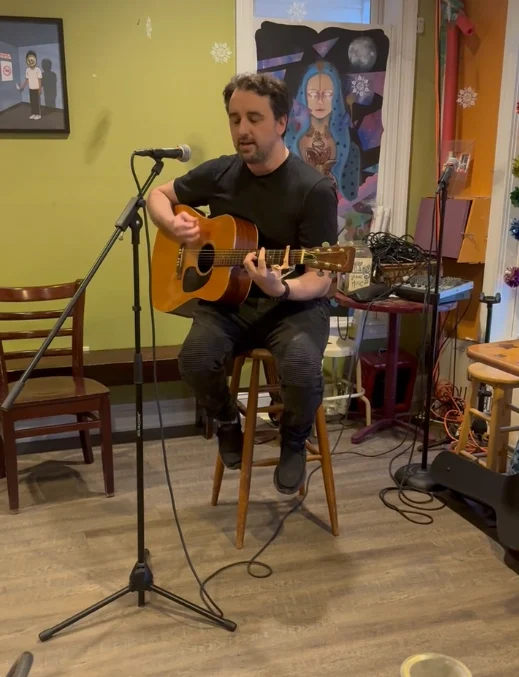
Currently, Keith is focused on daily songwriting and participating in local open mics, a testament to his renewed emphasis on direct artistic expression. However, collaborative efforts are underway for "Through Broken Land," with colleague Blake developing elements that are anticipated to re-inspire a deeper dive into the project, likely in the fall.
Future Outlook and Industry Implications
Despite the commercial setbacks and personal introspection, Keith remains resolute in his commitment to game development. He affirms his intention to complete "Through Broken Land" "one way or another," and to continue creating other games, including a small card game prototype for which playtesting is soon anticipated.
The journey of this independent developer reflects a critical juncture for many in the indie game sector. It highlights the increasing difficulty of achieving commercial success in a hyper-saturated market, even for experienced creators producing high-quality work. The narrative underscores the significant financial and emotional toll that such an environment can exact.
However, it also points to a potential evolution in the definition of "success" for independent artists. When market forces prove overwhelmingly challenging, creators may pivot towards prioritizing intrinsic artistic fulfillment and personal expression over commercial viability. This shift suggests a growing segment of independent developers might embrace a model where games become a medium for profound self-exploration and societal commentary, akin to other art forms, rather than solely products for mass consumption.
This development could signal a maturation of the indie space, moving beyond a purely commercial pursuit to embrace a wider spectrum of artistic motivations. While the financial sustainability of such an approach remains a significant challenge for individual developers, it nonetheless enriches the cultural landscape of gaming, offering experiences driven by deep personal resonance and a broader vision for art’s role in the world. The ongoing story of Keith and "Through Broken Land" will be a compelling case study in this evolving paradigm.
About the Author