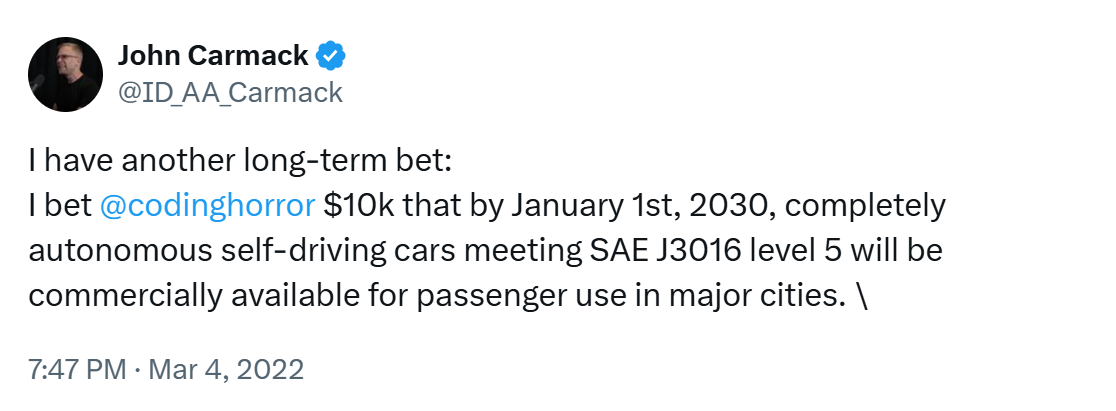
In a high-stakes, yet friendly, wager that pits technological optimism against the pragmatic realities of complex engineering, prominent tech luminaries Jeff Atwood, co-founder of Stack Overflow and author of the "Coding Horror" blog, and John Carmack, the legendary programmer behind iconic video games like Doom and Quake and a pioneer in virtual reality, have formalized a $10,000 bet. The charitable wager hinges on a definitive technological milestone: whether fully autonomous, SAE J3016 Level 5 self-driving cars will be commercially available for passenger use in major United States cities by January 1st, 2030. Atwood, known for his critical and often skeptical analysis of emerging technologies, is betting against this ambitious timeline, while Carmack, a perennial futurist and innovator, firmly stands for its realization. The proceeds of the bet, which may be adjusted for inflation to ensure its intended impact, will be donated to a 501(c)(3) charity of the winner’s choice, transforming a personal challenge into a public good.
Defining the Apex of Autonomy: SAE Level 5 Explained
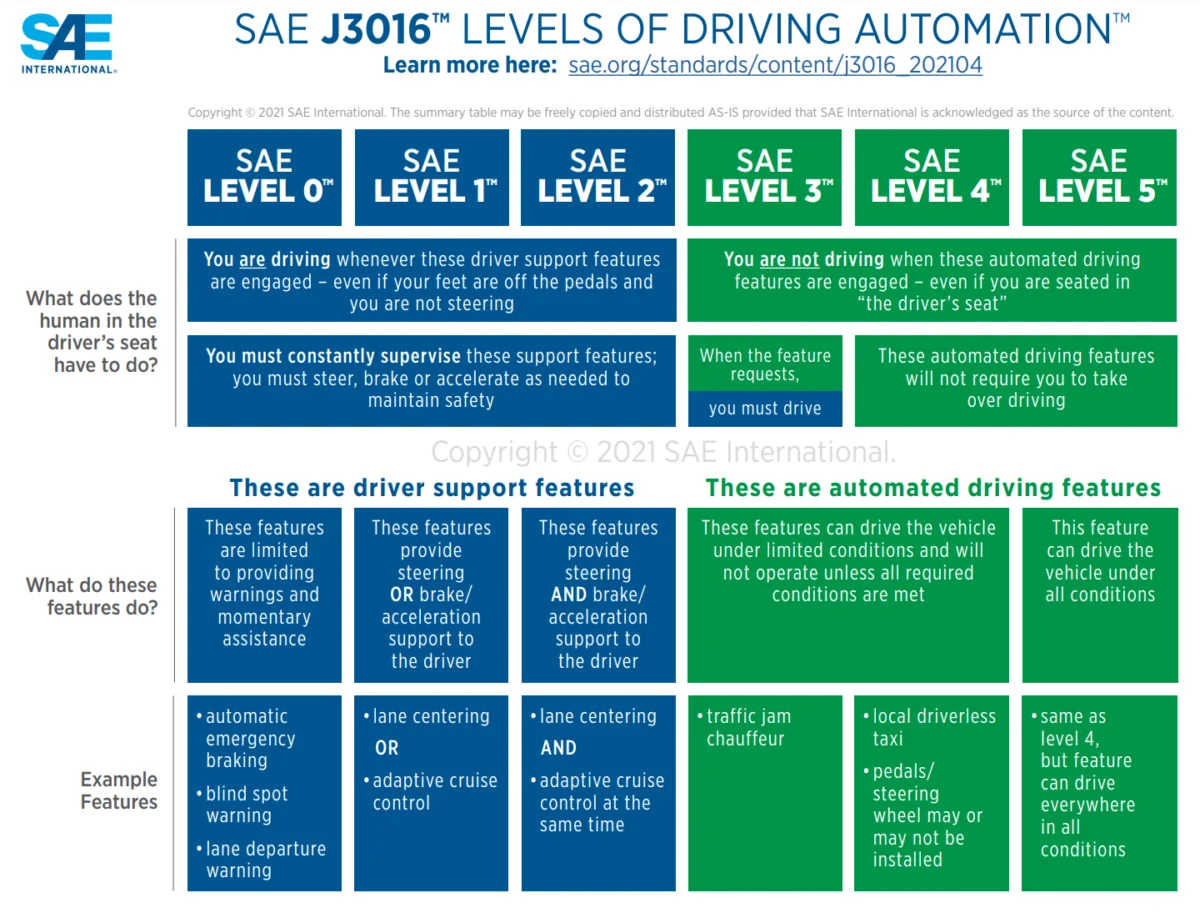
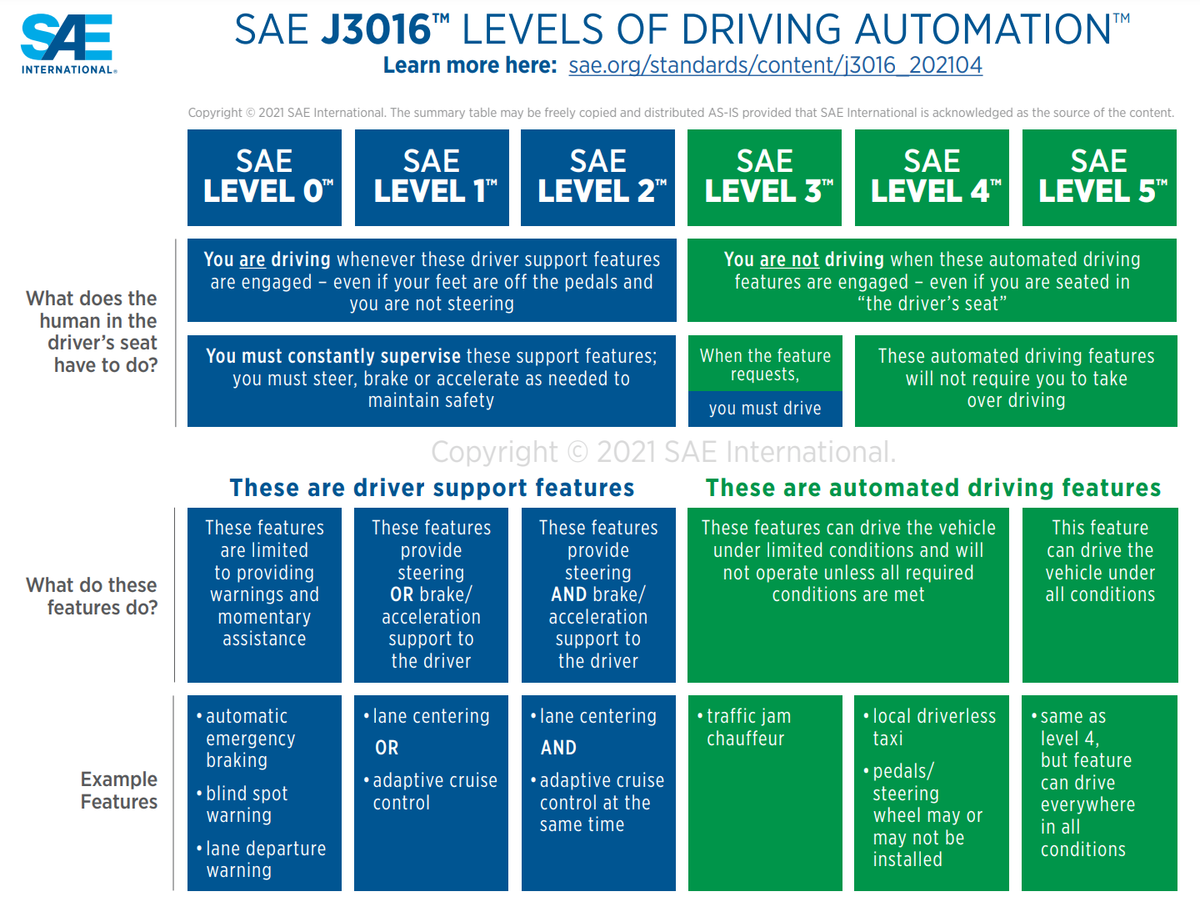
At the heart of this wager lies the precise definition of "completely autonomous" vehicles, as outlined by the Society of Automotive Engineers (SAE) J3016 standard, specifically Level 5. This designation represents the pinnacle of driving automation, where the vehicle is capable of performing all driving tasks under all conditions, without any human attention or interaction required during the journey. The only exceptions are natural disasters or extreme emergencies that would render any form of travel impossible. Unlike lower levels of automation, such as Level 2 (partial automation requiring constant human supervision) or Level 3 (conditional automation where the human driver must be ready to intervene), a Level 5 vehicle operates entirely independently. A passenger merely enters the vehicle, selects a destination, and the vehicle handles every aspect of navigation, perception, decision-making, and control, regardless of weather, road conditions, or geographical location. There are no operational design domains (ODDs) limiting its functionality, meaning it can operate anywhere a human driver could.
The terms further specify that these vehicles must be "commercially available for passenger use," implying widespread production and accessibility to the general public, not merely experimental prototypes or limited pilot programs. Furthermore, the availability must extend to "major cities," defined as any of the top 10 most populous cities in the United States. This includes sprawling urban environments like New York City, Los Angeles, Chicago, Houston, Phoenix, and Philadelphia, which present diverse and inherently complex driving challenges ranging from dense traffic and unpredictable pedestrian behavior to varied infrastructure and inclement weather conditions. The combination of these stringent requirements – Level 5 autonomy, commercial availability, and deployment in diverse major urban centers – underscores the monumental scale of the technological and logistical challenge being debated.
The Contrasting Philosophies: Atwood’s Skepticism vs. Carmack’s Optimism
The $10,000 wager is more than just a bet; it’s a public reflection of two distinct perspectives on technological progress, embodied by two highly influential figures in the tech world.
Jeff Atwood, through his popular "Coding Horror" blog and his work on Stack Overflow, has consistently championed practical engineering and robust software development. His stance against the 2030 deadline for Level 5 autonomy stems from a deep-seated belief that the industry is "underestimating how difficult fully autonomous driving really is." Atwood acknowledges the allure of self-driving vehicles, expressing a personal desire to free himself from the chore of driving to engage in more productive or enjoyable activities. He also recognizes the problem as a "fascinating, incredibly challenging computer science problem." However, his skepticism is rooted in the immense complexity of replicating human-level perception, prediction, and decision-making in the infinitely variable and unpredictable real world. He has historically adopted a cautious view on technologies that promise transformative shifts but face significant practical hurdles, notably expressing a far more pessimistic outlook on the near-term impact of virtual reality, arguing that augmented reality and projection technologies hold greater near-term promise. For Atwood, the bet serves as a challenge, an invitation for the engineering community to prove his skepticism wrong and accelerate innovation.
John Carmack, on the other hand, represents a quintessential figure of technological optimism. A legendary software engineer, his career has been defined by pushing the boundaries of what’s possible, from revolutionizing 3D graphics in video games to his pioneering work in virtual reality at Oculus. Carmack’s participation in the bet, as noted by Atwood, was motivated by a desire to generate "STEM publicity," framing it as a fun, public challenge to inspire innovation and discussion around autonomous technologies. His history suggests a belief in the power of relentless engineering and scientific breakthroughs to overcome seemingly insurmountable obstacles. Carmack’s career is replete with instances where he tackled problems others deemed impossible, often with elegant and highly optimized solutions. His embrace of the 2030 timeline for Level 5 autonomy aligns with a worldview that sees rapid, exponential progress in fields like artificial intelligence and computing power, making such achievements not just possible but probable within a decade.
The Current Landscape of Autonomous Driving: Bridging the Levels
To understand the magnitude of the Atwood-Carmack wager, it’s crucial to examine the current state of autonomous vehicle (AV) technology. As of late 2023 and early 2024, the AV industry has made significant strides, yet remains predominantly in the realm of Level 2 and Level 4 automation.
Most commercially available vehicles with "self-driving" features, such as Tesla’s Autopilot and Full Self-Driving (FSD) Beta, General Motors’ Super Cruise, and Ford’s BlueCruise, operate at SAE Level 2. These systems provide advanced driver-assistance, managing steering, acceleration, and braking under certain conditions, but they explicitly require constant human supervision. The driver must remain attentive, with hands on the wheel or eyes on the road, ready to take over at a moment’s notice. Level 3 systems, like Mercedes-Benz’s Drive Pilot, are emerging, offering "conditional automation" where the vehicle can handle all driving tasks in specific conditions (e.g., congested highways below a certain speed), but still demands a human driver capable of intervention when prompted.
The most advanced deployments currently operating are at Level 4, specifically within highly defined Operational Design Domains (ODDs). Companies like Waymo (an Alphabet subsidiary) and Cruise (a GM subsidiary) have launched robotaxi services in select cities. Waymo, for instance, operates fully driverless services in parts of Phoenix, Arizona, and San Francisco, California, and recently expanded to Los Angeles. Cruise has had operations in San Francisco, Austin, and Phoenix. These Level 4 services are remarkable: they operate without human safety drivers and handle complex urban scenarios. However, their scope is limited by geofenced areas, specific weather conditions, and predefined operating hours. They still encounter "edge cases" – unusual, rare, or complex scenarios that test their AI’s limits – and sometimes require human remote assistance. Recent incidents, such as Cruise vehicles stalling en masse or a highly publicized collision in San Francisco involving a pedestrian, have highlighted the significant challenges even Level 4 systems face, leading to temporary suspensions and increased regulatory scrutiny.
The gap between current Level 4 deployments and the ultimate Level 5 goal is immense. Level 4 systems, while impressive, rely on extensive high-definition mapping, robust sensor arrays (Lidar, radar, cameras), and powerful AI trained on billions of miles of real-world and simulated data. The transition to Level 5 means shedding the constraints of ODDs, mastering truly adverse weather (heavy rain, snow, dense fog), navigating unmapped territories, and flawlessly interpreting human behavior in every conceivable context, all without any human oversight. This "last mile" of autonomy represents a qualitative leap, not merely an incremental improvement.
A History of Optimism and Missed Deadlines: A Timeline of AV Projections
The history of autonomous vehicle development is replete with ambitious projections that have often outpaced reality. The concept of self-driving cars has captivated innovators for decades, but it gained significant momentum with the DARPA Grand Challenge series in the mid-2000s, which spurred university and industry research into truly autonomous navigation.
- Early 2000s: Initial successes in controlled environments from the DARPA challenges sparked widespread optimism.
- 2010s: Google’s self-driving car project (later Waymo) began public testing, leading to a surge of predictions from tech leaders. In 2012, Google co-founder Sergey Brin suggested fully autonomous cars could be available to the public within five years. Elon Musk, CEO of Tesla, famously predicted in 2015 that full self-driving capabilities would arrive within "about two years," and that a million Tesla robotaxis would be on the road by the end of 2020.
- Mid-2010s: Many automakers and tech companies announced timelines for Level 4 or Level 5 vehicles by 2020 or 2021. General Motors, for instance, aimed for a robotaxi service by 2019.
- Late 2010s – Early 2020s: As these deadlines approached, the industry largely acknowledged the immense complexity and pushed back timelines. The "easy problems" of autonomous driving were solved, but the "hard problems" – the myriad edge cases, ethical dilemmas, and unpredictable human interactions – proved far more difficult than anticipated. This period saw a recalibration of expectations, with a greater focus on incremental progress within defined ODDs.
These missed deadlines underscore Atwood’s cautious approach. The transition from controlled environments to the chaos of real-world urban driving, especially without human intervention, has consistently proven more challenging than even experts initially projected. The bet’s 2030 deadline gives the industry another 6-7 years from the present, a period that some optimists believe is sufficient for major breakthroughs, while skeptics see it as a continuation of previous overestimations.
Challenges and Hurdles to Achieving Level 5 by 2030

The path to Level 5 autonomy by 2030 is fraught with significant technical, regulatory, economic, and societal hurdles.
Technological Barriers:
- Perception in All Conditions: Current sensors (cameras, lidar, radar) struggle with adverse weather like heavy rain, snow, fog, and extreme sunlight. Achieving robust perception in all conceivable environmental conditions is a monumental task.
- Predicting Human and Animal Behavior: Humans are inherently unpredictable. Understanding and anticipating the intentions of pedestrians, cyclists, and other drivers, especially in ambiguous situations, is a profound challenge for AI.
- Edge Cases: The "long tail" of unforeseen scenarios is virtually infinite. From unusual road debris to unexpected construction zones, complex multi-vehicle interactions, or emergency vehicle responses, Level 5 systems must handle everything a human driver can, and more reliably.
- Decision-Making and Common Sense: Replicating human "common sense" and intuitive judgment in machines remains a core AI challenge. How should a vehicle prioritize safety when faced with unavoidable risks?
- Cybersecurity: As AVs become more connected, they become targets for cyberattacks, raising critical safety and privacy concerns.
Regulatory and Legal Complexities:
- Lack of Unified Framework: The United States currently lacks a comprehensive federal regulatory framework for autonomous vehicles, leading to a patchwork of state-level laws that hinder widespread deployment.
- Liability: Determining liability in the event of an accident involving a fully autonomous vehicle is a complex legal issue that remains largely unresolved. Is it the manufacturer, the software developer, the owner, or none of the above?
- Certification and Testing: Establishing rigorous and universally accepted standards for testing and certifying Level 5 safety and reliability is essential but highly challenging, given the infinite variability of real-world driving.
Economic Considerations:
- High Development Costs: The research, development, and testing of Level 5 systems require massive investments. Billions of dollars have already been poured into the sector, and significant further investment will be needed.
- Sensor and Computing Costs: The advanced sensor suites and powerful onboard computing necessary for Level 5 operation are currently very expensive, making the commercial viability of such vehicles at scale a challenge.
- Scalability: Mass production and deployment of Level 5 vehicles across major cities will require significant infrastructure changes, manufacturing scale, and a robust support ecosystem.
Societal and Ethical Challenges:
- Public Trust and Acceptance: Despite advancements, public trust in fully autonomous vehicles remains a significant hurdle. High-profile incidents, even minor ones, can erode confidence.
- Job Displacement: The widespread adoption of Level 5 AVs would have profound implications for millions of professional drivers (truckers, taxi drivers, delivery personnel), raising concerns about mass job displacement and the need for economic transition strategies.
- Ethical Dilemmas: While often oversimplified, the "trolley problem" – how an AV should make life-or-death decisions in unavoidable accident scenarios – highlights the deep ethical questions that society must grapple with.
Industry Perspectives: The Spectrum of Optimism
Within the autonomous vehicle industry and the broader tech community, opinions on the 2030 timeline for Level 5 vary widely, reflecting the dichotomy of the Atwood-Carmack bet.
The Optimists (Carmack’s Camp): Proponents of rapid Level 5 deployment often point to the exponential growth in artificial intelligence capabilities, particularly in deep learning and neural networks. They argue that advancements in sensor technology, coupled with massive data collection and highly realistic simulation environments, are accelerating development. They believe that breakthroughs in AI’s ability to generalize and learn from edge cases, rather than explicitly being programmed for each scenario, will be the key. This camp often emphasizes the "Moore’s Law" effect on computing power and the increasing sophistication of machine learning algorithms, which could lead to a sudden, rather than gradual, leap in capability. They envision a future where Level 5 is not just possible but inevitable, driven by the compelling safety and efficiency benefits.
The Skeptics (Atwood’s Camp): Those who share Atwood’s skepticism highlight the "hard problems" of AI that remain unsolved. They argue that while machines excel at pattern recognition and data processing, they still lack genuine understanding, common sense, and the ability to reason about the world in a human-like way. The complexity of the real world, with its infinite variables and unpredictable human element, is seen as an intractable challenge for purely algorithmic systems, at least within the current paradigm. They caution against overestimating AI’s current capabilities and point to the repeated failures of previous ambitious timelines as evidence of the deep-seated difficulty of the problem. For them, Level 5 may be a distant future, perhaps decades away, or might require fundamental shifts in AI architecture that are not yet on the horizon.
The Pragmatists: A more moderate view suggests that while pure Level 5 might not be achieved by 2030, significant advancements in Level 4 within expanded ODDs are highly probable. This perspective focuses on the incremental expansion of operational domains, covering more cities, weather conditions, and complex scenarios. The emphasis is on safe, measured deployment and the gradual building of public trust, rather than a sudden, all-encompassing Level 5 solution. They believe that a hybrid approach, where advanced Level 4 systems handle most driving, with human oversight or remote assistance for truly exceptional circumstances, might be the more realistic near-term future.
Implications of the Wager’s Outcome
Regardless of who wins the $10,000 wager, its outcome in 2030 will carry significant implications for the technology industry, transportation, and society at large.
If John Carmack Wins (Level 5 Achieved):
- Transformative Impact: A Carmack victory would herald a new era of transportation. It would validate the immense investment in AI and robotics, fundamentally reshaping urban planning, logistics, and personal mobility. Traffic congestion, accidents caused by human error, and pollution could see dramatic reductions.
- Economic Boom: New industries and services would emerge, from robotaxi fleets and autonomous delivery networks to in-vehicle entertainment and productivity services. The global economy would experience a significant shift, creating new job categories while displacing others.
- Societal Changes: Personal freedom would expand, particularly for those unable to drive. Cities might reallocate vast swathes of land currently used for parking. The very fabric of daily life, from commuting to leisure travel, would be reimagined.
If Jeff Atwood Wins (Level 5 Not Achieved):
- A Sobering Reality Check: An Atwood victory would serve as a powerful reminder of the enduring challenges in artificial intelligence and complex engineering. It would signal that the "hard problems" of AI, particularly those involving real-world unpredictability and human-like reasoning, are more profound than many optimists currently believe.
- Industry Reassessment: Investment strategies in the AV sector might be re-evaluated, potentially shifting focus from Level 5 to the continued refinement and expansion of Level 4 capabilities and advanced driver-assistance systems.
- Continued Human-AI Collaboration: The future of driving would likely involve a prolonged period of human-AI collaboration, where technology assists and enhances human drivers rather than fully replacing them. The emphasis would remain on safety, reliability, and incremental progress, tempering overly ambitious timelines.
Beyond the specific outcome, the wager itself has already served its intended purpose: generating significant public discourse around the promises and perils of autonomous technology. It forces a critical examination of the definitions, the challenges, and the ethical considerations involved in developing machines that can navigate the complexities of human society. As the deadline approaches, the bet will undoubtedly become a focal point for tracking progress in the autonomous vehicle space, offering a tangible benchmark for one of the most ambitious technological endeavors of our time. The ultimate beneficiaries, regardless of who wins, will be the chosen charity and the broader public, who gain from a more informed and engaged discussion about the future of transportation.
About the Author