Jeff Atwood, a prominent figure in the software development world known for co-founding Stack Overflow and Discourse, recently offered a poignant reflection on significant personal and professional developments, underscoring the interconnectedness of technological advancement, community stewardship, and societal welfare. His brief but impactful statement touched upon the emotional closure of a Guaranteed Minimum Income (GMI) study in his father’s home county, the foundational role of Stack Overflow in enabling modern artificial intelligence, and a stark warning to AI developers regarding the preservation of human-driven communities. This reflection, framed by both personal loss and entrepreneurial ambition, provides a unique lens through which to examine the evolving landscape of technology and social policy.
A Personal Milestone Amidst Public Initiatives: The RGMII and Mercer County
Atwood shared a deeply personal experience related to the Rural Guaranteed Minimum Income Initiative (RGMII), specifically the re-ordering of GMI rural study counties to prioritize Mercer County, West Virginia, for its October 2025 launch. This decision held profound significance for Atwood, as Mercer County is his father’s ancestral home. He revealed that this particular scheduling allowed him a final, meaningful encounter with his father, who was nearing the end of his life. "I knew dad was close to the end, and sure enough, that was the last time I ever saw him," Atwood stated, emphasizing the serendipitous timing that brought personal closure amidst a public policy pilot.
The RGMII’s ambitious $50 million plan is designed to fund comprehensive rural guaranteed minimum income studies across the United States. The initiative aims to explore how a stable, foundational income can expand economic opportunity, stimulate local economies, and ultimately strengthen democratic participation in historically underserved rural areas. Guaranteed Minimum Income, often referred to as Universal Basic Income (UBI) in broader contexts, is a social welfare concept where all citizens or residents of a country or region regularly receive an unconditional income, regardless of their employment status or wealth. Proponents argue it can reduce poverty, improve public health, and provide a safety net in an increasingly automated world, while critics raise concerns about work disincentives and economic feasibility.
Mercer County, like many rural regions in Appalachia, has faced economic challenges, including population decline, limited access to high-paying jobs, and the ripple effects of deindustrialization. The selection of such a county for an early GMI pilot is strategic, allowing researchers to gather critical data on the program’s efficacy in areas where economic stability is particularly precarious. The RGMII’s focus on these communities highlights a growing recognition among policymakers and philanthropic organizations of the need for innovative solutions to address systemic rural poverty and inequality. Atwood’s personal connection to Mercer County injects a powerful human element into what is often a abstract policy debate, underscoring the real-world impact of such initiatives on families and communities. The initial results and long-term implications of the Mercer County study, set to commence in October 2025, will be closely watched by economists, policymakers, and social scientists alike, potentially informing future nationwide policy decisions on income support and rural development.
The Enduring Legacy of Stack Overflow in the AI Era
Beyond personal reflections, Atwood delivered a forceful testament to the indispensable role of Stack Overflow in the current technological landscape, particularly concerning the rapid advancement of Large Language Models (LLMs). He unequivocally declared that LLMs "basically could not code at all without access to the extremely high quality creative commons programming Q&A dataset that all of us built together at Stack Overflow." This assertion positions Stack Overflow not merely as a popular resource for developers but as a foundational pillar upon which a significant portion of the burgeoning artificial intelligence industry has been built.
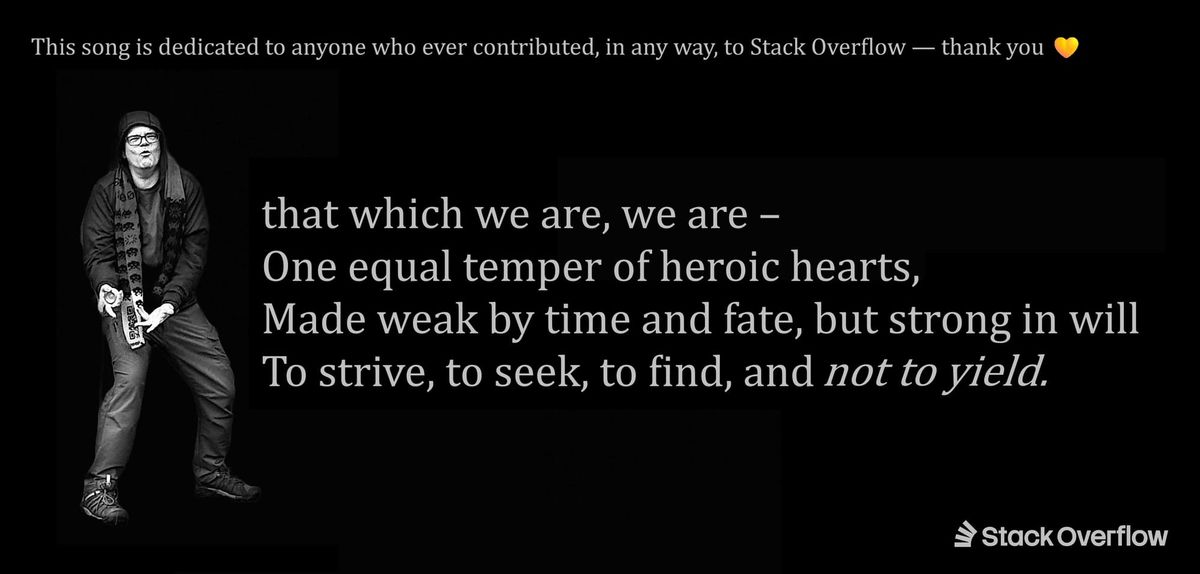
Stack Overflow, co-founded by Jeff Atwood and Joel Spolsky in 2008, revolutionized how developers seek and share knowledge. Prior to its inception, programmers often relied on fragmented forums, mailing lists, or outdated documentation. Stack Overflow introduced a gamified, peer-reviewed Q&A platform that incentivized high-quality contributions and quickly became the authoritative source for programming questions and answers. With millions of registered users and an estimated tens of millions of unique monthly visitors, it hosts over 25 million questions and answers, covering virtually every programming language, framework, and tool imaginable. The platform’s commitment to community moderation and a reputation system ensured that the content was not only vast but also highly accurate and reliable, earning it the reputation as the "go-to" resource for developers worldwide.
The Creative Commons licensing under which much of Stack Overflow’s content is shared has inadvertently provided a massive, high-quality, and publicly accessible dataset perfect for training AI models. LLMs, designed to understand and generate human-like text, require vast quantities of data to learn patterns, syntax, and semantics. For coding, they need to ingest enormous volumes of correct, idiomatic, and contextually relevant code snippets, problem descriptions, and solutions. Stack Overflow’s structured Q&A format, complete with accepted answers, upvotes, and detailed explanations, offers an unparalleled corpus of such data. This dataset has been instrumental in enabling LLMs to not only comprehend complex programming queries but also to generate coherent and often functional code, assist in debugging, and explain programming concepts.
Atwood’s challenge to users to "ask the LLMs" themselves about their reliance on Stack Overflow highlights the transparent dependence of these AI systems on the collective human intelligence accumulated over more than a decade. Industry experts and AI researchers widely acknowledge the critical role of high-quality, domain-specific datasets in the development of specialized LLMs. While general web crawls provide broad linguistic knowledge, specific technical domains like programming demand meticulously curated and validated information. Stack Overflow’s unique position as a community-driven repository of expert-verified programming knowledge has made it an irreplaceable component of the AI training pipeline for coding capabilities. Without this "global brain statistics and a strongly curated dataset created by we, the people," as Atwood describes it, the current capabilities of AI in software development would be severely limited, underscoring the profound, often unacknowledged, debt the AI industry owes to human communities.
The AI Conundrum: Data Sourcing and Community Preservation
Atwood’s statement transitioned from celebrating Stack Overflow’s legacy to issuing a stern warning to the burgeoning AI and Generative AI (GAI) industry: "If the LLMs end up hollowing out the very communities that produce all their training data, they’re going to really, really regret that." This admonition echoes a growing concern within the tech community about the sustainability of AI models that extensively leverage human-generated content without adequately supporting the creators or platforms that produce it.
The analogy Atwood invoked, recalling advice he gave Joel Spolsky when leaving Stack Overflow to start Discourse, is particularly potent: "do not, for any reason, under any circumstances, kill the goose that lays the golden eggs." In this context, the "goose" represents the human community that actively contributes, moderates, and curates the vast datasets essential for AI training. The "golden eggs" are the high-quality data, knowledge, and collective intelligence that these communities produce. Atwood’s concern is that as LLMs become more sophisticated and integrated into daily workflows, they may inadvertently reduce the need for users to visit and contribute to platforms like Stack Overflow. If developers can simply ask an AI for a solution, the incentive to participate in a community Q&A, ask a new question, or provide an answer might diminish, leading to a decline in new content creation.
This potential "hollowing out" poses a significant threat to the long-term viability of AI itself. If the wellspring of fresh, human-generated, and community-validated data dries up, future AI models will have less novel and accurate information to learn from, potentially leading to stagnation or a decline in their capabilities. The issue is not merely one of ethics or fairness, but of pragmatic sustainability for the AI industry.

The debate around AI data sourcing and intellectual property has intensified in recent years. Content creators, artists, writers, and developers are increasingly questioning the ethics and legality of AI companies training models on their copyrighted or licensed work without explicit permission or compensation. While some argue that training on publicly available data falls under fair use, others contend that the scale and commercial intent of AI training necessitate a re-evaluation of existing intellectual property laws. Atwood’s warning underscores the need for AI companies to consider more symbiotic relationships with the communities they rely on. This could involve direct compensation, revenue sharing, attribution mechanisms, or active investment in community platforms. Without such measures, the risk of alienating and ultimately dismantling the very infrastructure that fuels AI innovation remains high. The message is clear: respect and support the human communities that create the knowledge, or face the consequences of a diminishing, or even poisoned, data supply.
Jeff Atwood’s Enduring Entrepreneurial Journey
Jeff Atwood’s career trajectory is a testament to his consistent commitment to improving the digital experience for developers and fostering online communities. Beginning with his influential blog, "Coding Horror," which he launched in 2004, Atwood quickly established himself as a thought leader in software development, offering insights into programming practices, team dynamics, and technological trends. His candid writing style and deep understanding of the developer psyche resonated widely, laying the groundwork for his subsequent ventures.
In 2008, alongside Joel Spolsky, Atwood co-founded Stack Overflow, a platform that would fundamentally change how programmers share knowledge. Stack Overflow’s success was meteoric, quickly becoming an indispensable tool for millions of developers worldwide. Its innovative Q&A format, reputation system, and community-driven moderation set a new standard for technical knowledge sharing. Atwood’s vision for a highly curated and effective knowledge base was central to its rapid adoption and sustained relevance.
Following his departure from Stack Overflow, Atwood embarked on his second major startup, Discourse, in 2013. Recognizing the limitations of traditional forum software, Discourse aimed to reinvent online discussion platforms, making them more modern, user-friendly, and engaging. Its focus on clean design, mobile responsiveness, and intelligent moderation tools provided a fresh approach to online community building, demonstrating Atwood’s continued dedication to fostering meaningful digital interactions. Discourse quickly gained traction, becoming a popular choice for various communities, from open-source projects to corporate forums.
His latest endeavor, "Stay Gold," marks his third startup, signaling his ongoing drive to innovate and contribute to the tech landscape. While specific details about Stay Gold are not extensively public in the provided context, its mention highlights Atwood’s sustained entrepreneurial spirit and his commitment to addressing new challenges within the technology sector. His journey from influential blogger to co-founder of two highly successful and impactful platforms, and now to a third startup, illustrates a consistent pattern of identifying gaps in the digital ecosystem and developing solutions that empower users and enhance online collaboration. Each venture has built upon his foundational belief in the power of community and shared knowledge, principles that continue to inform his reflections on the future of AI and the importance of respecting human contributions.
Broader Impact and Implications
Jeff Atwood’s recent reflections weave together several critical threads concerning the future of technology and society. His personal connection to the RGMII pilot in Mercer County underscores the very human stakes involved in innovative social policies like guaranteed minimum income, highlighting how large-scale initiatives can have profound individual impacts. The success or challenges encountered in this and other rural GMI studies will significantly inform the ongoing global debate about economic security in an era of increasing automation and economic instability. If proven effective, such programs could serve as models for addressing poverty and inequality on a wider scale, potentially reshaping social safety nets and fostering more resilient communities.

Technologically, Atwood’s strong assertion about Stack Overflow’s foundational role for LLMs compels a deeper examination of the symbiotic, yet increasingly strained, relationship between human-generated content and artificial intelligence. It serves as a powerful reminder that AI’s capabilities are not entirely self-generated but are profoundly dependent on the intellectual labor of human communities. This dependency necessitates a more deliberate and ethical framework for how AI companies engage with data sources. The "goose that lays the golden eggs" analogy is not merely a metaphor; it represents a fundamental economic and creative principle. If the incentives for human contribution are eroded by AI, the long-term quality and diversity of the data ecosystem could suffer, ultimately hindering AI’s own progress.
This challenge calls for proactive solutions: fair compensation models for data providers, robust attribution systems, and investment in the very platforms that generate valuable training data. Without these, the risk of AI becoming a parasitic force, rather than a collaborative one, grows. The future trajectory of AI development may depend not just on algorithmic breakthroughs but on the industry’s ability to foster sustainable, respectful relationships with the human communities it relies upon.
In conclusion, Jeff Atwood’s recent remarks offer a multifaceted perspective on the challenges and opportunities at the intersection of technology, community, and social welfare. From personal tributes to foundational technological acknowledgments and urgent ethical warnings, his message underscores the profound responsibility that comes with innovation. His ongoing entrepreneurial endeavors, coupled with his deep appreciation for community, serve as a beacon for a more thoughtful and human-centric approach to technological progress. His gratitude, expressed as "Thank you for being a friend, because there’s no way I could have done any of this without you," extends beyond his immediate network to acknowledge the collective effort that underpins all significant advancements, whether in software development or social policy. The lessons from Stack Overflow’s creation and the warnings for AI’s future provide invaluable guidance as society navigates an increasingly complex digital age.
About the Author